




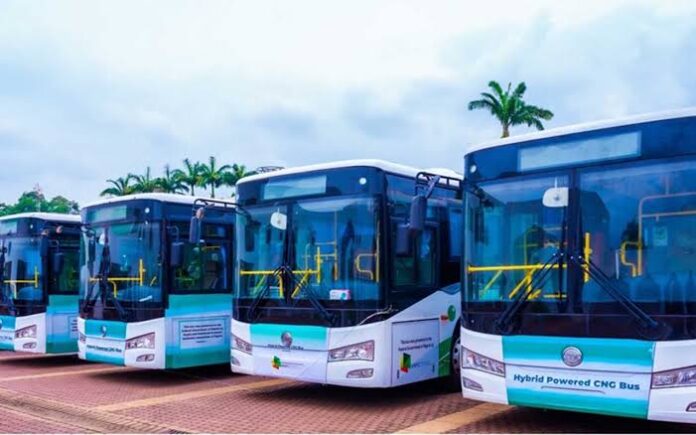
Passengers on selected transport routes in Nigeria have recorded fare reductions of between 15 and 50 per cent following the introduction of Compressed Natural Gas (CNG) buses, as the Federal Government plans to establish 127 additional refuelling stations across the country.
The expansion is expected to improve access to CNG, which the government is promoting as an alternative fuel for transportation amid efforts to make mobility more affordable.
Tosin Coker, chief operating officer of the Presidential Initiative on Compressed Natural Gas and Electric Vehicles (PI-CNG & EV), disclosed the figures during a media engagement organised by the initiative and the Decade of Gas Secretariat in Kano State on Thursday.
According to Brandspur Brand News, 670 CNG buses have been deployed nationwide, with 285 operating commercially across 13 states. Another 302 have been allocated to transport unions, students and government agencies.
The initiative said hundreds of additional buses and tricycles were also on order to expand the availability of alternative transport options.
However, wider adoption will depend partly on access to refuelling infrastructure. The planned 127 stations are expected to serve 31 states and the Federal Capital Territory, addressing a key requirement for the continued expansion of CNG-powered transportation.
Kano State is emerging as a strategic location for the programme in Northern Nigeria, with seven CNG refuelling stations already operational and 17 others at various stages of completion.
The state has also received 25 additional CNG buses to complement earlier commercial deployments.
Coker said the transition to CNG could help reduce transport costs and strengthen Nigeria’s energy security. He also urged vehicle owners to use certified conversion centres, approved equipment and proper maintenance procedures to ensure safety.
Beyond transportation, the government is pursuing investments to expand domestic gas production and distribution.
Taofeek Balogun, infrastructure and demand workstream lead at the Decade of Gas Secretariat, said Nigeria’s proven gas reserves rose from 208.83 trillion cubic feet in 2023 to 215.19 trillion cubic feet as of January 2026.
Average gas production also increased from 6.86 billion cubic feet per day to approximately 7.5 billion cubic feet per day, while domestic supply exceeded two billion cubic feet daily.
Balogun added that four major gas projects had attracted $3.5 billion in committed investments. The OB3 Gas Pipeline had been completed, while the Ajaokuta-Kaduna-Kano Gas Pipeline was approximately 95 per cent complete.
He also disclosed that N671 billion in public infrastructure funding had attracted about N1.6 trillion in private investment.
The government’s gas expansion plans extend to household energy use, with its liquefied petroleum gas programme targeting five million households by 2030.
Balogun said implementation activities had commenced in Bayelsa and Akwa Ibom states, alongside initiatives involving the distribution of 27,000 LPG cylinders and regional public awareness campaigns.
The two initiatives also outlined plans for Nigeria to transition to a Willing Buyer, Willing Seller gas market framework by September 24, 2028, in a move intended to improve competition, transparency and commercial sustainability.
The Kano engagement brought together about 27 journalists from television, radio, print and digital media organisations to discuss developments in the gas sector.
Participants raised questions about affordability, infrastructure, safety and the implementation of government policies, highlighting the importance of public awareness as Nigeria expands its use of gas across transportation and household energy.
