




• Home
  • Brand News
    • Beverages: Alcholic & Non-Alcoholic
    • Retail – Brick & Click
    • Pay TV
  • Business & Economy
  • Banking and Finance
  • News
    • Agro News
    • Health
    • Telecom & IT
    • Transportation
    • Tech
    • Entertainment & Lifestyle
    • Cryptocurrency
    • Hospitality & Tourism
    • Education
  • More
    • Media outreach
    • Magazine
    • Politics
    • Promo
    • Opinions
    • Business Intelligence
  • About Us
    • Contact Us
    • Advertise With Us…
    • Email Sign-Up
Search
Brand Spur Nigeria's No.1 Online Brand Insight Magazine...
  • Home
  • Brand News
    • 8 Reasons To Avoid Joining A Startup

      Nigerian Startups Defy Funding Slowdown As Select Founders Secure Fresh Capital…

      Legacy Car Brands Face Growing Pressure In South Africa

      Legacy Car Brands Face Growing Pressure In South Africa

      M-KOPA Achieves Fifth Consecutive FT Fastest gGompanies Ranking

      M-KOPA Achieves Fifth Consecutive FT Fastest Growing Companies Ranking

      Guinness Nigeria PLC Surpasses ₦1 Trillion Market Capitalisation, Signalling Strong Investor Confidence And Sustained Value Creation

      Guinness Nigeria Hosts Media, Highlights Growth, Governance, Business Transformation

      TikTok Launches £3.99 Subscription For No Ads In UK

      TikTok Launches £3.99 Subscription For No Ads In UK

    • Beverages: Alcholic & Non-Alcoholic
    • Retail – Brick & Click
    • Pay TV
  • Business & Economy
  • Banking and Finance
  • News
    • Agro News
    • Health
    • Telecom & IT
    • Transportation
    • Tech
    • Entertainment & Lifestyle
    • Cryptocurrency
    • Hospitality & Tourism
    • Education
  • More
    • Media outreach
    • Magazine
    • Politics
    • Promo
    • Opinions
    • Business Intelligence
  • About Us
    • Contact Us
    • Advertise With Us…
    • Email Sign-Up
Home Business & Economy Nigeria Has Room for More Public Debt, Expert Insists
  • Business & Economy
  • News

Nigeria Has Room for More Public Debt, Expert Insists

By
Brand Spur
-
July 31, 2019
0
WhatsApp
Facebook
Twitter
Linkedin
Telegram
Email
Print
    Total public debt increased by ₦2.4 trillion in Q2 2020 - NBS

    Most of the recent arguments surrounding Nigeria’s public debt in Q1 2019, following the Debt Management Office (DMO) publication on 10 July 2019, focus on the increase of N560billion Little has been said about the real issue, which is the ability of the Federal Government of Nigeria (FGN) to service the debt from the current low revenue and, more importantly, to offer solutions or ideas on how the government can manage its debt portfolio in the short-term, taking advantage of the opportunities the financial markets, both local and global, present. In addition, efforts have not been made to compare the debt sustainability of the DMO with the debt figures. And finally, there is a need to make a comparison with other countries. Putting everything together, FSDH Research concludes that Nigeria can still increase its public debt. However, more accountability is required in the use of the borrowed fund. Revenue and interest expenses also need to be properly matched.

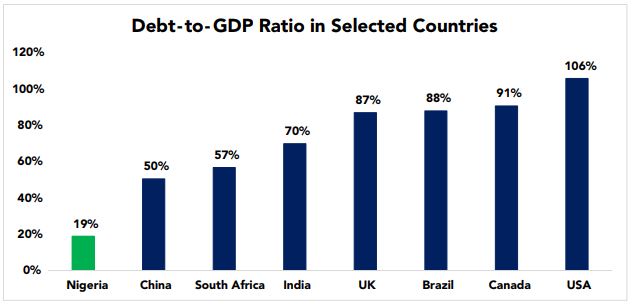
    As noted in our previous reports, just as individuals and companies are faced with the dilemma of whether or not to borrow, countries also face the same problem. Although it is difficult for any country not to borrow, there are key questions each country must ask. How much debt should they contract? What projects will the debt be used for? How will the loan be repaid, as well as the associated interest? Whom should they approach to lend the money? What will be the impact of the loan servicing on the country’s ability to perform her obligations to the citizens? Some countries have shown that debt in itself is not bad. What truly matters is the productivity of the debt that is contracted. Countries such as China, South Africa, India, UK and USA have high Debt-to-Gross Domestic Product (GDP) of over 50%.

    These countries, however, have managed to deploy their borrowings into activities that can
    stimulate revenue generation including education, transportation, construction, security,
    technology, and other growth-enhancing infrastructure. By utilising these borrowed funds in
    areas that improve the ease of doing business in their countries, they have been able to grow their economies further, attract new investment, create job opportunities, and establish more avenues for their governments to grow their revenue. So, in itself, debt is not bad after all. However, the loan contracted must not be spent on consumption. If a 30-year loan is contracted but is spent on a year of consumption, there is a problem as unborn generations will carry the burden of paying for what they did not enjoy. But imagine using the loan to improve infrastructure and security in the country that will lead to job creation, people will be willing to pay taxes from which government will repay the loan.

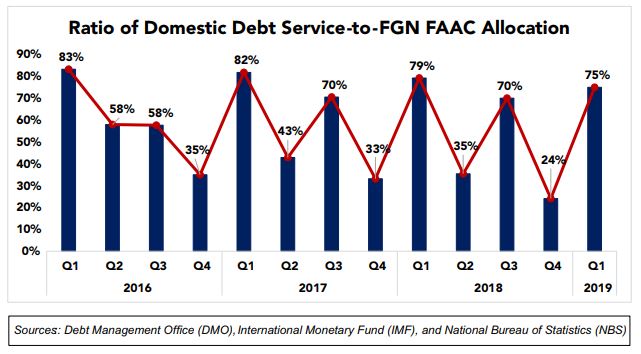
    In reviewing Nigeria’s debt prole, FSDH Research observes that the level of debt has been on the increase over the years. As at the end of March 2019, the total public debt increased to N24.95trillion from N24.39trillion as of December 2018. For a country with a Gross Domestic Product (GDP) of over N130trillion, that debt level is not too much. The debt-to-GDP ratio is 19.03%, which is below both the 25% benchmark set by the FGN and the 56% international threshold set for countries in Nigeria’s economic peer group. Therefore, Nigeria is actually under borrowing at the current level. It has the capacity to borrow an additional N7trillion, given the 25% benchmark. The main problem, however, is the country’s ability to service the debt without causing untold hardship on the country. In measuring the ability of Nigeria to service her debt obligations, we look at the ratio of domestic debt service-to-FGN Federation Account Allocation Committee (FAAC) allocation. This is where the problem lies in Nigeria. Low revenue generation makes it very difficult for the FGN to meet its debt obligations without sacrificing other important responsibilities.

    As outlined in our previous reports, FSDH Research notes that the current high debt service to revenue structure in Nigeria is unsustainably high and the high figure is due to the low revenue of the country. Although the strategies of the DMO in debt management and the Central Bank of Nigeria (CBN) in monetary policy administration have reduced the interest burden of the government, Nigeria needs to accelerate revenue generation to enable it to meet all her debt obligations without stress.

    FSDH Research recommends that the DMO considers the issuance of discount bonds (zero-coupon bonds) to manage the interest expenses of the FGN in the short-term. The low-interest-rate environment, both in Nigeria and in the international market, provides a good opportunity for the government to lower its interest expenses. There is also high appetite at the moment for quality fixed income securities. However, we cannot overstress the importance for loans to be tied to specific projects which will increase the competitiveness of the Nigerian economy to attract investment, create job opportunities and generate diversified revenue for the country.
    Related

    • TAGS
    • cbn
    • Central Bank of Nigeria
    • Debt Management Office
    • dmo
    • FAAC
    • Federation Account Allocation Committee
    • fsdh
    • FSDH Research
    • Public Debt
    WhatsApp
    Facebook
    Twitter
    Linkedin
    Telegram
    Email
    Print
      Previous articleWema Bank grows PAT by 43.2% to ₦2.25bn in H1’19
      Next articleUAC Nigeria Plc declares ₦2.59 billion PAT in H1”19 Results; Revenue grows by 12.4%
      Brand Spur
      Brandspur LogoBrandSpur Nigeria

      Category

      • Brand News
      • Business & Economy
      • Telecom & IT
      • Beverages
      • Transportation
      • Agro News
      • Business Intelligence
      • Energy & Power
      • Retail
      • Entertainment & Lifestyle

      Links

      • About Us…
      • Advertise With Us…
      • Magazine
      • Contact Us
      • Privacy Policy
      • Promo
      • Corporate News Provided By Media OutReach

      Stay connected

      Facebook
      Instagram
      Linkedin
      Twitter
      Youtube

      Newsletter Signup

      [tdn_block_newsletter_subscribe input_placeholder=”Your email address” btn_text=”Subscribe” tds_newsletter2-image=”518″ tds_newsletter2-image_bg_color=”#c3ecff” tds_newsletter3-input_bar_display=”row” tds_newsletter4-image=”519″ tds_newsletter4-image_bg_color=”#fffbcf” tds_newsletter4-btn_bg_color=”#f3b700″ tds_newsletter4-check_accent=”#f3b700″ tds_newsletter5-tdicon=”tdc-font-fa tdc-font-fa-envelope-o” tds_newsletter5-btn_bg_color=”#000000″ tds_newsletter5-btn_bg_color_hover=”#4db2ec” tds_newsletter5-check_accent=”#000000″ tds_newsletter6-input_bar_display=”row” tds_newsletter6-btn_bg_color=”#da1414″ tds_newsletter6-check_accent=”#da1414″ tds_newsletter7-image=”520″ tds_newsletter7-btn_bg_color=”#1c69ad” tds_newsletter7-check_accent=”#1c69ad” tds_newsletter7-f_title_font_size=”20″ tds_newsletter7-f_title_font_line_height=”28px” tds_newsletter8-input_bar_display=”row” tds_newsletter8-btn_bg_color=”#00649e” tds_newsletter8-btn_bg_color_hover=”#21709e” tds_newsletter8-check_accent=”#00649e” embedded_form_type=”mailchimp” embedded_form_code=”JTNDIS0tJTIwQmVnaW4lMjBNYWlsY2hpbXAlMjBTaWdudXAlMjBGb3JtJTIwLS0lM0UlMEElM0NsaW5rJTIwaHJlZiUzRCUyMiUyRiUyRmNkbi1pbWFnZXMubWFpbGNoaW1wLmNvbSUyRmVtYmVkY29kZSUyRmhvcml6b250YWwtc2xpbS0xMF83LmNzcyUyMiUyMHJlbCUzRCUyMnN0eWxlc2hlZXQlMjIlMjB0eXBlJTNEJTIydGV4dCUyRmNzcyUyMiUzRSUwQSUzQ3N0eWxlJTIwdHlwZSUzRCUyMnRleHQlMkZjc3MlMjIlM0UlMEElMDklMjNtY19lbWJlZF9zaWdudXAlN0JiYWNrZ3JvdW5kJTNBJTIzZmZmJTNCJTIwY2xlYXIlM0FsZWZ0JTNCJTIwZm9udCUzQTE0cHglMjBIZWx2ZXRpY2ElMkNBcmlhbCUyQ3NhbnMtc2VyaWYlM0IlMjB3aWR0aCUzQTEwMCUyNSUzQiU3RCUwQSUwOSUyRiolMjBBZGQlMjB5b3VyJTIwb3duJTIwTWFpbGNoaW1wJTIwZm9ybSUyMHN0eWxlJTIwb3ZlcnJpZGVzJTIwaW4lMjB5b3VyJTIwc2l0ZSUyMHN0eWxlc2hlZXQlMjBvciUyMGluJTIwdGhpcyUyMHN0eWxlJTIwYmxvY2suJTBBJTA5JTIwJTIwJTIwV2UlMjByZWNvbW1lbmQlMjBtb3ZpbmclMjB0aGlzJTIwYmxvY2slMjBhbmQlMjB0aGUlMjBwcmVjZWRpbmclMjBDU1MlMjBsaW5rJTIwdG8lMjB0aGUlMjBIRUFEJTIwb2YlMjB5b3VyJTIwSFRNTCUyMGZpbGUuJTIwKiUyRiUwQSUzQyUyRnN0eWxlJTNFJTBBJTNDZGl2JTIwaWQlM0QlMjJtY19lbWJlZF9zaWdudXAlMjIlM0UlMEElM0Nmb3JtJTIwYWN0aW9uJTNEJTIyaHR0cHMlM0ElMkYlMkZicmFuZHNwdXJuZy51czE1Lmxpc3QtbWFuYWdlLmNvbSUyRnN1YnNjcmliZSUyRnBvc3QlM0Z1JTNEZTBlNTYzYWNjNjVlNmRkNzBlMDdiNDE2NyUyNmFtcCUzQmlkJTNEYWRkM2YzMTg3MyUyMiUyMG1ldGhvZCUzRCUyMnBvc3QlMjIlMjBpZCUzRCUyMm1jLWVtYmVkZGVkLXN1YnNjcmliZS1mb3JtJTIyJTIwbmFtZSUzRCUyMm1jLWVtYmVkZGVkLXN1YnNjcmliZS1mb3JtJTIyJTIwY2xhc3MlM0QlMjJ2YWxpZGF0ZSUyMiUyMHRhcmdldCUzRCUyMl9ibGFuayUyMiUyMG5vdmFsaWRhdGUlM0UlMEElMjAlMjAlMjAlMjAlM0NkaXYlMjBpZCUzRCUyMm1jX2VtYmVkX3NpZ251cF9zY3JvbGwlMjIlM0UlMEElMDklMEElMDklM0NpbnB1dCUyMHR5cGUlM0QlMjJlbWFpbCUyMiUyMHZhbHVlJTNEJTIyJTIyJTIwbmFtZSUzRCUyMkVNQUlMJTIyJTIwY2xhc3MlM0QlMjJlbWFpbCUyMiUyMGlkJTNEJTIybWNlLUVNQUlMJTIyJTIwcGxhY2Vob2xkZXIlM0QlMjJlbWFpbCUyMGFkZHJlc3MlMjIlMjByZXF1aXJlZCUzRSUwQSUyMCUyMCUyMCUyMCUzQyEtLSUyMHJlYWwlMjBwZW9wbGUlMjBzaG91bGQlMjBub3QlMjBmaWxsJTIwdGhpcyUyMGluJTIwYW5kJTIwZXhwZWN0JTIwZ29vZCUyMHRoaW5ncyUyMC0lMjBkbyUyMG5vdCUyMHJlbW92ZSUyMHRoaXMlMjBvciUyMHJpc2slMjBmb3JtJTIwYm90JTIwc2lnbnVwcy0tJTNFJTBBJTIwJTIwJTIwJTIwJTNDZGl2JTIwc3R5bGUlM0QlMjJwb3NpdGlvbiUzQSUyMGFic29sdXRlJTNCJTIwbGVmdCUzQSUyMC01MDAwcHglM0IlMjIlMjBhcmlhLWhpZGRlbiUzRCUyMnRydWUlMjIlM0UlM0NpbnB1dCUyMHR5cGUlM0QlMjJ0ZXh0JTIyJTIwbmFtZSUzRCUyMmJfZTBlNTYzYWNjNjVlNmRkNzBlMDdiNDE2N19hZGQzZjMxODczJTIyJTIwdGFiaW5kZXglM0QlMjItMSUyMiUyMHZhbHVlJTNEJTIyJTIyJTNFJTNDJTJGZGl2JTNFJTBBJTIwJTIwJTIwJTIwJTNDZGl2JTIwY2xhc3MlM0QlMjJjbGVhciUyMiUzRSUzQ2lucHV0JTIwdHlwZSUzRCUyMnN1Ym1pdCUyMiUyMHZhbHVlJTNEJTIyU3Vic2NyaWJlJTIyJTIwbmFtZSUzRCUyMnN1YnNjcmliZSUyMiUyMGlkJTNEJTIybWMtZW1iZWRkZWQtc3Vic2NyaWJlJTIyJTIwY2xhc3MlM0QlMjJidXR0b24lMjIlM0UlM0MlMkZkaXYlM0UlMEElMjAlMjAlMjAlMjAlM0MlMkZkaXYlM0UlMEElM0MlMkZmb3JtJTNFJTBBJTNDJTJGZGl2JTNFJTBBJTBBJTNDIS0tRW5kJTIwbWNfZW1iZWRfc2lnbnVwLS0lM0U=” tds_newsletter=”tds_newsletter1″ tds_newsletter1-input_bar_display=”” tdc_css=”eyJhbGwiOnsibWFyZ2luLWJvdHRvbSI6IjAiLCJkaXNwbGF5IjoiIn19″ tds_newsletter1-f_input_font_family=”712″ tds_newsletter1-f_btn_font_family=”712″ tds_newsletter1-f_input_font_size=”14″ tds_newsletter1-btn_bg_color=”#266fef”]
      - Advertisement -

      © BrandSpurNg. All rights reserved.

      Related

      We use cookies on our website to give you the most relevant experience by remembering your preferences and repeat visits. By clicking “Accept”, you consent to the use of ALL the cookies.
      Do not sell my personal information.
      Cookie settingsACCEPT
      Manage consent

      Privacy Overview

      This website uses cookies to improve your experience while you navigate through the website. Out of these, the cookies that are categorized as necessary are stored on your browser as they are essential for the working of basic functionalities of the website. We also use third-party cookies that help us analyze and understand how you use this website. These cookies will be stored in your browser only with your consent. You also have the option to opt-out of these cookies. But opting out of some of these cookies may affect your browsing experience.
      Necessary
      Always Enabled
      Necessary cookies are absolutely essential for the website to function properly. This category only includes cookies that ensures basic functionalities and security features of the website. These cookies do not store any personal information.
      Non-necessary
      Any cookies that may not be particularly necessary for the website to function and is used specifically to collect user personal data via analytics, ads, other embedded contents are termed as non-necessary cookies. It is mandatory to procure user consent prior to running these cookies on your website.
      SAVE & ACCEPT
       

      Loading Comments...