




To combat inflation, the Central Bank of Nigeria (CBN) has increased its benchmark interest rate once more.
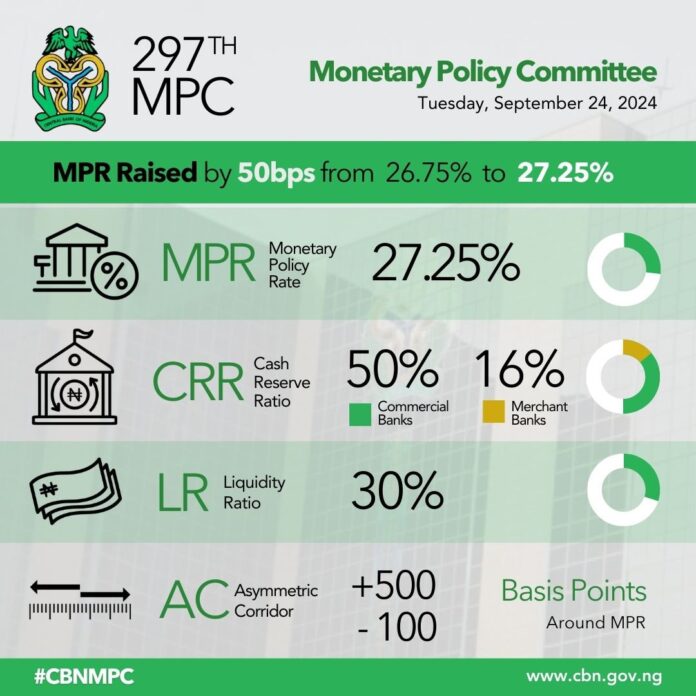
The Monetary Policy Rate (MPR), which was previously set at 26.75%, was raised by 50 basis points to 27.25%. After the Monetary Policy Committee (MPC) met most recently in Abuja, under the direction of CBN Governor Olayemi Cardoso, a decision was made.
Additionally, the CBN raised the Cash Reserve Ratio (CRR) for commercial banks by 500 basis points to 50% to tighten monetary policy. With a minor adjustment, merchant banks experienced a comparable increase in CRR, rising by 200 basis points to 16%. On the other hand, the asymmetric corridor surrounding the MPR was maintained at +500/-100 basis points, and the liquidity ratio stayed at 30%.
Continuing, Governor Cardoso highlighted that measures were required to keep the pressure on inflation, which is still a significant issue for the economy of Nigeria. The MPC decided to tighten further to stop price instability from returning, even in the face of some signs of decreasing inflation.
For Nigerians, the steady increase in interest rates—which is already on its fifth jump of the year—is problematic. Support and caution have been shown on the CBN’s strategy as stakeholders continue to evaluate the long-term effects of persistently high interest rates on investment and economic growth.
The governor of the CBN justified the several interest rate hikes in his statement accessed by BrandSpur banking and finance news, saying that the economy would have been further burdened by inflationary pressures if these actions hadn’t been taken.
He, however, emphasised the significance of controlling inflation, pointing out that no economic model could effectively reduce poverty in a setting where inflation is allowed to run uncontrolled.
