




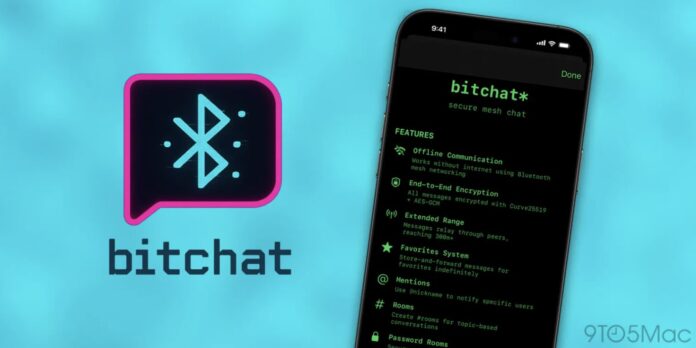
The new decentralised peer-to-peer (P2P) messaging app Bitchat, developed by Block CEO and Twitter (now X) Founder Jack Dorsey, operates over Bluetooth mesh networks and does not require the internet, central servers, phone numbers, or emails. The full white paper is available on GitHub, and the beta version is live on TestFlight, Dorsey announced on Sunday, July 6, 2025.
In a Sunday post on X, he revealed that the new app is a personal experiment with message encryption, store-and-forward models, relays and stores, Bluetooth mesh networks, and a few other things. He claims that Bitchat allows for brief, encrypted communication between adjacent devices.
According to CNBC, even in the absence of Wi-Fi or cell signals, users can communicate with peers from a distance by using their phones to create local Bluetooth clusters and send messages from one device to another. Bridge devices increase the mesh over longer distances by connecting to overlapping clusters, he revealed. The fact that messages are only saved on devices, vanish automatically, and never come into contact with centralised infrastructure demonstrates Dorsey’s commitment to censorship-resistant, privacy-preserving communication, according to experts.
His support for Damus and Bluesky is expanded upon with Bitchat’s launch, which also represents a larger movement to decentralise everything from payments to social media. During outages, shutdowns, or surveillance, Bitchat provides a censorship-resistant method of staying connected by continuing to function even when the internet is blocked.
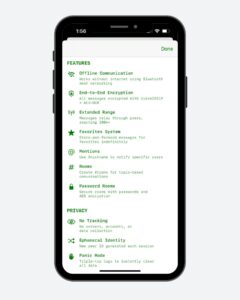
Additionally, group chats, or rooms, are supported by the new app and can be password-protected and hashtagged, BrandSpur digital news platform reports.
Store-and-forward features are included to send messages to users who are not online. It has been reported that a future update will incorporate WiFi Direct to boost speed and range, further advancing Dorsey’s plan for user-owned, off-grid communication.
In contrast to other chat apps, Bitchat, developed by Jack Dorsey, offers several distinctive features. One of the main differences is that it emphasises decentralisation and privacy. The new app ensures that messages are not stored or controlled by a central authority by using decentralised technology, in contrast to many well-known messaging platforms that depend on central servers to manage user data. Users have more control over their data with this method, which puts their privacy and security first.
Bitchat also incorporates Bitcoin’s Lightning Network to facilitate quick and inexpensive transactions. By enabling users to send small payments within the chat, this establishes a smooth connection between cryptocurrency and communication. Users searching for a platform that ensures anonymity and decentralisation while fusing financial transactions with social interaction will find this particularly alluring.
Bitchat’s open-source nature, which enables developers to contribute and expand upon it, is another noteworthy aspect. This transparency encourages creativity and makes sure that community and user input, not business interests, drive the app’s evolution. It focuses on privacy, decentralised management, and cryptocurrency integration, taken together, making it a welcome change from conventional messaging apps.
Continuing, with no accounts, identifiers, or data collection, Bitchat functions peer-to-peer in contrast to popular messaging apps like WhatsApp, Messenger, and Telegram. Elon Musk recently announced the launch of xChat, a messaging app that will compete with popular messaging services like WhatsApp.
The CEO of Tesla asserts that the platform’s new XChat feature will provide cross-platform audio and video calls, encryption, and disappearing messages. The direct messaging (DM) feature is going to revolutionise communication on the platform, he said.
Musk reportedly stated that XChat uses encryption techniques akin to those used by Bitcoin’s protocol to improve privacy and data protection. The platform is based on Rust, a programming language renowned for its speed and security, according to the Times of India.
