




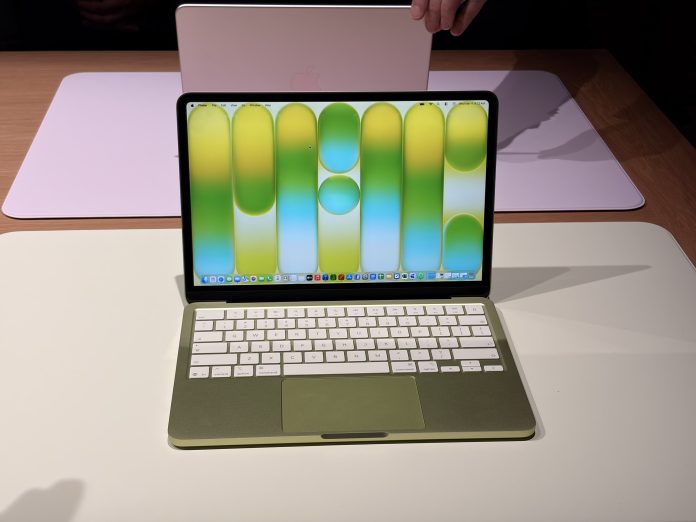
Apple has expanded its Mac lineup with the introduction of the MacBook Neo, a new entry-level laptop designed to attract price-sensitive consumers seeking access to the macOS ecosystem at a significantly lower cost.
The MacBook Neo was announced on March 4, 2026, shortly after the release of the iPhone 17e, and is now open for pre-orders globally. The device carries a starting price of $599, translating to roughly ₦570,000 to ₦620,000, depending on exchange rates and local market conditions.
Brandspur Brand News reports that the MacBook Neo represents a strategic shift by Apple to broaden its reach beyond premium buyers, offering a more affordable alternative to its higher-end MacBook Air and MacBook Pro models.
Unlike existing MacBooks powered by Apple’s M-series processors, the MacBook Neo runs on the A18 Pro chip, a processor originally designed for iPhones. The chipset delivers solid performance for everyday computing tasks such as web browsing, video streaming, light content editing and AI-assisted applications, while keeping power consumption and costs relatively low.
In terms of hardware, the MacBook Neo features a 13-inch Liquid Retina display with a resolution of 2408 by 1506 pixels, up to 500 nits of brightness and support for one billion colours. It comes with 8GB of unified memory and storage options of 256GB or 512GB SSD.
Apple says the device offers up to 16 hours of battery life, a 1080p FaceTime HD camera, dual side-firing speakers with spatial audio support, and a Magic Keyboard paired with a large multi-touch trackpad. Connectivity options include two USB-C ports, a headphone jack, Wi-Fi 6E and Bluetooth 6.
The MacBook Neo runs on macOS Tahoe and is available in multiple colour options, including Silver, Indigo, Blush and Citrus. Touch ID, however, is limited to the 512GB storage variant, a move seen as part of Apple’s cost-control strategy for the base model.
Shipments are scheduled to begin on March 11, 2026, with education pricing starting at $499 for eligible buyers.
While the MacBook Neo does not match the raw power of Apple’s M-series laptops, analysts say it fills a key gap in the company’s product range. For students, small business owners and professionals who prioritise battery life, design and ecosystem integration over heavy computing workloads, the new device offers a more accessible entry point into Apple’s hardware lineup.
In markets such as Nigeria, the MacBook Neo is expected to compete directly with mid-range Windows laptops, although final retail prices may be influenced by import duties and local distribution costs.
