




As Nigeria grapples with rising food costs and a widening animal-protein
gap, U.S. soybean leaders say the solution lies not in competing with
local farmers but in collaboration, improved technology, and workforce
training.
In separate interviews during the USSEC & U.S. Soy Nigeria: Now
Conference 2026, three senior executives from the U.S. Soybean Export
Council outlined why Nigeria is a strategic market and how U.S. Soy,
knowledge transfer, and sustainable practices can help bridge the
country’s protein deficit.
_Why Nigeria? “Population, demand, and energy”_
Brent Babb, Executive Director – Soy Excellence Center (SEC) &
Sub-Saharan Africa for USSEC, said Nigeria’s demographics make it
impossible to ignore. “Over 60% of the U.S. soybean crop is exported
worldwide. We’ve worked extensively in Asia and North Africa, and we
see strong opportunities in Sub-Saharan Africa, with Nigeria as the
regional leader.”
Population growth is driving demand, yet per capita protein consumption
remains low. “That gap creates a significant opportunity,” Babb
explained. “Nigeria grows soybeans, but as demand for consumption
rises, more soybeans will need to be imported. Our role is to complement
Nigeria.”
This complement means working directly with poultry, aquaculture,
livestock, and soy food processors to build demand and use for soy. The
partnership is already showing results: in early 2025, Nigeria imported
62,000 tons of U.S. soybeans after a six-year break. “We’re here for
the long term,” Babb said. “This isn’t a competition with local
soy production. Local production and imports can grow together.”
_More than beans: Consistency, energy, and mill efficiency_
For Nigerian feed millers and farmers, Babb stated that U.S. Soy’s
edge goes beyond crude protein. “U.S. Soy has high levels of
digestible amino acids. It’s not just protein—it’s digestibility
for poultry, livestock, and fish. The energy value is also often
overlooked, and higher energy means you can reduce energy costs in the
diet while maintaining performance.”
U.S. Soy’s consistency, he added, is underrated. “As a producer, you
know the product will be the same every time, year-round. You don’t
need to over-formulate because the digestibility and energy values are
reliable. That reduces costs.”
USSEC also works beyond the bag of beans. The team advises on feed
formulation, materials handling, and biosecurity—critical for
Nigeria’s poultry industry. The Soy Excellence Center serves as the
main vehicle for that technical training.
_“A rising tide lifts all boats”: The farmer’s view_
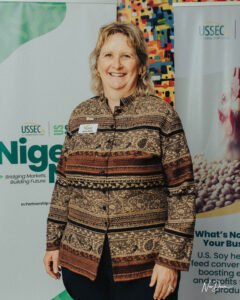
Cindy Pulskamp, a soybean farmer from North Dakota and Director with the
U.S. Soybean Export Council & United Soybean Board, framed the
relationship like this: “We see it as collaborating. I’m looking to
work with Nigerian agribusiness and food security stakeholders—sharing
knowledge and learning from you.”
Pulskamp’s 114-year-old family farm achieves one of the lowest carbon
footprints in global soy through soil health and precision agriculture.
Cover crops prevent erosion in high winds, GPS-guided technology reduces
field passes, and drones replace heavy equipment for crop protection.
“Sustainability matters because our goal is to hand soil to the next
generation in better condition than we received it,” she said.
On post-harvest losses, she noted that North Dakota’s dry climate
gives U.S. farmers an advantage. But her advice to Nigerians is
practical: “Where there is will and resources, there’s a way. I
suspect high moisture and humidity during storage are the primary
drivers of loss here. U.S. Soy can be stored for a year or more while
maintaining quality because of our climate and technology.”
_Training that changes operations_
Anne Meis, Chair of the Soy Excellence Center Global Advisory Panel,
points to the biggest impact so far: people. “We provide free
training, starting with virtual courses accessible by phone.
Participants take that knowledge back to feed mills and poultry farms
and change practices immediately.”
The numbers back it up. This year alone, over 1,200 Nigerians graduated
from SEC courses. Since its launch, more than 5,000 individuals have
participated. At Dunn-Maid Farms, graduates improved biosecurity and
reduced bird mortality. One feed mill increased pellet production 15-20%
while cutting costs 10% after adopting full-fat soy techniques. “Our
surveys show 94% of graduates report stronger job skills, and 93% say
their companies are more profitable,” Meis said.
Her advice to Nigerian protein producers is direct: “Protect your land
and resources. You’re already exploring technology and innovation.
Keep doing that, and you’ll be on the right path.”
_Challenges and the road ahead_
Babb is optimistic but realistic about hurdles. “Financing is often
the biggest challenge—pulling all the pieces together. The other is
consistency across the value chain. You need quality day-old chicks,
reliable soybean supplies for crushers to run at high capacity, and
consumer demand that can withstand inflation.”
Still, the energy is undeniable. “Growth won’t always be linear, but
the energy is there, demand is there, financial investment is coming in,
and the value chain gets stronger each year,” Babb concluded.
“Nigeria is well-positioned to take advantage of that opportunity.”
As USSEC marks over seven years in Nigeria, the message from U.S. Soy
leaders is clear: this is a partnership built for the long haul,
intending to get more affordable, quality protein onto Nigerian tables.