




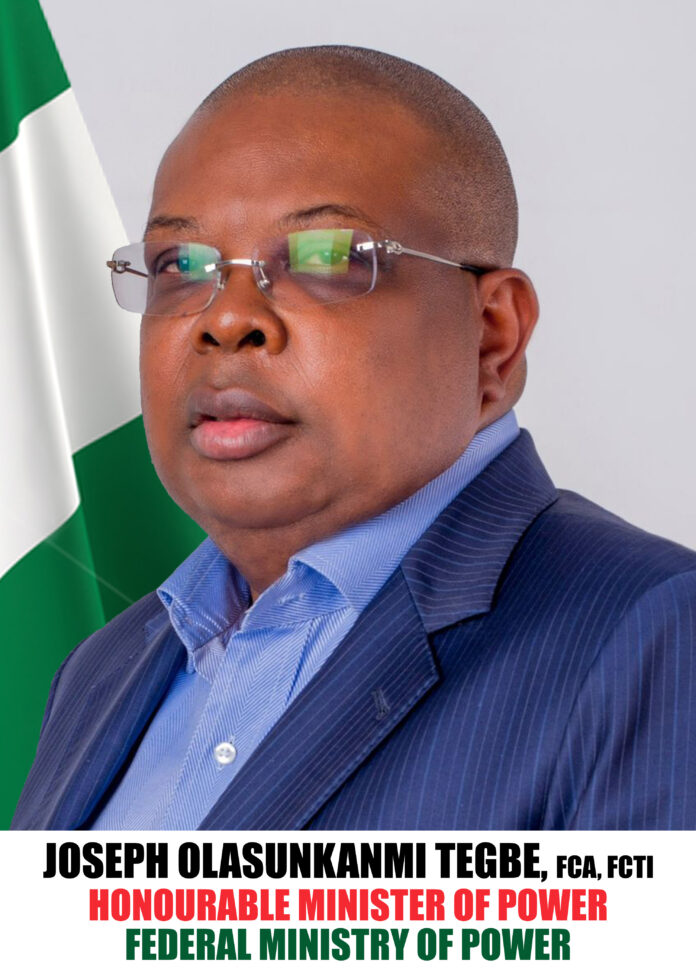
Minister calls for shared accountability, transparency and protection of power assets
Honourable Minister of Power, Mr Joseph Tegbe, has outlined his
Ministerial Action Plan for the stabilization and growth of Nigeria’s
electricity sector, speaking at the second quarterly Nigerian
Electricity Supply Industry (NESI) Stakeholders Meeting recently
convened by the Nigerian Electricity Regulatory Commission (NERC) in
Abuja. The forum, which was Chaired by the Chairman of NERC, Dr Musiliu
Oseni, featured power sector stakeholders including operators,
regulators and policy actors and had in attendance the Special Adviser
to the President on Power, Mr Rilwan Lanre Babalola, and the Permanent
Secretary of the Ministry of Power, Alh Mahmud Mamman.
Delivering the keynote address, the Minister framed his plans around a
core conviction that Nigeria’s electricity crisis demands collective
ownership across the entire value chain. “Nigeria’s power crisis was
not built by one hand, and it will not be fixed by one hand,” he said,
calling on GenCos, DisCos, TCN, NISO, regulators, and government to
accept shared responsibility for both the depth of the problem and the
discipline of the solution.
On infrastructure, Tegbe called for power assets to be formally
designated and treated as Critical National Assets, describing
vandalism, grid sabotage, and energy theft as economic warfare against
ordinary Nigerian households. He added that securing existing assets
must run concurrently with optimizing their output, with transmission
weak points, spinning reserves, and priority substation relays all being
actively addressed to improve near-term grid reliability.
Turning to metering and tariffs, the Minister argued that estimated
billing had for too long penalized poor Nigerians while masking systemic
losses. His ministry is working with stakeholders to accelerate metering
rollout and reduce ATC&C losses, alongside developing a sustainable
tariff transition pathway designed to protect the most vulnerable
consumers from cost shocks while offering investors the long-term
predictability that serious capital commitment demands.
On market governance, Tegbe stressed that tariff reform could only hold
if payment compliance was enforced across the board. He called
specifically for transparent Derived Remittance Obligation calculations,
arguing that trust in the electricity market could not rest on opaque
arithmetic. “Trust in the market begins with trust in the numbers,”
he said. The Minister further announced that his ministry is working
toward the public publication of KPIs and performance scorecards for
GenCos and DisCos, making both excellence and underperformance visible
to the Nigerian public..
Closing his address, the Minister anchored his personal commitment to
three principles: transparency, with no hidden agendas; speed, through
dismantling bureaucratic bottlenecks; and accountability, with
consequences for those who undermine the sector. “Reform is not a
promise deferred,” he said. “It is a discipline being executed,
every day.”
The 2nd NESI Stakeholders Meeting of 2026 was convened by the Nigerian
Electricity Regulatory Commission (NERC) in Abuja on Monday, 29 June
2026.
