



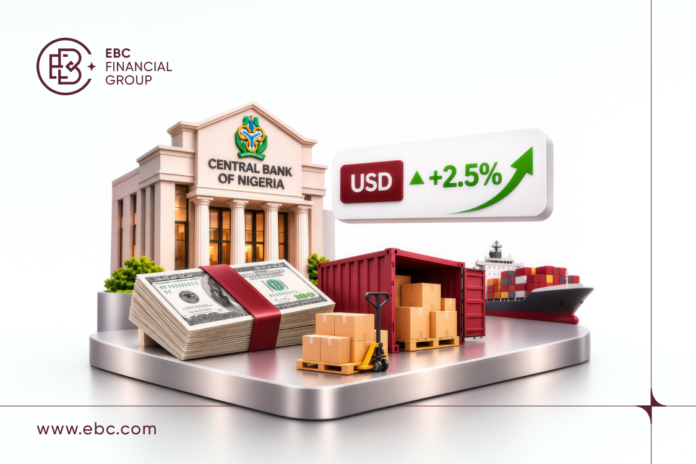
Nigerian importers may face limited financing relief in December following a 2.5% rise in the naira cost of dollars between 16 and 20 November. EBC Financial Group (EBC) considers exchange-rate stability to be as important as lower commercial lending rates in easing financing pressures on import-dependent businesses, after the Central Bank of Nigeria (CBN) unanimously decided to retain its Monetary Policy Rate (MPR) at 23% today.
- Following the Central Bank of Nigeria’s decision to hold its policy rate at 23%, EBC Financial Group highlights how currency weakness and commercial lending conditions could constrain financial relief for Nigerian businesses.
The currency move raises the amount of naira required for an unchanged dollar invoice. CBN closing rates moved from NGN 1,360 per dollar on 16 November to NGN 1,394 on 20 November, before easing marginally to NGN 1,393 on 23 November. For businesses borrowing to pay overseas suppliers, a lower interest rate can coexist with a larger amount to finance.

David Precious, Senior Market Analyst at EBC Financial Group, said, “Lower borrowing rates address the cost of financing, while the exchange rate influences how much an importer needs to finance in the first place. Supplier payments may fall due before any reduction in the policy rate translates into cheaper bank credit. For businesses preparing for December sales, stability in the naira could therefore be as important as lower lending rates in easing pressure on working capital.”
Currency Weakness Can Constrain Financing Relief
An unhedged importer faces the currency cost when it buys dollars to settle an invoice. If the supplier keeps its dollar price unchanged, a weaker naira increases the local payment. Where the business finances that payment, it must find additional cash or obtain more credit before it can replace the stock.
The eventual effect on borrowing costs depends on the loan amount, the interest rate and how long the borrowing remains outstanding. A percentage increase in the dollar price cannot be set directly against a percentage-point reduction in an annual interest rate. The two changes affect different parts of the bill over different periods.
Businesses also face different payment arrangements. Existing dollar balances, currency hedges or stock bought earlier can soften the immediate effect. Supplier price changes and bank conversion charges can alter the final cost. EBC views the recent currency movement as a specific exposure for businesses with outstanding dollar payments, rather than a measured increase in every importer’s expenses.
Loan access had improved before this meeting, although pricing offered a less reassuring signal. The CBN third-quarter Credit Conditions Survey recorded increased credit availability and loan approvals, alongside wider gaps between lending rates and the policy rate for secured and overall corporate lending.
Read also: CBN Banking Reforms: What Nigeria’s New Financial Rules Mean For Savings, Loans, Fintech Apps And The Naira
Those responses show why improvements in credit availability may not immediately translate into financial relief for businesses. Wider lending spreads suggest that the transmission of monetary policy into commercial borrowing costs remains an important consideration, particularly for importers facing higher currency costs. Conducted in September 2026, the survey provides background to loan pricing; it cannot establish how banks have responded to the November decision. EBC has previously noted that easier credit access can coexist with weak borrowing for expansion.
Lower Inflation Offers a Route to Relief
The inflation slowdown provides a counterweight to the currency exposure. The National Bureau of Statistics (NBS) October report put annual headline inflation at 14.06%, down from 14.63% in September. Monthly food prices fell 0.75%, while core prices, excluding farm produce and energy, fell 0.53%. These figures support a more favourable cost outlook for some businesses.
Moderating inflation may create more favourable conditions for monetary easing, although consumer prices describe a different basket from a company’s imported inputs. October inflation also predates the November currency movement. EBC considers the December outlook uneven, with easing domestic price pressures offering potential relief in some categories while currency weakness increases financing requirements for businesses with outstanding dollar payments.
A sustained naira recovery and lower commercial lending rates are important conditions for meaningful financing relief among Nigeria’s import-dependent businesses. Upcoming official exchange-rate observations can indicate whether pre-meeting currency pressure persists, while subsequent CBN lending-rate data can show whether monetary policy is translating into cheaper bank credit. Findings from the next credit survey will provide further insight into broader lending conditions. Together, these developments will help determine whether businesses benefit from improving financing conditions or continue to face elevated working capital requirements.
For more information, visit www.ebc.com.
About EBC Financial Group
EBC Financial Group, headquartered in London, UK, is a comprehensive financial services group licensed and operating in multiple key jurisdictions worldwide. The group offers over 200 Contracts for Difference (CFDs) products, including currency exchange, precious metals, energy, stock indices, US stocks, ETFs, and digital currency. With branches in major global financial centres such as Tokyo, Sydney, Singapore, and Hong Kong, its service network covers over 100 countries and regions.
Regulation is the cornerstone of trust in the financial industry. EBC’s various operating entities hold financial regulatory licenses issued by the UK’s Financial Conduct Authority (FCA), Australia’s Securities and Investments Commission (ASIC), the Cayman Islands Monetary Authority (CIMA), and South Africa’s Financial Sector Conduct Authority (FSCA), strictly adhering to local regulatory rules in their operations.
Leveraging its FCA-regulated liquidity access, EBC has established long-term and stable partnerships with over 50 leading banks and non-bank liquidity providers globally. By integrating clearing-grade liquidity quotes, EBC provides clients with direct access to the primary liquidity market, delivering highly competitive institutional-grade liquidity depth and bank-level spreads, allowing clients to easily enjoy extremely low transaction costs. All clients within the group can enjoy top-tier liquidity access through its FCA licence; even for offshore accounts, quotes and orders are ultimately processed by a UK company. Combining big data and AI algorithms to optimise order matching mechanisms, EBC achieves over 87.6% of its orders executed at more favourable prices. For high-frequency and high-volume traders, EBC offers the customised EBC Private Room, a dedicated segregated trading channel that conceals trading orders and avoids market order manipulation. EBC is also one of the few licensed brokers in the industry capable of providing qualified professional investors with FCA liquidity clearing accounts with leverage up to 100x.
The Group’s core management team has over 30 years of experience working in large global financial institutions, having gone through multiple complete financial cycles. They have held core management positions in institutions regulated by the FCA, SEC, and CFTC, and their expertise covers key areas such as brokerage business, operations management, compliance and governance, and corporate risk management.
EBC has been named World Finance’s “Best Broker in the World” for four consecutive years, earning the trust of over 5 million registered users worldwide. Upholding a long-term perspective, the Group actively fulfils its social responsibilities: as an official partner of FC Barcelona, it collaborates with the University of Oxford’s Department of Economics to promote financial education, supports the UN Foundation’s “United to Beat Malaria” project, and partners with the World Association of Girl Guides and Girl Scouts (WAGGGS) to advance women’s empowerment and social equity.
EBC firmly believes that everyone who trades seriously deserves to be treated seriously.
