




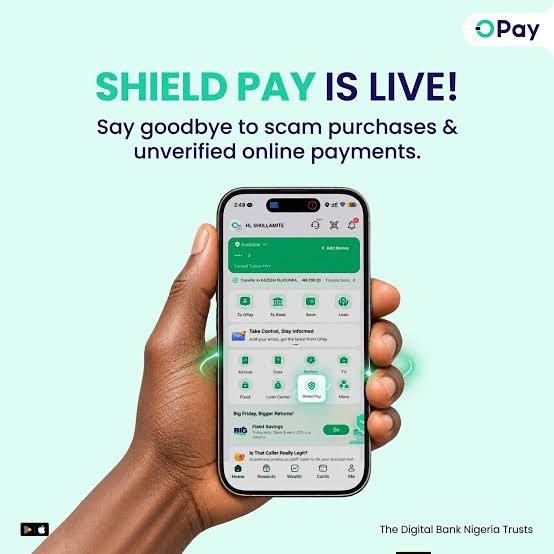
OPay’s new Shield Pay escrow feature could make online shopping safer for Nigerians by allowing customers to pay for goods and services without immediately transferring their money to sellers. The service is designed to hold funds until buyers confirm that sellers have fulfilled the terms of an agreed transaction.
The feature addresses a persistent concern in Nigeria’s growing social commerce market, where purchases are frequently arranged through Instagram, WhatsApp and other online platforms. Buyers often have to transfer money to vendors they have never met, with little assurance that the products will arrive as advertised.
The scale of the problem is reflected in a June 2026 study by Visa, which found that 83 per cent of Nigerian consumers had purchased products directly through social media. However, 57 per cent said they had experienced scams while shopping online. Brandspur Banking News Desk notes that services offering payment protection could help address some of the trust issues affecting transactions between buyers and independent vendors.
Shield Pay introduces an arrangement in which OPay temporarily holds a buyer’s payment while the seller completes the agreed transaction. The money is released to the seller only after the buyer confirms that the terms have been met.
The feature could be particularly useful to small businesses that depend on social media to reach customers. An individual buying a fashion item, household appliance or used phone from an unfamiliar vendor would have the option of keeping the payment within the escrow arrangement rather than sending it directly to the seller.
For instance, a customer purchasing a laptop can agree with the seller on its specifications, price and delivery conditions before making payment. If the item is not delivered or fails to meet the agreed terms, the buyer can raise a dispute through the service.
Freelancers and independent professionals could also use Shield Pay for transactions involving services. A business hiring a graphic designer, photographer or other service provider can agree on the fee and expected delivery time before payment is made.
Read also: OPay Customers Can Check Eligibility for FG’s ₦50,000 Monthly Relief Through App, USSD
However, the arrangement may be less straightforward when disputes concern the quality of completed work. Shield Pay does not automatically assess whether a service meets professional standards, meaning disagreements over what constitutes satisfactory delivery may require further evidence and review.
To use the feature, both the buyer and seller must have OPay accounts. They first agree on the payment amount, purpose and expected completion time. The seller then sends a payment request, which the buyer has 24 hours to pay.
After completing the transaction, the seller submits evidence of fulfilment for the buyer to review. OPay releases the funds once the buyer confirms that the agreed conditions have been met.
Where a disagreement arises, buyers can report issues including non-delivery, late delivery, misleading information or goods and services that do not match the agreement. Both parties are given 48 hours to submit evidence for OPay to review.
The dispute process also allows buyers to raise concerns within 15 days of confirming a transaction if they subsequently discover that the agreement was not fulfilled.
Despite the protection it offers, the feature introduces a potential challenge for vendors who depend on quick access to sales proceeds. Buyers have seven days to review an order before the seller receives the money, with an additional week possible where a dispute involving a more complex transaction arises.
For small retailers operating on limited working capital, the waiting period could affect their ability to restock goods, pay suppliers or meet other business expenses. Sellers may therefore have to weigh the potential benefit of attracting more cautious customers against the delay in receiving payment.
There are also limits to the service’s reach. Since both parties must use OPay, buyers cannot use Shield Pay for purchases involving vendors who accept only transfers through other financial institutions or payment platforms.
The feature does not independently verify the quality of products or take responsibility for delivery arrangements. Its role is primarily to hold the money and provide a process for resolving disagreements over whether the agreed conditions have been met.
OPay is also entering a market where escrow-style transactions are not entirely new. Jiji, an online classifieds marketplace, already offers Safe Deal, a service designed to provide payment protection for transactions conducted through its platform.
Shield Pay’s introduction brings a similar payment arrangement into a financial app used by many Nigerians. Whether it becomes widely adopted will depend partly on how effectively buyers and sellers understand its terms, how disputes are handled and whether vendors are comfortable waiting before receiving their money.
