Consequently, the Market Indicators (NSE-ASI and NSE Market Capitalization) increased by 1.36% w/w to close for this week at 39,834.42 absolute points and N20.85 trillion compared to 39,301.82 absolute points and N20.57 trillion last Friday. This nominally translates to a week-on-week gain of N278.73 billion in Market Capitalization value.
Three of the five major sectors closed positively, led by the Insurance Sector (+3.80%), Industrial Sector (+2.86%), and Oil and Gas Sector (+1.30%), while the Banking and Consumer Goods Sector closed negatively with a percentage decrease of -2.09% and -0.02% respectively.
ROYALEX emerged best performing stock this week with a w/w gain of +47.22%, while HONYFLOUR shed -17.14% to emerge as the top loser.
A total turnover of 1.44 billion shares worth N10.88 billion in 19,614 deals was traded this week by investors on the floor of the Nigerian Stock Exchange as against a total of 1.60 billion shares worth N42.14 billion in 19,507 deals.
Thirty-six (36) equities appreciated during the week, lower than thirty-nine (39) equities in the previous week. Forty-one (41) equities depreciated, higher than twenty-four (24) in the previous week, while eighty-five (85) remained unchanged, lower than ninety-99 (99) equities recorded in the previous week.
Outlook
We expect mixed sentiment in the coming week, amidst profit-taking from the recent price appreciation, however, the decline in the banking sector could trigger buy sentiment despite mixed Q1’2021 performance.
This week, sell-interest dominated in nine (9) of the fourteen (14) stocks markets under our coverage, amid the strong U.S Economic Data showing the U.S real gross domestic product (GDP) increased at an annualized rate of 6.4% in the first quarter of 2021 on the back government money.
However, two of the three broadest market indices in the U.S, which includes the DJIA Index, the Nasdaq Composite Index declined by 0.50% and 0.39%w/w respectively, save for S&P 500 that gained 0.02%w/w, as the U.S Federal Reserve left interest rate and its bond-buying program unchanged in the recent Federal Open Market Committee (FOMC) Meeting.
However, positive sentiment reign in the major market around Europe, as UK FTSE 100, France CAC 40 gained 0.45%w/w and 0.18%w/w respectively, while the Germany DAX lost 0.94%w/w respectively, amidst a report by the European Central Bank (ECB) that Eurozone GDP fell by 0.6% in the first quarter of 2021.
Nevertheless, mixed sentiment prevailed across the major market in Asia, as Hong-Kong HANG SENG Index, China Shanghai Composite Index, and Japan Nikkie 225 that lost 1.22%w/w, 0.79%w/w, and 0.72%w/w respectively, save for India S&P SBE Index that gained 1.89%w/w, amid reports of a resurgence of Covid-19 cases in the region.
Furthermore, three of the four emerging market indices under our coverage, Brazil’s BOVESPA, Egypt EGX30, and South-Africa FTSE/JSE Index all lost 1.36%w/w, 1.18%w/w, and 0.53%w/w respectively, except for Argentina MERVAL Index gained 3.55%w/w.
We expect to see some modest recovery in the next trading week in reaction to the report of the strong U.S Economic Data, which may be the sign that world economic recovery is back on track.
Recommends investments in localized technology and strategies for early warning system for detection of social anomalies and to serve as an arrow-head for intervention
The plenary session, themed ‘Trends and dynamics of armed banditry: making sense of the problem,’ brought together industry captains, academicians, government representatives, and thought leaders in areas of security and peacekeeping to deliberate and proffer innovative ideas for sustainable solutions to Nigeria’s incessant security challenges.
In his welcome address, Prof. Ufo Okeke-Uzodike, the Executive Director of African Heritage Institution stated that
“after over six decades since independence, Nigeria is struggling to achieve basic human security needs of its people. Average Nigerians are consistently afraid of assorted security uncertainties.
Nigerian parents and their children worry about personal safety at the markets, schools, churches and other places of worship. Even farmers worry about their personal safety because of reputed hoodlums or bandits as they attend to their farms or livestock.
“These challenges persist because Nigeria remains a country of culturally disparate and unintegrated people who are still finding it difficult to work together with the view to solve common problems. Sadly, effective national and human security usually require meaningful and inclusive participation and ownership by citizens.
While Big Ideas Podium events convene stakeholders for effective collaboration on critical issues, it is with the view to proffering big and unbiased ideas that could help policymakers formulate impactful public policies”.
Also, the Director-General of the Institute for Peace and Conflict Resolution (IPCR), Dr. Bakut Tswah Bakut, Ministry of Foreign Affairs — represented by Mr. Andy Nkemneme (Deputy Director, Internal conflict Prevention and Resolution) – emphasized the need for all to work together in harmony to achieve and maintain peace.
“The Big Ideas Podium would not have taken place at a better time than now considering the devastating impact of the conflict that is closing in on the nation’s safe spaces. Armed banditry has become one of the biggest threats to peace and security in Nigeria.
The Institute for Peace and Conflict Resolution (IPCR) of the Ministry of Foreign Affairs exists to strengthen the adoption of peace and conflict resolution mechanisms in Nigeria and across Africa. The IPCR has played and will continue to play vital roles in peace and conflict resolution in Africa and we thank AfriHeritage for this impactful collaboration in entrenching peace and security in Nigeria”.
During his keynote address,Dr. Chukwumemeka B. Eze – Executive Director, African Network for Peace Building, Accra, Ghana stated categorically:
“Moving forward, there is first of all the need to re-examine the existing strategies of mitigating the threat of armed banditry, identify the gaps and chart a new pathway towards sustainable peace.
I want to state emphatically that armed banditry is not a problem that will be solved through the barrel of a gun. There is the need to revitalize activities that promote social inclusion and human security, which will provide prospects for transformative changes, peace and development in Nigeria”.
Dr Eze added that
“We must all realise that every environment has its peculiarities. These myriads of social cleavages can only be effectively taken care of if we collectively fashion out an efficient strategy to meet them. This we believe strongly can only be actualised through engagements like this.
If you look around here we have women and men from all the six geo-political zones and who from their academia, CSO or hybrid has been a big player in the issues that confront us. I have no doubt therefore that we will be having stimulating discussions and the outcomes and conclusions would be contributory in designing and envisioning the future we desire and deserve”.
Furthermore, the discussants reflected briefly on different dimensions of the subject matter and proffered ideas on relevant solutions for Nigeria. Anthony Odo Agbor of the Federal University, Wukari, Taraba State, highlighted the impact of armed banditry on families, livelihoods, and Human Security; Dr. Kingsley Udeh, Esq. – Special Adviser to the Governor of Enugu State on Education – outlined the impact of armed banditry on education and human capital development; and Eng. Umar Ibrahim of Kano Electricity Distribution Company explicitly highlighted the impact of armed banditry on communities, human life and socio-economic development.
Over the years, AfriHeritage has influenced transformative public policies in Nigeria by providing effective platforms like the Big Ideas Podium for objective discussions on salient issues that affect the public in Nigeria. The Institution remains deeply committed to bridging the ideas and data gaps in the formulation and implementation of transformative public policies in Nigeria and across the continent.
African Heritage Institution (AfriHeritage) is a not-for-profit, non-partisan and independent policy think tank incorporated by guarantee in Nigeria in December 2000 as African Institute for Applied Economics.
The need to expand its scope and area of coverage led to a name change in 2013. The Institution is devoted to governance and socio-economic policy researches and facilitates policy advocacy, training and networking. It also provides consultancy services to governments, local and international development organizations and the organized private sector.
Microsoft Corporationpartners with Federal Government to accelerate digital transformation in Nigeria.
Brand Spur Nigeriaunderstands that the collaboration between Nigeria and Microsoft would enable the Corporation to equip about five million Nigerians with digital information technology skills over the next three years.
In a joint announcement with the Federal Government, Microsoft detailed several projects aimed at intensifying the nation’s move to become a more digital economy.
After extensive consultations with the Nigerian government, Microsoft identified three key pillars that will help to build strong foundations for a digital economy in Nigeria: connectivity, skilling and digital transformation.
“We believe in the future of Nigeria, and we are excited as a company to add to our investments,” says Brad Smith, Microsoft President.
“Together, we have an enormous opportunity to put technology to work, create jobs, to foster the technology ecosystem across Nigeria, and use technology to preserve the best of the past and take us into the future.”
Research points to internet penetration in Nigeria of around 50 per cent and while the pandemic has increased the pace of digitisation, much needs to be done to empower all citizens to take advantage of the opportunities of a digital economy. Microsoft’s Airband Initiative has succeeded in bringing high-speed internet connectivity to underserved communities around the world, tapping into the unused broadcasting frequencies of television white spaces. The technology is cheaper and faster to deploy than fibre and has the added benefit of being able to travel long distances and through forested terrain.
Following discussions with the Federal Ministry of Communication and Digital Economy and local partners, six regions in the country have been earmarked for the development of high-speed internet infrastructure. Microsoft’s Airband team will work closely with local partners to improve broadband connectivity in these communities while also assisting with the design and implementation of hyper-scale cloud services.
Technological infrastructure alone is not enough to ensure sustainable digital transformation, so Microsoft is committing to upskilling five million people in Nigeria over the next three years. To help reach this goal, 1,700 trainers will provide blended online and in-person training courses to the country’s youth as well as government workers.
The government will also be given the tools to digitally transform skilling, education, and employment methods to match job seekers with the right employers. In doing so, we hope to create over 27,000 new digital jobs in the next three years.
“We are setting ourselves a big goal, to bring access to digital skills to five million people in Nigeria over the next three years,” continues Smith. “But this is not something we can do by ourselves. We will equip master trainers and, along with them, are committed to creating thousands of new jobs.”
The final pillar, digital transformation, will initially be made up of two initiatives. The first will address corruption, a major global challenge with economic losses totalling $3.6 trillion each year. By collaborating with local partners, Microsoft will support the design and implementation of cloud-based tools to further enable the government’s fight against corruption.
Microsoft will be partnering with the Economic and Financial Crimes Commission to apply technologies like artificial intelligence and machine learning to help identify potential risk, highlight them, and reduce corruption.
The second initiative will help protect Nigeria’s rich cultural heritage, as Microsoft will look to deploy artificial intelligence tools to safeguard these treasures for future generations. Through a newly formed partnership with the National Institute of Cultural Orientation, Microsoft will support the organisation’s efforts to preserve and revive Nigeria’s three major indigenous languages: Hausa, Yoruba, and Igbo.
“This is one of my favourite projects that we pursue around the world. It uses the most advanced technology of the 21st century to nurture and keep alive the culture that has been so important for humanity from the centuries past,” concludes Smith.
Reacting to the partnership, Vice President, Yemi Osinbajo said, “Indeed, it is with this in mind that we have sought constructive partnerships that bridge the knowledge, skills and technology gap that exist in most of our communities.
“Microsoft’s extensive experience in the utilization of technology as an enabler for the delivery of public and social good makes them an ideal partner.”
The Broadcast Research Council (BRC) of South Africa has awarded Ipsos the contract to perform the official radio research in South Africa for the next five years.
As part of the new relationship, Ipsos will utilise global expertise, working closely with the industry, to introduce a leading-edge and innovative measurement to the market, the aim being to integrate the latest form of electronic measurement tools to future-ready this programme.
“In addition to the changing media landscape and consumer habits, the international pandemic and our own lockdown regulations accelerated the clear need for the radio listenership currency to be made future-ready for many reasons,” says Gary Whitaker, CEO at the Broadcast Research Council (BRC) of South Africa.
Pitch consultants, IAS, were appointed by the BRC to manage the RFP process, ensuring that a structured and fair process was followed. The RFP was run in the true spirit of collaboration with the inclusion of as many sectors as possible on the RFP briefing and judging committees.
The broadcasters appointed members with varied roles inside their own organisations ranging from research to programming to commercial sales. Community radio was represented by members of the MDDA (Media Development and Diversity Agency) and NCRF (National Community Radio Forum) as well as The Media Connection. The AMF (Advertising Media Forum) appointed a representative as did the MRF (Marketing Research Foundation).
“Broadening the scope to the measurement of audio listening, as opposed to just traditional radio listening, is an exciting development, which should assist planners and strategists to form a much clearer picture of audiences’ listening behaviour and consumption patterns across the different audio platforms,” says Johann Koster, CEO of the MRF.
In South Africa, Ipsos will introduce a combined methodological approach, deploying international measurement standards that will provide robust sampling. The programme will measure linear broadcast and digital consumption of 4,000 panellists weekly, with minute-by-minute tracking of activities. In addition, 3,000 CATI interviews will be conducted monthly to provide audience measurement in 15-minute segments, along with audience tracking on radio events and roadshows. The programme will cover 280 stations (commercial, South African language and community).
“Consumers are able to access media across a variety of platforms and devices, and we have to keep pace with the technology that changes the way that these consumers access radio. We also understand that broadcasters are not only looking for reliable currency, but for deeper insights on how listening habits are changing.
Our approach will future-ready this programme with the integration of data from multiple sources and by driving new technology solutions from MediaCell for passive measurement, a first in the sub-Saharan Africa market. This will provide broadcasters, media agencies and advertisers the robust and representative data they require,” says Nick Coates, country manager of Ipsos in South Africa.
Jim Ford, global MediaCell lead at Ipsos, adds: “This is a really exciting development for both Ipsos and the radio industry in South Africa. The faster and more granular data that the MediaCell technology delivers is a game-changer and will capture both broadcast radio and device streaming from a large and representative panel, ensuring the measurement of audio services in South Africa will be future-ready.”
The Lagos Zonal office of the Economic and Financial Crimes Commission (EFCC) has arrested Access Bank staff identified as Elizabeth Modupe Osunjuyigbe, for allegedly defrauding customers to the tune of over N34m (Thirty-four Million Naira).
The suspect, who was arrested on Friday, April 30, 2021, allegedly sent a fraudulent request sometime in January to the Branch Service Manager of Access Bank, Adeola Odeku, Lagos State.
The request was to issue a draft of the sum of N31, 330, 165. 00 (Thirty-One Million, Three Hundred and Thirty Thousand, One Hundred and Sixty-five Naira) in favour of one Best Timland Nigeria Limited.
Investigations revealed that the suspect allegedly forged a solicitor’s letter dated January 19, 2021, directing the bank to issue the draft in favour of Best Timland, claiming that the request was for the payment of rent to the landlord of one of the bank’s branches in Akwa-Ibom State.
May 3, 2021 – As part of its strategy to grow its business in West Africa, Kaspersky has partnered with value-added distributor DataGroupIT who will provide the global cybersecurity company with access to new markets in Nigeria and Ghana.
“DataGroupIT is a well-known distributor in Africa with a clear value-add when it comes to generating focused business growth, especially in the enterprise segment. It also has the capacity to support the Kaspersky business logistically and provide valuable technical expertise on Kaspersky solutions,”says Lehan van den Heever, Enterprise Cyber Security Advisor for Kaspersky in Africa.
DataGroupIT has more than 1 000 clients in over 15 Sub-Saharan African countries with its professional teams delivering exceptional sales, pre-sale, logistic, marketing, and financial support.
The partnership between the two organisations will further enhance Kaspersky’s rapidly expanding footprint in Africa. It is designed to empower customers to leverage Kaspersky’s knowledge, market intelligence, and world-class cybersecurity professionals with best-in-class local market support.
“West Africa is becoming a major focus for Kaspersky. The agreement with DataGroupIT will see Kaspersky gain access to new verticals in this region while helping new and existing customers build their cybersecurity strategy. It also puts Kaspersky in a position to work with major regulators to elevate the digital protection threshold across the region,” says van den Heever.
Amir Shtarkman, VP Business Development at DataGroupIT says;
“Our partnership with Kaspersky is an excellent fit for our growing product portfolio and our ‘6 pillar model’. Kaspersky is an experienced vendor and a leader in its product portfolio.
Their offerings will enable our customers across the region to realise the benefits of cybersecurity and, in particular, endpoint protection and cyber intelligence. DataGroupIT has a wealth of experience in the cybersecurity market in Africa, and we are looking forward to growing the Kaspersky business with this partnership.”
With the DataGroupIT partnership in place, Kaspersky plans to replicate the success it has observed in other African regions.
“This expansion will help move the maturity of cyber defence tools and processes in West Africa to a new level especially at a time when organisations and consumers are adapting to a new distributed working environment that creates the potential for additional cyber risk,”concludes van den Heever.
According to the latest research from Strategy Analytics, China’s rapid adoption of 5G technology is powering demand for 5G smartphones.
Apple and the domestic trio of OPPO, Vivo, and Xiaomi benefitted most as the demand exploded. OPPO, Vivo, and Xiaomi closed on Apple capturing 16%, 14%, and 12% global market share in the quarter respectively.
Exhibit 1: Global 5G Smartphone Shipments & Marketshare by Top-5 Vendors (numbers are rounded) (Graphic: Business Wire)
Ville-Petteri Ukonaho, Associate Director at Strategy Analytics, said, “Global 5G smartphone shipments soared 458% YoY from 24.0 million units in Q1 2020 to a record 133.9 million in Q1 2021. Huge demand in China, a strong push from Apple iPhone, and a wave of value priced Android models fueled a record quarter for 5G smartphone shipments.”
Ken Hyers, Director at Strategy Analytics added, “We estimate Apple shipped a record 40.4 million 5G iPhones worldwide in Q1 2021, building on its strong performance of 52 million shipments globally in Q4 2020. Apple iPhone is the clear 5G leader with a 30% 5G smartphone market share globally in the quarter. Apple iPhone 12 5G is proving wildly popular across China, Europe, and the United States, due to its sleek hardware design and surprisingly competitive pricing.”
Yiwen Wu, the Senior Analyst at Strategy Analytics, commented “We estimate OPPO captured 16% global 5G smartphone market share in Q1 2021, more than doubling its share from 7% in Q1 2020. OPPO has leaped ahead of domestic competitors Vivo and Xiaomi, taking advantage of Huawei’s collapse in 5G smartphones to capture share.
“OPPO’s A55 5G and Reno 5 5G have become hugely popular in China. We estimate that Vivo increased its global 5G smartphone share in Q1 2021, up 646% YoY on volumes of 19.4 million, taking 3rd place in global 5G smartphone shipments for the quarter.”
Woody Oh, Director at Strategy Analytics added, “We estimate that Samsung shipped 17.0 million 5G smartphones globally in Q1 2021, up from 8.3 million in Q1 2020. Samsung holds a 13% market share in 5G smartphone shipments globally in Q1 2021, down from 35% in Q1 2020.
“The surge in 5G volumes in China, allied with the Apple factor inevitably had a negative impact on share despite impressive product diversity from Samsung in 5G. Xiaomi rounded out the top-5 global 5G smartphone vendors on volumes of 16.6 million 5G smartphones shipped, up from 2.5 million in Q1 2020. Xiaomi captured a 12% share of the global 5G smartphone market in Q1 2021.”
An official of the United Bank for Africa (UBA) simply identified as Monday Sule Ilemona has been accused of duping five customers of N15 million.
According to FIJ, a customer, Mberede Lovelyn Chiamaka had invested N11 million alongside her husband, Onuba Julius, in UBA’s Target Account.
The UBA Target account is a saving account specifically designed for individuals to save towards a project or set goal e.g. children’s education, wedding, further studies, etc. It offers customers the convenience of savings and maximizing their investments, whilst having flexible access to their account at any time.
How Top UBA Staff Duped Five Customers Of N15 Million-Brand Spur Nigeria
For four years, Chiamaka had been operating a UBA account. She opened her account at Oba Akran, Lagos, where she and her husband had been fixing their money through her own account at the banks treasury bill. She said that anytime they fixed their money, they always obtained a certificate of investment from UBA.
In 2019, while her husband, Onuba Julius, was at their shop at Oshodi Express, along Charity Road, where they sold cosmetics and hair extensions in wholesale, he was approached by a staff member of UBA, Monday Sule Ilemona, who marketed the UBA Target Account to them.
Onuba explained to Monday that they already had an account with UBA where they fixed money. This explanation did not deter Monday. He sought to know the platform they fixed their money in, and when he was told that it was treasury bills, Monday found a perfect opportunity to market UBA Target Account.
Monday explained that treasury bills was fixing money with the Federal Government through UBA, while the UBA Target Account was directly fixing money with UBA. He further convinced Onuba that if they had enough turnover in their target account, they would be granted a loan from UBA to expand their business. In addition to all these, Monday explained that UBA gave gifts to those who ran UBA Target Accounts, depending on the amount of money that was fixed.
When Onuba got home, he gave Chiamaka a download of everything Monday had told him. He also suggested that instead of going to the Oba Akran branch where they had been using, it was more convenient to use the Oshodi branch that was close to their shop to renew their fixed deposit. This decision would lead to a downward spiral that both husband and wife would struggle to recover from.
When they started using the Oshodi branch, Monday became their account manager and had unfettered access to their accounts. He had asked Chiamaka and her husband to write a letter to change account officers from the person who was managing it before to him.
But first, Chiamaka and her husband went to the Oshodi branch to confirm if Monday Sule Ilemona was really a staff of UBA. In the bank, they saw Monday upstairs, in his office, with his identity card, working on a laptop like other staff. This, for them, was a confirmation that at least, Monday was authentic.
Monday took the couple to the branch manager, Oyekunle Oyetunde, introducing them to him as his new customers. They detailed out what Monday had told them, and confirmed from Oyekunle if everything Monday had said was true. Oyekunle answered in the affirmative and gave Monday the percentage of interest that would be used for the amount they wanted to fix.
Chiamaka said “Based on the information we got from the branch manager, we had the confidence that what he told us was real. We never knew that it would come out to be a fraud.”
The last money Chiamaka had fixed at UBA with the treasury bills was N9million. After she and her husband had come to a decision following a meeting with the branch manager, they decided to try out the UBA Target Account. They met Oyekunle again and told him they’d like to fix their money. Monday was called to attend to them. Still, they were hesitant to put in all their money at once and told Monday that they weren’t going to put all the N9million into the new package (UBA Target Account) that had just been introduced to them.
Around November 2019, Chiamaka fixed N7million in the treasury bill and N2 million in the Target Account so that they could familiarize themselves with how it worked. Monday brought out a form and asked Chiamaka to write her name and sign on it.
“Monday was filling other parts of the form. I asked him what are you filling? Monday said that that side would be filled by him, by the bank, not by me,” Chiamaka said.
She later did a thumbprint and left the bank for her shop. At her shop she received a debit alert of N2 million with Monday’s name appearing instead of UBA as she would have expected. Immediately, she returned to the bank and confronted Monday, but he explained that since he was the account manager, anytime they fixed money with UBA Target Account, it was his name that would appear.
Chiamaka’s experience with fixing money in the treasury bill was different. She told Monday that when she used to fix the money, it was UBA and not any individual’s name that she saw in the debit alert.
“He said that all the debit and credit alert on Target Accounts must show your account officer’s name,” she recalled.
Chiamaka was not the only victim of Monday Ilemona. The UBA staff also defrauded five customers of N15million while operating straight from the bank premises.
However, Ramon Nasir, UBA’s Group Head of Media and External Relations, said immediately after sighting the story, the Head of Internal Control wrote to the bank’s Head of Customer Service and an Executive Director to investigate the issue and find an immediate resolution to the matter.
In the just concluded week, the Nigerian Electricity Regulatory Commission (NERC) indicated its readiness to conclude the Extraordinary Tariff Review process for the 11 Distribution companies (DisCos) and commence the processes for the July 2021 Minor Review of Multi-Year Tariff Order (MYTO) – 2020, in its recently released notice tagged “Notice of Minor and Extraordinary Review of Tariffs for Electricity Transmission and Distribution Companies.
According to the electricity regulatory body, actors to be considered in the review process include changes in inflation, foreign exchange, gas prices, available generation capacity, and capital expenditure (CAPEX) required to evacuate and distribute the available generation capacity.
The proposed electricity tariff review is in consonance with the MYTO methodology in setting out the basis and procedures for reviewing electricity tariff in the country which was adopted by NERC and backed by the provisions of the Electric Power Sector Reform Act (“EPSRA”).
Accordingly, the MYTO of 2015 provides for Minor Reviews every 6 months, Major Reviews every 5 years – which was due in 2020, and Extraordinary Tariff Reviews in instances where industry parameters have changed from those used in operating tariffs to such an extent that a review is urgently required to maintain the viability of the industry.
Meanwhile, NERC in its second-quarter 2020 industry report, noted that the capacity utilization rate of generated power has been consistently challenged by issues relating to gas supply shortages, as well as transmission and distribution network bottlenecks despite the increase in total electric energy generated.
According to the report, electric energy generated rose by 1.40% quarter on quarter (q-o-q) to 8,734,927MWh in Q2 2020, printing a peak daily generation of 5,316MW as the number of plants generation units increased to 73 from the daily average of 66 units in Q1 2020.
Also, the Commission noted that the financial viability and commercial performance of the industry have also been challenging as the total billing to and collection from electricity customers by all the eleven (11) DisCos stood at N164.07 billion and N121.61 billion respectively in Q2 2020.
Hence, DisCos’ billing efficiency declined to 68.38% in Q2 2020 from 78.38% in Q1 2020; however, their collection efficiency increased to 74.12% in Q2 2020 from 61.18% in Q1 2020.
During the quarter under review, a total invoice of N222.51 billion was issued to the 11 DisCos for energy received from the Nigerian Bulk Electricity Trading Plc (NBET), out of which N62.41 billion was settled, representing a remittance performance of 28.05%.
The Commission noted that the liquidity challenge was partly due to the non-implementation of cost-reflective tariffs, high technical and commercial losses exacerbated by energy theft as well as consumers’ apathy to payment under the widely prevailing practice of estimated billing.
This is in addition to the non-settlement of energy bills by the Ministries, Departments and Agencies of the three tiers of government (Federal, State and Local Governments). Hence, in order to partly resolve the issue of liquidity, NERC secured a-year deferral of new import levy to allow for speedy rollout of meters under the framework of the Meter Access Provider (MAP) regulations.
Barring any opposition from labour, we expect electric energy tariffs to be reviewed upward as a result of increases in the aforementioned parameters. This is more so as the industry has been struggling with operators’ inability
to recover their costs amid unfavorable selling prices, and relatively low collection efficiency rate due to estimated billing. Nevertheless, we feel that the massive roll-out plan of prepaid meters and further capital investment in transmission infrastructure would kick-start the much-desired recovery in the sector.
We use cookies on our website to give you the most relevant experience by remembering your preferences and repeat visits. By clicking “Accept”, you consent to the use of ALL the cookies.
This website uses cookies to improve your experience while you navigate through the website. Out of these, the cookies that are categorized as necessary are stored on your browser as they are essential for the working of basic functionalities of the website. We also use third-party cookies that help us analyze and understand how you use this website. These cookies will be stored in your browser only with your consent. You also have the option to opt-out of these cookies. But opting out of some of these cookies may affect your browsing experience.
Necessary cookies are absolutely essential for the website to function properly. This category only includes cookies that ensures basic functionalities and security features of the website. These cookies do not store any personal information.
Any cookies that may not be particularly necessary for the website to function and is used specifically to collect user personal data via analytics, ads, other embedded contents are termed as non-necessary cookies. It is mandatory to procure user consent prior to running these cookies on your website.


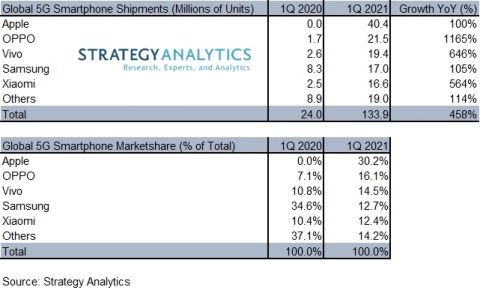 Exhibit 1: Global 5G Smartphone Shipments & Marketshare by Top-5 Vendors (numbers are rounded) (Graphic: Business Wire)


