Initial Public Offering: CCBA, Africa’s Largest Coca-Cola Bottler, to be Listed as Standalone Business

The Coca-Cola Company and Coca-Cola Beverages Africa Announce Plans for Initial Public Offering for Bottler

The Coca-Cola Company and Coca-Cola Beverages Africa (CCBA) today announced plans to list CCBA as a publicly-traded company.

“The Coca-Cola Company sees Africa as a key growth market and views a separate listing of CCBA as an opportunity to deliver a broad, supportive, long-term investor base for the ongoing development of the business”

Tweet this

The Coca-Cola Company intends to sell a portion of its shareholding in CCBA via an initial public offering. The decision is in line with The Coca-Cola Company’s objective of focusing its resources on building consumer-loved brands and innovation.

Cola-Cola-chi-total beverage company-brand spur

The companies intend for an IPO within the next 18 months. The exact timing will be driven by a number of factors, including macroeconomic conditions. Shares will be listed in Amsterdam and Johannesburg, with Amsterdam being the primary exchange.

The IPO will allow CCBA to operate as an independent, Africa-focused, South African-headquartered, managed and domiciled business. The plans underscore The Coca-Cola Company’s continued and long-term belief and commitment to the African continent and the leadership of CCBA from South Africa.

Bruno Pietracci, president of the Africa operating unit of The Coca-Cola Company said,

“The Coca-Cola Company sees Africa as a key growth market and views a separate listing of CCBA as an opportunity to deliver a broad, supportive, long-term investor base for the ongoing development of the business,”

Jacques Vermeulen, CEO of CCBA said,

“A standalone listing for CCBA will enable the bottler to build on its growth trajectory and access capital independently to meet the investment needs of the business, which is great for stakeholders across Africa,”

The Coca-Cola Company has retained Rothschild & Co. to advise on the IPO.

First Bank Unveils a New Corporate Website, Reiterates its Commitment to Service Delivery Excellence

0

First Bank Nigeria and indeed West Africa’s premier financial inclusion services provider has announced the launch of its newly designed website. The new website is upgraded with features that are streamlined to reinforce its role in delivering seamless banking and technology solutions to its customers across the world.

First Bank Unveils a New Corporate Website, Reiterates its Commitment to Service Delivery Excellence Brandspurng

The website is configured with modern design and improved functionality that eases customer experience whilst carrying out various activities on the site, including electronic banking. Non-customers are also able to open an account, putting them at an edge in the industry as they establish a relationship with the Bank that puts YOU, its customers, First.

The new website seamlessly adopts a fresh, magazine-style look and feel for easy navigation to promote access to essential information for its customers, FirstMonie agents, prospective agents, and the public. This upgrade also guides one to make well-informed decisions about one’s personal, business, and private financial needs.

Dr. Adesola Adeduntan, CEO of First Bank Group, while speaking on the launch of the New Corporate Website, said that

“As one of the key contact points to existing and potential customers, the Bank’s website remains a gateway to our business, supporting our unique value propositions and financial services solutions. As such, we are committed to continuously improve the overall user experience through intriguing content quality, exciting features, and ease of navigation”.

He further noted that

“The Bank’s new website will be updated on a regular basis with exciting features that will continue to reinforce the Bank’s resolve to promote digital customer interactions and transactions across our virtual touchpoints and platforms”.

Concluding, he remarked that

“The website will also serve as a financial services library that will keep customers and the public abreast of various financial services solutions and offerings, thereby helping them to improve their economic and social wellbeing”.

He encouraged everyone to explore the website and follow the Bank’s social media pages for updates.

FirstBank has continued to evolve over the years, successfully adopting the latest technology and embracing innovation in its quest to be African’s bank of first choice.

Coca-Cola Beats Earnings Estimates, Says Demand In Q1 Hit Pre-Pandemic Levels

The Coca-Cola Company today reported first-quarter 2021 results and provided an update on progress against its strategic initiatives.

Highlights – Quarterly Performance

  • Revenues: Net revenues grew 5% to $9.0 billion, and organic revenues (non-GAAP) grew 6%. This was driven by a 5% growth in concentrate sales, while price/mix grew 1%. The quarter included five additional days, which resulted in an approximate 6-point benefit to revenue growth.
  • Margin: Operating margin, which included items impacting comparability, was 30.2% versus 27.7% in the prior year, while comparable operating margin (non-GAAP) was 31.0% versus 30.7% in the prior year. Operating margin expansion was primarily driven by effective cost management, partially offset by currency headwinds.
  • Earnings per share: EPS declined 19% to $0.52, and comparable EPS (non-GAAP) grew 8% to $0.55. Comparable EPS (non-GAAP) growth included the impact of a 2-point currency headwind.
  • Market share: The company lost value share in total nonalcoholic ready-to-drink (NARTD) beverages as an underlying share gain in both at-home and away-from-home channels was more than offset by negative channel mix due to continued pressure in away-from-home channels, where the company has a strong share position.
  • Cash flow: Cash from operations was $1.6 billion, up $1.1 billion versus the prior year, driven by positive business performance, five additional days in the quarter and working capital initiatives. Free cash flow (non-GAAP) was $1.4 billion, up $1.2 billion versus the prior year, primarily driven by cash from operations along with lower capital expenditures versus the prior year.

James Quincey, Chairman and CEO of The Coca-Cola Company said,

“We remain focused on emerging stronger and executing against our growth accelerators during the recovery phase. We are pleased with the progress we are making, we are encouraged by improvements in our business, especially in markets where vaccine availability is increasing and economies are opening up, and we remain confident in our full-year guidance.”

Coca-Cola To Unveil Wall Murals Across The Country in Celebration of Nigeria’s Strength And Resilience

Company Updates

  • Business environment update: Global unit case volume trends remain closely linked to consumer mobility, driven by vaccination rates in different markets and related improvements in away-from-home channels. Through the first quarter, volume trends steadily improved each month, driven by a recovery in markets where coronavirus-related uncertainty has abated. The path to recovery, however, remains asynchronous around the world. March volume was back to 2019 levels, with growth in at-home channels being offset by pressure in away-from-home channels. Solid growth in Trademark Coca-Cola, sparkling flavours and the nutrition, juice, dairy and plant-based beverages category was offset by pressure in the hydration category during the quarter.
  • Driving consumer-centric innovation through scaled brands: The company launched new products across several categories, leveraging loved brands to drive scale and impact. In the United States, the company launched smartwater®+, a lineup of infused hydration options featuring unique ingredient pairings and flavour extracts tailored for specific wellness occasions. Three smartwater®+ variants – smartwater®+ clarity, smartwater®+ tranquility and smartwater®+ renew – deliver unique hydration experiences and will be supported by a 360-degree marketing campaign. This rollout is the latest addition to the company’s portfolio of premium beverages across key markets. After initial success in international markets, the company launched Coca-Cola® with Coffee and Coca-Cola® with Coffee Zero Sugar in the United States to give consumers a refreshing and reinvigorating reset to their daily routine. This innovation exemplifies the company’s lift-and-shift strategy to scale successful beverage innovations to new markets, with the United States becoming the 50th market to launch the product. Additionally, Topo Chico™ Hard Seltzer continued its expansion in Latin America and Europe and was recently launched in key markets in the United States under an agreement with Molson Coors Beverage Co.
  • Aligned bottling system investing for growth: The company continues to focus on strengthening bottling partnerships and bottler alignment as the system enters the recovery phase. Seamless system connectivity is helping the company maintain local relevance while benefiting from a global scale. In line with its objective of focusing its resources on building consumer-loved brands and on innovation, the company announced in a separate Form 8-K filing with the Securities and Exchange Commission today that it plans to list Coca-Cola Beverages Africa (CCBA) as a publicly-traded bottler and intends to sell a portion of its holdings in CCBA via an initial public offering. This demonstrates a commitment by the company for CCBA to remain Africa-focused and South Africa-headquartered. For more information, please refer to the press release section of the company’s website.
  • Progress against long-term sustainability goals and creating business value: Environmental, social and governance (ESG) goals remain core to the company’s business and are embedded in its operations. The company delivered on its decade-long drive to enable the economic empowerment of 5 million women entrepreneurs through the 5by20 initiative. The program has reached more than 6 million women entrepreneurs, providing business-skills training, financial services, peer networks, mentoring and other resources. In addition, building on its water stewardship leadership, the company recently announced a holistic strategy to achieve water security where the company operates by 2030. The strategic framework focuses on three priorities: reducing shared water challenges around the world; enhancing community water and sanitation access with a focus on women and girls; and improving the health of priority watersheds. A full update of the company’s ESG priorities will be published April 20 in the 2020 Business & ESG Report, reflecting a continued journey toward driving sustainable business practices.

Consolidated

Unit case volume was even, as continued strength in at-home channels was offset by coronavirus-related pressure in away-from-home channels. Volume benefited from cycling the impact of the coronavirus pandemic in certain parts of the world last year. Strong growth in developing and emerging markets, led by China and India, was offset by pressure in developed markets, primarily the United States and Western Europe. Category performance was as follows:

    • Sparkling soft drinks grew 4% as solid growth in China, India and Latin America was partially offset by pressure in the fountain business in North America and away-from-home channels in Europe due to the coronavirus pandemic. Trademark Coca-Cola grew 4%, led by the Asia Pacific and Latin America, along with solid growth in Coca-Cola® Zero Sugar, which grew 8%, driven by strong performance across all geographic operating segments. Sparkling flavours grew 2%, led by growth in Trademark Sprite in the Asia Pacific.
    • Nutrition, juice, dairy and plant-based beverages grew 3% due to solid performance by Minute Maid® Pulpy in China and Maaza® in India. In North America, continued strong growth in Simply® and fairlife® was more than offset by a decline in Minute Maid®.
    • Hydration, sports, coffee and tea declined 11%. Hydration declined 12%, driven by a broad-based decline across all geographic operating segments. Sports drinks declined 1%, driven by a decline in Europe, Middle East & Africa, partially offset by continued strength in premium offerings and the zeros/lights portfolio in North America. Tea declined 6%, driven by declines in North America and Asia Pacific. Coffee declined 21%, driven by coronavirus-related pressure on Costa® retail stores.
  • Price/mix was 1%, primarily driven by pricing in North America and Latin America, partially offset by negative channel and package mix due to the impact of the coronavirus pandemic. Concentrate sales were 5 points ahead of unit case volume, primarily due to five additional days in the quarter (an approximate 6-point benefit) partially offset by the timing of concentrate shipments.
  • Operating income grew 14%, which included items impacting comparability in addition to currency headwinds. Comparable currency neutral operating income (non-GAAP) grew 7%, driven by solid organic revenue (non-GAAP) growth along with effective cost management across most geographic operating segments and Global Ventures.

Europe, Middle East & Africa

  • Unit case volume declined 2%, primarily due to coronavirus-related pressure in away-from-home channels in Europe, partially offset by solid growth in sparkling soft drinks in Pakistan, Nigeria and Turkey.
  • Price/mix declined 5%, driven by negative channel and package mix in Europe along with geographic mix pressure. Concentrate sales were in line with unit case volume as the benefit from five additional days in the quarter was offset by cycling the bottler inventory build in the prior year related to the uncertain environment.
  • Operating income declined 15%, impacted by comparability items. Comparable currency neutral operating income (non-GAAP) declined 10%, primarily driven by top-line pressure from the negative channel and package mix in Europe.
  • The company gained a value share in total NARTD beverages, primarily due to share gains in Europe and Eurasia & Middle East.

Latin America

  • Unit case volume was even, as growth in sparkling soft drinks led by Mexico, Brazil and Argentina was offset by a decline in the hydration category across most markets.
  • Price/mix grew 7%, driven by pricing in the marketplace including inflationary pricing in Argentina. Concentrate sales were 2 points ahead of unit case volume as the benefit from five additional days in the quarter was partially offset by cycling the bottler inventory build in the prior year related to the uncertain environment.
  • Operating income grew 2%, which included items impacting comparability and an 11-point currency headwind. Comparable currency neutral operating income (non-GAAP) grew 15%, driven by solid organic revenue (non-GAAP) growth along with effective cost management.
  • The company gained a value share in total NARTD beverages as well as in most categories.

North America

  • Unit case volume declined 6%. North America had strong growth in sparkling soft drinks in at-home channels along with growth in fairlife®, Simply® and Topo Chico®. This was more than offset by continued coronavirus-related declines in the fountain business, along with a decline in the hydration category primarily due to cycling the consumer stocking in the prior year driven by coronavirus-related uncertainty.
  • Price/mix grew 4%, as solid growth in juice and dairy finished-goods brands, along with the category mix benefit from cycling strong sales in the hydration category last year, were partially offset by pressure in the fountain business and away-from-home channels. Concentrate sales were 6 points ahead of unit case volume, primarily driven by five additional days in the quarter.
  • Operating income grew 105%, which included a tailwind from items impacting comparability. Comparable currency neutral operating income (non-GAAP) grew 24%, driven by pricing and effective cost management.
  • The company lost value share of the total NARTD beverages due to coronavirus-related restrictions in away-from-home channels, where the company has a strong share position.

Asia Pacific

  • Unit case volume grew 9%, as strong growth in China and India was partially offset by coronavirus-related pressure in Japan and Southeast Asia. Growth in China benefited from cycling the impact of coronavirus-related lockdowns last year.
  • Price/mix declined 2%, largely driven by geographic mix due to growth in emerging and developing markets outpacing developed markets. Concentrate sales were 11 points ahead of unit case volume, primarily due to five additional days in the quarter along with the timing of shipments in China.
  • Operating income grew 34%, which included an 8-point currency tailwind. Comparable currency neutral operating income (non-GAAP) grew 29%, driven by solid organic revenue (non-GAAP) growth along with effective cost management across most operating units.
  • The company lost value share in total NARTD beverages. This was driven by a share loss in Japan due to coronavirus-related restrictions in away-from-home channels, partially offset by share gains in China and Southeast Asia.

Global Ventures

  • Net revenues declined 1% in the quarter, which included a 5-point currency tailwind. Organic revenues (non-GAAP) declined 5%. The revenue declines were primarily driven by coronavirus-related pressure on Costa® retail stores, partially offset by strong performance in Costa Express® machines in the United Kingdom and the benefit from five additional days in the quarter.
  • Operating income and comparable currency neutral operating income (non-GAAP) grew 37% and 48%, respectively. This was primarily driven by effective cost management, partially offset by coronavirus-related pressure on Costa® retail stores.

Bottling Investments

  • Unit case volume grew 5%, primarily due to solid growth in sparkling soft drinks in India and South Africa.
  • Price/mix grew 5%, driven by pricing and trade promotion optimization in most markets along with a benefit from category and package mix.
  • Operating income growth of 125% included a tailwind from items impacting comparability and a headwind from currency. Comparable currency neutral operating income (non-GAAP) grew 91%, driven by solid pricing along with effective cost management.

Global Smartphone Shipments Surge to 340 Million units, Up +24% YoY in Q1 2021

0

According to the latest research from Strategy Analytics, global smartphone shipments were 340 million units in Q1 2021, up +24% YoY representing the highest growth since 2015. The smartphone market rebound was driven by the healthy demand of consumers with ageing devices and a phenomenal 5G push from Chinese vendors.

Global Smartphone Shipments Surge to 340 Million units, Up +24% YoY in Q1 2021 Brandspurng
Exhibit 1: Global Smartphone Shipments (M Units) and Market Share (%) by Top Five Vendors. Note: All Q1 2021 smartphone shipment numbers are preliminary version and subject to minor adjustments. (Graphic: Business Wire)

Linda Sui, Senior Director, at Strategy Analytics, said,

“The China smartphone market had a sensational quarter driven by 5G product success across multiple price tiers. China smartphone shipments were up +35% YoY reaching 94 million units in Q1 2021.

Globally, the top five vendors combined took a 76% market share in Q1 2021, up from 71% one year ago. Chip shortages and supply-side constraints did not have a significant impact in Q1 among the top 5 brands but was and will be a concern for smaller vendors over the next few quarters in our view.”

Neil Mawston, Executive Director at Strategy Analytics, added:

“Samsung remains the largest vendor shipping 77 million smartphones globally in the first quarter, growing +32% YoY from 58 million units in Q1 2020. Samsung’s newly launched more affordable A series 4G and 5G phones, and the earlier launched Galaxy S21 series combined drove solid performance in the quarter.

Apple shipped 57 million units iPhones worldwide, capturing second place with a 17% volume market share. The strong momentum behind the 5G iPhone 12 series continued across multiple markets.”

Yiwen Wu, Senior Analyst at Strategy Analytics, noted:

“Xiaomi held third place in terms of volume of smartphones shipped for the second quarter in a row. It shipped 49 million smartphones globally and took a 15% market share in Q1 2021, up from 10% one year ago.

The vendor maintained strong momentum in both India and China, and the expansion in Europe, Latin America and Africa region also started to bear fruit. OPPO (not including Realme and OnePlus) won 11% market share and remained the fourth-largest smartphone vendor in the first quarter, followed by Vivo. vivo grew an impressive 85% YOY in Q1 2021.”

Mouka Flags Off ‘Mums In Business Challenge’, Calls For Entry

0

To celebrate this year’s Mother’s Day in May, Mouka has rolled out the ‘Mums in Business Challenge’ to reward female entrepreneurs with cash grants for their ventures. The initiative is in line with the brand’s mission of adding comfort to life and falls under its CSR pillar of “skills for life”.

In May of 2019, Mouka ran a similar online competition, organised in partnership with AGS Tribe, a firm that provides entrepreneurs opportunities across Africa. Maryam Adebola-Salami, the founder of Mobaby Care Nigeria, emerged the winner and was presented with a cheque of US$1,000.

This year, Mouka is taking this initiative further by supporting three mum entrepreneurs. The first prize winner will go home with a cash grant of N500,000, the second prize winner with N300,000 and the third with N200,000. All winners will also go home with Mouka mattresses and pillows.

The 2021 ‘Mums in Business Challenge’ is also being organised in conjunction with the AGS Tribe. Consumers are encouraged to visit Mouka’s social media handles for information on how to participate as well as terms and conditions.

According to Mouka’s Head of Marketing, Tolu Olanipekun,

“Mouka is a brand that genuinely cares for its consumers and is continuously looking for ways to add comfort to their lives through its products and initiatives as these. We see mums as the pillars that support the homes. They should be encouraged and supported to excel in their chosen fields of endeavour”.

Mouka is Nigeria’s leading brand of mattresses, pillows and other bedding products. Among its array of quality products are the Wellbeing Orthopaedic mattresses, Mondeo Plus spring mattress, Royal Luxury Pillow Top spring mattress and an assortment of pillows to help Nigerians sleep well and wake up refreshed.

What Pandemics Mean For Robots And Inequality

0

From car manufacture to self-service checkouts, we all see how automation can transform the world of work—with lower costs and higher productivity on one hand, and more precarious employment for people on the other. But the COVID-19 pandemic added fuel to the fire.

The rise in telework, for example, is hurting low-wage workers and increasing inequality. More broadly, if the pandemic accelerates the pace of automation, then we may face a jobless recovery for low-skilled workers. Our recent IMF staff research suggests that such concerns are justified.

We focus on one form of automation, industrial robots, and analyze the effect of past major pandemics on their adoption: SARS in 2003, H1N1 in 2009, MERS in 2012, and Ebola in 2014. We use econometric techniques and robot data at the sectoral level from the International Federation of Robotics covering 18 industries in 40 countries between 2000 and 2018.

We find that robot adoption (measured by new robot installations per 1000 employees) increases after a pandemic event, especially when the health impact is severe and when the pandemic is associated with a significant economic downturn.

Why do pandemics lead to the rise of robots? We see two key reasons.

First, after large shocks like recessions, firms restructure their businesses and adjust production toward technologies that lower labor costs. Second, firms may prefer robots because they are immune from health risks. Pandemic-induced uncertainty also adds to incentives for automation, as firms try to make sure they can withstand the next pandemic.

The Rise Of Robots And Inequality

Robots do not affect all workers in the same way. Low-skilled workers are more at risk of displacement by robots than high-skilled workers, which reinforces existing inequality dynamics.

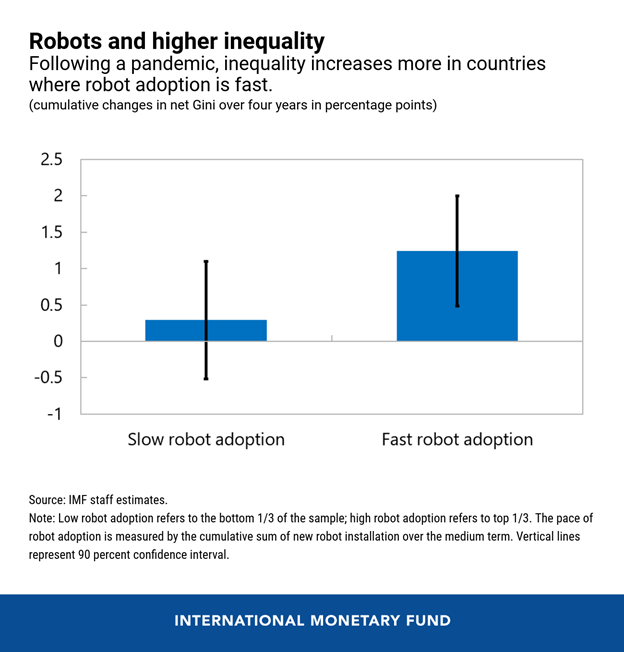
Looking at country-level data and a larger sample, we find that following a pandemic the increase in inequality, measured by the Gini coefficient, over the medium term is larger where new robot adoption has increased more. Our results suggest that the acceleration of robotization is an important channel through which pandemics lead to higher inequality

chart 2

Looking forward, a corollary of our results is that while automation and robotization are accelerating from still-low levels, they will likely become even more important drivers of inequality in the future. Left unchecked, growing disparities may lead to long-lasting grievances and ultimately to social unrest, forming a vicious cycle.

Policymakers need to pay attention to preventing scarring effects on the livelihoods of the most vulnerable, including through appropriate labor market policies.

As automation intensifies following COVID-19 and transforms workplaces, more workers will need to find new jobs, especially those who are less skilled. Policies to mitigate rising inequality include revamping education to meet the demand for more flexible skill sets, and lifelong learning and new training—especially for the most affected workers. A good example is Singapore’s SkillsFuture initiative, which promotes learning in all stages of life to address the challenges brought by technological changes.

These measures may still fall short if the training involves acquiring a substantively different and challenging set of skills, raising the possibility of dropouts. It is therefore important for policymakers to consider ways to address medium-term social challenges, including through strengthened social safety nets.

While robotization is inevitable, its distributional outcome will depend on policies. A society that is more willing to provide support to those who are left behind can accommodate a faster pace of innovation, while ensuring that all members of society are better off.

Nigerian Idol: The Search Continues As 68 Contestants Proceed To Theatre Week

After 4 weeks of excitement, the auditions for Nigerian Idol season 6 came to an end last Sunday night with 14 contestants receiving golden tickets to proceed to the Theatre round.

One of the performances that stood out from last night’s auditions was from Winning, a 22-year-old producer, who performed a self-written song much to the admiration of the audience and judges. Another outstanding performer was Faith Jason. Faith’s rendition of ‘All-Time Low’ by Jon Bellion was so good that Seyi Shay stood up to personally hand him a golden ticket and named him one of her favourites this season.

Nigerian Idol Brandspurng The Search Continues As 68 Contestants Proceed To Theatre Week

Some contestants had a night to forget as they were unable to impress the judges. Mufidat’s performance fell short of the judges’ standard as she was visibly nervous throughout her performance and Virginia, a professional singer was also let down by her voice.

Over the past four weeks, viewers from across Africa have witnessed many talented Nigerians auditioned to earn a place in the next round of the singing competition. 68 of these talents will proceed to the theatre week next Sunday, where they will battle each other to prove they have what it takes to make it to the next stage for the live shows.

Nigerian Idol continues next week Sunday, April 25 on Africa Magic Showcase (DStv ch 151) and Africa Magic Urban (DStv ch 153) and Africa Magic Family (DStv ch 154 & GOtv ch 2) from 7 pm. Viewers can also catch a special 24-hour Nigerian Idol Extra content on DStv Channel 198 and GOtv Channel 29.

Nigerian Idol season 6 is sponsored by Bigi Drinks and Tecno Mobile. The show is available to customers on DStv Premium, Compact Plus, Compact, Confam, Yanga and GOtv Max and Jolli. Visit www.dstvafrica.com or www.gotvafrica.com and download MyDStv or MyGOtv Apps to pay your subscription or switch your package.

You can also watch Nigerian Idol Season 6 via the DStv app on multiple devices at no additional cost. The app is available for download on iOS and Android devices. For more information, visit www.africamagic.tv/nigerianidol. You can also follow the official Nigerian Idol social media pages for news and updates with the hashtag #NigerianIdol on Twitter @nigerianidol, Instagram @nigerianidol and Facebook.

What Does WhatsApp’s Privacy Policy Update Mean For Brands?

Despite public pushback, Facebook-owned messaging app WhatsApp will be going ahead with the privacy policy update it announced earlier this year.

While the public has begun to appreciate that WhatsApp’s privacy rules are in fact still very much in favour of the user, with messages sent remaining private and encrypted at all times, what will this mean for brands that use the app to reach and engage with consumers?

“The benefits for brands are massive,” says Kyle Oosthuizen, Chief Operating Officer at Blue Robot – creators of messaging solutions that allow brands to communicate with their audience at scale. “These updates form part of Facebook’s efforts to make communicating with a business secure, better, and easier for everyone.

“The new updates will be made to business features that will help businesses engage with their users in a more intuitive and more advanced way. 2021 is the year that WhatsApp will be rolling out more ad products and features for businesses, but it will also be looking to monetize the app to a greater degree and deliver better services for users. WhatsApp is the most pervasive messaging app in South Africa, and it’s free for the user. Facebook is navigating that balance between maintaining a compelling user experience, whilst funding it by giving brands access to the WhatsApp audience, but with strict protocols in place to protect privacy.”

As to what exactly is changing, he shares that it will be a superior level of customer service; the ability to discover and interact with businesses; and a more shoppable experience.

“Additionally, with the development of Click2WhatsApp ads – which Blue Robot helped to BETA launch in South Africa – brands can reach a targeted audience on Instagram or Facebook, who can simply click on an ad that takes them directly into the WhatsApp conversation with the brand.

“Previously, the user journey would have many hurdles from an ad to a conversation on WhatsApp with a brand. Now, the process is far smoother by enabling users to simply click on a WhatsApp button below the ad.”

WhatsApp will also be introducing product lists, carousels and the ability to process payments within WhatsApp – all of which will enhance users’ ability to transact on the platform and engage with brands on a more commercial level – making conversational commerce a big opportunity for brands in the future.

Despite the positives for brands, some WhatsApp users aren’t so sure and have tried competitors like Telegram and Signal (with the former seeing a 91% increase in downloads and the latter a 4,200% increase in the week following WhatsApp’s initial announcement[1]). While Blue Robot has the capabilities to build chat solutions on Telegram for brand engagement, it is evident that it would be a risky undertaking as they have little to no rules and regulations.

“On the other hand, WhatsApp’s new updates mean that regulation will be stricter and a more brand-safe environment which could potentially mean the rollout of more ad products in future. Part of Blue Robot’s process with brands is to get them a verified business profile on WhatsApp, giving consumers peace of mind that they are communicating with the official business account.”

“All in all, WhatsApp’s policy updates will be a boon for brands. Users should also rest assured knowing that their personal messages and calls will remain private and that the processing, storage and usage of their data is subject to global data protection acts,” concludes Oosthuizen.

Users have until 15 May to agree to or reject the terms of the new Privacy Policy.

US Closes In On Quarter Of A Billion Video Subscriptions

0

Q3 2020 results from kantar Entertainment On Demand service in the US reveal the following consumer behaviors:

  • Over 7% of US households took out a new video-on-demand subscription (SVoD) in the first quarter. This means US SVoD subscriptions reached 241 million by March 2021.
  • WandaVision was the top-rated title over Q1 2021, with The Mandalorian at #2 and Bridgerton also proving popular, taking third place.

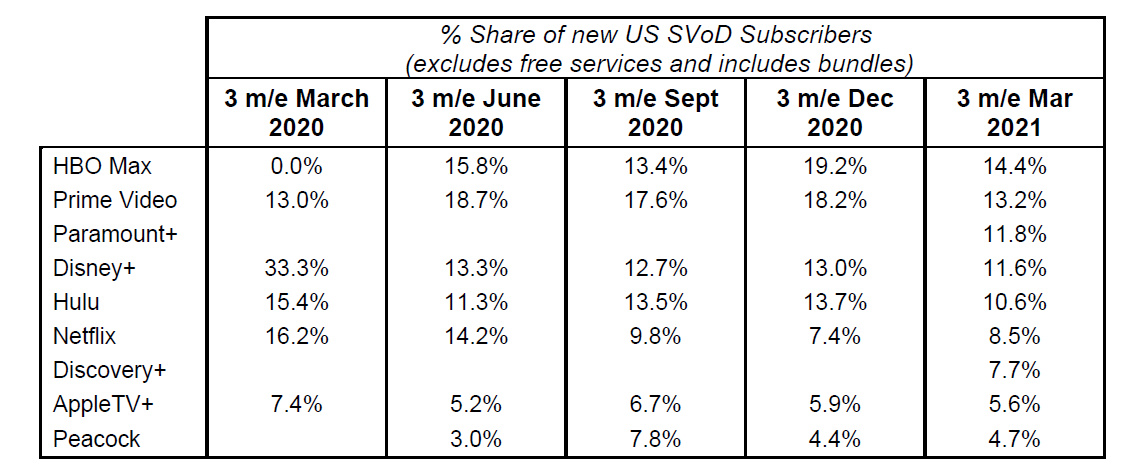
EoD US graph

HBO Max Holds On

In a quarter that saw the launch of Paramount+ and Discovery+, it’s all the more impressive that HBO Max held onto the top spot in a share of new SVoD subscribers. HBO is not just winning new subscribers, its also dramatically increasing the advocacy rates of its subscriber base at the same time.

When HBO Max launched in Q2 2020 its Net Promoter Score (a measure of subscriber advocacy), was the 10th highest in the SVoD market, it’s now a joint second. This bodes well for both retention and word-of-mouth recommendations to drive future subscriber acquisition. Subscribers specifically cite the number of new release films as a key catalyst to their increased satisfaction with the HBO Max service.

More ad-supported services?

The average number of SVoD subscriptions in each US household continues to rise, hitting 3.8 in Q1 2011, up from 3.3 a year ago. With paid subscription stacking increasing, so is the number of households that plan to cancel at least one SVoD subscription in the next 3 months, which hit 24.9%, up from 20.5% the previous quarter and 23.2% a year ago.

With the cost of hosting multiple video streaming subscriptions increasing, ad-supported services are experiencing strong growth, with Peacock Free and Tubi leading in growth. Some 49% of American’s now agree they don’t mind seeing some advertising if it makes video streaming services cheaper.

As the battle for new subscribers intensifies further, we are likely to see more ad-based tiers come online to widen adoption and provide consumers with more choice.

A strong performance for Paramount+

Looking to individual performance, Paramount+ successfully won more than 1 in 10 new SVoD subscribers in the quarter, as its rebrand and expansion of CBS All Access hit the market. Star Trek proved the key pull for the new service, with 53% of new subscribers saying they signed up because of a specific title and 24% of these citing Star Trek. Stephen King’s The Stand also proved a key pull, with 9% of new content drive customers referring to the mini-series.

Welcome Discovery+

Discovery+ launched into the US on 4 Jan 2021 and captured 7.7% of new SVoD adds in the quarter, an impressive number for a service with a narrower focus on documentary and reality-based content. In a nod to the effectiveness of the Discovery+ TV launch campaign, 68% of new subscribers said watching a TV advert for the service was a key part of their decision-making process, whilst 40% stated they were enticed through a free trial offer.

The service has proved particularly popular with post-family working and retired households, together accounting for 45% of their subscriber base. Titles including Ghost Adventures, Fixer Upper, 90 Day Fiancé, and Expedition Bigfoot all proved important titles to drive subscriber acquisition in the quarter.

Disney+ still growing

Disney+ continues to show solid growth in the US market, winning 11.6% of new SVoD subscribers in the quarter. Overall WandaVision was the top-rated SVoD title, followed by The Mandalorian –achieving the top two highest-rated titles across the US is an impressive feat that takes the content challenge directly to Netflix.

It’s clear that Disney+ is winning acclaim for the quality of its titles, but consumer sentiment is also improving significantly across the amount of original content it offers: net satisfaction in this area has improved from +20% in Q1 2020 to +33% in Q1 2021, a key measure for long-term retention.

West Africa Launches New Payments Digitization Agenda

The Senegalese government has launched with support from the Better Than Cash Alliance (United Nations) (www.BetterThanCash.org), the World Bank, and the National Agency of Statistics and Demography of Senegal. Combining digital payments with health insurance benefits offers an excellent opportunity for social inclusion, formalization, and financial innovation.

Digital payments stimulate domestic production and consumption. If 50% of temporary workers in  Senegal received payments digitally, 45 billion CFA francs would be added to GDP per year (around $80 million USD). Paying workers digitally, speeds up the financial inclusion for the population boosts business competitiveness, and increases financial system liquidity.

To tap into this potential, the SME Development Agency (ADEPME) plans to bolster its SME support fund with $20 million USD (around 11 billion CFA francs) from the World Bank. This will be used to strengthen SME digitization initiatives and support digital payment projects for workers.

High-level Leadership Speaks Out In Support Of Digital Payments For Workers

Senegalese President Macky Sall and H.M. Queen Máxima of the Netherlands, who serves as UN Secretary-General’s Special Advocate for Inclusive Finance for Development (UNSGSA), have launched an appeal to fellow leaders, the private sector and civil society, inviting them to: “use this report to ensure digital payments are at the center of a sustainable and fair economic recovery. We look forward to jointly providing leadership on this agenda to achieve an inclusive and digitally enabled recovery,” the two leaders added.

To set an example, the President of Burkina Faso, Roch Marc Christian Kaboré, also decreed, in late 2020, the digitization of payments for workers in the administration of Burkina Faso. When the COVID crisis emerged, the West African Economic and Monetary Union (WAEMU) and the Central Bank of West African States (BCEAO) took decisions (https://bit.ly/3mZVAcr) aimed at reducing the circulation of cash in the 8 countries. These actions have had tangible impacts which are beginning to change the lives of workers and companies.

Digitizing Payments And Advancing Universal Healthcare Coverage

While receiving a salary is often linked to health care contributions, globally at least 61% of workers operate in the informal sector (https://bit.ly/3sxhSUd) without adequate coverage, according to the International Labour Organization (ILO). Indeed, in some countries, there is not always a legal obligation for employers to contribute to any kind of coverage for their informal/self-employed workers, which affects women more than men.

To meet this challenge of inclusion, the National Agency for Universal Health Coverage in Senegal has launched an ambitious digital payments platform (https://bit.ly/3n0Rv83). It has partnered with fintechs and private companies to link access to universal health coverage and digital payments – specifically targeting women.

Flagship national enterprises such as the agricultural giant SODAGRI or SMEs such as QUALIOCEAN and Kossam SDE are setting an example by providing temporary workers with universal health coverage. More than 200,000 workers will now have access to quality, government-subsidized health care.

While 81% of national companies have fewer than 20 employees, on average hundreds or even thousands of temporary workers are employed in their supply chains. Employees are generally banked, but 93% of employees on temporary contracts are paid in cash. The latter are systematically excluded from the formal health system.

The Successful Transition Towards Digital Payments

Three obstacles have limited the growth of payment digitization in Africa: the size of the informal sector, sometimes up to 90% of the economy; the historically low financial inclusion rate; and most importantly, 21% of African workers receive a wage keeping them below the poverty line.

This has all changed dramatically. Financial inclusion has surged since 2010 (https://bit.ly/3gmU0Aq) with the arrival of electronic money issuers and fintech.

The country’s largest employer, Compagnie Sucrière Sénégalaise, has successfully digitized payment for around 8,000 workers via a partnership with local fintech. “We wanted to digitize payments without using the banking system, which isn’t suited to some populations,” noted Claude Fizaine, the company’s Secretary General, in an interview with an African media outlet (https://bit.ly/3x8hvmn). “For employers, the benefits of digitizing payments include avoiding the constraints of managing large amounts of cash, and all the risks that distribution can involve. It also makes it possible to offer employees tools tailored to their financial and family situations, which can only have a positive impact on their personal and professional lives,” he added.

WAEMU’s innovations should continue to inspire the rest of Africa. Since 2012, it has been the continent’s engine for economic growth and stability (https://bit.ly/3x23abr). The examples of Senegal and its neighbours reinforce the ILO’s global agenda (https://bit.ly/2Qe24IW) that could well make digital payments for workers a new global standard for promoting decent work.