Baby Drama To Premiere On Africa Magic, April As Judging Matters, Comedy Nites Get New Seasons

From April 2021, lovers of great local entertainment will be treated to the start of a new drama series as well as return seasons of their favourite shows on Africa Magic.

Africa Magic will on Wednesday, April 21st premiere Baby Drama, a drama series that x-rays the lives of five women – Iye, Kese, Amara, Esosa and Oni – from different walks of life as they deal with the reality of how a baby or lack of one will alter their futures forever.

The 13-episode series which will air at 9pm on Africa Magic Showcase (DStv channel 151) stars some of the finest talents in Nollywood such as Bimbo Akintola, Joseph Benjamin, Bikiya Graham-Douglas, Wole Ojo and Uru Eke.

Speaking on the premiere of Baby Drama, Channel Director, Africa Magic, Wangi Mba-Uzoukwu said, “Baby Drama will take viewers on an emotional rollercoaster as they get immersed in the lives of the characters, their relationships and their journeys to parenthood.

It also explores the myths and cultural nuances associated with pregnancy, assisted reproduction and how individuals deal with the changes a baby or no baby brings. We’re excited about this new series and we are sure our viewers will be entertained by the stellar cast and excellent storytelling we are known for”.

Also on the content slate this April on Africa Magic, is the return season of fan favourites, Judging Matters, Comedy Nites and Eve.

The legal reality TV show, Judging Matters returns for a second season from Monday, April 5th at 6pm on Africa Magic Showcase (DStv channel 151).  Judging Matters addresses small claims and minor cases in Lagos which present a huge challenge for the established courts to deal with. TV host and lawyer, Ebuka Obi-Uchendu and Justice Olusola Williams continue in their roles as counsellor and Judge and seek to secure amicable resolution and justice for people.  

Ik Osakioduwa’s stand-up comedy television show, Comedy Nites also makes a return this April for a third season. The new season which premieres on Africa Magic Urban (DStv Channel 153) on Thursday, April 8th at 9:30pm promises to entertain the audience with top-notch performances from a mix of newly discovered, fast-rising and established comedians.

After a year-long production break, Eve will return with its third season on Monday, April 12th at 9pm. The series which follows the trials and tribulations of a young female lawyer originally premiered in 2018 and has featured top-rated Nollywood actors and Ex BBNaija housemates Elozonam Ogbolu. The series will air on Africa Magic Showcase (DStv channel 151).

DStv viewers can watch these exciting series via the DStv app on multiple devices at no additional cost. The app is available for download from the Apple and Google Play app stores.

The series will also be available on the online streaming service, Showmax. DStv Premium customers get Showmax at no extra cost whilst DStv Compact Plus, Compact, Confam and Yanga customers get it at half the price.

For more information on these and other Africa Magic programming, visit www.africamagic.tv or follow the verified social media pages of DStv, GOtv and Africa Magic.

IT Coy, Partners French School To Advance AI, Business Learning

0

Coven Works, a Nigerian-American Information Technology company, is collaborating with French School to help Nigerians advance learning in Artificial Intelligence (AI), Business and Ethics.

The partnership was announced by Olusola Amusan, the Chief Executive Officer of Coven Works in Abuja.

Amusan said the institution, Aivancity School for Technology, Business and Society, Paris-Cachan, Paris, was built around three cores areas – AI, Business and Ethics of the 21st century.

He said the school was focusing on developing the capacity of humans, organisations to address economic and social challenges related to the exploitation of data and AI’s potential.

“Globalisation is forcing companies to hire humans from all countries in highly skilled occupations like data science and AI, hence the need for these sort of partnerships with a top French institution.

“Most business schools have rigid admission requirements, they mostly require that students have a background in certain fields before admission can be guaranteed but our partner is open to students from various disciplinary backgrounds like literary, economy, science and more.

“The school offers an update guarantee that enables graduates take courses and continue to have access to online courses, media library and many resources even upon graduation.

“This largely contributes to accomplishing the mandate of the school’s value which provides a guide to graduates throughout their professional career and strengthening their professional integration,” he said.

Amusan said that the school offered the Grande École programme (higher education programme), which included a course such as Building Fundamentals and Deepening knowledge of AI handled by Microsoft.

According to him, the course spans two years with the third year of an apprenticeship programme.

Amusan said the course was open to persons with a background in mathematics, statistics, computer science, engineering sciences, economics or management with a certificate issued by an international higher education institution.

He said that admissions into the second year of the Grande École Programme was open to graduates with a bachelor’s degree or equivalent in mathematics, statistics, computer science, engineering sciences, economics and management from any business or engineering school.

“The third year of such programme is offered as an apprenticeship or professionalism contract in study-work dual system manner with tuition fees paid by the host company.

“Another programme is a Bachelor of Science on Applied AI which also runs for three years and admissions are open to students holding a general university Bachelor’s degree or any other international diploma.

“More programmes include a Master’s of Science in Machine Learning for Business Intelligence and this includes a one week trip to Silicon Valley.

“There is also a continuing professional development certification for companies and public organisations and customised in a remote model,” he said.

Other courses include certifications in Data Science and Modelling, Neural Network and Deep Learning, AI and Data Science for Managers, AI and Data Science for Marketing, AI and Big data Management for Chief Information and Technology Officers.

He said that the organisation was helping Nigerians facilitate careers in the available courses, and urged interested individuals to log on to-http://www.Covenworks.com/aivancity for more information.

Mr Tobi Ricketts, the Regional Manager of the school reiterated that Africa would be the next frontier of the digital revolution in the world.

According to Ricketts, this is already evident in groundbreaking solutions developed by talents in Africa and huge talent acquisitions by major players in tech.

He said, “The heart of Aivancity’s development work in Africa is contributing to the preparedness of its teeming talents for technological and societal impacts and development of responsible practices in AI.

“Our partnership with Coven Works, one of the leading AI boot camps in Nigeria is evidence of our commitment to achieve these audacious goals.”

Some of the objectives of Coven Works include focusing on preparing the workforce for the future of work, shaping the growing adoption of AI in the workplace, expansion of the workforce to include both on-and off-balance-sheet talents and ensuring remarkable IT global transformation at the grassroots.

Traders’ Voice: Lagos Traffic At Sea

In an unfathomable turn of events, a major global trade route underwent an occurrence similar to the everyday experience of a Lagos resident, except, this occurrence lasted way longer and is far more consequential.

The Suez Canal, which serves as a trade conduit in Egypt allowing water vessels to conveniently sail between Europe and the Middle East, India and Asia, was obstructed by what seemed like the aftermath of a bad driver getting stuck after attempting a U-turn on a very narrow road.

If you have seen the pictures of this blockage, then you probably get the gist. Last Tuesday, the Suez Canal was completely blocked by the Ever Given mega vessel, hence, shuttering a major global trade route that usually accommodates around 12% of global trade.

Before we delve into the far-reaching implications of this mishap, we need to ruminate over what caused this in the first place. Just by looking at the picture, it is apparent that someone or a group of persons made a mistake. Hence, it was quite surprising to hear speculations that the obstruction might have been mainly caused by strong winds and weather factors. However, recent reports from the Suez Canal Authorities unsurprisingly stated that technical or human errors might have been the major cause of the blockage.

While we wait on further information from ongoing investigations, the impact of the movement disruption has been devastating. With about 369 ships stuck as of Sunday, the blockage has severely disrupted global trade, holding up an estimated $9.6bn of trade daily (out of curiosity, I wonder what the economic implications of the strenuous Lagos traffic are).

To make this more relatable for our Nigerian readers that only understand the magnitude of cost when expressed in naira terms, the blockage has cost roughly N4.5 Trillion each day (30 percent of Nigeria’s total budget for the year), assuming we convert the dollar cost using a generous parallel market rate of 1$/N470.

However, oil-producing nations like Nigeria found some silver lining amid this chaos, as the supply disruption triggered by the blockage sparked some positive movement in the international oil market. With an estimated one million barrels of oil supply disrupted daily and expectations of the blockage lasting for weeks, Brent crude recorded its largest daily gain in nearly one year, as it ticked up by 5.95% last Wednesday to close at $64.41 per barrel.

That was a very long week for global trade, but luckily, the nightmare seems to be over. It was reported on Monday that the ship blocking the Suez Canal was fully dislodged, hence, allowing for the passage of the stranded ships. Nevertheless, one must wonder how and why this happened. While analysts from our end remain satisfied with the official reports and expectant of further fallouts from the investigation, initiators and patronizers of conspiracy theories must have a full plate on hand, as this is one complicated scoop.

Eurobond issuance season…

The Sub-Saharan Eurobond market in terms of new issuance was largely subdued last year as a lot of Sub-Saharan African countries were faced with the tough decision of issuing Eurobonds in an unfavorable market condition to ease FX liquidity pressures caused by the pandemic or Focus on getting Debt service relief from the IMF and World Bank. 

The chart above paints a clear picture of how SSA handled its FX needs for 2020. The region raised a total of USD 5.2 bn through various Eurobond issues, an 8.8% reduction compared to USD 5.7 bn raised in 2019, with Ivory Coast being the only Sub-Saharan African country to issue a Eurobond after the pandemic hit.

The reduction in regional Eurobond issue was attributed to the global pandemic, which prompted institutional investors to dump risky assets in favour of safe havens and subsequently causes yields to rise, making it expensive for regional economies to access the market, coupled with the depreciation of local currencies in the region which made debt servicing costs more expensive.

The year 2020 also saw Zambia become the first nation in the region to default on its debt service obligations of a USD 42.5 mn Eurobond coupon in November 2020.

Eurobond Issuance in 2020

Country Amount Issued Issue Date Issue Tenor Coupon Maturity Date
Ghana                                          1,250.00 11-Feb-20 7 6.40% 11-Feb-27
Ghana                                          1,000.00 11-Feb-20 15 7.90% 11-Feb-35
Ghana                                             750.00 11-Feb-20 41 8.80% 11-Feb-61
Gabon                                          1,000.00 6-Feb-20 11 6.60% 6-Feb-31
Ivory Coast                                          1,191.00 30-Nov-20 12 4.90% 30-Jan-30


The Ivory Coast’s 12-year issue was priced at a historical record-low yield for regional issuers of 4.9% and yet, recorded the highest oversubscription rate of 5.0x in 2020.

This was attributed to investors’ hunt for high yields following a massive monetary easing in developed markets, which unlocked liquidity in financial markets and consequently resulted in declining yields.

The low supply of Sub-Saharan Eurobonds in the market also contributed to the oversubscription, with Ivory Coast being the first Sub-Saharan African Eurobond issuer in 9 months.

Performance so far… 

Benin Republic takes the lead…

The Republic of Benin completed a €1 billion bond issue on the international debt market in January 2021, making it the first SSA Eurobond issued in 2021. €700 million at an interest rate of 4.8% with a maturity of 11 years while the remaining €300 million was issued with an interest rate of 6.8% and a maturity of 31 years.

The two tranches were subscribed at €1.9 billion and €1.2 billion, respectively, signaling strong investors’ appetite for SSA paper.  We have also witnessed some corporate Eurobond issuance with the most recent being Seplat. Seplat issued $650m 5-Year Senior Unsecured Callable Eurobond (first 2 Years cannot be called) at 7.75% last week, of which part of the proceeds will be used to call back their existing Eurobond on April 21st, 2021 at a 102.31 cash price.

The Banking sector wasn’t left out as Ecobank Nigeria also lunched the first SSA bank Eurobond issuance of the year, Yield was set at 7.125% for a USD 300mn trade size.

Ghana Issuance: Oversubscribed but weak… 

Ghana held its Eurobond issuance yesterday with a four-year zero-coupon bond, seven-year, twelve-year, and twenty-year debt being offered. Ghana received a total subscription of $6bn as against the $5bn initial target but ended up selling $3.025bn across all maturities.

Ghana sold $525 million worth of 4-year zero-coupon instruments at 78 cents, $500 million worth of 20-year securities at 9.25%, $1 billion of 12-year notes at 8.75%, and $1billion of 7-year bonds at 7.75%. The current weakness caused by the rising US treasury coupled with US inflationary concerns seems to have weakened bid levels as the stop rate closed below initial price guidance despite the reduced sales.

The Ghana auction was meant to set the tone of the SSA Eurobond issuance in 2021. Strong demand for Ghana’s sovereign would clearly highlight the region’s ability to have continuous access to international capital markets and avoid uncertainty. But the result seems to tell us two things; one, there is still much dollar liquidity out there, and two, the liquidity seeks attractive yields.

This begets the question, “given the current rise in the yields at the local market, do you think this is the right time for a Eurobond issuance bearing in mind the increase in debt service?”

“What Worries The World?”: One Year On, COVID-19 Remains The Greatest Global Concern

0

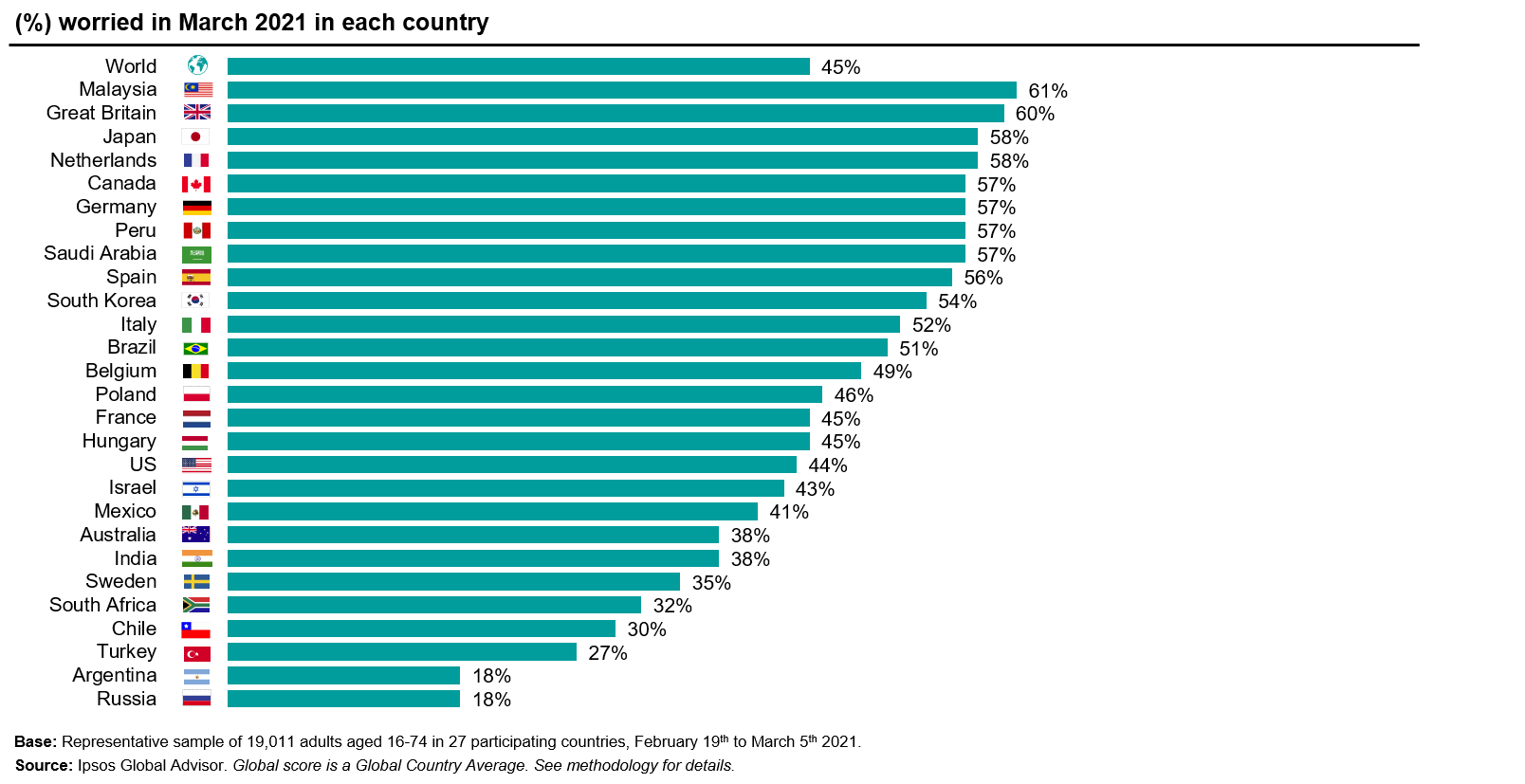
Nearly one in two people worldwide (45%) say that Covid-19 is one of the top issues facing their country in March 2021, one year after the global pandemic was declared. Although this is down 5 points from last month and the lowest level recorded since October 2020.

Unemployment is the second biggest issue across all countries (37%), followed by Poverty & social inequality (31%) and Financial/political corruption (29%). Crime & violence is the fifth most prominent issue this month, level with last month at 24%.

When asked whether things in their country are heading in the right direction or are off on the wrong track, over six in 10 (62%) members of the public across all 27 countries opted for “wrong track” in March 2021, while 38% say “right direction”.

This more pessimistic view is most widely shared by those in Peru (85%), South Africa (80%) and Poland (also 80%). Three-quarters or more in Argentina (78%), Spain (77%) and Chile (75%) also say that things in their country are heading in the wrong direction.

The countries with the largest month-on-month increases in the respondents saying things are on the “wrong track” are Turkey (+5 points) and Hungary (+4).
On the other hand, more say things in are heading in the “right direction” in Great Britain (+11 points), the Netherlands (+8) and the US (+5) compared to last month.

This month’s headlines for each of the top issues are set out below.

Coronavirus (45%)
Malaysians remain the most concerned about Covid-19, but today’s 61% is significantly lower than the 77% of last month. Just behind, with 60%, is Great Britain, again in second place, followed by Japan and the Netherlands (both 58%).
Most countries record a decline in concern about Covid-19 this month, but there have been moderate increases in Brazil (+6) and Hungary (+6).

Coronavirus is the single top issue in 14 of our 27 countries, down from 17 last month. The three countries that have dropped off this list are South Korea (where Covid-19 is now joint-top with Unemployment), Mexico (where Crime & violence is once again first in the list), and Spain (Unemployment overtakes Covid-19).

COVID-19

COVID 19

Unemployment (37%)

Unemployment is currently the second greatest worry worldwide, a position it has occupied throughout the Covid-19 pandemic. On average, 37% select it as one of the most important issues facing their country today.

60% in both Italy and South Africa say that Unemployment is currently a top worry in their country. Spain is just behind with 58% and more than half in South Korea (54%) also place joblessness among their top concerns.

The largest month-on-month increase in concern about Unemployment is in Belgium (+9 percentage points).

Poverty & social inequality

Three in ten (31%) on average across all countries say Poverty & social inequality is one of the most worrying issues in their country today. This has been our survey’s third top issue for the past 12 months.

With six in 10 selecting Poverty & social inequality in Russia, the nation continues to show the highest level of concern about this issue of all 27 surveyed. Next in our ranking are Hungary (45%), Chile (43%) and Argentina (41%).

The largest increases for this issue compared to last month are seen in Argentina (+6 points) and Great Britain (also +6, to 31%).

Financial/political Corruption

Financial/Political Corruption is the fourth greatest global concern. Our study shows almost three in ten (29%) on average counting it among the big issues facing their country today.

Replacing Russia, South Africa is now top of the table; an 8-point increase here means almost two-thirds (64%) say corruption as a top concern. Next are Peru and Russia, both with 50% of the public worried about this.

Also registering high levels of worry about corruption are Malaysia (49%) and Hungary (46%).

Spain shows the greatest increase on this issue since last month (+13 points), followed by Mexico (+10) and Japan (also +10).

Crime & violence

Crime & violence is the 5th largest issue of concern in March with an average of 24% across all countries selecting it as one of the most important issues facing their country.
Sweden shows the highest score (59%), followed by Chile and Mexico (both 51%), and then Argentina and South Africa (both 47%).

This month, Crime & violence emerges as the number one issue of all 18 in our study in Argentina, Chile, Mexico and Sweden.

Previously, our survey had found Mexicans most concerned about Covid-19. While this was top for the first two months of 2021, it has now shifted back to Crime & violence.

Economic Focus

Across 27 nations, two-thirds (67%) consider the economic situation in their country to be “bad” while one-third say it is “good”, according to our global country average. However, there has been a 3-point increase in those rating their economy positively vs. last month.
People are more likely to rate their country’s economy as “very” or “somewhat” good in:
1.    Saudi Arabia (90%)
2.    India (68%)
3.    Sweden (64%)
4.    Australia (64%)
5.    = Germany (52%)
= The Netherlands (52%)
The nations where larger majorities say their country’s economy is “very” or “somewhat” bad are:
1.    Argentina (92%)
2.    Peru (89%)
3.    = Italy (88%)
4.    = Japan (88%)
5.    France (86%)

Our tracking of economic expectations in 27 countries finds a slight rise in optimism about the future of the local economy since last month. On average, one-third (32%) say it will be stronger in six months’ time (+4 points), while one-quarter (24%) think it will be weaker.

More people say the economy will be “much” or “somewhat” stronger in:
1.    Saudi Arabia (72%)
2.    India (60%)
3.    Brazil (54%)
4.    Mexico (48%)
5.    Australia (45%)

In the following nations, more expect the economy to be “much” or “somewhat” weaker:
1.    Japan (47%)
2.    Poland (43%)
3.    France (37%)
4.    The Netherlands (37%)
5.    = South Korea (36%) =Turkey (36%)

HOPE Consortium And Leading Experts Pledge To Close The Global Immunisation Gap

0

HOPE Consortium and world-leading experts marked the end of The World Immunisation & Logistics Summit today by pledging to close the global immunization gap.

Through a series of key discussions with global healthcare professionals, philanthropists, decision-makers, and senior government officials, the consensus was formed that innovation, ingenuity, and inclusiveness are key to finding a global solution to the COVID-19 pandemic and ensuring equitable access to vaccines for all.

H.E. Abdullah bin Mohammed Al Hamed, Chairman, Department of Health – Abu Dhabi, delivered the opening address titled ‘Innovation, ingenuity, and inclusiveness: Finding the human solution to a global challenge’. He spoke of the pace at which countries and communities had collaborated since the pandemic began.

“In 2020 and so far this year, the COVID-19 global pandemic continues to be one of the largest and most complex global challenges in modern times. It’s incredible how the world has come together to tackle this issue that transcends communities, borders and continents,” he said.

Discussing the resilience and success that the world has shown, the Chairman said: “There are incredible technology and scientific advancements that have been developed as a result of the pandemic. Under one unified goal, countries around the world are working tirelessly to find solutions.”

Speaking of the achievements of Abu Dhabi and the HOPE Consortium to date, H.E. Abdullah explained: “We strongly believe no one can do this alone. Together, we have a capacity to handle over six billion doses of the vaccine this year, and we are already increasing this to deliver over 18 billion vaccine doses by the end of 2021, with the capacity to deliver this anywhere in the world. We believe the HOPE Consortium is a catalyst for even greater collaboration with partners worldwide.”

“No one is out of this pandemic until everyone is out of this pandemic,” he concluded.

Robert Mardini, Director-General International Committee of the Red Cross then delivered a keynote address on ‘Equitable access to vaccines’, during which he said: “The COVID-19 pandemic has shown us that global solidarity is not only morally right, but strategically smart.

The worst could be yet to come, for all of us, unless we succeed in ensuring equitable access to the vaccine in every part of the globe. Let us hope that the spirit of humanity and unity bringing different sectors together at this Summit will be an example for the international community everywhere.”

The first panel of the day themed ‘Demand planning, preparedness and overcoming challenges in vaccine administration’, began with distinguished global experts that included Prof. Nachman Ash, COVID-19 National Coordinator, Israel;  Nadhim Zahawi MP, Parliamentary Under-Secretary of State and Minister for COVID Vaccine Deployment- UK; Dr. Farida Al Hosani, Official Spokesperson UAE Health Sector and  Manager, Communicable Disease Department, Abu Dhabi Public Health Center; and Rashed Saif Al Qubaisi, CEO Rafed.

These experts addressed the best ways to coordinate and overcome the challenges of a mass global COVID-19 immunization programme, and discussed lessons learned from regional vaccination efforts. In particular, the group spoke about how COVID-19 has tested the preparedness and responsiveness of healthcare systems around the world. These healthcare systems now face an unprecedented challenge as countries work to secure vaccines for their citizens in order to achieve mass immunization as quickly as possible.

The ‘Focus on the Middle East: Coordinating vaccine logistics operations in the Middle East’ panel looked at how remote and conflict areas will be able to gain access to the vaccine., with the Middle East region being home to some of the highest inoculation rates in the world. The panelists examined vaccine programme implementations, the region’s ongoing challenges, and how they are being addressed. Finally, the panelists discussed the role the Middle East can play in supporting the efficient and effective delivery of vaccines to other parts of the world.

Panelists for this session included: H.E. Dr. Mariam Ibrahim Al Hajeri, Assistant Undersecretary of Public Health Ministry of Health, Bahrain; H.E. Dr. Hani Jokhdar, Undersecretary of Public Health, Ministry of Health, Saudi Arabia; H.E Dr Hussain Abdul Rahman Al Rand, Assistant Undersecretary for Health Centers and Clinics and Public Health, Ministry of Health and Prevention, UAE; Simon Bland, CEO, the Global Institute for Disease Elimination (GLIDE); and Dr. Rana Hajjeh, Director of Programme Management , WHO-EMRO. 

The importance of supply chain partnerships in bridging geographical gaps and overcoming financial and infrastructural challenges was the main topic of discussion during the ‘Focus on Africa: Overcoming complex logistical challenges to ensure equitable access to vaccinations across Africa’ panel. With an estimated total population of more than 1.2 billion people across 54 countries, Africa presents a significant funding and logistical challenge for authorities and NGOs working to ensure equitable access to vaccines across all communities.

The panel discussed how supply chains can provide vaccine access to the continent, with perspectives from a range of experts including the Hon. Dr. Osagie Ehanire, the Minister of Health of Nigeria; Sen. Mutahi Kagwe EGH – Cabinet Secretary, Ministry of Health, Republic of Kenya; David Hadley, CEO , Mediclinic Middle East; Kashif Khalid, Regional Director- Africa & Middle East, IATA; and Bruce Mokaya Oriana, ICRC Head of Delegation in Addis and Permanent Representative to the Africa Union.

The final panel discussion of day two of the Summit was ‘Focus on Asia: Vaccine production and distribution across Asia’.

Panelists in this session included: Dr. Harsh Vardhan, Union Minister for Health & Family Welfare, Science & Technology and Earth Sciences, and Chairman, Executive Board, World Health Organization; Madhav Kurup, Regional CEO MESA, Hellmann Worldwide Logistics; and Dr. Pascal Rey-Herme, Co-Founder and Group Medical Director, International SOS.

The panelists shed light on the latest developments in vaccine production throughout the region. The panel discussed the current challenges facing distribution, and how further collaboration and partnership agreements can help overcome supply chain bottlenecks, especially as they relate to reaching remote and hard-to-reach areas. With millions of doses already dispatched, the current challenges facing distribution around the region, and how further collaboration and partnership agreements support the overall performance of the supply chain.

During the panel, Dr. Pascal Rey-Herme said: “Continuous worldwide collaboration and discussion around the current immunization situation is critical. I am honored to be part of this forum. International SOS has been called on to support in many ways during the pandemic. From evacuations to helping clients with their return to business and safe travel, and now, increasingly, regarding vaccine programmes.

As important as the production of vaccines is, efficient and widespread distribution is just as significant. We must not leave any part of the world behind in the fight against COVID-19.“

Over 4,000 senior decision-makers, government officials, industry stakeholders, NGOs, and leading academics registered to attend the Summit. It provided an open forum for global players to discuss the logistical challenges associated with vaccine transport and distribution with the aim of finding solutions to achieve mass and equitable worldwide vaccine access.

The HOPE Consortium is a public-private partnership that has developed into a leading international effort, broadening its global transport and delivery capabilities by attracting new partners including Agility, Aramex, Bolloré Logistics, CEVA Logistics, DB Schenker, DHL, FedEx Express, Expeditors, Hellmann, Kuehne + Nagel, MICCO Logistics, RSA Global, and UPS.

Equities Market Contracts, Benchmark Index Lost 57bps

The Nigerian equities market reverse its uptrend following losses in bellwether tickers in the Industrial sector. At the close of market proceedings, the NSE ASI contracted by 57bps to 39,267.11 while the market capitalization shed N118.38bn to print at N20.54tn.

In summary, the YtD performance moderated to -2.49%.

Across sectors, performance was mixed with the Industrial (-1.90%) index topping the losers’ table followed by a 0.50% and 0.16% decline in Insurance and Oil & Gas indices. The drop in the industrial index is attributable to a 4.02% decline in DANGCEM while PRESTIGE (-8.89%) and JAPAULGOLD (-2.22%) dragged the Insurance and Oil & Gas indices respectively.

On the flip side, the Banking and the Consumer Goods indices advanced by 0.94% and 0.07% on the back of gains recorded in ZENITHBANK (2.49%) and GUINNESS (1.44%) respectively.

With 22 stocks advancing and 13 stocks declining today, the market breadth contracted from 2.33x to 1.69x indicating a weaker sentiment when compared to the previous trading session. Similarly, the activity level weakens as the volume and value of transactions plunged by 35.63% and 69.31%. Notably, investors traded a total of 336.13 million units of shares worth N3.27bn.

Fixed Income Market

In the bond market, the yields on the  short-term maturities dropped, while those of long-term maturities increased. The FGN-MAR-2024 bond yield declined by 1bps to 7.49%, along with the FGN-MAR-2025 which declined by 1bp to 10.48%. On the other end of the curve, the FGN-JUL-2045 bond yield advanced by 6bps to 11.90%, and the FGN-MAR-2050 bond yield climbed up  14bps to 11.67%.

Treasury bill yields remained stable for the 91-day and 365-day instruments at 2.80%, and 6.64%, while the yield for the 180-day instrument compressed by 28bps to 4.34%.

Market Snapshot

  • Equities Market Contracts, Benchmark Index Lost 57bps
  • Bond Yields Compress on the Short End of the Curve and Rise on the Long End
  • US Stocks Drop Further Amid Virus Risk
  • Oil Falls with Stronger Dollar Compounding Latest Virus Risks
  • Naira Weakens Against the USD at the Parallel Market to ₦486/1$

SCB Acts As Global Coordinator On Seplat’s $650m Corporate Bond Issuance

Standard Chartered Bank, (SCB) alongside three other banks, acted as Global Coordinator on Seplat’s $650m five-year bond.

The bond, priced at a yield and coupon of 7.75%, a significant improvement over the 9.25% coupon and initial yield of 9.50% of Seplat’s debut corporate bond issued in 2018.

The transaction was successfully executed in a challenging market backdrop demonstrating global investors’ confidence in Seplat and Standard Chartered’s deep knowledge of the Oil & Gas industry, access to a diverse investor pool, and strong relationships with the key stakeholders.  This transaction is the largest Nigerian oil and gas bond ever priced in international markets.

Standard Chartered remains the only bank that has led and served as Global Coordinators on all high yield Africa-linked oil and gas bond transactions since 2018 underscoring our unparalleled leadership in the space.

Standard Chartered’s Executive Director, Corporate, Commercial and Institutional Banking, Nigeria & West Africa, Mr. Olukorede Adenowo noted that “Standard Chartered is proud to partner with Seplat on this landmark transaction which is the largest Nigerian oil and gas bond issuance by a corporate issuer.

“The success of this issuance, in the current challenging environment, demonstrates investors’ confidence in the Seplat strategy as a leading independent energy supplier. We continue to work with our clients across Africa to deliver on their growth aspirations

Unsplash to be acquired by Getty Images, But Photos Will Remain Free

0

Unsplash has announced that as of today it is being acquired by Getty Images. In a blog post, Unsplash’s founder Mikael Cho says that it will continue to operate as a standalone brand inside of Getty and that the free content model won’t be changing.

The entire Unsplash team will be staying and building Unsplash in the direction its has always been. The main difference now is Unsplash will have access to the resources and experience of Getty Images to help accelerate its plans to create the world’s most useful visual asset library.

Unsplash to be acquired by Getty Images, But Photos Will Remain Free Brandspurng

In 2016, we first met the Getty Images team. We weren’t sure they would see the world the same way we did give their business was largely built on licensing. Over years of conversations, however, we learned about the level of respect they had for the Unsplash community and the rights of creators to choose how and where their imagery is made available. Craig Peters, Getty Images CEO, told me, “We have so much admiration for Unsplash. What you’re doing for creativity and what you’ve built is incredible.”

It also became clear we shared a similar view of the world. The impact of imagery has never been greater and will only become greater in the future. And we both aim to push that impact further than anyone has ever done before.

After interacting with the team at Getty Images more and better understanding their long-term vision, we realized we shared so much alignment that going at this together could be much more impactful than going at it separately.

What’s to come

In the last year, Unsplash passed two billion image downloads (and just passed three billion), Unsplash for Brands tripled in size and recently launched Unsplash Hire.

In partnership with Getty Images, Unsplash will be accelerating its plans on each of these. The company has identified ways we can grow faster together, collaborate more with brands, and create many more opportunities for creative talent.

We’ll be hiring and adding resources to bring each of these parts of Unsplash to full bloom much quicker than we could have done alone.

So yes, we are excited about what’s to come. It’s been nearly eight years since Unsplash began as a Tumblr blog with ten images. Since then, Unsplash grew into something greater than we ever could have imagined.

There are now over two million high quality, high-resolution images on Unsplash that have been contributed by people from every country. The number of creative works that have been enabled by these visuals is in the billions. It’s impossible to estimate the collective impact but from what we’ve seen and the stories we’ve heard, images on Unsplash are fundamental to helping so many people make positive things happen.

It’s hard to say the Unsplash community merely created a dent in the universe. It feels more like you’ve helped create an entirely new universe.

With the added resources and support, we’re looking forward to creating so much more for you and with you.

Although specific terms of this acquisition were not disclosed, Getty Images says it’s a cash deal that is set to close at the end of the month.

#EasterHolidays: FG Declares Friday, Monday Public Holidays

0

The Federal Government has declared Friday 2nd and Monday 5th April 2021, Public Holidays to mark the 2021 Easter Celebration.

Minister of Interior, Ogbeni Rauf Adesoji Aregbesola, made this known in a statement released on behalf of the federal government, on Tuesday in Abuja.

He urged Christians to emulate the attributes of forbearance, forgiveness, kindness, humility, love, peace, and patience, which were demonstrated by Jesus Christ

The minister called on them to use the occasion of this year’s Easter Celebration to pray for the Peace, Unity, and Progress of our country.

Aregbesola assured that the government will leave no stone unturned in dealing decisively with the spate of kidnapping, armed banditry, and other crimes and criminality being perpetrated by enemies of the country in parts of Nigeria.

“Security is everybody’s business, I, therefore, encourage all Nigerians and foreigners resident in Nigeria, to display a high level of patriotism at this critical time in the history of our country, to support the efforts of all security agencies in ensuring peace and security of lives and property of the citizenry,” he said.

ATL Tops Smartphone Battery Market Rankings In 2020

Amperex Technology Limited (ATL) tops the global market for smartphone battery cells as total revenue hits $7.5 billion in CY 2020.

According to Strategy Analytics Handset Component Technologies report, the total smartphone battery market revenue saw an increase of 7 percent year-over-year in 2020.

The market was led by ATL capturing 42 percent revenue share followed by LG Energy and Samsung SDI in 2020. The top-three vendors captured almost 83 percent revenue share in the global smartphone battery market in 2020. The vendors drove their success by customizing battery cells to meet smartphone customer needs.

Jeffrey Mathews, Senior Analyst at Strategy Analytics commented, “The smartphone battery cell market revived as customer orders expanded in the second half of the year driven by seasonal smartphone launches. Smartphone OEMs increased the adoption of high-density cells and dual-cell battery system leading to the growth in market revenues.

ATL saw impressive design wins in flagship smartphones which aided in the vendor’s battery cell shipments in 2020.”

Stephen Entwistle, Vice President of the Strategic Technologies Practice at Strategy Analytics commented, “We forecast battery cell shipments to rise on the back of growing demand for high-density cells to meet the mass market and 5G smartphone adoption. This will be further complemented by the uptake in fast charging smartphone technology.”