In this issue, we look at FemTech—the definition and the latest developments—as well as the mismatch between health investments and women’s health needs.
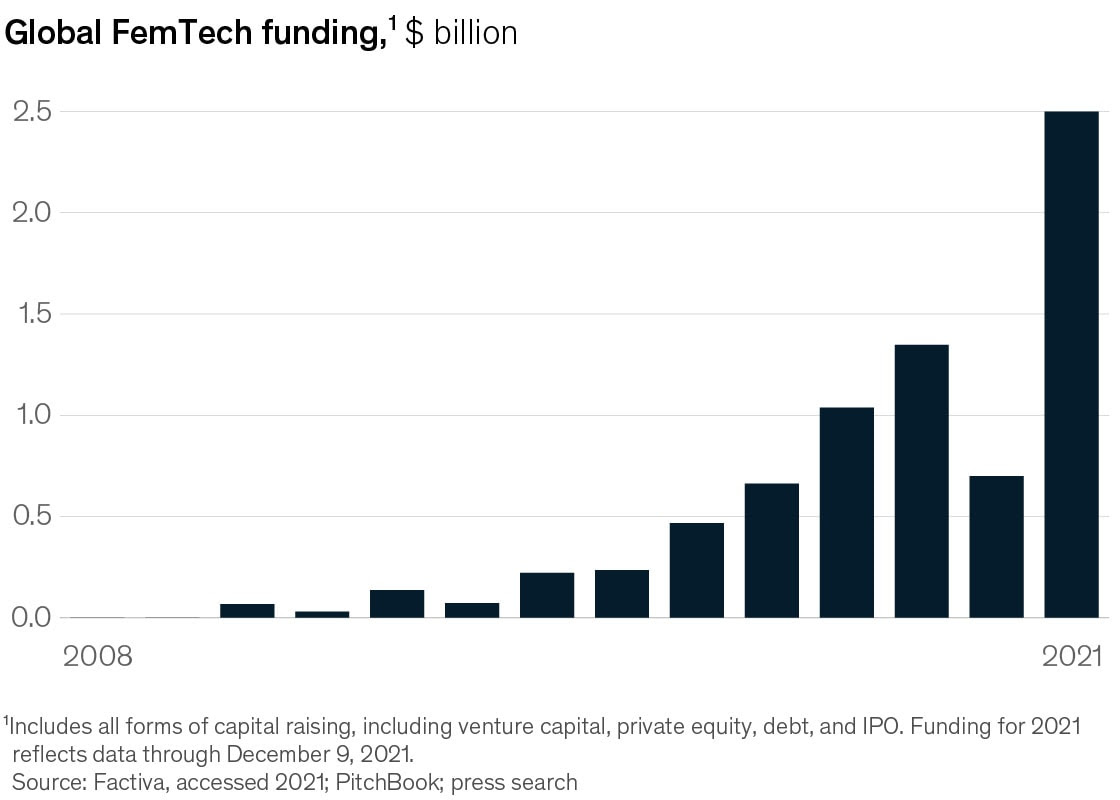
More than $2.5 billion—that’s how much funding the world’s FemTech companies received last year (including all forms of capital raising). What do we mean by “FemTech”? Coined in 2016 by Danish entrepreneur Ida Tin, the term has grown to encompass a range of tech-enabled, consumer-centric products and solutions. These span menstrual health, pelvic and sexual health, contraception, fertility, maternal health, and menopause, as well as a number of health conditions that affect women disproportionately or differently, such as osteoporosis or cardiovascular disease.
FemTech funding is surging, but this is just the beginning. McKinsey analysis shows that there are plenty of white spaces in the start-up landscape, particularly in areas beyond fertility and maternal health. Some companies have already branched out: Maven Clinic, for example, started in maternity care and then expanded across the reproductive life cycle. The company was recently valued at more than $1 billion.
“Is there really still an unmet need in this area?” Although that attitude may be surprising, that’s the kind of question that some FemTech entrepreneurs continue to face, explains McKinsey senior partner Dr. Lucy Pérez.
McKinsey research shows that the market is there—and some investors are taking notice.
Less than 2 percent—that’s the share of the global healthcare pipeline that’s focused on conditions beyond oncology that are largely specific to women. Remarkably, women’s health has been considered a niche market and a mere subset of healthcare—but that’s finally beginning to change.