



Stakeholders in the Nigerian automobile sector claim that the country can build 1.15 million vehicles annually, opening up a plethora of job opportunities and considerably increasing GDP.
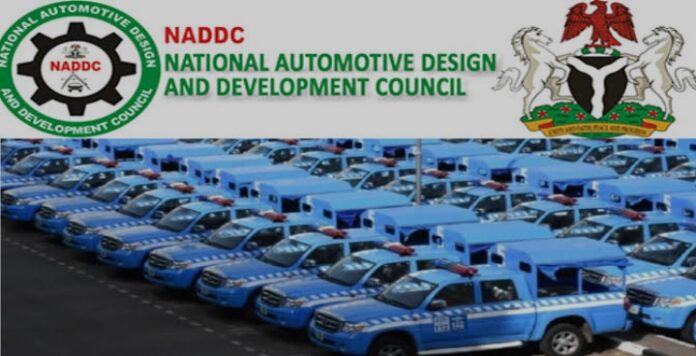
At a recent summit hosted by the National Automotive Design and Development Council (NADDC) and the Nigeria Auto Journalists Association (NAJA), they made this claim.
Board member of the Nigeria Automobile Manufacturers Association (NAMA), Benedeth Ejindu, discussed how the global automotive industry plays a catalytic role in driving economic growth in his paper presentation on “Developing Nigeria’s Economy Through the Auto Industry.” This is demonstrated by the sector’s significant contributions to employment generation and economic development in other countries.
According to Ejindu, “For instance, in the United States, the automotive industry employs over 1.7 million people directly, with a single job in the industry creating 10 more. In India, the industry employs 19 million people directly and indirectly, while in South Africa, it employs 110,000 people directly.”
He claimed that Nigeria is only at the beginning of the automotive value chain, pointing out that, “It’s like only getting the ‘froth’ of the industry while the rest of the world enjoys the full glass. Our role is limited to the dealership and ownership aspects, just the surface level of the industry. It’s like settling for just the foam on a glass of beverage, missing out on the full, rich experience of the drink itself, which represents the heart of the industry—the factories, the manufacturing, the true essence of auto production.”
Declaring that Nigeria presents a special blend of potential and resources, making it a haven for automakers, he said, “We can produce 1.15 million vehicles annually. The necessary resources are readily available, including abundant leather, textiles, and rubber.
“There are iron, steel, aluminium, plastic, elastomers, and more. Additionally, we have the necessary materials for electric vehicle production, including cobalt, lithium, manganese, bauxite, and graphite. These resources are readily available in Nigeria, making us an ideal location for automotive production,” he added.
He advised the government to support the industry through legislation, infrastructure development, and incentives to fully realise the potential of Nigeria’s automotive sector. He also mentioned that the industry needed to be in line with international best practices and that Nigeria needed to outlaw used cars to foster the growth of local manufacturing.
Also read: https://brandspurng.com/2024/07/05/nlc-revolts-over-increment-for-band-a-customers/
Continuing, he advised on how local manufacturing businesses in Nigeria, like as Innoson, Anamco, Pan, and all the other players, might use common infrastructure, just as in China, to avoid having to travel to build their press or machine.
He revealed, “Most of the cars, like pickup trucks and Hiace, have the same mode of body. The OEM or the vehicle maker will now maybe design their own and sell their engines or the components that they want and put in them. But the fact that the factory produces the body shell is just one of them.”
According to Dr. Doris Uzoka-Anite, Minister of Industry, Trade, and Investment, Nigeria’s automotive sector has the potential to be the backbone of the country’s economic recovery and offers a host of advantages, including the transfer of technology and the creation of jobs.
Uzoka-Anite emphasised the government’s acknowledgment of the automotive sector as a crucial pillar for economic development and recovery. She was accompanied by Olumuyiwa Ajayi-Ade, deputy director of the Industrial Development Department.
With the national brand news following in her closing remarks, Uzoka-Anite emphasised the labor-intensive nature of the automotive sector and its potential to generate thousands of jobs throughout the value chain, greatly lowering unemployment and offering sustainable livelihoods. She also emphasised the significance of teamwork in realising the sector’s full potential.
The local brand news holds that if the crucial action is not taken to revitalise Nigeria’s auto sector, it will eventually collapse, as previously cautioned by Joseph Osanipin, Director-General of the National Automotive Design and Development Council (NADDC).
He used Morocco as an example, which declared in its 2013 National Automotive Sector Development Plan (NAIDP) that Nigeria had effectively expanded its auto sector from 23,000 units exported in 2013 to 460,000 units at present.
Nigeria, on the other hand, has not improved; rather than exporting automobiles, it has continued to import them, regressing from Semi Knocked Down (SKD) to Dismembered Knocked Down (DKD).
To boost Nigeria’s economy through the auto industry, he urged stakeholders to collaborate and emphasised that the industry cannot afford to remain still as technology progresses.
