




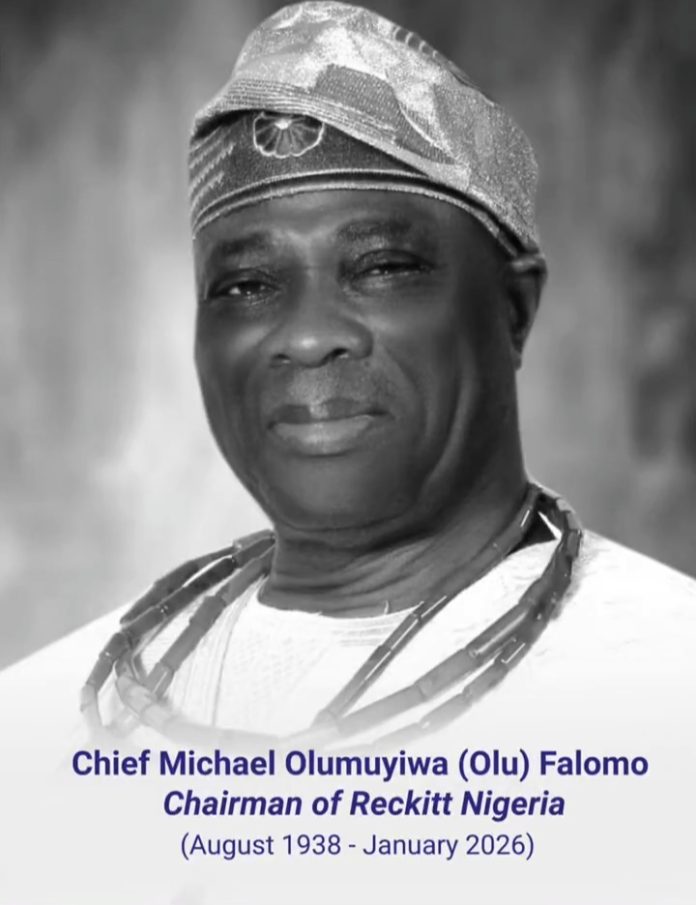
Nigeria’s advertising and marketing communications industry has lost one of its most influential pioneers following the death of Chief Michael Olumuyiwa Falomo, a revered industry leader, regulator and corporate statesman, who passed away at the age of 87.
Chief Falomo’s death marks the end of an era defined by institution-building, ethical leadership and quiet excellence. With a career spanning more than six decades, he played a defining role in shaping modern advertising practice in Nigeria, influencing regulation, agency development, multinational brand governance and professional mentorship.
Born on August 13, 1938, in Ilesa, Osun State, Falomo did not set out to build a career in advertising. His early ambition was in broadcasting and telecommunications, fields he pursued after attending St. John’s Anglican School, Iloro, and Government College, Ibadan. He began his professional journey at the radio broadcasting corporation before joining Western Nigeria Television, Nigeria’s first television station.
A pivotal internal redeployment into WNTV’s commercial services unit would redirect his career permanently, exposing him to advertising production and client service at a formative stage of Nigeria’s media industry. That transition laid the foundation for a professional rise that would later place him among the most respected names in African advertising.
By the early 1960s, Falomo had moved fully into private sector advertising, joining West Africa Public typing Limited, later known as Lintas. His steady ascent through senior management roles reflected a blend of technical discipline, client-centred strategy and strong leadership instincts.
Brandspur Brand News reports that Falomo’s executive career included senior positions at Lintas, Ogilvy and Benson & Mather Nigeria, before he established Forum Advertising Nigeria Limited in 1986. As founder, Managing Director and Chief Executive Officer, he built Forum Advertising into a competitive indigenous agency at a time when multinational dominance defined the sector.
Beyond agency leadership, Falomo’s most enduring national contribution came through regulation. In December 1999, he was appointed Chairman of the Advertising Practitioners Council of Nigeria, APCON, now the Advertising Regulatory Council of Nigeria. His tenure coincided with a critical post-military period that required institutional clarity, ethical enforcement and industry consolidation.
Under his leadership, APCON expanded its regulatory scope, strengthened professional standards and formally integrated media independent practitioners into Nigeria’s advertising governance framework, a move widely regarded as forward-looking and transformative for the marketing communications value chain.
His influence extended internationally through service on the World Board of Directors of the International Advertising Association, where he represented Nigerian and African industry interests in global policy and professional discussions.
Outside advertising, Falomo was a respected corporate chairman, most notably at Reckitt Benckiser Nigeria, where he oversaw governance for one of the country’s leading consumer goods companies. His board leadership supported brand growth, regulatory compliance and long-term business resilience in a challenging operating environment.
Equally significant was his lifelong commitment to humanitarian service. He devoted decades to the Nigerian Society for the Blind, served on the boards of elderly welfare and cancer care organisations, and was deeply involved in church and community development initiatives in Lagos and Osun State.
Despite national and international acclaim, Falomo remained closely connected to his Ijesa roots, holding multiple chieftaincy titles and leading cultural development efforts, including the revitalisation of the Iwude Ijesa festival.
Industry colleagues, protégés and civic leaders have described him as principled, self-effacing and deeply committed to service. His leadership style was marked by calm authority, inclusiveness and an unwavering belief in professionalism.
Chief Olu Falomo is survived by his children and grandchildren. His wife, Mrs. Hilda Titilola Falomo, predeceased him.
As Nigeria’s advertising industry reflects on his passing, his legacy endures through the institutions he strengthened, the professionals he mentored and the standards he upheld.
