




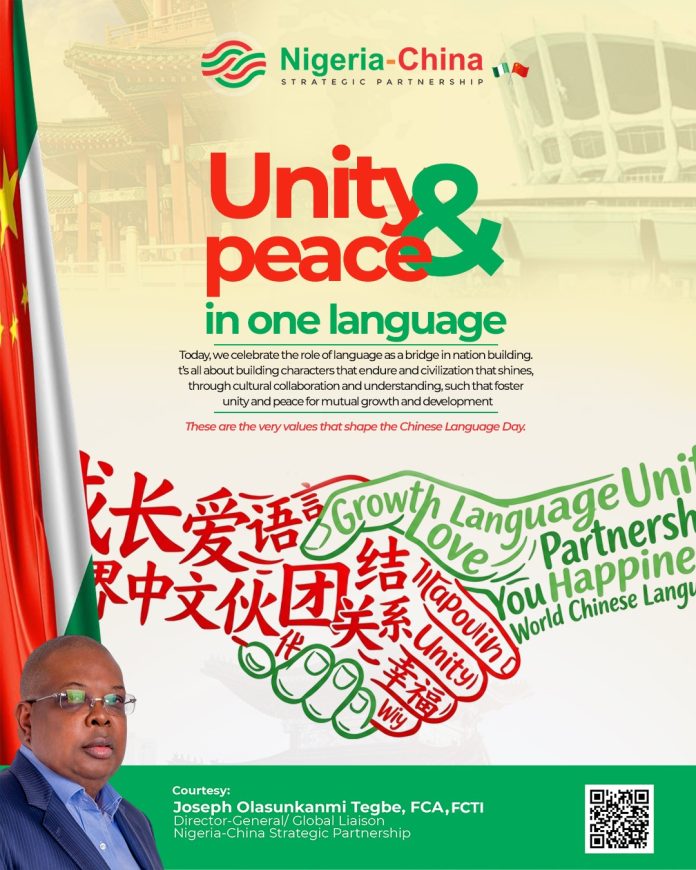
As the global community marks Chinese Language Day 2026, the
Nigeria–China Strategic Partnership (NCSP) has underscored the role of
language as a strategic enabler of economic growth, cross-border
collaboration, and sustainable development.
Established by the United Nations in 2010 to promote multilingualism and
cultural diversity, this year’s observance is themed “Characters
Endure, Civilization Shines,” highlighting the enduring influence of
language on identity, heritage preservation, and economic diplomacy in
an increasingly interconnected world.
In a statement commemorating the Day, the Director-General of NCSP,
Joseph Olasunkanmi Tegbe, described the Chinese language as a reflection
of the discipline, structure, and long-term thinking underpinning one of
the most significant economic transformations in modern history.
“Chinese characters are more than symbols; they embody history,
discipline, and philosophy. These same principles—clarity of purpose,
consistency, and long-term vision—have underpinned China’s rise and
remain highly relevant to Nigeria’s development journey,” he said.
Tegbe noted that as Nigeria deepens bilateral engagement with China,
language and cultural literacy are becoming critical enablers of
effective collaboration, particularly across trade, technology transfer,
and industrialisation value chains.
He further highlighted that China’s development trajectory offers
practical insights for Nigerian enterprises, including the importance of
mastering core competencies, replicating scalable models, and driving
incremental innovation within efficient, structured ecosystems.
“There is a direct link between how people communicate and how they
build. The precision and depth of the Chinese language are reflected in
institutional development and industrial scaling. For Nigeria, embracing
structured learning—including language—is not optional; it is
strategic,” Tegbe added.
Reaffirming its mandate, the NCSP stated that its interventions extend
beyond facilitating bilateral agreements to advancing knowledge exchange
that delivers measurable economic value. Through targeted initiatives
supporting SMEs and improving access to Chinese markets—including
emerging zero-tariff trade frameworks—the Partnership continues to
position Nigerian businesses for global competitiveness.
Tegbe also urged Nigerian entrepreneurs to adopt long-term,
systems-driven growth models, drawing from China’s emphasis on
reinvestment, cost discipline, and industrial clustering.
“Language is the entry point, but understanding is the advantage. As
we strengthen Nigeria–China relations, we must equip our
people—especially young entrepreneurs—with the tools to engage,
compete, and collaborate effectively on a global scale,” he said.
Chinese Language Day 2026 reinforces the intrinsic link between language
and civilisation. For Nigeria, it presents a strategic opportunity to
leverage cultural literacy as a pathway to economic inclusion and
enhanced global relevance.
The NCSP reaffirmed its commitment to advancing a structured,
results-driven partnership between Nigeria and China, anchored on mutual
respect, shared growth, and long-term value creation.
