




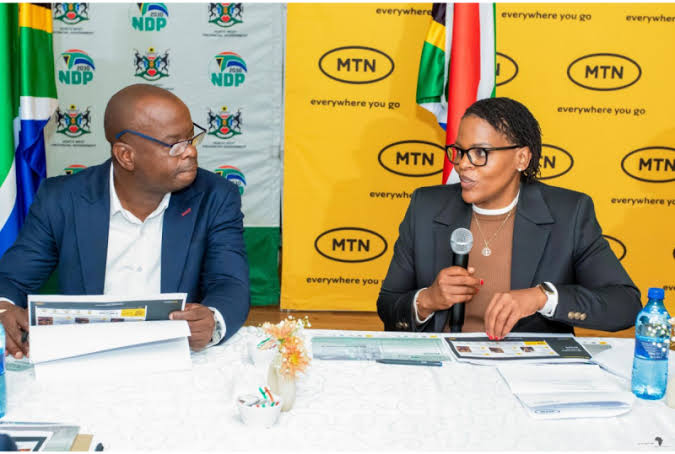
MTN South Africa is committing R150 million ($9.1 million) to expand and modernise its telecommunications infrastructure across the North West province during 2026, signalling a strategic pivot toward secondary cities and rural areas where demand for high-speed mobile broadband continues to accelerate. The investment will upgrade more than 1,000 network sites and extend both 4G and 5G coverage to towns including Mahikeng, Klerksdorp and Taung.
The network upgrade initiative underscores a fundamental shift in South Africa’s telecom competitive landscape, with major operators increasingly directing capital expenditure toward regions beyond the traditional economic hubs of Johannesburg, Cape Town and Durban. The strategy reflects growing recognition that the next phase of connectivity growth lies in underserved areas where mobile broadband penetration remains uneven despite rising demand.
Deputy Chief Executive Officer Yolanda Cuba disclosed the investment plans, positioning the network expansion as part of MTN’s broader commitment to bridging the digital divide while capturing growth opportunities in provinces that have historically received less infrastructure investment. The company’s focus on the North West aligns with its strategy of strengthening network quality in regions where customer demand for data-intensive services is rising.
Brandspur Brand News reports that the deployment of new towers and the upgrade of existing sites will enhance network capacity and reliability, addressing longstanding concerns about service quality in secondary urban centres and rural communities. The investment comes as South African consumers increasingly rely on mobile connectivity for work, education, entertainment and financial services.
MTN’s strategic shift mirrors trends across African telecommunications markets, where operators are discovering that saturation in major cities makes rural and peri-urban expansion essential for sustained growth. The North West investment represents a calculated bet on provinces where population growth, economic activity and digital adoption are creating new connectivity demands.
The network modernisation programme will involve significant infrastructure deployment, including the installation of new tower sites and the upgrading of existing equipment to support higher-speed mobile broadband services. The expansion of 5G coverage in towns like Mahikeng, Klerksdorp and Taung represents a notable step toward democratising access to next-generation connectivity.
South Africa’s telecom market has witnessed intense competition among major operators, with network quality emerging as a key differentiator in customer acquisition and retention. MTN’s focus on infrastructure improvement in the North West aims to strengthen its competitive position in a region where network experience can significantly influence subscriber choice.
The investment also carries economic development implications for the North West province, where improved telecommunications infrastructure can support business growth, enhance access to government services and enable greater participation in the digital economy. Small and medium-sized enterprises in the region stand to benefit from more reliable connectivity for their operations.
Industry analysts note that the telecom sector’s pivot toward secondary cities reflects changing consumption patterns, with data usage growing at faster rates outside major metropolitan areas. The shift in capital allocation recognises that connectivity needs are becoming more evenly distributed across geographic regions, requiring operators to expand their infrastructure footprints accordingly.
MTN’s R150 million commitment represents one of several infrastructure investments announced by South African telecom operators as they position for the next wave of connectivity growth. The company’s focus on both network upgrades and coverage expansion demonstrates a comprehensive approach to improving service delivery in targeted regions.
