



China is tightening controls over professional content published online, with platforms required to verify the credentials of people producing specialist medical and health information.
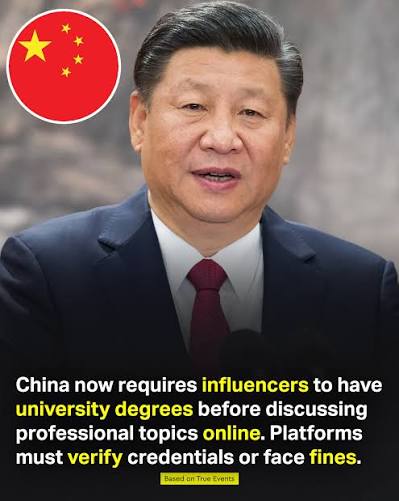
The development has fuelled renewed attention to claims that Chinese authorities now require online creators discussing medicine, finance, law and education to prove their professional qualifications. However, available official records show that the requirement is not a newly introduced blanket law covering all social-media influencers.
The Brandspur News Desk found that China’s regulatory framework has particularly focused on medical and health-related content. Under rules introduced in 2022, online presenters producing livestream content requiring a high level of professional expertise, including healthcare, finance, law and education, are required to obtain relevant professional qualifications and submit evidence to platforms for verification.
More recent measures have placed additional emphasis on medical science content. Chinese authorities have directed online platforms to strengthen verification of credentials for accounts producing medical information and to distinguish between different categories of medical professionals.
Platforms are expected to verify documents such as doctors’ licences, nursing certificates and other relevant professional qualifications. Information about an account holder’s professional background and status is also expected to be displayed clearly on qualifying accounts.
The measures prohibit unqualified accounts from producing professional medical science content. Platforms can also restrict interaction and monetisation or suspend and close accounts where creators repeatedly violate the rules.
The regulations also address misleading health information and disguised advertising. Creators are expected to identify the sources of medical information and properly label AI-generated or synthetic material, while commercial advertising must not be presented as independent health education.
For Nigerians who increasingly turn to social media for health, investment and legal information, the development highlights a wider issue: having a large online audience is not the same as having recognised professional expertise. Advice delivered through a short video can reach thousands of people within minutes, but popularity alone does not establish professional competence.
Importantly, the widely circulated claim that China has introduced a new rule imposing fines of up to $15,000 on anyone without a degree who discusses medicine, law, finance or education online is not supported by the regulatory framework described above. The available evidence does not establish the existence of a new blanket law imposing that requirement across all such online discussions.
What is clearly documented is a continuing tightening of platform responsibility and professional verification, particularly for medical information. The policy direction gives online platforms a greater role in determining who is qualified to provide specialist information and in taking action against accounts that breach the rules.
