




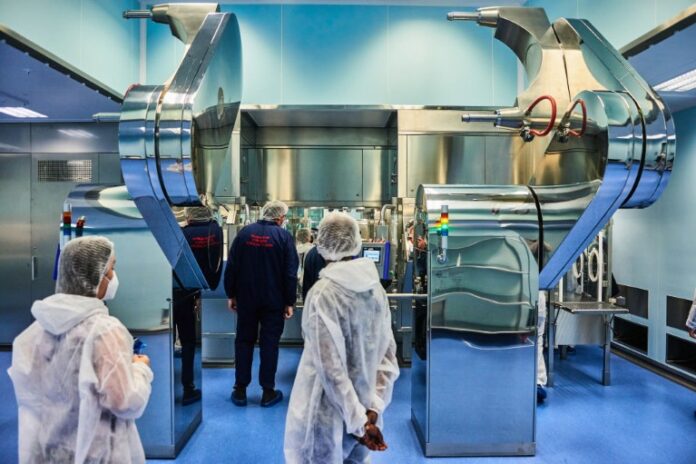
South Africa’s new pharmaceutical innovation facility has renewed discussions about Africa’s capacity to develop and manufacture essential medicines locally, with industry experts calling for similar shared infrastructure across Nigeria and other African markets.
The facility, known as FuturePHARMA, was officially launched by President Cyril Ramaphosa on October 7, 2026, at the Council for Scientific and Industrial Research (CSIR) campus in Pretoria. Unlike conventional pharmaceutical factories, it is designed to provide researchers, startups and pharmaceutical companies with access to specialised equipment and technical expertise needed to develop and scale up medicines.
Brandspur Brand News reports that the facility is intended to address a major obstacle facing pharmaceutical innovators: the difficulty of moving promising discoveries from laboratory research to commercial production because of the high cost of establishing specialised manufacturing infrastructure.
FuturePHARMA operates as an open-access platform, allowing universities, emerging businesses and established industry players to use its facilities to advance pharmaceutical technologies towards manufacturing.
Its capabilities include the development and production of active pharmaceutical ingredients (APIs), the substances responsible for the therapeutic effects of medicines.
The distinction is significant for African countries seeking to reduce their dependence on imported pharmaceutical products. Developing a medicine involves more than discovering a promising compound. Researchers must also establish production processes, conduct technical assessments, meet quality requirements and demonstrate that their products can be manufactured consistently.
These stages often require expensive equipment and specialised expertise that smaller companies cannot independently afford.
The development has attracted attention from African healthcare and pharmaceutical industry professionals, particularly over whether the model could be replicated across other regions of the continent.
In a LinkedIn post, Samuel Adeoye, a digital health and commercial strategy professional working across nine African markets, argued that African countries need to invest in the infrastructure that connects pharmaceutical research with actual production, rather than concentrating exclusively on building conventional factories.
He identified API production, process development and regulatory science as important capabilities required to turn local pharmaceutical discoveries into medicines that can reach patients.
Adeoye said Nigeria, Ghana, Kenya and other countries pursuing domestic pharmaceutical manufacturing needed facilities that would allow innovators to develop products without first bearing the enormous cost of establishing their own infrastructure.
He also questioned whether South Africa’s investment could inspire similar regional facilities serving West Africa, East Africa and Francophone Africa.
However, he noted that replicating the facility would require more than constructing buildings and installing pharmaceutical equipment. The infrastructure must be designed to serve markets beyond the countries where it is located.
The discussion also highlighted the importance of connecting pharmaceutical facilities across national borders.
Vetja Haakuria, a vaccines and biologics ecosystem consultant, pointed to Namibia as an example of the challenges facing smaller African markets. With a population of approximately three million, the country may struggle to justify major pharmaceutical infrastructure investments based solely on domestic commercial demand.
Haakuria argued that regional regulatory policies capable of creating demand across multiple countries would be necessary to make such investments economically sustainable.
She suggested that shared facilities could specialise in different pharmaceutical technologies and therapeutic products, allowing countries to benefit from capabilities that might be too expensive to establish independently.
Other industry participants also identified existing private-sector initiatives in South Africa, including One Bio and UVU Bio, as part of the country’s pharmaceutical development ecosystem.
Adeoye welcomed the examples but distinguished between privately operated facilities and government-backed infrastructure designed to provide access to companies that might not yet have the financial resources to secure private manufacturing services.
He argued that both models could complement each other in building a stronger pharmaceutical industry.
The debate also extends beyond infrastructure to the commercial arrangements needed to make regional manufacturing viable. These include harmonised regulatory requirements, cross-border procurement agreements and financing structures that enable manufacturers to sell their products in several African countries.
See Also: South Africa Launches National Registry To Block Spam Calls, Tightens Marketing Rules
For Nigeria, where pharmaceutical companies and healthcare providers depend on reliable access to medicines and their underlying ingredients, the development raises questions about how local research can be translated into affordable, commercially available products.
FuturePHARMA forms part of South Africa’s wider effort to strengthen its pharmaceutical value chain and improve domestic production capabilities.
The CSIR facility is expected to support research, technology transfer, skills development and the advancement of pharmaceutical innovations towards commercial manufacturing.
The wider challenge for African countries will be establishing the regional partnerships and market arrangements needed to ensure that such investments benefit patients beyond their immediate national borders.