




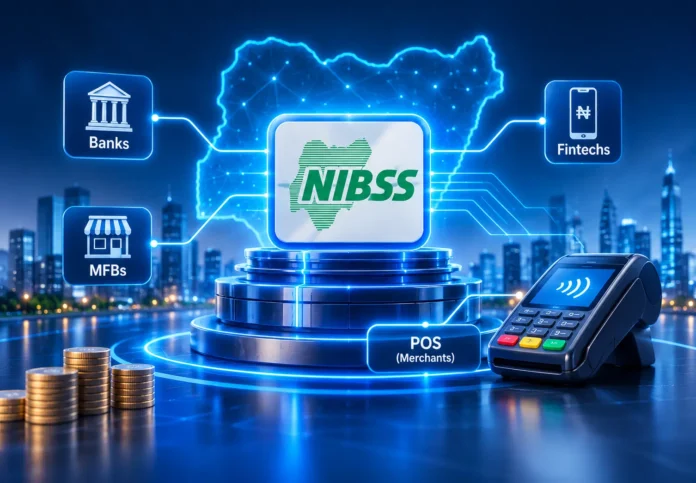
The Nigeria Inter-Bank Settlement System (NIBSS) has adopted open-source payment technology to develop the National Payment Stack (NPS), a platform designed to support instant transfers, merchant payments and other transactions across Nigeria’s financial ecosystem.

The technology, developed by Transactility, combines its jPOS open-source framework with the jPTS transaction switch. The arrangement gives NIBSS access to an established payment processing system while allowing it to customise the infrastructure to meet the demands of Nigeria’s financial market.
Brandspur Banking News Desk understands that the development reflects NIBSS’s approach to building national payment infrastructure without having to develop every component from scratch or surrender control of the system to an external technology provider.
The NPS was completed in 2025, while its first live test transaction was conducted in November that year by PalmPay and Wema Bank. Transactility announced its role in the project on October 13, 2026, providing further details about the technology supporting the platform.
The payment stack supports instant account-to-account transfers, QR code merchant payments, phone number-based payment addressing and bulk payments. It also uses the ISO 20022 messaging standard, which enables payment transactions to carry more structured information.
The choice of technology is significant for a country where millions of individuals and businesses depend on electronic payments for everyday transactions. Banks, fintech companies and other financial service providers rely on shared infrastructure to process payments between accounts.
NIBSS has used jPOS for years, particularly for payment transactions based on the older ISO 8583 messaging standard. The National Payment Stack extends that relationship by incorporating ISO 20022 capabilities.
According to Transactility, jPOS is a flexible framework that allows developers to construct different types of electronic payment systems. Its modular design provides building blocks that can be adapted to specific requirements.
NIBSS Managing Director and Chief Executive Officer, Premier Oiwoh, said the platform was developed to meet the scale and demands of Nigeria’s payments market, with the technology allowing it to evolve alongside the financial ecosystem.
See Also: NIBSS Deploys New Payment Platform To Expand Nigeria’s Digital Transactions
Fintech and payments business leader Israel Oladipupo said adopting established technology could be more practical than developing an entirely new payment infrastructure, particularly when the system must support a large and interconnected financial market.
He added that open-source technology could give NIBSS greater control over its infrastructure while enabling it to adapt the platform to local payment requirements.
The arrangement also allows NIBSS to retain access to the underlying source code and develop additional capabilities around the framework. This could reduce its dependence on a proprietary vendor’s product development schedule when responding to changing market or regulatory demands.
However, open-source software does not necessarily mean that the entire system is free. While developers can inspect and modify the jPOS framework, Transactility also offers commercial products and services, including jPTS.
Transactility declined to disclose the financial terms of its partnership with NIBSS, with its chief executive, Constantino Voulgaris, saying the company does not typically publish customer-specific information.
Voulgaris said NIBSS could independently handle most of the platform’s development and operational requirements, estimating that it could manage about 99 per cent of its needs without escalating them to Transactility.
He added that the company remained available to provide technical support when required, although most engagements involved discussions about features NIBSS wanted to develop rather than routine technical problems.
The system’s ability to scale will also be important as Nigeria’s digital payments market expands. According to Voulgaris, jPOS can accommodate increased transaction demand by upgrading individual systems or distributing computing resources across multiple systems.
Oladipupo said Nigeria had capable engineers and technology companies that could develop sophisticated financial infrastructure, but argued that technical competence, security, reliability and relevant experience should take priority when selecting a technology partner.
He also called for greater investment in local technical capacity, even where international technology is adopted.
The National Payment Stack’s long-term performance will depend on more than its underlying software. Capacity planning, system redundancy, disaster recovery and the management of peak transaction volumes will be critical to ensuring that payments remain reliable.
For Nigerian consumers and businesses, the practical measure of success will be whether the infrastructure can support fast, dependable transactions as more financial services rely on it.
