Jollof Rice Index: Cost of Preparing Jollof Rice Rises By 6.93% in Q2 2021

In March 2021, the average cost of making a pot of Jollof rice for the average Nigerian family stood at N7,124 but has increased up to N7,618 in June 2021, marking a 6.93% increase within a period of three months.

This was disclosed in the quarterly SBM Jollof index report for Q2 2021 titled “Jollof Index Q2 2021: Food Prices Enter Geostationary Orbit”, published by SBM Intelligence.

The Jollof rice index covers major food items used in making a pot of jollof rice such as rice, curry, thyme, seasoning cube, groundnut/vegetable oil, turkey/chicken, beef, other seasonings, pepper, tomatoes, salt and onions.

The increased food prices coupled with a high unemployment rate speaks of the growing misery index of Nigerians and the declining ability to purchase food. The contributing factors are enormous as emphasised in our previous reports; a combination of government and market failures.

Nigeria-Jollof-rice jollof rice index

Restating the key drivers, insecurity, adverse weather conditions, lack of storage facilities, increased energy tariffs, land border closure policy and the Coronavirus Pandemic made critical impacts.

This begs the question, how do 40.1% of Nigerians who were already below the poverty line before the Pandemic purchase food considering the exacerbating effect of the Coronavirus?

SBM advised the federal government to reverse unnecessary fixation on domestic food production, and rather prioritise the availability of cheap food, both locally produced and imported, and providing the support everyone needs to produce or bring in food.

It asked the federal government to remove the politicising of security and deal with it across Nigeria, especially in food-producing areas of the country.

SBM further said the federal government needs to look urgently into the storage and infrastructure around food preservation and transportation in the country.

SBM warned that the prevalence of stunting in children under five increased to a 36.8 score from 36.2 in 2012 and the proportion of the undernourished in the population grew from 7.6 in 2012 to 12.6 in 2020. However, the prevalence of wasting in children under five (14.1 in 2012 to 6.8 in 2020) and the under-five mortality rate (13.0 in 2012 and12.0 in 2020) have both dropped.

In the 2020 Global Hunger Index (GHI), Nigeria ranks 98th out of the 107 countries, getting a GHI score of 29.2 out of a 100-point scale. This places Nigeria at a hunger level that is considered serious. However, when compared with data from 2012, when the country had a GHI score of 32, which is an 8.75% decrease.

Mouka Launches New Campaign With Bedroom Makeover Worth N1 Million

0

Mouka, Nigeria’s leading brand of mattresses and pillows has launched a new campaign to encourage consumers to buy the right Mouka mattress based on their unique needs.

The “Get the Mouka for You” campaign seeks to educate consumers about the need to consider their age, body builds, lifestyle and budget before choosing the right Mouka mattress. The campaign also features the leading associations in the bedding industry, the Nigeria Society of Physiotherapy (NSP) and the National Association of Orthopaedic and Manual Therapists (NAOMT).

According to these experts, sleeping on the right mattress is paramount for proper body alignment, support and relief from pressure points. These are all needed for quality sleep to enable the individual to wake up refreshed the following day.

Mouka Launches New Campaign With Bedroom Makeover Worth N1 Million

To further entrench this “buy right” behaviour, Mouka has rolled out a competition in which one lucky consumer gets to win a bedroom makeover worth up to N1 million.

To participate, consumers visit the Mouka website to fill an online questionnaire that tells them the right Mouka mattress for them. Afterwards, they take a screenshot and post it on social media using the hashtag #IFoundMyMouka. They also need to tag @MoukaLimited and challenge two friends to find their Mouka as well. The terms and conditions for this competition can be found on @MoukaLimited’s Instagram and Facebook platforms.

Mouka’s impressive portfolio includes the Dreamtime mattresses specially designed for children, Royal Luxury Pillow Top mattress, Wellbeing orthopaedic range for adults and the elderly, and a wide range of pillows.

COVID-19 deaths in Africa surge more than 40% over previous week – WHO

0

15 July 2021 – Africa has recorded a 43% week-on-week rise in COVID-19 deaths, as hospital admissions increase rapidly and countries face shortages in oxygen and intensive care beds.

Fatalities increased to 6273 in the week ending on 11 July 2021 from 4384 deaths in the previous week. Africa is now less than 1% shy of the weekly peak reached in January when 6294 deaths were recorded. Namibia, South Africa, Tunisia, Uganda and Zambia accounted for 83% of the new deaths recorded in the past week. The continent’s case fatality rate, which is the proportion of deaths among confirmed cases, currently stands at 2.6% against the global average of 2.2%.

COVID-19 cases have risen for eight straight weeks, topping 6 million on 13 July 2021. Over the past month, Africa recorded an additional 1 million cases. This is the shortest time it’s taken so far to add 1 million cases. Comparatively, it took around three months to move from 4 million to 5 million cases. This COVID-19 surge is the fastest the continent has seen.

COVID-19 deaths COVID-19 cases surge

The surge is driven by public fatigue with key health measures and an increased spread of variants. To date, the Delta variant, which is currently the most transmissible of all variants, has been detected in 21 African countries, while the Alpha variant is in 35 countries and Beta in 30.

“Deaths have climbed steeply for the past five weeks. This is a clear warning sign that hospitals in the most impacted countries are reaching a breaking point,” said Dr Matshidiso Moeti, World Health Organization (WHO) Regional Director for Africa. “Under-resourced health systems in countries are facing dire shortages of the health workers, supplies, equipment and infrastructure needed to provide care to severely ill COVID-19 patients.

Hospital admissions in around 10 countries have increased rapidly and at least six countries are facing shortages of intensive care unit beds. Demand for medical oxygen has spiked and is now estimated to be 50% higher than at the same time in 2020, yet supply has not kept up. A rapid WHO assessment of six countries facing a resurgence found that just 27% of the medical oxygen needed is produced.

“The number one priority for African countries is boosting oxygen production to give critically ill patients a fighting chance,” Dr Moeti said. “Effective treatment is the last line of defence against COVID-19 and it must not crumble.”

Insufficient quantity, disrepair or poor maintenance of production plants as well as challenges in distribution, scarcity of cylinders, personnel or technical skills are among the barriers to adequate medical oxygen supply in Africa.

Nigeria Economy in 2021: Tough times, tough takes!

In a WHO survey to which 30 African countries responded, only 18 countries had included corticosteroids in their national treatment guidelines, as recommended by WHO. Nine countries are including medications that are not recommended in treating COVID-19, such as hydroxychloroquine and lopinavir.

WHO is working with countries to improve COVID-19 treatment and critical care capacities by providing guidance on clinical management and support to update protocols and train health workers. Along with partners, the organization is also delivering essential medical supplies, such as oxygen cylinders and has supported the manufacture and repair of oxygen production plants.

The rise in cases comes amid inadequate vaccine supplies. The continent has vaccinated 52 million people since the start of the vaccine rollout in March this year, accounting for just 1.6% of the 3.5 billion people vaccinated worldwide. Only 18 million people in Africa are fully vaccinated, representing 1.5% of the continent’s population compared with over 50% in some high-income countries.

“The double barrier of vaccine scarcity and treatment challenges is seriously undermining effective response to the surging pandemic,” said Dr Moeti. “However, with the expected fresh vaccine shipments and strong preventive measures, we can still turn the tide against the virus.”

Additional vaccines supplies expected in the coming weeks and months will help shore up the vaccination rates. Around 190 million extra COVID-19 vaccine doses will be needed to fully vaccinate 10% of Africa’s population by September 2021, with around 750 million more doses needed to fully vaccinate 30% by the end of 2021.

Dr Moeti spoke during a virtual press conference today facilitated by APO Group. She was joined by Hon. Dr Jean-Jacques Mbungani Mbanda, Minister of Public Health, Hygiene and Prevention, the Democratic Republic of the Congo, and Dr Ishmael Katjitae, Physician Specialist, Ministry of Health and Social Services, Namibia.

Also on hand to answer questions were Dr Richard Mihigo, Coordinator, Immunization and Vaccines Development Programme, WHO Regional Office for Africa; Dr Thierno Balde, Team Leader, Operational Partnerships, WHO Regional Office for Africa; and Dr Nicksy Gumede-Moeletsi, Regional Virologist, WHO Regional Office for Africa.

PMI Launches Free Online Course to ease Project Execution

0

15 July 2021 – Project Management Institute (PMI), the world’s leading association for project professionals and changemakers, recently announced the launch of KICKOFF, a new, free online course and tool kit to help introduce anyone doing project-based work to the best practices and tools needed to effectively manage projects from ideation to execution.

Much of the working world revolves around projects, which have become more complex than ever due to global Megatrends, including COVID-19, climate change, and more. The need for changemakers, regardless of industry or position level, to be well-versed in the principles of project management in order to help drive results, has never been greater.

PMI

KICKOFF is the ideal solution for those who are new to doing project-based work and would benefit from learning project management skills to help successfully navigate the process from idea to launch and execution. The course is packed with digestible content, downloadable templates, a glossary of key terms, and thoughtful questions to ask to help anyone kick off any project at any time.

According to PMI’s Pulse of the Profession® report, an estimated 11.4% of all investment into projects currently goes to waste due to poor project performance and an inability to nimbly adapt and execute in our rapidly changing world. Introducing changemakers to project management strategies and tools enables single learners and entire teams to have the framework in place to adapt quickly and efficiently to help reduce wasted time and investment.

KICKOFF is the free, go-to resource for those looking to quickly learn the basics of effective and strategic project management to complete projects on time and within budget.

“KICKOFF is an easily deployable resource to ensure all employees and team members have the foundational skills to seamlessly collaborate and work smarter,” said  George Asamani, the Business Development Lead for Africa at PMI. KICKOFF arms everyone from first-time project team members to C-Suite executives with the knowledge to kick start a project at any time to help drive results and deliver value.”

No two projects are the same, so KICKOFF uses a guided questionnaire to tailor the learning experience based on the best project management approach for the needs of the project. Learners have presented a series of short modules that can be completed in sequence or in any order. The modules include bite-sized content focused on the fundamentals, and templates to be downloaded or distributed for immediate use.

Accessible to anyone from their laptop, phone, or tablet, KICKOFF can be completed in just 45 minutes and is available in five languages: English, Chinese, Portuguese, Spanish, and French. Following completion of the KICKOFF course, learners will receive a badge to share on their professional social media profiles to show their peers and company that they have the foundational skills to successfully lead any project.

To sign up for the free KICKOFF digital course and tool kit, visit: PerfectKickoff.com.

Project Management Institute (PMI) is the world’s leading professional association for a growing global community of millions of project professionals and changemakers worldwide.

As the world’s leading authority on project management, PMI empowers people to make ideas a reality. Through global advocacy, networking, collaboration, research, and education. PMI prepares organisations and individuals at every stage of their career journey to work smarter so they can drive success in a world of change.

Building on a proud legacy dating to 1969, PMI is a “for-purpose” organisation working in nearly every country around the world to advance careers, strengthen organisational success, and enable changemakers with new skills and ways of working to maximise their impact. PMI offerings include globally recognised standards, certifications, online courses, thought leadership, tools, digital publications, and communities.

Visit us at https://www.pmi.org/www.projectmanagement.comhttps://www.linkedin.com/company/pminstitutewww.facebook.com/PMInstitute, and on Twitter.

Paxful Donates To Friends of Nigerian Basketball in Olympic Push

Donation will support the Nigeria men’s national basketball team in their Olympic run

15 July 2021: Paxful, the leading global peer-to-peer fintech platform, announced that it will be donating to the Friends of Nigerian Basketball Foundation (FONB), a non-profit corporation with a mission to amplify and support the global sport of basketball at all levels of engagement and competition. Additionally, Paxful’s Co-Founders Ray Youssef and Artur Schaback will give a personal donation to the FONB. 

The donation will directly support the D’Tigers, the Nigeria men’s national basketball team during their Olympic run in Tokyo, Japan later this month. Paxful will be donating on behalf of the Built With Bitcoin Foundation, a humanitarian organization devoted to creating equitable opportunity by providing clean water, access to quality education, sustainable farming, and humanitarian support—all powered by cryptocurrencies.

paxful nigerian basketball olympic

The Nigeria men’s national basketball team is led by Head Coach Mike Brown, associate head coach for the Golden State Warriors. The D’Tigers are currently ranked 1st in Africa and 22nd in the world by the FIBA World Ranking and they are showing great promise during the Las Vegas, Nevada exhibition games this week–beating both the men’s national teams for the United States and Argentina.

Nigeria will tip-off its Olympic schedule against Australia on July 25 (1:20 a.m. PDT) to open play in Group B of the preliminary round, followed by games against Germany (July 27, 6 p.m. PDT) and Italy (July 30, 9:40 p.m. PDT).

Ray Youssef, CEO and co-founder of Paxful, said:

“Paxful is incredibly proud to donate to the Friends of Nigerian Basketball Foundation. On the Olympic stage, the D’Tigers will bring pride and confidence to not only the people of Nigeria – but to all of Africa. It’s time for Nigeria to show the world their grit and determination.”

Artur Schaback, COO and co-founder of Paxful, said:

“All eyes will be on Tokyo this month, as athletes bring pride to countries around the world. The Nigeria men’s national basketball team already have exhibition wins under their belt – and they have the right coaches and players to bring home a medal. I am thrilled to support the team as they chase this dream.” 

Mike Brown, Head Coach of the Nigeria men’s national basketball team, said: “We’re going to Tokyo to try and win. This is the mentality of the entire organization and we’re excited to have support from companies like Paxful who truly believe in the people of Nigeria.”

Founded in 2015 and completely bootstrapped since then, Paxful is headquartered in New York with offices in Estonia, the Philippines and Russia. The team has doubled in size over the last 12 months, growing to over 400 people.

Paxful is a peer-to-peer finance platform for people to make payments, transactions, and send money by buying and selling cryptocurrencies as a means of exchange. Founded in 2015 by Ray Youssef and Artur Schaback, Paxful’s mission is to help everyone have equal access to finance no matter who or where they are. Six million people use Paxful to buy and sell Bitcoin (BTC), Ethereum (ETH) and Tether (USDT) with almost 400 different payment methods.

Ray Youssef, co-founder and CEO of Paxful, set up the Built with Bitcoin Foundation to provide people with access to education and water. To date, the foundation has built six schools (two in Rwanda, two in Kenya, and two in Nigeria), multiple water projects, and cultivated dozens of farms. The Built with Bitcoin Foundation is funded by Paxful and the cryptocurrency community.

The Friends of Nigerian Basketball Foundation (FONB) is a non-profit corporation. Donations provide training, travel, and organizational support to the FONB program. Our mission is to amplify and support the global sport of basketball at all levels of engagement and competition; while encouraging inclusion through positive international, national, community, and individual relationships with the nation of Nigeria and those who are connected to the Nigerian diaspora around the world.

Covid-19: CDC Group announces $50m trade finance facility with Ecobank

0

July 15, 2021 – Provides systemic liquidity and supports vital supply chains across Africa’s markets; Sustains and increases access to goods and services during the pandemic; Bolsters economic opportunities and inclusive growth, in markets such as Togo, Burkina Faso and Chad.

CDC Group, the UK’s Development Finance Institution and impact investor, has announced a US$50 million trade finance facility for Ecobank International (EBI SA), the Paris based member of the Ecobank Group.

This marks CDC’s first partnership with EBISA with the commitment aimed at providing systemic liquidity to underserved markets and crucial trade finance support to local banks and businesses across Africa.

The Covid-19 crisis has had a significant adverse effect on trade flows, business operations and jobs in Africa’s markets. This CDC facility will support the continent’s economic recovery and is expected to generate between US$70 – $140 million in additional trade annually. The investment will enhance the import of essential goods, commodities and capital equipment, while also helping to expand access to goods and services in general.

EBI SA, the international subsidiary of Togo-based Ecobank Group, is an ideal partner to boost CDC’s impact across Africa and help strengthen financial support for local banks and the businesses that they serve. With the Ecobank Group’s extensive footprint and operations across 33 countries on the continent, the facility will broaden economic opportunities and inclusive growth, particularly in markets such as Togo, Burkina Faso and Chad.

The trade finance risk-sharing facility will meet the liquidity needs of local African banks at a crucial time especially with the economic impact of the pandemic. By committing capital to address these shortfalls, CDC is taking on additional risk and providing further credit support and trade finance lines to local banks, thus protecting commerce across the continent.

The facility contributes to the UN Sustainable Development Goals Zero Hunger (SDG 2) and Decent Work and Economic Growth (SDG 8).

Admir Imami, Director, Head of Trade & Supply Chain Finance, CDC Group, said:

“Our partnership with Ecobank presents an opportunity for CDC to provide trade support where it is most needed. Keeping trade flowing across the continent is a key objective in CDC’s Covid-19 response, and we are thrilled that our patient capital can support businesses that are at the centre of economic activities in our markets.

We remain committed to playing our part in closing the trade finance gap in Africa, by helping to facilitate business and job growth, and building resilience for the long term.”

Akin Dada, Ecobank Group Executive Corporate and Investment Banking, said:

“Our partnership with CDC to enhance finance and capacity comes at a crucial time in Africa’s history with much-needed recovery from the challenges of Covid-19 and the immense trade and investment opportunities being created by the African Continental Free Trade Area.

We welcome the opportunity to work with development finance institutions such as CDC to help realise Africa’s potentials and sustainably drive its economic development.”

Jean Erwin NIZET, Ag. Managing Director at EBI SA, said:

“This partnership with CDC will allow EBI SA to provide further support for African trade. In this challenging Covid-19 environment, this represents an important step in increasing Ecobank’s trade capacity and better serve its clients in Africa. This will ensure that Ecobank continues to contribute to the creation of value and sustainable growth across the continent.”

Zenith Bank Named Best Commercial Bank In Nigeria

0

Zenith Bank Plc has been named the Best Commercial Bank in Nigeria in the World Finance Banking Awards 2021.

The award, which was announced in the July 2021 edition of the World Finance Magazine, was based on individual banks’ ability to adapt to a continually evolving technological environment while maintaining top-class customer relations and bolstering their financial footing amidst the upheaval of the COVID-19 pandemic.

Commenting on the award, the Group Managing Director/Chief Executive of Zenith Bank Plc, Mr. Ebenezer Onyeagwu said that: “This recognition reflects our resilience and ability to adapt to a very challenging macroeconomic environment exacerbated by the COVID-19 pandemic, as well as our commitment to creating value for our teeming customers through our best-in-class service and innovative products and solutions.”

He expressed his heartfelt gratitude to the bank’s customers for making Zenith Bank their preferred financial Institution which has culminated in this award.

World Finance is a leading international magazine providing comprehensive coverage and analysis of the financial industry, international business, and the global economy.

The editorial combines award-winning reportage, covering a broad range of topics from banking and insurance to wealth management and infrastructure investment, with contributions from some of the world’s most well-respected economists and theorists as well as consultants in government think tanks and the World Economic Forum.

This award comes in the wake of several awards and recognitions received by the bank in recent times for its track record of excellent performance and commitment to global best practices. Zenith Bank was voted as Bank of the Year (Nigeria) in The Banker’s Bank of the Year Awards 2020, Best Bank in Nigeria in the Global Finance World’s Best Banks Awards 2020 and 2021, and Best Corporate Governance ‘Financial Services’ Africa 2020 and 2021 by the Ethical Boardroom.

Also, the bank emerged as the Most Valuable Banking Brand in Nigeria in the Banker Magazine Top 500 Banking Brands 2020 and 2021, and Number One Bank in Nigeria by Tier-1 Capital in the “2021 Top 1000 World Banks” Ranking by The Banker Magazine.

The bank was also recognized as Bank of the Decade (People’s Choice) at the ThisDay Awards 2020, Retail Bank of the year at the 2020 BusinessDay Banks and Other Financial Institutions (BOFI) Awards, and Best Company in Promotion of Good Health and Well-Being as well as Best Company in Promotion of Gender Equality and Women Empowerment at the Sustainability, Enterprise and Responsibility (SERAS) Awards 2020.

Zenith Bank has continued to distinguish itself in the Nigerian financial services industry through superior service offerings, unique customer experience, and sound financial indices.

The bank has remained a clear leader in the digital space with several firsts in the deployment of innovative products, solutions, and an assortment of alternative channels that ensure convenience, speed and safety of transactions.


Mobile Computing Revenue To Grow Double Digits In 2021

…What’s to Come Post-COVID?

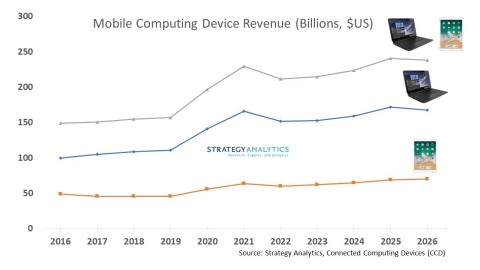
The mobile computing market is in the full recovery after several years of shipment and revenue declines as the COVID-19 pandemic has brought on a new level of short-term demand with long-term implications, according to a new report by Strategy Analytics.

Hybrid work environments will become more prevalent post-COVID than pre-COVID times as many employees report tangible benefits from remote work and are increasingly demanding more flexible work environments, which will keep demand relatively steady for mobile computing devices.

Exhibit 1. Mobile Computing Chart H1 2021 Device Revenue (Source: Strategy Analytics, Inc.)Exhibit 1. Mobile Computing Chart H1 2021 Device Revenue (Source: Strategy Analytics, Inc.).
The full report from Strategy Analytics’ Connected Computing Devices (CCD) service, Mobile Computing Shipments, Revenue, Installed Base and Penetration Forecast by Type by 88 Countries 2010-2026: H1 21 Update can be found here: https://www.strategyanalytics.com/access-services/devices/tablets-and-pcs/connected-computing-devices/market-data/report-detail/mobile-computing-shipments-revenue-installed-base-and-penetration-forecast-by-type-by-88-countries-2010-2026-h1-21-update

The pandemic is not over, and mobile computing device demand remains hot. Supply chain issues and wider vaccine distribution will tamp down supply and demand by the beginning of 2022, but the report forecasts household ownership to continue growing over the forecast period to reach 39% of total households globally and the Windows 11 / post-pandemic refresh cycle will push the market to new highs of $241 billion in revenue in 2025 from $197 billion in 2020.

Eric Smith, Director – Connected Computing said, “Smartphones have become larger and more essential to daily life, but we found out the hard way that real productivity still happens on Notebooks and Detachables. Commercial clients provide a steady level of demand for productivity devices and increasingly, mobile solutions are becoming preferable to stationary desktops while consumers build up multiple device ownership per household to keep everyone at home productive.”

Chirag Upadhyay, Industry Analyst added, “The newest wave of COVID-19 infections will continue to affect key markets and consumer behavior, resulting in sustained high demand, however there is risk that supply chain disruptions will emerge from time to time until the 2023 timeframe. Demand patterns will also re-adjust to the new reality that work-from-home (WFH), virtual learning options, and hybrid work schedules are more suitable than previously thought, boosting mobile computing device shipments to 458 million units in 2026.”

Exhibit 1: Windows 11 / Post-pandemic Refresh Cycle Will Push the Market to New Highs1

1 Mobile computing devices include slate tablets, detachable tablets, and large-screen foldable tablets as well as traditional notebooks, thin-and-light notebooks, convertible notebooks, and Chromebooks spanning all operating systems and connectivity options

Has The US Video Streaming Market Reached Saturation?

0

New US video subscribers dropped by 12.9% year on year, while Amazon Prime Video growth remained consistent… posing serious competition for Netflix.

The US Subscription Video on Demand (SVoD) market may have just entered a transformational period.

Entertainment on Demand, the solution measuring streaming service subscription levels, reveals the following subscriber behaviours in the US for the second quarter of 2021:

  • Amazon regains the top spot for new subscribers for the first time since Q3 2020.
  • Discovery+ leaps to the #2 spot in terms of new subscribers, in just its second full quarter of operation.
  • Netflix installed base falls to 2/3 of US subscribers, its lowest penetration yet, as viewers trade in for newer offers.
  • As restrictions continue to ease, there has been a drop in the number of US households taking out a new subscription in the last three months – down to 3.9% in Q2 2021 from 12.9% last Q2. This is the smallest growth in new subscribers we have recorded.
  • The proportion of US households who have a video subscription has remained consistent at 74.6%, meaning there are now 95.8 million households with subscriptions, as of June 2021.
  • In its second quarter, Discovery+ wins 1 in 10 new SVoD subscribers.
  • Disney+’s Wandavision celebrates being the top-rated title for the second quarter in a row, with Hulu’s The Handmaid’s Tale in #2 and Mare of Easttown on HBO Max in third place.

EoD US July 2021

Performance highlights across the major vendors include:

Amazon Prime Video’s growth remains strong

Whilst most services have suffered a reduction in new subscribers for Q2 2021, Amazon Prime Video has gained market penetration (up +3% YoY to 58%) and ranks first place for share of new subscribers. Looking at these new subscribers’ path to purchase, Amazon Prime Video is gaining through owned touchpoints such as offering a free trial and subscribers visiting Amazon.com. Amazon Prime Video is currently amongst the highest for free trials at 31%, beaten only by Apple TV+ at 37%. Both factors indicate that Prime Video is still benefitting from the increase in Amazon Prime subscriptions taken out during lockdown.

As well as gaining new subscribers, Prime Video’s average stacking of subscriptions has only increased from 2.6 to 2.8 YoY, compared to the market average of 3.1 to 3.8. This means there is less competition for viewership time and indicates that subscribers are getting what they need from fewer services. Examining the reasons for satisfaction, Amazon Prime Video scores higher than the total market for touchpoints such as ease of use (48% vs 44%), the amount of original content (44% vs 41%) and value for money (44% vs 41%).

As people return to bricks and mortar stores, it will be interesting to see whether Prime Video’s original content can carry them through and prevent subscribers from cancelling their Prime subscription.

Over the last year, despite new entrants to the market like HBO Max, Discovery+ and Peacock, Amazon’s acquisition has remained strong. This reflects the calibre of original content such as The Boys and The Marvellous Mrs Maisel.

Netflix experiencing competition from newcomers

Netflix has not fared well in garnering new subscribers this quarter. Netflix’s share of SVoD-enabled households is at its lowest, down to 67% from 74% in Q2 2020, and similarly their share of new SVoD subscribers hit 6% this quarter, down from 13% last year. A

lthough share of the market outranks the competition, the saturation of the US VoD market may be resulting in Netflix subscribers trading the service in for a newer model. Whereas Disney+, Hulu and HBO Max take the top spots for content this quarter, Netflix comes in fourth and fifth position with The Crown and Lucifer.

This is the first time they have missed out on a top-three spot for content enjoyed for at least the past 5 quarters.

Further indication that Netflix subscribers are picking up new services comes from the average number of VoD subscriptions. Netflix went from having the lowest stacked subscriptions of the main services at 2.5 last year to 3, meaning that Prime Video now has a lower average.

This is another indication of Amazon Prime Video managing to navigate the new landscape. In addition, the most common stacks for Netflix subscribers are Netflix, Amazon Prime Video and Hulu. Netflix should be cautious of this competition, as the cost of stacking can quickly add up and Netflix subscribers’ top planned cancellation reason is to save money (31%).

Earlier in the year, subscribers were concerned that Netflix was preparing a widescale crackdown on account sharing; however, the co-CEO Reed Hastings has reassured viewers that this isn’t the case.

Interestingly, Netflix has the highest proportion of subscribers who say that someone else pays (27.4%), compared to Disney+ (26.3%) and Hulu (23.1%) suggesting a lot of account sharing is taking place.

Perhaps this media attention has cast Netflix in a negative light in the eyes of some subscribers. This may explain why Netflix received its lowest NPS score over the last 5 quarters with a score of 37. Luckily, this has not equated to planned cancellations, which sit at a steady 6% for Q2 2021.

Stacked subscriptions continue to climb

With three quarters of US households now accessing VoD services, room to grow is slowing and we’re seeing less gateway subscribers entering the market. This is driving the competition as existing SVoD households shop around for the content they love.

Price-sensitive consumers in the US now have more options than ever to drive down subscription costs, with existing services splitting out their offerings into premium, ad-supported and free tiers. HBO Max, for example, is launching an ad-supported service as of this month. For those stacking multiple subscriptions, $9.99 for HBO’s ad-free version is more attractive to a subscriber already paying $30/40 a month for SVOD, than HBO Max’s $14.99 offer. If the content is there and the interface is good, consumers are still satisfied with ad-supported services.

Evaluating the first 6 months of Discovery+

The newest member of the SVoD family, Discovery+ has captured a tenth of all new subscribers and is rated first for satisfaction with the quality of the shows. In its first 6 months, Discovery+ is already delivering a great onboarding experience for new customers, which is rivalling Netflix.

The two services sit in top place when it comes to ease of setting up the service on a device (8.6 average score) and sign up is simple and intuitive (8.6). Furthermore, Discovery+ beats Netflix on subscribers being able to find the content they wanted to watch (8.5), although Disney+ performs strongest on this onboarding touchpoint (8.6).

As more subscribers will be coming to the end of their free trial in the following months, it’s important for Discovery+ to keep them engaged. Although only capturing 3% of the market penetration currently, if they can continue to boost their share of new subscribers and push out new content, Discovery+ could be a service to watch out for in the future.

Global sustainable debt issuance exceeded $680bn in H1 2021 – Report

Global sustainable debt issuance is on track to surpass $1 trillion in 2021 – up 30% from 2020’s totals. However, emerging markets still represent less than 15% of the sustainable debt universe, highlighting strong growth potential; China, Chile, Turkey, and Mexico are the top issuers.

Global sustainable debt issuance exceeded $680bn in H1 2021, more than twice the level of H1 2020–and is already close to the $700bn marks reached for the full year 2020. Yet another quarterly record in issuance activity ($350bn in Q2 2021) has brought cumulative sustainable debt issuance to some $2.6tn since the end-2015.

Chart 1: Exponential growth: sustainable debt issuance on track to surpass $1 trillion in 2021

sustainable debt issuance
Source: Bloomberg, BNEF, IIF

With Net-Zero commitments in the spotlight, an acceleration in low-carbon energy investment and technological innovation has been supporting ESG securities issuance, along with strong investor appetite: ESG bond funds attracted over $62bn in H1 2021, double the pace of 2020.

While most of this activity is still euro-denominated, global sustainable debt issuance is projected to top $1tn in 2021, which will bring the market size to well above $3tn. Mature market issuance continues to dominate: at present, emerging markets account for just 13% of the total market (see Table 1 for the size and breakdown by product and region).

The expansion of sustainable debt markets has been fastest in the U.S, Europe (especially France, Belgium, and Germany), and China. Within emerging markets, Chile, Turkey, and Mexico are the largest issuers after China, accounting for a quarter of total EM issuance in H1 2020.

Green bonds are now a $1+ trillion market:

The de- mand for green bond financing continues to rise exponentially—issuance hit $240bn in H1 2021. Over $115bn of green bonds was issued in Q2 2021, led by Germany, China, and France. The size of the green bond market has now sur- passed $1tn, with average daily secondary market trading reaching $2.7bn this year—up from $1.6bn in 2020.

While financial firms, utilities and sovereigns currently dominate green bonds issuance, the issuer base continues to broaden. Ex-financials, more firms from the energy, consumer discretionary, and materials sectors have been issuing green bonds in recent years (Chart 2).

Chart 2: Green bond issuer base continues to broaden

sustainable debt issuance
Source: Bloomberg, IIF

Despite this rapid expansion, the green bond market is still relatively small—less than 1% of the global bond market—and not sufficiently diversified. Although liquidity in sustainable debt markets is im- proving, concerns over liquidity, volatility and credit risk persist (Chart 3).

Chart 3: Non-financial corporate green bonds tend to be slightly more costly to buy and sell

Source: Bloomberg, IIF

Robust issuance across the board…

Sustainability bond issuance surged to $90bn in H1 2021, on the back of a new quarterly record—$54 bn in Q2 2021. Of note, the U.S. dollar replaced the euro as the most dominant currency of issuance.

Social bond issuance reached $140bn, more than 3 times higher than in H1 2020, boosted in part by increasing interest in Europe in the wake of the EU Sustainable Finance Disclosure Regulation (SFDR). At around $160bn, global sustainability-linked debt issuance (bonds and loans) was nearly four times higher than in H1 2020,