See Why Digital Work May Help Promote Inclusion Of Youth With Disabilities

Digital jobs are opening up important new work opportunities for youth with disabilities in developing countries.  The COVID‒19 pandemic has accelerated the expansion of jobs that offer flexibility, accommodations for a disability, and functional access for remote communities.   

In our new report “Digital Jobs for Youth with Disabilities,” S4YE highlights strategies that programs have used to increase inclusion of youth with disabilities in digital jobs.

Here are five reasons why recent developments in digital work opportunities may present an opportunity to ramp up efforts to include youth with disabilities

1.    New forms of work through flexible, remote, digital gig jobs can provide opportunities to include those with disabilities 

Technological advances have given rise to a growing digital economy, creating new forms of digital job opportunities such as business process outsourcing and digital ‘gig’ jobs. An impact sourcing model, taking offshored digital work and directing it towards workers and areas that would not typically access it, can provide a meaningful business-led approach to engage youth with disabilities.  e.g., Digital Divide Data(DDD) in Cambodia and  Enablecode in Vietnam are both social enterprises which work with youth with physical disabilities to connect them to outsourced digital jobs.

Microwork can be especially helpful as a starting point for remote populations, like those in fragile, conflict and violent (FCV) contexts,  with low digital skills, mobility constraints and limited access to  local jobs. Online work experience can help youth with disabilities establish a work history and develop a professional network that can help expand more opportunities in future.  Recent studies have found that, online work can also help youth with disabilities to build a sense of self-worth and empowerment that is combined with feelings of creativity, and social contribution.

2.    Recent developments in assistive technology solutions can help level the playing the field

Digital tools can support people with disabilities to perform tasks that they might otherwise be unable to do effectively.  Thus, making  youth with disabilities suitable candidates for jobs, irrespective of their disability, and create more inclusive workplaces. Some examples are below.
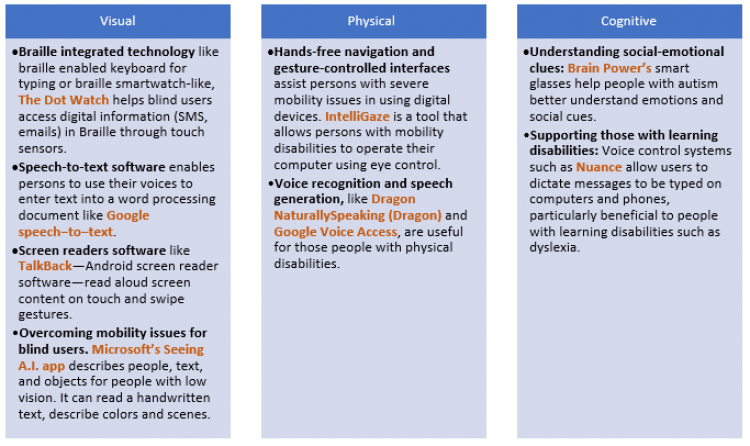
Tech solutions for different types of disabilities-Brand Spur Nigeria
Tech solutions for different types of disabilities. Source: s4ye.org

An increase in accessible online recruitment platforms (e.g., JobAbility) can offer youth with disabilities direct access to employment and employers, thus  expanding their access to the traditional labor market.

3.    Technology solutions can be used to provide experience with life like situations, essential to develop skills for work

Youth with disabilities who have been beneficiaries of charities often lack confidence when entering a workplace. Innovative simulations like in Accenture’s Skills to Succeed Academy, which does skill building though bite-sized, gamified modules with relatable characters, help provide youth with disabilities a safe learning environment and build confidence.

Also, business simulations, like Youth Business International’s ‘The Digital Entrepreneur Experience Simulator’ (DEES), have the potential to train youth with disabilities on entrepreneurship skills. These have been used extensively to train workers in finance, hospitality etc. and provide persons with disabilities the opportunities to experience personalized learning close to real-life business development process.

4.    Digital entrepreneurship opportunities, although limited, may also become more inclusive over time.

With the emergence of online platforms, new possibilities of digital entrepreneurship have emerged. Youth with disabilities with digital enterprises may now have more opportunities to find and interact with clients and sell their goods and services across physical and infrastructural barriers  (e.g., Alibaba). Accessible mobile applications for financial transactions can allow entrepreneurs with disabilities to mainstream their operations and improve efficiency. Private sector engagement in supplier diversity programs can also improve access to markets for youth with disabilities. For example, Google runs a small business supplier diversity program that includes disability-owned small businesses.

5.    Digital jobs can especially  help provide young women with disabilities, an opportunity to earn income. 

Digital jobs can be advantageous for young women with disabilities who experience additional workplace discrimination, limiting their advancement opportunities , and facing societal or family pressure that discourages their formal employment.

Digital skills can help young women with disabilities who are often homebound to access income-earning opportunities through online outsourcing and e-lancing. 

While digital jobs offer many new opportunities for youth with disabilities, there are also challenges for policymakers to consider. These include lack of accessibility and affordability of digital tools, inherent but unspoken biases of online platforms, lack of adequate social protection measures, and risks of isolation.

This blog is part of a series about jobs for youth with disabilities. In our next blog, we will discuss a few ways of engaging the private sector to hire more youth with disabilities

HP Launches ‘Digitally Advanced Schools’ Programme In Africa, Middle East

HP has launched its new, comprehensive, digital teaching and learning programme, HP Digitally Advanced Schools, in key markets in Africa and the Middle East.

The initiative brings together the complete education ecosystem by integrating three components: devices, solutions, and capabilities, all under the HP brand.

Blending hardware and advanced pedagogy technologies into school curriculums, the programme ensures an impactful, immersive teaching and learning experience for both students and faculty members, the need for which has been accelerated by the pandemic.

The HP Digitally Advanced Schools programme consists of:

·         Intel-powered HP Notebooks: This includes using a range of HP’s specially designed Education Edition products, such as the HP ProBook x360 11 G7 notebook, to ensure high-performance services for an uninterrupted learning experience that will increase student engagements and enable personalised learning

·         HP Classeasy: A gamified learning management system, powered by Classera, that is designed to reinvent learning by inspiration, personalisation and engagement. Essentially, the platform re-creates classroom activities that were conducted in a brick-and-mortar school into a bytes and pixel environment. This includes integrating around 25 different modules into one learning solution; creating a virtual classroom using video conferencing tools such as Microsoft teams; and adding a layer of gamification to the platform to increase engagement, motivate and inspire learners and accelerate adoption of the tool

·         HP School Coach: Powered by Mirai, this programme aims to improve school performance and student outcomes through high-impact digital teaching and learning, school governance and literacy attainment. The three functions of the programme are:

o   Digital Pedagogy Coach: Helps to create a digital transformation strategy that is unique to each school by conducting a self and external assessment framework. It will therefore identify the digital direction for each school and will determine the need for development workshops based on gap analysis for teachers and school leaders

o   School Improvement Coach: Puts the regulatory framework of the country into software to be able to track and monitor the performance of the school, based on insights, efficiency and transparency. This is especially important as school improvement and effective governance is essential to raising performance standards. It is a solution to the challenge of creating sustainable year-on-year improvement within schools and the education system in a cost-effective manner 

o   Literacy Attainment Coach: Literacy is considered a significant contributor to the development of students and schools. This service works on a country’s literacy index and aims to radically improve the literacy reading levels and attainment through artificial intelligence, targeted intervention and professional learning

Mayank Dhingra, Senior Education Business Lead, Middle East, Africa and Eastern Europe, HP Inc., said, “Our education solutions are bold, articulate and compelling. The launch of the HP Digitally Advanced Schools programme demonstrates HP’s commitment to supporting educators and students, by bringing together technology, expertise and solutions.

“It is no surprise that the education system has been disrupted by the pandemic. As a result, educators need to be agile and quickly adopt to the new reality, to ensure students’ learning stays on track.

“The launch of the HP Digitally Advanced Schools programme highlights the role technology and IT play in keeping students learning from wherever they are, now and into the future,” he continued.

The new programme is a part of HP’s commitment to extending HP’s education reach and enabling better learning outcomes for 100 million people globally by 2025. In addition to this new solution, HP has been introducing series of educational initiatives such as the Classroom of the Future, HP Innovation GarageHP IDEA, and HP LIFE that aim to utilise transformative technology for immersive learning.

For more information on HP Digitally Advanced Schools, please click here.

MPC Keeps Policy Rates Unchanged, A Positive Surprise As Rate Of Food Price Increase Lowers

The Monetary Policy Committee (MPC), at its meeting held on May 24 -25, 2021, voted to keep all its policy rates unchanged from previous levels. Specifically, the Committee voted to:

  • Retain the Monetary Policy Rate (MPR) at 11.50%.
  • Retain the asymmetry corridor at +100/-700 basis points around the MPR.
  • Retain the Liquidity Ratio at 30.00%.
  • Retain CRR at 27.50%.

The Committee’s Considerations

In arriving at a decision, the Committee noted the activities in the global economy, notably the high inflationary pressures due to legacy structural issues, capital flows reversal, and exchange rate pressures.

The Committee also noted the global financial market stability, resulting from the accommodative monetary stance by monetary policy authorities across the globe. However, the Committee maintained that a monetary policy normalisation may begin by Q4 2021.

In the domestic economy, the marginal GDP growth of 0.51% in Q1 2021 was noted, driven by the non-oil sector. The Committee also noted the improvement in the Manufacturing Purchasing Manager Index (PMI) from 48.80 index points in March 2021 to 49.00 index points in April 2021.

On the other hand, the NonManufacturing Purchasing Manager Index (PMI) declined from 47.90 index points to 43.30 index points. The moderation in the inflation rate from 18.17% in March 2021 and 18.12% in April 2021 was also highlighted, in which the Committee partly attributed to sustained CBN’s intervention in various sectors of the economy, particularly the SMEs.

In the foreign exchange market, the Committee noted the continued pressure and applauded the CBN’s efforts in stabilising the foreign exchange market. The external reserves declined to $34.17bn as of May 21, 2021, from $34.29bn as of April 2021, reflecting sales to the foreign exchange market and third-party payments.

Outlook

The Committee posits a slow recovery in both the global and domestic economies, due to the lingering impact of the coronavirus pandemic.

The Committee expects to see improved macroeconomic conditions in the domestic economy, premised on sustained government intervention in the agricultural sector, improved food supply, and declining inflationary trend – on the back of improved fiscal and monetary policies.

The Committee expects an improved economic capacity and full restoration of the supply chain to ease inflationary pressures.

On inflation management, the Committee expressed that its administrative policy approach to control money supply has begun to yield results. The Committee also believed that its intervention efforts to drive output growth have started to yield results.

The MPC Holds

The Committee expressed that the recent economic developments presented two broad options, which included either to combat the high inflationary pressure or continue its pro-growth stance.

Therefore, the policy options were to ease monetary policy to drive credit growth and boost economic recovery, or to tighten to moderate price developments.

The Committee voted to maintain its hold stance to allow its current alternative policy approaches to permeate. The Committee argued that while an easing stance could quicken the pace of economic recovery, the downside of an easing approach would result in price instability in the economy.

On the other hand, while a tightening approach could tackle the monetary drivers of inflation, the structural drivers of inflation remain and could keep inflation levels higher. Also, a tight stance will hamper the CBN’s objectives of providing credit for households and other economic units.

COVID-19 Accelerates the Growth of India’s Online Grocery Market

India’s online grocery market grew by 80 percent to $2.66 billion in 2020 primarily due to COVID-19 and the resulting lockdown. The sector is expected to grow exponentially over the next few years thanks to expanding internet connectivity and rising consumer demand for convenience, value, safety/hygiene, ease of payment, and product variety.

Opportunities for U.S. exporters exist in consumer-oriented products, especially tree nuts, fruits, and packaged/processed foods.

Rising Urbanization and Internet Connectivity Facilitate Online Grocery Purchases

As of March 2021, India’s population stands at 1.38 billion, 18 percent of the total world population.

Online Grocery Market
Taj Mahal, Agra, India | Photo by Sylwia Bartyzel

According to the World Bank, 66 percent of this population (900 million) lives in rural areas while 34 percent lives in urban ones. On average, India’s urban population increases by 2.3 percent every year, while rural population growth continues to decline with only 0.3 percent growth in 2019.

This rapid urbanization is facilitating access to a wide range of goods and services for an increasingly younger, “globally-conscious” consumer base whose incomes are growing, and tastes/preferences are evolving.

Along with this, internet connectivity is expanding thanks to declining costs of data and mobile devices (the preferred method of internet access).

According to the Internet & Mobile Association of India, India has over 504 million active internet users, of whom 227 million and 205 million are from rural and urban areas, respectively.

Moreover, nearly 70 percent of the country’s internet population are daily users, who primarily use the internet for social networking and messaging.

India’s rapid digital adoption will continue to grow as local sources estimate that the country will reach 1 billion internet users by 2025. This adoption will accelerate e-commerce use in rural and urban areas for years to come.

India’s Online Grocery Sector – A Small but Rapidly Expanding Market

Although online grocery sales represent less than one percent of total grocery sales in India, this sector is expected to experience tremendous growth in the next decade.

India’s grocery retail sector is considered the third-largest in the world and reached sales of $410 billion in 2020, according to Euromonitor International. The sector is dominated by traditional and unorganized retail formats, specifically, hawkers and neighbourhood shops called Kirana stores (similar to mom & pop stores in the United States), which represent 90 percent of the market in sales.

The remaining 10 percent is made up of modern grocery retailers (such as supermarkets and hypermarkets) and e-commerce. In 2020, online grocery sales grew by 80 percent to $2.66 billion as COVID-19 compelled consumers to shop more online due to lockdown restrictions and safety concerns.

During this period, consumers shifted their attitudes towards grocery e-commerce and began to see it as the most convenient and safest way to procure essential supplies.

India – Food and Beverage E-Commerce Sales

Online Grocery Market
Source: Euromonitor International

Traditional grocery stores are the greatest challenge to online retail in India as they are neighbourhood shops that can be quickly reached to deliver a range of essential and gourmet products. These shops are prevalent in both urban and rural areas and have maintained a loyal customer base, thanks to benefits such as discounts, promotional offers, and personalized service.

Moreover, these stores have also digitized their operations by accepting credit, debit, and e-wallet payments, and receiving orders through messaging apps, such as WhatsApp.

Just a few years ago, nearly 97 percent of grocery sales were made through 12 million shopkeepers around the country. However, this began to shift in 2005 with the emergence of modern grocery stores, which now total over 8,000 and continue to increase in number.

According to private estimates, the Indian online grocery sector is expected to reach $20-25 billion by 2025. This sector’s burgeoning growth is supported by rising urbanization and incomes, busier lifestyles, greater internet connectivity, the entrance of offline grocery chains, and changing consumer attitudes that demand greater convenience, product variety, safety/hygiene, and value.

The sector is highly dynamic with domestic and foreign firms competing to expand their market share and presence.

Major online grocery retailers include BigBasket, Grofers, Amazon India, Flipkart, and Jio Reliance, along with emerging retailers such as Nature’s Basket, DMart, More, Easy Day, and Milk Basket.

Titan Trust Bank Opens New Branch in Lagos

0

In furtherance of its efforts to offer customers an endearing experience, Titan Trust Bank Limited, one of the fastest-growing financial service providers in Nigeria, has announced the opening of its state-of-the-art branch located at 53, Allen Avenue, Ikeja, Lagos for commercial operations.

Executive Director, Titan Trust Bank, Mrs. Adaeze Udensi, PhD, while declaring the new branch opened on May 20, 2021, said the move was in line with the bank’s quest to provide financial service to micro, small and medium scale enterprises within Lagos state.

Titan Trust Bank

“The opening of this branch would go a long way in ensuring that customers within and around the Ikeja axis can experience the bank’s wide array of services.

“At Titan Trust Bank, our goal is to continue to deliver exceptional banking services by making financial services easy and accessible to our teeming customers.

“Ikeja people and entrepreneurs, we are now in your neighbourhood. Come join the Titan train,” Udensi added.

Also commenting on the feat, Mr. Mudassir Amray, the Managing Director and Chief Executive Officer of Titan Trust Bank, noted,

“This is yet another great milestone for us as a bank.

“I am particularly gratified because this launch represents a translation into the concrete reality of our determination to live by our mission and keeping to our service promise to provide simple, reliable, and quick banking solutions to all our customers.

“The launch of the branch marks for the people in the environs more than just the opening of a new edifice but the beginning of a fresh phase in the development of the region, an expansion of facilities and intensification of our efforts to render financial services to the people of Ikeja – to our businessmen and women, to our agriculturists, and to our industrialists, both large and small.
“We shall continue to strive to remain on an upward trajectory until we get to the top even as we put our customers’ satisfaction as a top priority,” the bank’s chief concluded.

Since its inception, the lender has continued to take industry watchers by surprise with its sterling achievements both on physical and digital banking within a short period.

In addition to its lists of international laurels, the lender recently bagged two awards as the ‘Best New Commercial Banking Brand’ and ‘Fastest Growing Digital Banking Brand in Nigeria for the Year 2021’ at the 2021 annual United Kingdom-based Global Brands Magazine Awards.

The bank clinched the coveted influential awards in less than two years of its commercial operations.

Titan Trust Bank was established to take advantage of the identified gaps in the banking sector and address the unmet needs of the retail mass market, SMEs and corporates.

First Bank Bags Wins Big At The Global Banking And Finance Awards 2021

0

First Bank of Nigeria Limited, Nigeria’s premier and leading financial services provider, has been awarded the 2021 ‘’Retail Banking CEO of the Year Nigeria’’, ‘’Most innovative Retail Banking App Nigeria’’ and ‘’Best CSR Bank Nigeria’’ awards by Global Banking and Finance magazine.

Brand Spur Nigeria reports that the respective awards conferred on First Bank are in recognition of the indelible roles it plays in deepening financial inclusion in the country; advancing the digital banking eco-system as well as impacting people in its host communities with technology to make learning available to individuals of all ages, amongst many others.

The Global Banking and Finance Awards reflect the innovation, achievement, strategy, progressive and inspirational changes taking place within the Global Financial community.

The awards were created to recognize companies of all sizes which are prominent areas of expertise and excellence within the financial world.

With its over 750 branches and 100,000 Firstmonie Agent banking network spread across the nook and cranny of the country, FirstBank’s robust retail banking framework has been at the forefront of bridging the financial exclusion gap, thereby empowering Nigerians to carry out their financial and business-driven activities in contributing to national growth and development.

Also, in order to put customers ahead in enjoying state of the art digital banking services, the Bank’s industry-leading banking application, Firstmobile, is configured with modern banking functionalities which are regularly upgraded and designed with self-service features to ease the navigation capability and proficiency of customers to carry out their respective transactions with no hassles.

The smart banking application is also embedded with a card protection service for customers to enable and disable cards on channels, account switch off as well as second-factor authentication and device registration. With the upgraded FirstMobile, customers can remotely initiate the request for a new debit card as well as the replacement of a lost or damaged one.

Woven into the fabric of society for over 127 years, overcoming challenges and remaining a dominant player in Nigeria’s financial services landscape, FirstBank has been partnering and supporting various sustainable activities towards the continued growth of its host communities and the nation at large.

As a responsible corporate organization committed to supporting all its stakeholders in the most sustainable manner possible, the bank partnered with various state governments through the private sector-led Coalition Against COVID-19 (CACOVID) intervention to promote the readiness and efficiency of health care professionals and other compatriots at the forefront of fighting the pandemic.

First Bank also forged a formidable partnership with the Lagos State government, Robert & John, IBM, and Curious Learning amongst others to promote e-learning of school children that were affected by lockdown at the height of the pandemic. The initiative is still enjoyed by thousands of individuals, irrespective of age.

Dr. Adesola Adeduntan, the CEO of FirstBank commenting on the awards said ‘’we are proud to be recognized with these awards, which speak to the investments we have made over the past years in bolstering our electronic platforms for our customers; enhancing financial inclusion through agent banking as well as empowering our communities in the education space especially by bridging the digital divide through e-learning initiative.

These awards are dedicated to all our customers, as the trust, they reposed in us being their bank of first choice in meeting their business and financial needs has been instrumental to the success we have achieved in our existence of over 127 years. We remain committed to putting You, our customers First as we contribute to the growth and development of our host communities” he concluded.

Ekeh, Zinox Boss, Sues For Peace In Imo State

0

Serial digital entrepreneur and Chairman, Zinox Group, Leo Stan Ekeh have called on all aggrieved parties in Imo State to embrace peace, noting that no form of progress can take place in an atmosphere of unrest or insecurity.

He made this known while speaking at the Imo State Government House during a courtesy visit to Governor Hope Uzodinma on Monday, May 24, 2021.

The Zinox boss, who has been pained by recent developments regarding insecurity in Imo State, had decided, based on reportage and discussions with various stakeholders, to visit the state for a personal assessment of the situation, even as he noted that the facts on the ground show that the situation was not as bad as portrayed.

Zinox
Chairman, Zinox Group, Leo Stan Ekeh | Brand Spur

‘‘I think it is a temporary pain as activities were on full gear during the day and I hope nightlife shall soon return to what was a very peaceful state before this challenge,’’ he stated.

Ekeh, however, seized the opportunity to call for a cease-fire from all concerned parties.

‘‘The most critical thing to note is that peace is essential to the progress of any society. No meaningful progress can take place in a state where there is a high level of unrest, insecurity or a break-down of law and order. I wish to use this opportunity to plead with everyone to embrace peace, especially because this is not a time for division, but a time for all of us to band together and usher in progress in our dear state,’’ he declared.

The foremost digital disruptor, who hails from Mbaitoli LGA, decried the loss of lives and property in the state, noting that the situation may scare away potential and existing investors, if not curtailed.

Furthermore, he pleaded with the people of Imo State, to save the state from such a scenario and see dialogue as a better option.

‘‘Imo youths are very brilliant kids and street smart, but they must have faith in their future. This may be the right time to reskill to alter their destinies. Violence solves no problem.

Instead, it makes a bad situation even worse. Rather than resort to violence, it is better to dialogue or find a middle ground. I plead with you all to consider this whenever issues arise. I also understand that a governor is a busy man. In such cases, you can reach out to people like some of us to speak with him.

‘‘I urge you all not to allow yourself to be used to destroy the state. Remember that any actions we take today may also destroy the future of our children and unborn generations.’’

Also speaking at the event, Gov Uzodinma, who reassured the Zinox boss that things had normalized, disclosed his commitment to ensuring peace and security in the state as a means of creating a conducive environment for progress and for businesses and other entrepreneurial pursuits to thrive.

While speaking with journalists on the sidelines of an event, Ekeh restated his love for Imo State, noting that he would continue to support every government in power in the state, irrespective of the status, party or identity of the governor.

‘‘I am not a politician and shall never be one in this my lifetime. My single interest is supporting any government in power for the progress of the state. I can tell you the Governor assured me that he is putting a lot in place to revive the economy.

I frankly think the Federal Government, well-meaning Imo indigenes no matter where they reside, our friends and corporates operating in Imo state, should support in whatever little ways they can for absolute peace to return. I shall also do my bit.’’

In addition, the digital entrepreneur, who remains one of the biggest employers of graduates from Imo State, disclosed plans to enhance his investment in the state. Stating that the coronavirus pandemic was a huge challenge to businesses and individuals worldwide, Ekeh noted that Nigeria was also experiencing the bitter pangs of the pandemic, having to be ill-prepared for the crisis.

‘‘The truth is that no government or religious leader anticipated this disaster,’’ Ekeh disclosed.

He advised all to draw closer to God, even as he disclosed that God is the only distinguishing factor.

Ekeh, a renowned philanthropist, has touched millions of lives in Imo State and across Nigeria through his support for the less privileged, churches, educational institutions and other segments of the populace.

Through the Leo Stan Ekeh Foundation, his personal foundation, Ekeh has granted scholarships to many indigent students, constructed markets, provided Medicare for many and also set up an interest-free N1.5bn revolving loan scheme for entrepreneurs, among many other noble interventions.

Investment in Infrastructure: The GOtv Nigeria Example

Investing in Nigeria, as every prospective investor is aware, promises enormous dividends. On account of the country’s huge population, the largest on the continent, there is a vast market for any product or service. This makes investment commitment in Nigeria so appealing.

But reaping the dividends available from the large market, in most cases, requires the investor to face and surmount numerous intense challenges such as high operating costs, policy instability and often declining disposable income, which inhibits effective demand.

GOtv Nigeria

The requirements are much stiffer for investors with long-term investment commitments, who have to confront the country’s notoriously acute infrastructural deficit and fill the gaping gaps-all by themselves-and continue to do so.

To take on the infrastructural challenges, particularly of the technological variety, requires near-blind faith in Nigeria and, of course, money. Tonnes of it, that is.

This is what I have seen with the approach of GOtv Nigeria, the country’s second digital terrestrial television (DTT) service provider, which launched in 2011. The operator was, so to speak, condemned to take the route it has taken, as it was a pioneer on a few fronts.

It arrived at a time that migration from the analogue to the digital broadcasting platform had become a major programme for around the globe, following the International Telecommunications Union (ITU) agreement of 2006 of which Nigeria was a signatory.

It also coincided with the initial expression of the Federal Government’s interest in getting the country on the digital broadcasting train. In line with Nigeria’s aspiration to be part of the new broadcasting ecosystem, GOtv Nigeria launched with the DVB-T2 decoder, the second-generation, ITU-approved hardware for digital television broadcasting.

This made the DTT operator the first in the country to offer its subscribers the most modern broadcast technology which, unlike analogue, delivers premium audio-visual quality and a higher number of channels, including access to Free-to-Air at the expiration of the subscription, as well as preventing signal depreciation in adverse weather conditions.

The hardware (decoder and antenna) also offered ease of installation, as it can self-installed, making the use of an installer not absolutely necessary. With additional television channels, the new technology offers also came audio channels, at no extra cost to the subscriber, on the GOtv platform. These came with the launch of Wazobia FM and Naija FM, making it the first DTT operator to carry such on its platform.

Further support for Nigeria’s digital transition aspirations also came in the shape of commitment to ramping up public awareness of the programme, with GOtv Nigeria becoming the first DTT operator to support of National Broadcasting Commission’s (NBC) digital migration flag-off in Jos, with “Digilevelz Don Land, No Carry Last” campaign, which covered 26 cities across the country.

Making all of these available to the subscriber was no cakewalk. Nothing of the sort is ever is, I have to add. Mallam Ishaq Modibbo-Kawu, former Director-General of the NBC, famously noted that a major impediment to DTT network coverage in states where the digital transition programme of the Federal Government had been launched was topography.

“Coverage is related to topography. Take an example of the Federal Capital Territory, Abuja. It is a city of hills and undulating grounds. The signal distributor for Abuja has purchased feeder pillar transmitters, which will be installed for the entire Abuja and environs to be covered.

The same thing applies in Plateau. The signal distributor has to put feeder pillar transmitter in places like Langtang for the entire state to be covered,” Modibo-Kawu explained at the time.

Topographical hindrances were exactly what GOtv subscribers did not have to endure because the operator, running on the digital platform from the off, had already rolled out in about 50 cities across 26 states across the country. To make the service available to subscribers in zones across the country took heavy investments in digital transmission technology infrastructure.

In four years, 2011 to 2015, a hefty sum of $95.5million was sunk into the erection of 73 transmitter sites. The transmitter sites make available DTT network coverage for more than 50 per cent of the country’s population.

To maintain the transmitter sites, which number grew as time went on, for effective transmission, the sum of N8, 178, 372, 223. 40 was spent on between 2014 and 2018.  In 2014 alone, N572.2million was spent. The following year, the sum rose to N1.39billion.

It would climb, respectively, to N1.9billion in 2016, N2.033billion in 2017 and N2.28 billion in 2018. The heavy lashings of money have ensured subscriber access to the operator’s service in about 70 cities across the country, making it, by a distance, the most expansive DTT network coverage in the country.

It is to this wide network coverage that the two companies licensed as signal distributors by the under the Federal Government’s digital switchover programme are playing catch-up and may do so for much longer, given how sparse their respective coverage has been in about five years since they started operations.

Experts have blamed their inability to provide sustainable nationwide DTT coverage on a lack of finance and technical capacities. I am tempted to agree with the diagnosis.

The internet is brimming with complaints by Nigerians who have purchased the device recommended by NBC as its digital transition vehicle. In states where the switchover programme has been launched, the complaints have been heavy on partial or total lack of reception, making their set-top-boxes into something acquired for decorative purposes.

In most of the states, the signal is received only in the state capitals, leaving residents out of them out in the lurch. There are subscribers, who have complained of non-receipt of signal for as long as six months, as infrastructure provided by signal carriers have remained grossly sup-par.

Along with these investments in transmission, infrastructure has been similarly hefty outlays in the shape of regulatory fees. In 2019, Details Nigeria, promoters of GOtv Nigeria, paid N1.5billion to NBC for the renewal of its DTT licence for another three-year period.

It also paid the sum of N50million for the renewal of its Direct-to-Home (DTH) licence for another five years. In 2014, it paid N2billion for a five-year DTT licence and N50 million for the renewal of its DTH licence for a further five-year period.

The various sums invested in the provision and maintenance of broadcast infrastructure as well as regulatory levies are exclusive of what was invested in bringing digital broadcasting to Nigeria.

Palang Yakubu, a public affairs commentator, writes from Jos

Mercedes-Benz USA Announces New C-Class Sedan Features

The new-generation Mercedes-Benz C-Class is poised to reinforce its leading position as the most advanced vehicle in its segment by showcasing a new progressive interior and sporty exterior design, electrified engine, innovative comfort features and groundbreaking technology.

Taking cues from the all-new flagship S-Class, the C-Class takes comfort, safety, and the overall driver and passenger experience to a new level. The all-new Mercedes-Benz C-Class Sedan will arrive in U.S. dealerships in the first half of 2022.

In order to streamline the packaging structures, the new-generation Mercedes-Benz C-Class Sedan will be offered in three highly-equipped, strategically curated trims for the U.S. market: Premium, Exclusive and Pinnacle. Each trim is available on both the C 300 and C 300 4MATIC Sedan, and showcases innovative technologies and luxurious features beyond the generous standard features, along with extensive options for customization.

Longer and wider than its predecessor, the new-generation C-Class also showcases an all-new, cab-backward exterior design. The sporty look is accentuated by the new A-shaped grille with an open star pattern and power domes on the hood that lends the vehicle an aggressive profile and striking new look.

The new headlights, two-piece horizontal taillight design, and sleek side profile with a higher shoulder line underscore the character of the C-Class as a modern sports sedan. With five new paints, all new upholstery options, and a portfolio of new Mercedes-Benz and AMG wheel options, the C-Class can be customized to suit individual tastes across the board.

The progressive interior of the C-Class demonstrates a clear focus on technology and high-quality materials with its host of new trim options, freestanding 12.3″ digital instrument panel, and new large 11.9″ central touchscreen multimedia display. Adopted from the S-Class, its portrait orientation is particularly advantageous for fullscreen navigation, further enhancing the driver experience.

Mercedes-Benz USA Announces New C-Class Sedan Features-Brand Spur Nigeria

As an exclusive new C-Class feature, the 11.9″ central display is slightly tilted towards the driver by six degrees for the first time, further underscoring the sporty and dynamic driver-centered design and performance of the C-Class.

The latest generation of MBUX (Mercedes-Benz User Experience) technology is on par with that of the S-Class with its sophisticated, learning-capable infotainment system with advanced Voice Control.

With significant processing power abilities, the vehicle interior becomes even more digital and intelligent including features such as the newly standard wireless smartphone integration with Apple CarPlay and Android Auto.

Additionally, with individual MBUX profiles that can be activated by biometric authentication via the fingerprint sensor, the possibilities for personalization and intuitive operation have become far more extensive, and controlling vehicle and comfort functions is easier than ever before.

The C-Class model range also debuts a new turbocharged 4-cylinder engine with an integrated starter generator and 48-volt mild-hybrid technology – the first four-cylinder gasoline engine in the Mercedes-Benz lineup with this technology.

The systematically electrified 2.0-liter 4-cylinder engine in the C 300 and C 300 4MATIC Sedan boasts effortless and efficient power and improved comfort and performance. With an output of 255 hp and 295 lb-ft of torque, the C 300 models benefit from an increase of 22 lb-ft of torque compared to the predecessor.

The 48V mild-hybrid system provides a further 148 lb-ft of torque as well as up to an additional 20 hp for short periods for smooth acceleration and power delivery.

The entire suite of available active and passive driver assistance systems have been enhanced on the new C-Class with additional and advanced functions that reduce driver workload in day-to-day situations for more comfortable and safe driving.

With Active Distance Assist DISTRONIC, Active Steering Assist, and Active Lane Change Assist, the vehicle can semi-autonomously maintain its speed and the distance to the traffic in front as well as stay in its lane on multi-lane roads, and reduce the vehicle speed according to the traffic situation.

The extensive driver assistance systems, as well as the sophisticated crash sensor systems, ensure the C-Class upholds the highest levels of safety and sophistication. Newly available Active Stop-and-Go Assist can also provide semi-autonomous support in traffic jams at speeds up to 37 mph.

The available AMG Line with Night Package represents the sportiest expression of the C-Class Sedan. In addition to AMG body styling, black accents and AMG wheels, the striking diamond grille with the star design in chrome is a distinguishing feature of AMG Line, along with the front fascia with its prominent A-wing that looks even more aggressive. The sporty interior is complete with a flat-bottom AMG Steering Wheel, AMG floormats and MB-Tex Dashboard.

The next-generation C-Class is poised to redefine the benchmark and take comfort, safety, and the overall driver and passenger experience to a completely new level. The 2022 Mercedes-Benz C-Class Sedan will arrive at U.S. dealerships in the first half of 2022.

Trims At A Glance:

Premium Trim Exclusive Trim Pinnacle Trim
Equipment Feature Highlights:

  • 12.3″ Driver Display
  • 11.9″ Center Touchscreen Display
  • MBUX with Biometric Fingerprint Scanner
  • KEYLESS START® and KEYLESS-GO®
  • HANDS-FREE ACCESS with Electronic Trunk Closer
  • Blind Spot Assist
  • PRE-SAFE®
  • ATTENTION ASSIST
  • Active Brake Assist
  • Parking Damage Detection Wireless Smartphone Integration with Apple CarPlay
    and Android Auto
  • Heated Front Seats
  • Sunroof
  • 18″ Wheels
  • LED Taillamps and Headlamps with Adaptive Highbeam Assist
  • Ambient Lighting
  • DYNAMIC SELECT

Optional Feature Highlights:

  • AMG Line with Night Package DIGITAL LIGHT Intelligent Lighting System with Adaptive Curve Illumination
  • MB Navigation
  • Ventilated Seats
  • Panorama Roof
  • Heated Steering Wheel
  • Advanced USB Package with additional USB data ports in front and rear, including 100W ports for quick and powerful charging
  • SiriusXM® Satellite Radio
Equipment Feature Highlights:

  • All content of Premium Trim
  • PARKTRONIC w/ Active Parking Assist
  • Surround View System with Guard 360˚ security functionality
  • Enhanced Ambient Lighting
  • Illuminated Door Sills
  • Inductive Wireless Charging
  • Burmester® 3D Surround System with Sound
    Personalization

Optional Feature Highlights:

  • Driver Assistance Package
  • AMG Line with Night Package DIGITAL LIGHT Intelligent Lighting System with Adaptive Curve Illumination MB Navigation
  • Ventilated Seats
  • Panorama Roof
  • Heated Steering Wheel
  • Advanced USB Package with additional USB data ports in front and rear, including 100W ports for quick and powerful charging
  • SiriusXM® Satellite Radio
Equipment Feature Highlights:

  • All content of Exclusive Trim
  • MB Navigation
  • Head-Up Display
  • MBUX Augmented Video for Navigation

Optional Feature Highlights:

  • Driver Assistance Package
  • AMG Line with Night Package DIGITAL LIGHT Intelligent Lighting System with Adaptive Curve Illumination
  • Dashcam
  • Ventilated Seats
  • Panorama Roof
  • Heated Steering Wheel
  • Integrated Toll Pass
  • Advanced USB Package with additional USB data ports in front and rear, including 100W ports for quick and powerful charging
  • SiriusXM® Satellite Radio


How is COVID-19 impacting footwear retail in different countries?

0

With the world fast approaching 180 million cases of infected people and with vaccination now in place in several countries, we bring a summary of our latest Flash Reports focused on some key markets

We first started to hear about COVID-19 a year ago and it has been part of our conversations and lives since then. Pandemic, lockdown, sanitary measures and restriction of movements became familiar words impacting our routines in 2020.

Second, third and fourth waves hit countries and have led to new lockdowns and new restrictions. As we fast approaching the middle of 2021, countries face different realities, in terms of new cases and in regard to the vaccination rhythm. The European Union is aiming to have 70% of its population vaccinated by the end of the summer.

How is COVID-19 impacting the footwear industry in different countries Brandspurng

The US President, Joe Biden, has laid out plans to vaccinate 70% of US adults by the 4th of July (a symbolic date as this is the country’s Independence Day). And with 1.1% of people vaccinated, Japan lags behind the developed world.

Japan has given enough doses to cover just 1.1% of its population, the lowest among the 37 members of the Organization for Economic Cooperation and Development, according to Bloomberg’s vaccine tracker. That compares to 36% in the United States and nearly 35% in the United Kingdom.

Given this scenario, let us look into what is happening in the Footwear Retail segment in some important markets.

France: Footwear Sales in Troubled Waters again

After a period of some return to normality, as reported in our previous Retail Flash for France, footwear retail in France plunged in November, when a second national lockdown has been announced, to recover over the Christmas period. The up and down continued when we entered 2021.

Confidence in the country seems to still be on a roller coaster mode: the French consumers’ confidence indicator has been deteriorating for two months after December 2020, to pick up in March, side by side with the retailers’ confidence. Uncertainty remains regarding the extent of such recovery.

It seems likely, that the ups and downs of footwear retail will not stop until vaccine deployment is widespread enough all over France. A concern is raised: if 2020 was not good, and if other waves of the pandemic emerge, how will the footwear retail resist in 2021? (More information HERE)

Germany: After some successful months, retail took a massive hit by the end of 2020

After the initial hit back in the first months of 2020, the impact of the pandemic in German retail sales seemed to be manageable for most of the year. Germany was a “successful retail story”, far from other European countries.

However, in the last two months of 2020 the plot of the story changed, and with strength. As in other geographies, the bad news for the offline channels has been accompanied by good news for the online.

Will this be enough? Most people believe it will not, as the online and the click & collect sales will likely fail to compensate for the expected drop in sales in physical stores. The good news seems to come from the confidence indicators: German consumers do not seem convinced that the COVID-19 risks will prevail.

Instead, consumer pessimism is fading away, as data for the two months ending in March 2021 shows. And retailers seem to follow. Will confidence beat COVID-19 sooner than the vaccine? (Extensive analysis HERE)

Japan: too early to be excited about retail

After a year of underperforming, the Retail Index for Apparel & Accessories in Japan managed to overcome the figures of the previous year in March 2021. Notwithstanding, importers do not seem yet convinced that this is a sustained recovery.

The good news, as in other geographies, comes from the confidence indicators, with consumers seem to be driving away from pessimism. And this gives good support for good retail expectations. However, all seems too fragile yet, especially as the State of Emergency has been expanded, and it might mean that it is too early to get excited with retail in Japan. (More details HERE)

Spain: depressed retail and online sales gaining share

The TCF retail Sales Index in Spain is showing some resistance to getting back to the pre-pandemic levels, even if some recovery took place over the second half of 2020. Behind the worsening of the business, conditions are new pandemic waves registered in Spain in November 2020 and again in January and February 2021.

The adverse retail effect is noticeable, even though it is not so pronounced when compared with the first wave. As it stands, unless the virus is substantially contained, footwear retail will hardly overcome the resistance gap, let alone return to the baseline.

One positive sign seems to come from internet retail, which is gaining share since September 2020. An opportunity to offset some losses for those retailers who are agile enough to jump into the online wagon. The concern raises as this is being done at the expenses of physical retail.

If one needs hope and goods news, those might come from some relative optimism from the consumer side, which might be followed by the retailers. The next few months will be key to see if they persist. (Complete report HERE)

UK: Christmas upsurge turns into big new dip at the beginning of 2021

As a new wave of COVID-19 struck the UK and new confinement hit the country after the New Year, retail sales of footwear slowed down again. One interesting fact comes from the indicator of consumer confidence, which is now increasing for two succeeding months.

If vaccination in the UK succeeds, and if it gets more and more ingrained in consumer expectations, footwear sales decline might not persist. Higher consumer confidence and vaccination success will come along with lockdown lifting, and with online becoming a strong player, higher total footwear demand might happen.

The question is what the impact will be for brick and mortar, as this virus seems to have been fatal for many high street players. (Available HERE)

US: Will retail go back to the trend?

Retail Sales in shoe stores started the year with a decreasing trend, putting an end in some recovery registered in the last months of 2020, especially when the stimulus checks started reaching the American households.

Ecommerce is on an upward cycle, as it continues to win market share, however, is not clear if the net result will be a good one, as its growth is taking place at the expenses of brick and mortar.

Once again, as in other geographies already analysed in the past weeks, Consumer Confidence seems to be on a good track, translating the feeling that mass vaccination will knock COVID-19 soon. And that seems to indicate that the pre-COVID trend will resume soon.

The question being: to what extent? As e-commerce is taking a bite on brick and mortar, it is still unknown if total footwear retail (online + offline) is going to grow or not. (Detailed information HERE)