Facebook Gaming Recorded Over 1B Hours Watched In Q1 2021- 91% YoY Increase

0

Facebook Gaming’s increasing popularity has done extremely well to catch up with established competitors and is now one of the fastest rising streaming platforms globally.

According to data presented by Safe Betting Sites, Facebook Gaming experienced a 91% YoY increase in Q1 2021 after viewership surpassed 1B hours for the first time in a quarter.

FB.GG Records Over 1B Hours Watched In A Quarter

Facebook Gaming(FB.GG) was launched in 2018 as the social network’s platform for gaming live streams where gamers and fans interact. When FB.GG was first launched, it had the unenviable task of entering a market that already had established platforms such as Twitch and Youtube Gaming, Nevertheless, FB.GG found almost immediate success and is now gaining ground on its main competitors.

In the first quarter of 2021, FB.GG logged a total of 1,057B hours watched of streaming content on the platform, the first time it crossed the billion-hour mark for a quarter. Q1 2021’s figures are also a 91% YoY increase from Q1 2020 when total hours watched was just at 554M.


Viewership in the first quarter of 2021 also increased by 156 million hours compared to the previous quarter giving it a 17% QoQ increase from Q4 2020. In terms of average concurrent viewers, FB.GG recorded 480K in Q1 2021, compared to just 408K the previous quarter – a 20% QoQ increase. The figure is also a 91% YoY increase from 2020 Q1’s 256K average concurrent viewer count.

Streaming On FB.GG On The Rise

The number of video game content streamed on the platform is also well on the rise. An estimated total of 19.5M hours was streamed on FB.GG in Q1 2021, an increase of about 5 million hours compared to the previous quarter for a 34.5% QoQ increase. Even more remarkably, the figure from the first quarter of 2021 is almost a 300% YoY increase compared to the figure in Q1 2020.

The number of unique channels on the platform also increased significantly in the first quarter of 2021 reaching an all-time high of 1.56M compared to 1.16M the previous quarter – a 32.8% QoQ increase.

Facebook Gaming To Surpass YouTube Gaming In 2021

Despite its young age relative to its competitors, Facebook Gaming has firmly established itself as one of the streaming industry’s leading platforms.

Rex Pascual, Esports editor at Safe Betting Sites commented;

“Facebook Gaming has grown by leaps and bounds since its launch in 2018. The strength of the FB brand and network combined with the lockdowns of the pandemic stricken 2020, gave the platform the ability to grow rapidly in a short amount of time. Based on the current figures from Q1 2021, FB.GG looks set to overtake YouTube Gaming as Twitch’s closest rival within the calendar year.”

Ford Accelerates Battery R&D With Dedicated Team, New Global Battery Center of Excellence Named Ford Ion Park

  • Building on nearly two decades of battery expertise, Ford creates a new global battery center of excellence – called Ford Ion Park – in southeast Michigan; the cross-functional team in place to drive high-volume battery cell delivery, better range, and lower costs for customers
  • Ford Ion Park will use state-of-the-art equipment to pilot new manufacturing techniques that will allow Ford to quickly scale breakthrough battery cell designs with novel materials once the company vertically integrates battery cells and batteries
  • $185 million collaborative learning lab coming next year will develop and manufacture lithium-ion and solid-state vehicle battery cells and arrays, test manufacturing approaches, while the team optimizes all aspects of the value chain – from mines to recycling

Ford today announces a new global battery center of excellence – called Ford Ion Park – to accelerate research and development of battery and battery cell technology – including future battery manufacturing.

“We’re already scaling production of all-electric vehicles around the world as more customers experience and crave the fun-to-drive benefits of electric vehicles with zero emissions,” said Hau Thai-Tang, Ford’s chief product platform and operations officer. “Investing in more battery R&D ultimately will help us speed the process to deliver more, even better, lower cost EVs for customers over time.

The company is building on nearly two decades of battery expertise by centralizing a cross- functional team of 150 experts in battery technology development, research, manufacturing, planning, purchasing, quality and finance to help Ford more quickly develop and manufacture battery cells and batteries.

The Ford Ion Park team also is exploring better integration and innovation opportunities across all aspects of the value chain – from mines to recycling – working with all teams within Ford, including experts at Ford’s new Battery Benchmarking and Test Laboratory, Ford Customer Service Division, plus key suppliers and partners.

“We are creating new tools and solutions we need for a carbon-free, affordable and better future,” Thai-Tang said. “We are modernizing Ford’s battery development and manufacturing capabilities so we can better control costs and production variables in-house and scale production around the world with speed and quality.”

The Ford Ion Park team already is underway. In addition, a $185 million collaborative learning lab in Southeast Michigan that is dedicated to developing, testing and building vehicle battery cells and cell arrays opens late next year.

This world-class 200,000 sq.-ft. learning lab will include pilot-scale equipment for electrode, cell and array design and manufacturing and will use state-of-the-art technology to pilot new manufacturing techniques that will allow Ford to quickly scale breakthrough battery cell designs with novel materials once the company vertically integrates battery cells and batteries.

Anand Sankaran will lead the Ford Ion Park team as its new director. A 30-year veteran of Ford, Sankaran brings to the new position decades of battery and electrification expertise – including his current role as the company’s director of Electrified Systems Engineering, as a 1999 Henry Ford Technology Award winner for his electrification work at the Ford Research Lab and a product development leader who applied his research and technical innovations on key production vehicles, including the award-winning original Escape Hybrid, 2021 Mustang Mach-E and 2022 F-150 Hybrid.

Sankaran also holds 32 U.S. patents in automotive power electronics and hybrid vehicle technologies and is a fellow of the Institute of Electrical and Electronics Engineers.

“Ford’s modern EV journey started with Escape Hybrid in 2004, the world’s first hybrid SUV, and it continues today – all driven by the inspiration to deliver no-compromise vehicles for a better world,” he said.

The Ford Ion Park team will ensure batteries are optimized for its diverse customers – from daily commuters to performance enthusiasts to commercial vehicle fleet operators.

The team will apply customer insights to optimize battery technologies that deliver the performance and capability truck, utility, commercial vehicle and fleet owners value most. That means creating distinct batteries and technologies to deliver meaningful towing and off-road capability for truck customers as well as stop-and-go driving efficiency for fleet operators in cities worldwide.

New Lab To Support Ford Ion Park Development Work

Ford’s new Battery Benchmarking and Test Laboratory in Allen Park, Mich., will help quickly test and identify the right battery cells and chemistries to power Ford’s growing EV lineup to best meet different customers’ needs.

“While some automakers have placed their bets, we are going to use this lab with the help of partners and suppliers to fine-tune our batteries to our vehicles and customer needs – exploring next-generation lithium ion solutions, including solid-state batteries,” Sankaran said.

Ford’s Battery Benchmarking and Test Laboratory, which opened late last year, has 150 test chambers and 325 channels for development work. Experts at the $100 million, 185,000 sq.-ft. lab already have analyzed more than 150 types of battery cells.

The state-of-the-art lab houses battery cell and pack test rooms, test benches and benchmarking facilities to support battery cell design validation, controls calibration, pack development and pilot battery pack projects with different chemistries. The lab team can replicate the performance of full-scale production batteries under extreme weather and customer use cases, speeding implementation in future vehicles.

Gaining Momentum

Ford this year announced its commitment to invest at least $22 billion through 2025 to deliver connected, electrified vehicles, building on its areas of strength, starting with EV versions of its most popular nameplates.

In North America, the Ford Mustang Mach-E already has found early sales success. Plus, the all-electric Ford Transit is set to go on sale late this year and the all-electric F-150 arrives by mid-2022.

In Europe, Ford is moving to an all-electric lineup by 2030, with its commercial vehicle range 100 percent zero-emissions capable – all-electric or plug-in hybrid – by 2024. Ford also is investing $1 billion in a new electric vehicle manufacturing center in Cologne to build a high- volume all-electric passenger vehicle for European customers starting in 2023.

In China, Ford is preparing to produce the Mustang Mach-E for local customers later this year, and recently announced it is establishing a BEV division with a direct sales model and network that will reach 20 major cities across China this year. In addition, Ford has partnered with China’s State Grid and NIO to offer EV customers access to more than 300,000 public charging stations, of which 160,000 are fast-charging, in more than 340 cities across the country.

Proven electrification expertise

Ford has been actively involved in battery research and electric vehicles, starting with Henry Ford and Thomas Edison. To date, the company has secured more than 2,500 U.S. patents in electrification technologies, with another 4,300 patents pending.

Since 2004, Ford has sold more than 1 million hybrids, plug-in hybrids and all-electric vehicles and integrated four generations of batteries into its vehicles. By year-end, the company will be manufacturing electrified vehicles and supporting technologies at more than 15 powertrain and vehicle assembly plants globally.

Ford has assembled hybrid battery packs and electric motors in Michigan since 2012, after making the state its center of excellence for vehicle electrification in 2010.

That same year, Ford invested $135 million to design, engineer and produce these components for hybrids. It included a combined 170 jobs at the Rawsonville plant to assemble batteries and VanDyke Transmission plant to assemble e-motors, plus hiring more than 50 electric vehicle engineers.

Ford To Build New Light Commercial Vehicle In Romania In 2023, All-Electric Model Debuts 2024

  • Ford invests $300 million to build a new light commercial vehicle at its Craiova facility in Romania starting in 2023.
  • All-electric model planned to debut in 2024; first Ford all-electric volume vehicle to be built in Romania and supports the company’s path to a zero-emissions future in Europe
  • Craiova follows the Ford Cologne Electrified Vehicle Center in Germany and Ford Otosan’s Kocaeli plant in Turkey to build all-electric vehicles
  • Ford’s European commercial vehicle range to be 100% zero-emissions capable, all-electric or plug-in hybrid, by 2024; two-thirds of commercial vehicle sales expected to be all-electric or plug-in hybrid by 2030

Ford is set will invest $300 million to build a new light commercial vehicle in 2023 at its Craiova Assembly Plant in Romania, including an all-electric version due to debut in 2024 – the first all-electric Ford volume vehicle to be built in Romania.

“Ford’s Craiova operations have a strong record of delivering world-class competitiveness and flexibility. Our plan to build this new light commercial vehicle in Romania reflects our continuing positive partnership with local suppliers and the community and the success of the entire Ford Craiova team,” said Stuart Rowley, president, Ford of Europe.

“Adding an all-electric version in 2024 means Craiova will be our third facility in Europe to build an all-electric vehicle. It follows recent investments this year in the Ford Cologne Electrified Vehicle Center in Germany and Ford Otosan’s Kocaeli plant in Turkey and sends another clear signal that we are on an accelerated path to providing our commercial vehicle customers with a zero-emissions future in Europe.”

In February, Ford committed that its entire commercial vehicle range will be zero-emissions capable, all-electric or plug-in hybrid, by 2024, with two-thirds of Ford’s commercial vehicle sales expected to be all-electric or plug-in hybrid by 2030.

The new light commercial vehicle also will be equipped with some of Ford’s most advanced conventional petrol and diesel engines. These will include, for example, advanced technology diesel engines from Ford’s Dagenham Engine Plant and transmissions will be sourced from Ford Halewood Transmissions Limited, both based in the UK.

Ford Craiova – world-class manufacturing

Ford’s overall investment in its Romanian manufacturing operations – including today’s investment announcement – is close to $2 billion since acquiring the Craiova facility in 2008.

Significant upgrades have been made to Craiova’s vehicle operations in recent years, with more than 600 robots installed to further improve efficiency and quality in the body, stamping, paint, trim and chassis shops. Around 6000 people are employed in its world-class vehicle and engine assembly operations.

Craiova’s commitment to electrification goes back to October 2019 with the start of Puma mild-hybrid production, while today’s announcement marks another milestone as Ford is the first manufacturer to announce it will build an all-electric vehicle in Romania. In addition to Puma, Ford Craiova currently builds the Ford EcoSport small SUV and the multi-award-winning 1.0-litre EcoBoost engine.

“This new planned investment in Craiova’s future is a sign of Ford’s hope that the Romanian government will ensure key improvements are delivered to support a competitive manufacturing landscape in the local region, including much-needed upgrades to the transport infrastructure,” said Rowley.

The start date for the production of the new vehicle and more product details will be confirmed closer to launch.

OPPO Nigeria Wins African Digital Award for Online Campaign of the Year with #shotonOPPO Campaign

Global Smartphone giant OPPO recently emerged as the winner of the prestigious GAGE Awards for Excellence in the Digital Space. OPPO Nigeria was recognised for executing the Online Campaign of the Year in 2020 with the #shotonOPPO content series during the A93 smartphone campaign.

Gage-awards-Brand Spur OPPO Nigeria Wins African Digital Award for Online Campaign of the Year with #shotonOPPO Campaign

#shotonOPPO is a digitally-led content creation campaign that encourages OPPO users and lovers all over the world to capture the beauty of the world using OPPO’s superior camera technology. With #shotonOPPO, the brand is at the forefront of encouraging the art of photography and videography among ordinary smartphone users who are passionate about telling visual stories from different perspectives.

Just like OPPO has many firsts, OPPO Nigeria is the first smartphone brand in Africa to win the prestigious GAGE Awards within the first 5 years of its penetration into a new market. Interestingly, OPPO Nigeria achieved this feat in its 3rd year and also ranked the most viral brand in Nigeria on Social Media in 2020 by a number of Social Conversations and Trends.

The Marketing Manager, OPPO Nigeria, Nengi Akinola emphasised that;

“As a youth-oriented brand operating in a country made up of over 65% of its population below 35 years old, we understand the need to connect with our young aspirational users within their interest points. We also see #shotonOPPO as an opportunity to showcase the unique capabilities of OPPO products.

We don’t just want to talk Megapixels and focal lengths, we want to show you what it means to have superior photography and videography technology on the go. We are excited to be the first in this market to take the bold step of doing things differently and most importantly, to get recognised for our hard work”.

Building on the successes of the previous year, OPPO has continued to break barriers in Nigeria across Photography, Videography, Fashion/Lifestyle and most recently, Music.

With the launch of the Reno5 Series, OPPO achieved yet another key peak with the recent viral song and creative Music Video/TVC done in collaboration with top entertainment sensations; Mayorkun, L.A.X, Dunnie & Dammy Twitch. The OPPO Dance song furthers OPPO’s mission i.e. letting extraordinary OPPO users enjoy the beauty of technology.

Visit https://ditto.fm/dance_ to stream the audio across top music platforms globally. Also watch the creative Reno5F TVC here: https://youtu.be/t-wODMZCrLQ

Apple Devices Now Available To Shoppers On Konga

Konga, Nigeria’s leading composite e-Commerce giant, is now a prime destination for the best deals in the market on all Apple products.

The development comes after Apple joined the growing list of top brands whose products are available to shoppers on the Konga platform.

Apple Devices Now Available To Shoppers On Konga

Consequently, all the existing and latest cutting-edge devices from Apple can be sourced directly on the Konga website or in any of the over 35 Konga retail stores spread across Nigeria. Among these are Apple’s flagship and most popular product – the iPhone, which is available in various models, as well as the iPad, Macbook, Apple Watch, Airpods and other accessories.

The devices can be sourced online at www.konga.com/content/apple_store

Konga: Leading From The Front In The E-Commerce Market

Further setting apart the authorised reseller partnership between Konga and Apple is the value-added benefits available to shoppers who purchase these products via Konga.

One of these is the peace of mind which comes from the lengthy warranty on all Apple products shopped at Konga; with shoppers entitled to a two-year extended warranty on all purchases. Furthermore, shoppers enjoy certified screen repairs for damages encountered on all devices, in addition to round-the-clock technical support.

Vice President, Konga Online, Kenny Oriola, says the development is a good one for shoppers in Nigeria and beyond, even as he disclosed that Konga remains the most reliable platform for the best deals on all Apple products.

‘‘We are delighted to confirm that Nigerians can now shop all Apple products directly on our website or in any of our retail stores nationwide. This is cheery news to all our customers and all lovers of the iPhone and other Apple products, as you are assured of direct access to all new releases, product launches or latest innovations from Apple.

‘‘Apart from that, Konga will be offering the best deals on the iPhone and other Apple devices in the market. This is in addition to other exciting incentives available to Apple lovers such as a two-year extended warranty, certified screen repair and technical support from a skilled team of engineers,’’ he stated.

‘‘For those already enquiring as to how to get their hands on the products, all you have to do is visit www.konga.com/content/apple_store to place an order for swift delivery or walk into any Konga store nearest to you,’’ he concluded.

Konga is arguably Nigeria’s most trusted e-Commerce brand, with its omni-channel structure expected to further deepen the growing appeal of the iPhone, as well as other Apple products among Nigerians.

Consumer Spending On Streaming Video To Exceed Pay-TV For First Time In 2024

The United States viewers will spend more on streaming video than pay-TV for the first time in 2024, according to the latest research from Strategy Analytics.

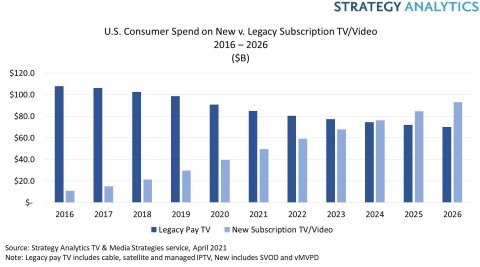
According to the report, U.S. Subscription TV Forecast, consumer spending on traditional pay-TV services fell by 8% to $90.7B in 2020 and will decline further to $74.5B in 2023.

By contrast, spending on streaming services (such as video-on-demand and internet-delivered subscription TV) rose by 34% to $39.5B in 2020 and will reach $76.3B in 2024, passing pay-TV for the first time.

By 2026 the report predicts that pay-TV will account for only 40% of spending on video and TV services, compared to 81% ten years earlier.

This continued shift in consumer expenditure is the most important sign of the transformation in the television and video business which is engulfing content producers, aggregators, distributors, and technology partners.

Figure 1. US Consumer Spend on New vs. Legacy Subscription TV /Video from 2016-2026 ($B)Figure 1. US Consumer Spend on New vs. Legacy Subscription TV /Video from 2016-2026 ($B)

Growth metrics in subscription video-on-demand (SVOD) usually focus on numbers of subscriptions, but this ignores what matters most – money. In spite of the many challenges it has faced, pay-TV still commands much higher monthly revenues from its declining base of customers than from any single SVOD service.

Nevertheless, as more households add new SVOD services while cutting the pay-TV cord, revenues will inevitably shift further away from legacy pay-TV.

“The revenue picture gives the best illustration of the relative strength of new and old businesses,” says Michael Goodman, Director, TV & Media Strategies.

“The fact that viewers are willing to divert an ever-increasing share of their entertainment wallet away from pay-TV and towards new internet-based services demonstrates that the future lies with streaming video services rather than legacy pay-TV players.

This is a long-term transition, but there is no doubt that the writing is on the wall for pay-TV as we have known it for more than 40 years.”

UNCTAD — China: The Rise Of A Trade Titan

0

China is perhaps one of the most unprecedented stories of economic development in recent history. In the last 25 years, the country’s economy rapidly expanded, lifting more people out of poverty than anywhere else in the world.

But all this wouldn’t have been possible without another outstanding story: the emergence of China from the periphery of world trade to becoming a global trade titan.

Genesis Of A Trade Transformation

While the rise of China as an export powerhouse became evident at the beginning of this century, the story began earlier. Towards the end of the 1970s, China began a set of reforms to upgrade its economy and open up to the world. At that time, its share of global trade stood at less than 1%.

In 1986, to enhance and secure access to foreign markets for its growing exports, China applied to join the General Agreement on Tariffs and Trade (GATT).

However, the accession process was derailed, and 15 years passed before China could formally connect to the multilateral trading system. During these years, its share of global trade gradually increased but China’s participation in the global economy remained well below its potential.

By the turn of the century, two intertwined events put China on the path towards becoming the manufacturing powerhouse of today: the emergence of global value chains (GVCs) and China’s accession to the World Trade Organization (WTO).

In the mid-1990s, advancements in transport logistics and information and communication technologies enabled the fragmentation of production across the globe. Soon thereafter, GVCs scoured the globe seeking reliable low-cost partners to allow them to scale up operations, but with mixed consequences on labour conditions and carbon dioxide emissions.

At the same time, the newly formed WTO – founded in 1995 – provided a more structured regulatory environment for international trade, an international dispute settlement mechanism, as well as lower cross-border transaction costs resulting from lower tariffs and restraints on the use of some non-tariff barriers.

China’s accession to the WTO in 2001 allowed GVCs to reliably tap into the country’s potential as a manufacturing powerhouse, enabling it to dramatically expand its exports to the rest of the world. From then on, history was written fast. By 2010, China was already the world’s undisputed export champion.

Meteoric Rise Both Admired And Questioned

The rise of this trade titan has been both admired and questioned. Concerns on the use of state subsidies, quotas, export measures, intellectual property rights and the management of its exchange rate have been a bone of contention.

In fact, many of these concerns form the bulk of complaints brought to the WTO and are behind the ongoing trade disagreements between the United States and China.

Nevertheless, China’s exports proved to be resilient not only to this constant stream of complaints but also to the trade tensions with the United States and souring relationship with the European Union – in March 2021 the EU issued its first sanctions against China since 1989.

Indeed, China’s importance to global production in most sectors, from precision instruments and industrial machinery to computers and smartphones, has constantly increased during the last two decades.

The COVID-19 pandemic has further demonstrated the keystone role that China plays in the global economy. In early 2020, when COVID-19 infections were gathering pace across the country, production processes across the globe stalled or slowed because of disruptions faced by Chinese suppliers.

Moreover, high levels of export resilience have afforded China not only a swift export recovery from the pandemic, but also allowed for further gains across a variety of export sectors, even when those sectors have experienced overall decline. As a result, China’s share of global trade increased further during 2020, to nearly 15%.

In 2021, China’s trade recovery from the crisis has been impressive. In the first quarter of this year, its exports surged by almost 50% year-over-year, to about $710 billion.

Although such a large increase is partly due to the low base of last year, the result of the first quarter is still 27% higher (about $150 billion) than the first quarter of 2019, before COVID-19 hit China and then the global economy.

What’s Next For China As The Global Export Powerhouse?

Overall, China is likely to remain the world’s leading exporter for the near future. However, its exports dominance in the global economy may be approaching its peak. There are a number of reasons for this.

First, China’s economy is maturing to be more reliant on domestic rather than foreign demand, as the prominence of exports in the Chinese economy has been rapidly declining in recent years. For global trade, this implies that Chinese imports are likely to increase faster than exports, thus eroding China’s exports share in the global economy.

Second, increasing labour costs in China are eroding its global competitiveness, especially in labor-intensive production processes. This will eventually result in the relocation of global production to lower-cost countries. Highly competitive economies like Viet Nam will likely chip away trade from China.

Moreover, advancements in labour-saving technologies, such as automation and robotics, as well as fiscal incentives like incentives to firms and tax credits for local employment, are improving the financial attractiveness of reshoring some manufacturing processes closer to consumers in developed countries.

Finally, headwinds hitting the globalized economy are strengthening. Current geopolitical tensions and national policy shifts, which are increasingly considering social and environmental aspects of development, may reverse the hyperglobalization process of the past more than 20 years.

A further escalation of tensions and a lack of global action to address social and environmental concerns could lead to a deglobalization process that will likely have stronger-than-average implications for major exporters such as China.


Aigboje Aig-Imoukhuede Launches A 12-Month Internship Programme For Nigerian Youths

As part of the global launch of Leaving the Tarmac: Buying a Bank in Africa, Mr Aigboje Aig-Imoukhuede has announced a golden opportunity for five young Nigerians to join his ecosystem of businesses and philanthropic ventures for a year as mentored interns.

Aig-Imoukhuede made the announcement on Thursday (April 22, 2021) when he met with the youth of the Ovie Brume Youth Centre to inspire them and engage with them on key learnings from his recently published memoir Leaving the Tarmac: Buying a Bank in Africa. A strong theme of the memoir is the compelling necessity for successful people to share their experiences and learnings with others to inspire and to help fast track their success.

It was both his responsibility and his honour, he said, to create the mentoring internships as he himself benefited greatly from the mentoring he received early in his career. He further stated that he was driven to share, with young people, the knowledge and experience he gained through years of building his businesses and bringing about real, impactful socio-economic change in Nigeria… a pursuit he remains actively involved in.

The internships will be offered to five Nigerians aged between 19 and 26 who either hold a degree or who will graduate at the end of 2021. Outside of these formal criteria for eligibility, Aig-Imoukhuede says, he is looking for young people with grit, determination, a passion to succeed, and the will and drive to work hard to accomplish their ambitions.

The five interns will join Aig-Imoukhuede, working alongside him and other senior executives, and will benefit from one-to-one and group mentoring meetings throughout the 12-month internship period. The internship programme also comes with a salary.

While addressing about 120 young people at the Ovie Brume Youth Centre on Thursday, Aig-Imoukhuede said: “I strongly urge young Nigerian to apply for the internship programme. I guarantee that working alongside myself and my team of senior executives will be an edifying and extremely valuable energy- and time investment. Expect to work hard, learn much and enjoy unrivalled professional and personal growth opportunities.”

The internships will be squarely mentoring-focused, he added, committing himself to making time to engage the interns on matters relating to excellence, growth and fostering networks with like-minded people who enable success.

Full details of the Internship and Mentoring Programme can be found at https://www.leavingthetarmac.com/mentoring-programme the website of the recently published memoir, Leaving the Tarmac: Buying a Bank in Africa.

Applications open on Tuesday, April 27 and the five successful candidates will be announced in the second half of May 2021.

Applications will be competitive. However, Aig-Imoukhuede has no doubt that among the ranks of Nigeria’s young people are the five that he seeks, and whose lives he is excited and eager to be a constructive part of for the next year.

“I urge all eligible young people to apply,” he adds. “I look forward to meeting you and working with you to put you on the path to success. Ambition is best served by partnerships, wisely cultivated friendships and mentoring. Come, let’s shape your future, and the future of Nigeria, together.”

Leaving The Tarmac: Buying A Bank in Africa was launched at a global virtual event om March 29, 2021 and has received great reviews. Profits from the sale of the book will be channelled to The Adopt-A-Health Facility Program (ADHFP) in Nigeria.

Chemical and Allied Products Revenue Declines; Profit Drops 55.5% in Q1 2020

27 April 2021 – Chemical and Allied Products Plc (CAP), one of Nigeria’s leading paints and coatings companies, announced its unaudited results for the period ended 31 March 2021.

Commenting on the performance, Managing Director, David Wright, stated:

“In the first quarter of 2021, we saw the biggest impact of the COVID-19 pandemic on our business. Increased global demand for chemicals driven by the economic rebound in Asia and feedstock challenges, with several suppliers declaring Force Majeures, resulted in a global shortage of raw materials.

This significantly impacted product availability in the first quarter of the year. In addition, there was a scarcity premium placed on all available raw materials which eroded gross margin across various product lines.

We have taken steps to secure alternative raw material sources and are increasing inventory levels to mitigate against further disruptions. As such, we expect a strong recovery in the remaining quarters of the year.

Our focus remains on creating shareholder value and we will continue to pursue attractive growth opportunities to achieve this.”

Highlights

  • Revenue of N2.1 billion, lower than Q1 2020 by 9.5%.
  • Gross profit of N703 million, with a gross margin of 33.5%.
  • Operating expenses better managed with opex/ sales of 23.3%, an improvement of 252 basis points from 25.8% in Q1 2020.
  • EBIT of N236 million, with EBIT margin of 11.3%.
  • Profit Before Tax of N299 million, with a PBT margin of 14.3%.
  • Profit After Tax of N203 million, with PAT margin of 9.7%.
  • Inventory of N2.0 billion, up 111% compared to N967 million at Dec 2020.
  • Trade and other receivables of N194 million, down 58.1% compared to N461 million at Dec 2020.
  • Cash of N5.7 billion, of which N1.4 billion is expected to be distributed as dividends to shareholders in June 2021.

Chemical and Allied Products Revenue Declines; Profit Drops 55.5% in Q1 2020 Brand spur nigeria

Chemical and Allied Products Plc (CAP) is a leading paints and coatings company in Nigeria with globally recognised brands such as Dulux and Caplux. CAP manufactures and sells premium and standard paints and coatings and is the sole technological licensee of Akzo Nobel Coatings International B.V. in Nigeria.

Chemical and Allied Products Board Meets for Q3 Results, Begins Closed Period

CAP pioneered the colour centre concept in Nigeria in 2005, which resulted in the evolution of the Nigerian paint industry.

Today, CAP has 76 colour centres and colour shops across 31 states. CAP is a public company listed on The Nigerian Stock Exchange now Nigerian Exchange Group. It is a subsidiary of UAC of Nigeria PLC which holds 51.49% of the company’s shares.

Q4 2020 Banking Data Report: Gross Loans Trend Higher Amidst Improving Asset Quality

Earlier, the National Bureau of Statistics released the Selected Banking Data Report for Q4-2020. In the report, the banking sector Gross loans reportedly grew 16.6% y/y as well as 5.3% q/q to N20.5tn.

Similarly, absolute Non-Performing Loans (NPLs) rose 16.0% y/y and 5.5% q/q to N1.2tn at the end of Q4-2020. Furthermore, while NPL ratio grew 1bp q/q, it declined 4bps y/y to print at 6.0% at the end of Q4-2020.

The growth in gross loans from the banking sector comes despite significant macroeconomic risks in 2020 due to the Covid-19 pandemic. That said, we note that gross loan growth has been driven by a confluence of factors.

First, the CBN’s regulatory directive which saw the Loan to Deposit ratio (LDR) rise to 65.0% supported lending appetite among commercial banks. Also, the Naira devaluations over the past year have increased the Naira value of foreign currency loans.

On the decline in NPL ratio, we believe this was driven by CBN’s regulatory forbearance which allowed banks to restructure their loan books, particularly in sectors vulnerable to the shocks ignited by the Covid-19 pandemic.

Looking ahead, we observe that growth risks have continued to dissipate amidst renewed optimism on full economic reopening in Nigeria. However, the operating environment for businesses remains fraught with legacy structural concerns.

Thus, we think lenders operating at the CBN’s 65.0% Loan to Funding ratio will be reluctant to provide more credit, while those still falling short will remain active credit creators, considering the effect of CRR debits on banking system liquidity.

On NPLs, given the banking sector’s exposure to the oil & gas industry, we do not expect a major shock in NPL ratio, considering the recovery in crude oil prices. Also, the near-fully reopened Nigerian economy posits a better macroeconomic and business story for loan performance in non-oil sectors.