Cybersecurity: Data Is An Asset – Are You Protecting It?

Cybersecurity refers to the tools, processes, and expertise used to protect computer networks from intrusions by outside parties.

Data theft is a major concern for businesses, and cybersecurity analysts are tasked with identifying and defending against hacking attempts. Companies that fail to take cybersecurity seriously may suffer financial, operational, and reputational damage.

There are many reasons someone would steal sensitive information, from identity theft to corporate espionage. The list of companies recently targeted by hackers includes household names from the retail and finance sectors. Building a robust cybersecurity framework has become a priority for businesses that collect or distribute sensitive information. In today’s digital economy, that encompasses both corner stores and multinational corporations.

How Cyber Threats Affect Businesses

Hackers are adept at uncovering system and software vulnerabilities that allow them to access or disrupt business networks. The risk of an intrusion is very real. Here are five common types of cyberattacks and how they can affect a business:

Malware

Malicious code, such as a virus, is introduced to a network through an email, a link, or a physical upload. The malware can wreak havoc on internal systems, stealing data, erasing files, or blocking access for authorized users. Malware that infiltrates a point-of-sale system, for example, can monitor credit card swipes and expose businesses and customers to identity theft risks.

So-called ransomware attacks are a variation on this theme, with hackers demanding payment in order to repair the damage they’ve done.

Malware spans three risk categories: operational, financial, and reputational. In many cases, computers infected with malware become very expensive paperweights. Businesses often lose access to customer files, inventory records, and other electronic documents. When a company’s ability to operate is disrupted, the financial damage is all but assured. Finally, news of hacks can cost a business customer or expose it to lawsuits.

Phishing

A common tactic of hackers, phishing allows unauthorized parties to collect login credentials. Phishing schemes can take several forms:

  • An attacker impersonates a legitimate user and sends an email or message to an employee seeking a username and password. The real employee thinks they’re helping a colleague but instead ends up abetting the scheme.
  • The hacker creates an official-looking bogus website for a company system or account. They then send a message asking an employee to login to the site, often to verify details. Once the attacker has collected the employee’s login information, they use it to gain access to the real website.

Once an unauthorized user has access to a business account, they can steal customer details, access proprietary information, and cause all manner of problems. Depending upon how long the scheme goes undiscovered, the company can suffer severe financial and reputational damage.

Network Eavesdropping

A Wi-Fi network is compromised, allowing unauthorized people to collect unencrypted data broadcast over company routers. Wi-Fi eavesdropping generally requires the intruder to be in close proximity to the network. Wi-Fi encryption can help prevent this, so long as attackers don’t gain access to router login credentials.

Access to a Wi-Fi network can be a goldmine for hackers. They can collect financial information, employee records, or any other sensitive files transmitted over the network.

Distributed Denial-of-Service Attacks

The goal of a DDoS attack isn’t to steal data, but instead to overwhelm a network to the point of collapse. Attackers will often release malware that hides itself on unsuspecting people’s computers all over the internet – until given an order to begin accessing a website. The server hosting the site suddenly receives a spike in requests from all those infected computers, causing it to “seize up” and deliver error pages.

What does a hacker gain from a successful DDoS attack? Usually nothing more than the temporary disruption of a business’s website. But this can have severe consequences if a site is pulled down during a peak time for the business, such as Black Friday or Cyber Monday. DDoS attacks have also been used to briefly silence political organizations or government agencies. Many so-called “hacks” of internet sites are DDoS attacks.

DDoS attacks present an operational risk, and extended outages can cause financial pain. There are fairly simple steps businesses can take to harden their defenses, but many companies are blind to the threat until it’s too late.

Device Theft

Traditional theft may not garner much media attention these days, but when an employee laptop, smartphone, or USB drive is stolen, it can be a formidable threat to the employer. Many people use multiple devices to do their jobs, and each piece of hardware contains a treasure trove of data that can simply “walk out the door” in the hands of a thief.

Device theft can expose a business to a broad range of risks depending upon the nature of the stored data. Confidential documents might contain sensitive financial details or reveal a company’s strategy for taking on competitors. If customer information is leaked by the theft, there can be legal ramifications and reputational damage. Taking measures to safeguard devices is essential to building a strong cybersecurity framework.

How to Prevent Cyberattacks

Cybersecurity experts must protect networks against attacks on multiple fronts. New viruses and security vulnerabilities are discovered daily, but businesses can adopt best practices to help shield themselves from cyberattacks:

  1. Educate employees about malware and phishing. Many people have at least a passing familiarity with the idea of computer viruses. Explaining how common attacks occur, including how to identify suspicious communications, can provide a good first-line defense against hackers. Ask employees to forward these messages to your IT team for further analysis. Network administrators may be able to block senders from delivering more messages.
  2. Ensure that communications are encrypted, and install software patches as early as possible to bolster security controls. Virtual private networks (VPNs), WPA2 and SSL encryption, and security updates from software publishers can all work together to make your network more resistant to hacking. Many attacks used by hackers are already known to cybersecurity experts, and these professionals have written code to protect against the threats. Take advantage of software patches as they become available.
  3. Establish strict data security policies. All employees should understand what the company expects in regards to data and device security. How should people log on to company systems when working remotely? What are their responsibilities when taking laptops or USB drives outside of the office? Most importantly, explain reporting standards that should be followed when an attack is suspected. Don’t wait until after an information security incident to consider the answers to these questions.

Cybersecurity Risk Management and Your Vendors

Many businesses share data with third-party vendors. Cloud-storage solutions may house customer information on servers owned by another company. As a result, a business depends upon another company’s cybersecurity risk management framework to secure data. Management must perform their due diligence when entrusting sensitive files to another party.

The cybersecurity threats discussed above can also affect your business partners. What can a company do to manage risks to data stored externally?

  1. Research potential vendors and existing partners. Learn all you can about their business, including data breaches that may have affected them in the past. You can consult business information databases and media reports to help uncover such incidents.
  2. Ask your partners about their data security infrastructure and policies. A business has every right to know how a vendor will safeguard their information. Pursue answers to your questions until satisfied that the other company is doing all they can to protect your data.

The battle between cybersecurity professionals and hackers will persist into the foreseeable future. Cybersecurity risk management can help businesses take steps to protect their digital resources from hackers.

What Is Brand Equity?

0

This is the first of a series of articles that explore the theme of brand equity – what it is, how to measure it, how to build it, the impact of media investment on it, the role of brand positioning as a solid foundation, all of which contribute (or should at least) to the making of one’s brand strategy.

First stop in your journey: ‘what is brand equity and how to clear the pandemic fogginess that’s currently around it.

A Short History Of Branding

Branding is about making your mark; without differentiation, everything is identical. Back in the 1500s (or some would say, even further back in ancient Egypt), it was all about making your mark – literally – with brand marks on cattle. Much, much later (if there’s anything Mad Men’s Don Draper taught us), the golden age of marketing cemented ‘instant associations’ as the winning formula for brand growth – i.e. making your mark figuratively.
This network of associations in people’s heads makes a product’s assets – verbal, visual or auditory – distinctive; these associations trigger an instant recognition that acts as a shortcut to brand meaning. There are some of those assets we would instantly recognize, even if we could only catch a glimpse of them, even if they were not fully formed. Think of strong brand mnemonics like Apple’s half-eaten apple, McDonald’s golden arches, Mastercard’s deep association with the word ‘priceless’, Intel’s three-second audio – someone, somewhere in the world plays that tune every five minutes, so it’s no wonder it’s entrenched in our minds.

An instantly recognizable brand is not always the chosen one though. It’s the power of brand equity that is revealed in people’s choices, which often is the tipping point between a brand and its competitors. And it all starts with power in the mind of the consumer, one’s predisposition towards a brand.

Power in the mind: the persistent nudge called predisposition

People and brands live and interact alongside each other. People form thoughts and feelings, gather facts and anecdotes, experiences, frustrations, even hopes towards a product or a service. It’s these cumulative associations that will steer their decision in a purchasing situation. Or, simply put, it’s the sum of all positive and negative attitudes and experiences that a consumer has developed towards a brand that defines whether they will ultimately pick it (often, again).

Predisposed consumers will find themselves inclined to:

  • buy with less reminding
  • overcome market obstacles to obtain that brand
  • pay more for it
  • be more likely to tell others about it
  • be less influenced by competitive advertising.

Over the last decade, companies have increasingly invested in inactivation, targeting, and incentivizing buyers in their category. Our analysis finds though that two-thirds of growth comes from people who are already predisposed to choose a specific brand. Fulfilling that predisposition is less a matter of discounts and promotions and more about ensuring a brand is easy to bring to mind and easy to buy.

Survived (or even thrived) During Last Year’s Storm? Your Brand Equity Had Something To Do With It

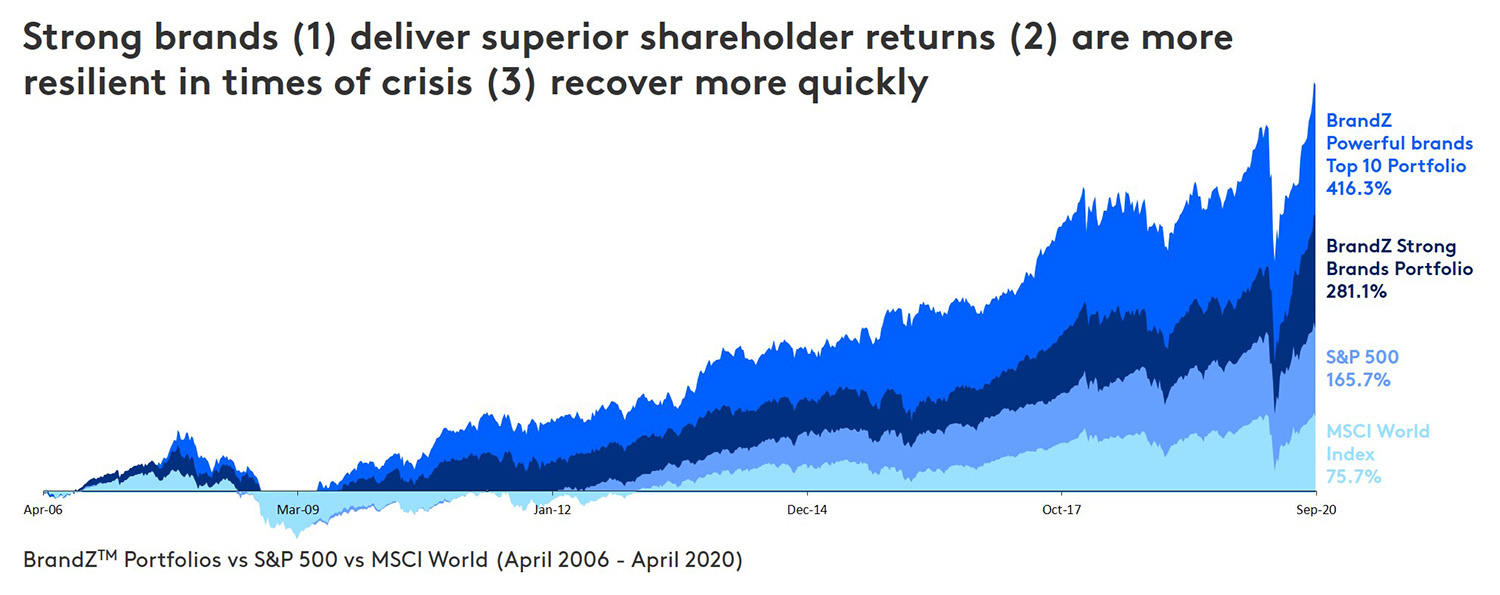
Brand equity is the core element of your brand strength. In good times and tough times, strong brands win. In good times, strong brands grow value faster; in tough times, strong brands recover faster. BrandZ research provides evidence from two crises – the 2008 Great Recession and the current pandemic. And although history hasn’t repeated itself exactly, it’s proven to be an important guide. Following the financial crisis of 2008, strong brands recovered almost three times faster within two years… and over the last year, it is the strong brands again that have managed to stave off the worst of the crisis – growing in value against a backdrop of uncertainty.

Strong brands deliver superior shareholder returns are more resilient in times of crisis recover more quickly

Brand strength is key. During the height of the pandemic, luxury brand sales declined precipitously in China. But when the market reopened, pent-up demand for these brands popped up like a jack-in-the-box. The primary factor for this was the power of the brand, in this case, that of the luxury category, which tends to enjoy strong brand equity in China. So, strong brand equity adds resilience.

Knowing your brand equity, how to measure it and how to build it, is the foundation for success. We will explore both themes in the upcoming articles of the series.

It Takes More Than Luck To Build Irresistible Brands.

Our meta-analysis of growth drivers shows that brands with strong clarity (i.e. the extent to which what a brand stands for is universally understood and perceived by consumers) contribute 70% more to sales. Clearly, meeting consumers’ functional and emotional needs (i.e. being instantly meaningful) offers a commercial advantage to a brand. But is this enough to maximise growth? The biggest success stories come from brands that are meaningfully different; those that stand out and then stand for something.

Jeremy Bullmore once said: “People build brands as birds build nests, from scraps and straws we chance upon.” Consumers construct their perceptions of brands from their own experiences, moments, trials, ads, in essence, all the clues that brand owners lay out in front of them. But brand owners can’t leave this to chance – their brand building needs discipline, it needs a framework that provides focus at every stage of the journey; from defining and refining/resetting brand strategy to guiding effective development and getting implementation right.

Using Kantar’s NeedScope, brand owners are making the most of every brand encounter, ensuring their brand’s essence consistently permeates and connects everything they do. Precisely how it drives meaningful difference and fuels a brand’s growth, we will explore in another upcoming article of the series.

The Bottom Line: Brand Equity Has A Strong Relationship To Sales – Both In the Short And the Long term

“But nothing ever moves” was a common observation in traditional survey brand trackers. KPIs, wave after wave, only shifted marginally. So, understandably, and fuelled by the abundance of digital and behavioural data, over the last few years there has been a concerted push for a narrower range of KPIs that have a proven relationship to financial outcomes. Which made marketers more commercially credible in the boardroom and their activities generating a definite sales return. For the short term, that is.

And I will explain: the drive for evidence-based KPIs pushed marketers towards activity with ROI that’s easier to demonstrate (short-term sales or digital click-through behaviours) as opposed to activity with potentially the greatest ROI (longer term growth and sustainable profitability). Binet’s and Field’s 60% brand building/40% sales activation* harmonic ratio is enjoying universal acclaim and their work of genius is now even featuring in modern job descriptions: “You’ll be responsible for developing an end-to-end marketing strategy, applying brand building and activation marketing approaches such as Binet and Field to develop and activate plans for (…)”. So, in principle, everyone is in agreement. But, “It’s groundhog day in most marketing departments,” as Mark Ritson puts it. “They never get to make money because they are trapped, paradoxically, in an ROI cycle, which delivers less money over the long term.”

Over the last few months, businesses worldwide, have taken multiple approaches to overcome the crisis and mostly focused on reducing fixed costs and discretionary spend; marketing, communications and media** were the hardest hit, as it was revealed in Kantar’s Global Business Compass. Which put even more pressure on marketers to appear impactful within the year’s planning cycle and the already malfunctioned pendulum swung even more towards immediate ratification – short-term sales activation.

With the overhaul of spend remaining, how can one combat short-sightedness and improve their brand’s chances of achieving sustainable growth?

Ka-ching… A First Taster Of Game-Changing Metrics

If only there was a set of proven indicators that can monitor and guide performance in the immediate short term, whilst, at the same time, signal if your brand is on track for longer term sales success. Well, there is. Mental availability/salience (not to be confused with awareness***) has been established as the foundation of brand tracking and equity research that has also a proven relationship to long-term sales. By no means the only one, but what Byron Sharp (n 2012’s ‘How Brand Grow’) calls ‘mental availability’ is a crucial determinant of whether people will buy (or not) a product/service, hence very relevant regardless of a marketer’s short-term or long-term focus.

Recent industry thinking, notably from the Ehrenberg Bass Institute, has further enhanced our understanding of mental availability/salience. Detecting the early signals of how easily your brand can come to mind when prompted by a relevant need or occasion will drive sales growth today and demand for tomorrow.

Please get in touch to discuss the full set of proven indicators for brand growth, and how we can help you build your brand equity. And watch this space as our brand equity series unfolds; over the course of the next few months, we will be releasing articles on all things brand equity addressing the themes raised here and more.

Notes

*for FMCG and varies by category

**Effective advertising is a critical mechanism to help build brands in the long term, as well as drive sales in the short term. This year’s Creative Effectiveness Awards highlights winning tactics and The 5 Habits of Highly Successful Advertisers

***Brand salience is the degree to which a brand comes to mind in a buying situation. Awareness is simply what brands come to mind when consumers are asked to recall brands within a category.

Kantar has appeared as a guest speaker on Mark Ritson’s Mini MBA programme for Marketers presenting our aligned thinking on ‘Measuring what matters and what moves’.

Ericsson Launches Automation Hub In Nigeria

Ericsson announces plans to create an Automation Hub in Nigeria to support operators for improved consumer experience.

Ericsson Automation Hub is an open innovation platform, inspired by lean startup methodology in which the Ericsson team works in close dialog with customers, users, and partners to showcase and reach the high potential that network automation allows in configuration, provisioning, assurance, and orchestration of network services.

This will enable service providers to gain the ability in their environments to govern, manage and orchestrate hybrid networks holistically and in real-time and as a result, offer an enhanced consuming experience.

Fields to be covered include but not limited to 5G and Internet of Things (IoT) use cases, Network Slicing and Orchestration, Hologram Calls, Complex Standalone, Business Support System (BSS) and Operations Support System (OSS), Cloud and Core product cases, Automated Acceptance Tests demonstration and enhancements as well as complex charging scenarios for 5G and 4G networks.

Lucky La Riccia, Vice President and Head of Digital Services at Ericsson Middle East and Africa at Ericsson says: “As Industry 4.0 accelerates in Africa, automation in operations is proven to boost customer experiences.

“Ericsson continues to support the telecom industry players in setting #AfricaInMotion, and with the Ericsson Automation Hub in Nigeria, we will focus on driving business outcomes for our partners in Africa as they aim to leverage on digital transformation to turn complexities to opportunities while offering a greater experience and value to consumers.”

Hyundai Unveils Segment-Shattering Santa Cruz Sport Adventure Vehicle

Hyundai has unveiled its highly anticipated Santa Cruz Sport-Adventure Vehicle. The 2022 Santa Cruz breaks new ground within the SUV, Truck, and Crossover segments by offering a true Sport-Adventure Vehicle unlike anything else in the U.S. market.

Santa Cruz boasts a bold yet sophisticated design, powerful and efficient powertrain options, a flexible open bed for gear, cutting-edge connectivity, and a highly maneuverable all-wheel-drive platform that is equally at home in urban and adventure-focused environments. The Santa Cruz Sport-Adventure Vehicle begins production in Montgomery, Alabama in June and will be available for sale in summer. The addition of Santa Cruz to HMMA production will add an estimated 1,200 jobs to the U.S. economy. Hyundai is also creating an early reservation system for the U.S.-market Santa Cruz in late April at https://www.hyundaiusa.com/.

“Santa Cruz, with its bold styling, breaks open all new segment territory, both for Hyundai and the industry as a whole. Open-bed flexibility coupled with closed-cabin security meets the changing everyday needs of its adventure-oriented buyers, while powerful and efficient engines and superb maneuverability ensure it is a pleasure to drive in urban or off-road environments. Our customers will wonder just how they managed before owning one,” said Jose Munoz, president and CEO, Hyundai Motor North America.

Hyundai Unveils Segment-Shattering Santa Cruz Sport Adventure Vehicle-Brand Spur Nigeria
Hyundai Unveils Segment-Shattering Santa Cruz Sport-Adventure Vehicle-Brand Spur Nigeria

Why Santa Cruz?
Santa Cruz was developed to be the ultimate Sport-Adventure Vehicle, a moniker confirmed in Hyundai’s early consumer research. The research found consumers, often living in urban environments, whose lifestyles include the need to escape to weekend adventures of all kinds. Many of these customers carry various gear and equipment that is better suited to an open bed rather than a typical SUV Bodystyle. These buyers want versatile transportation that is equally flexible for urban, adventure, occupational, or even home improvement gear. Santa Cruz features a secure, open bed area that includes a lockable tonneau cover, hidden bed storage, and versatile bed extension accessories. At the same time, these customers still value the secure utility of a compact SUV, with its comfort, passenger space, fuel efficiency, and parking ease. Santa Cruz, with its unique, bold design, created an entirely new segment that meets this specific buyer’s needs like no vehicle before it.

Everything about Santa Cruz reflects a duality of purpose in its design execution. This all-new category-bending vehicle holds a variety of imagery in balanced juxtaposition:

  • Urban life connectivity with escape to outdoor adventure
  • Work and play flexibility
  • Tough yet alluring demeanor
  • Roominess with maneuverability
  • Open cargo area and secured, lockable storage
  • Towing capability and fuel efficiency

The forward view of Santa Cruz deploys a hidden lighting signature that becomes visible within the grille only when illuminated. The daytime running lamps (DRLs) present a parametric jewel design with high-tech precision detailing. A bold, cascading grille anchors the front view, supported by a skid plate element in the lower front fascia. Voluminous hood and fenders further communicate an imposing first impression.

In profile, Santa Cruz signals a sporty yet capable spirit. The A- and C-pillars present faster forward and rearward rakes than typical open-bed utility vehicles. Large 20-inch alloy wheels with a multi-faceted, triangular design are surrounded by armor-like wheel arches, conveying both wheel-articulation potential and off-road capability. Powerful body side volumes contrast with precise triangular sheer-edged surfaces and tight radius character lines.

From the rear, a horizontal “T” lighting signature adds visual width and distinguishes Santa Cruz from anything on the road. The functional rear open bed area features secure, lockable in-bed storage, integrated corner bumper steps and a lockable tonneau cover, seamlessly integrated with the overall design. The rear tail lamps are embossed with: “Designed in California” as a testament to the passion of Hyundai’s California-based design team. Small, discrete design details such as this can be found throughout the exterior and interior.

Interior Design
The interior of Santa Cruz expresses a sophisticated and refined appearance. The contrasting rugged yet refined motif matches the boldness of the exterior, boasting a technical ambiance that appeals to those who appreciate cutting-edge technologies in their daily lives. It features an enveloping dual-cockpit design that encapsulates each passenger. Design teams focused on ease of ingress and egress and ergonomic comfort on long drives. The premium center stack display features an edgeless infotainment screen appearance, with an impressive 10 inches of visibility. The optional center digital cluster display also measures 10 inches. Under the rear seats is convenient, in-cabin storage. Completing the premium ambience is an available Bose® audio system.

Hyundai Unveils Segment-Shattering Santa Cruz Sport Adventure Vehicle-Brand Spur Nigeria
Hyundai Unveils Segment-Shattering Santa Cruz Sport-Adventure Vehicle-Brand Spur Nigeria

Powerful and Efficient Powertrains
Santa Cruz offers two powerful, flexible, and efficient powertrains. The standard powertrain is a 2.5L direct-injected in-line four-cylinder engine with an estimated 190+ horsepower and 180+ lb.-ft. of torque. This engine coupled to an eight-speed hydraulic automatic transmission for quick acceleration and superb efficiency. Santa Cruz also offers a 2.5L direct-injected turbocharged engine with an estimated 275+ horsepower and 310+ lb.-ft. of torque linked to an eight-speed dual-clutch automatic transmission (DCT). This DCT includes steering-wheel-mounted paddle shifters for manual shifting control by the driver. Eight-Speed Automatic Transmission
The eight-speed transmission for the standard 2.5-liter engine provides quick and crisp shifts for an engaging and efficient driving experience. This automatic transmission adds ratio range at both the top and bottom of output speeds allowing for extra thrust off-the-line and a quieter, more fuel-efficient trip on the interstate. A multi-disc and individually controlled hydraulic channel torque converter improve responsiveness by expanding the direct connection band, while a downsized oil pump and double ball bearings minimize frictional losses.

Advanced HTRAC® AWD and Towing Capability
Both 2.5L four-cylinder and 2.5L four-cylinder turbo models offer HTRAC® all-wheel-drive capability for complete confidence when pursuing adventures of all kinds or for that extra peace of mind when driving in an unexpected snowfall. The HTRAC AWD system was developed as a multi-mode system, providing an electronic, variable-torque-split clutch with active torque control between the front and rear axles.

The Sport setting gives a more agile feel by sending more torque to the rear wheels, for a sporty, dynamic experience. This system has a wide range of torque distribution variability, tuned for conditions such as straight-line acceleration, medium- and high-speed cornering, and hill starts. For those customers who like to tow their weekend gear with them, the 2.5L 4-cylinder is rated at 3,500 lbs. for towing and the 2.5L Turbo AWD model boasts a generous 5,000 lbs. of towing capability.

Compact Dimensions Yield Superb Maneuverability

Santa Cruz makes efficient use of its compact dimensions by offering high utility with excellent maneuverability. Its shorter wheelbase and smaller overall footprint make it a joy to maneuver and park in challenging urban parking, with an exceptional curb-to-curb turning radius of only 20.0 feet.

Specification (in.) Santa Cruz Tacoma Ridgeline Frontier
Length 195.7 212.2 210.0 205.5
Width 75.0 75.2 78.5 72.8
Height 66.7 70.7 70.3 70.1
Wheelbase 118.3 127.4 125.2 126.0
Bed Length Upper 48.4
Lower 52.1
60.4 63.6 59.4
Footprint Area
(sq. ft.)
101.9 109.7 114.6 103.9


Responsive and Refined Chassis Tuning
Santa Cruz was developed with a focus on enhanced driving dynamics and responsive performance for a wide variety of urban and off-road, multi-surface driving conditions. The shorter wheelbase, short overhangs and wide track create a planted stance that results in exceptional agility in urban environments. These specifications also provide confident agility when traversing off-road terrain. Available 20-inch alloy wheels with wide, all-season, all-terrain tires give surefooted, agile handling character on a variety of road surfaces. Available 18-inch wheels with more voluminous tire sidewalls for off-road adventures are also available.

Hyundai SmartSense Safety and Convenience
Santa Cruz offers excellent safety and convenience features, with an array of advanced safety technologies as part of the Hyundai SmartSense feature suite.

Standard SmartSense Safety and Convenience Standard
Forward Collision-Avoidance Assist (FCA) w/ Pedestrian and Cyclist Detection x
Lane Keeping Assist (LKA) x
Driver Attention Warning (DAW) x
Optional Features
Blind-Spot Collision-Avoidance Assist (BCA) OPT
Safe Exit Assist (SEA) OPT
Blind-spot View Monitor (BVM) OPT
Highway Drive Assist (HDA) OPT
Surround View Monitor (SVM) OPT
Rear Cross-Traffic Collision-Avoidance Assist (RCCA) OPT


Advanced Driver Assistance System (ADAS)

Drivers do not want to compromise when it comes to protecting their passengers, so Hyundai has expanded its available SmartSense technologies on the Santa Cruz. This generous suite of advanced features includes many available driver assistance systems, including:

Forward Collision-Avoidance Assist (with Pedestrian, Cyclist and Junction-Turning Detection)

If the preceding vehicle suddenly slows down, or if a forward collision risk is detected, such as a stopped vehicle or a pedestrian, FCA provides a warning. After the warning, if the risk of collision increases, FCA can automatically assist with emergency braking.

Hyundai Unveils Segment-Shattering Santa Cruz Sport Adventure Vehicle-Brand Spur Nigeria

While driving, if there is a risk of collision with a cyclist ahead or an oncoming vehicle while turning left at an intersection, FCA can automatically assist with emergency braking.

Blind-Spot Collision-Avoidance Assist (BCA)
When operating the turn signal to change lanes, if there is a risk of collision with a rear side vehicle, BCA provides a warning. After the warning, if the risk of collision increases, BCA automatically controls the vehicle to help avoid a collision. If exiting a parallel parking spot and there is a risk of collision with a rear side vehicle, BCA can automatically assist with emergency braking.

Rear Cross-Traffic Collision-Avoidance Assist (RCCA)

If there is a risk of collision with an oncoming vehicle on the left or right side while reversing, RCCA provides a warning. After the warning, if the risk of collision increases, RCCA can automatically assist with emergency braking.

Lane Keeping Assist (LKA)

If the driver leaves a lane without the turn signal on, LKA provides a warning. When a lane departure is detected, LKA can automatically assist with steering to help prevent leaving the lane.

Highway Driving Assist (HDA)

Highway Driving Assist helps to maintain a prescribed distance from the vehicle ahead when driving on a highway and helps center the vehicle in the lane while driving, including curves. HDA also can help maintain vehicle speeds according to posted speed limits on federal interstate highways.

Blind-Spot View Monitor (BVM)

When operating the turn signal, BVM displays video of the blind-spot view for the respective side of the vehicle in the cluster display.

Surround View Monitor (SVM)

Surround View Monitor displays a view of the space around the vehicle from above to assist with parking.

Safe Exit Assist (SEA)

When an occupant tries to open a door to exit the vehicle at a stop, if an approaching vehicle from the rear side is detected, SEA can provide a warning. SEA can also help to keep the rear doors closed through operation of the electronic child lock when a vehicle is approaching from the rear.

Smart Cruise Control (SCC)

Smart Cruise Control helps maintain distance from the vehicle ahead and maintain the speed selected by the driver. The vehicle can stop and start automatically when the vehicle ahead is stopped for a short period.

Driver Attention Warning (DAW)
DAW displays the driver’s relative attention level while driving and can provide a warning when signs of driver inattentiveness are detected.
Advanced Infotainment, Connectivity, and Convenience
Santa Cruz provides seamless connectivity and technology that helps drivers escape from the daily stress of long commutes, heavy traffic, road hazards, and distractions. Drivers also expect to stay connected wherever they go, and Santa Cruz provides this capability.

Santa Cruz offers a standard eight-inch color touchscreen. Wireless Apple CarPlay® and Android Auto® are also available to make staying connected easier than ever. Wireless pairing automatically connects an Android or Apple smartphone, so the driver can keep their phone in a pocket, backpack, or purse.

Owners can keep their devices charged on an available Qi wireless charger. Santa Cruz offers Digital Key supported by a dedicated smartphone app. The Hyundai Digital Key app also allows smartphones to control selected vehicle systems remotely. Users can lock and unlock the vehicle, activate the panic alert, and start the engine. Digital Key allows owners to leave traditional keys at home and allows secure sharing of keys with family and friends. Digital Key is currently compatible only with phones using the Android operating system.

The Santa Cruz navigation system offers split-screen functionality that enables multitasking capabilities. Santa Cruz also offers an eight-speaker Bose® Premium sound system.

Blue Link® Connected Car System

Santa Cruz receives many Blue Link® Connected Car service enhancements. As with most Hyundai models, Blue Link is complimentary for three years and includes features such as Remote Start with Climate Control, Remote Door Lock/Unlock, Stolen Vehicle Recovery and Destination Search by Voice and others. Blue Link features can be accessed via interior controls or through the MyHyundai.com web portal, the Hyundai with Blue Link smartphone app, the Amazon® Alexa Blue Link skill and the Blue Link Google Assistant app. Some features can be controlled via Android Wear™ and Apple Watch™ smartwatch apps.

2022 Santa Cruz key features include:

  • Remote Engine Start allows the owner to remotely warm-up or cool down the vehicle using the Santa Cruz key fob on models equipped with Proximity Key and Push Button Start.
  • Remote profile management—stores select vehicle settings to the Blue Link cloud, with the ability to remotely update and push back to the vehicle, personalized to driver preferences
  • Remote start enhancements:
    • Remote seat heating and ventilation(on/off/level for each individual heated/cooled seat)
      Profile selection (preloads individual driver settings for seating position/side mirrors)
  • Vehicle Status Notifications—if the vehicle is left with doors unlocked or windows open, customers will receive a notification
  • POI Send to Car now with Waypoints (ability to add up to three-way points, to be delivered to the vehicle together and automatically set order of destinations)
  • Maintenance Alert Enhancement—maintenance interval tracking is now visible in the multimedia system, with the ability to reset

Pinkberry Nigeria: April Full Of Pinkberry Surprises!

April starts on the cheeky side, with the first day set aside to find the most of laughs where you can get them and that sometimes means playing fun pranks on family and friends in hopes of surprising them for a laugh or a taste of Pinkberry.

With Pinkberry, this is a fantastic chance to give the tastebuds a very mouth-watering surprise as Pinkberry will be re-introducing two exciting flavours – the decadent caramel banana and the refreshing coconut flavour.

Now basking in an April full of exciting flavours- the caramel banana flavour will undoubtedly be the best midday refreshment to take the mind of daily mundane activities which make up the time. We also must mention the coconut flavour that will refresh the tastebuds with a pleasant cool taste, especially for those days when the weather is on the much hotter side.

Enjoy two for the price of one as Pinkberry celebrates National Buy One Get One Free (BOGOF) on the  13th and 20th of April with the incredible offer to purchase two medium cups (without toppings) for the price of one both online and at your nearest Pinkberry outlet.

Pinkberry delivery deal will blow your mind! You get an extra cup free when you buy a medium cup size: on original flavour.  Now, this is what I will call DOUBLE DOSE OF ENJOYMENT!

Pinkberry Nigeria: April Full Of Pinkberry Surprises!

The fun continues with the Pinkberry website fantastic offer, to enjoy 50% off on every purchase of a medium cup without toppings (offer available in all flavours).

Dance to the healthy tune with the super sumptuous, healthy lunch deals. – Sandwich + large cup of frozen yoghurt at N2500 only and salad with a midi to go cup of yoghurt for just N3500.

Get excited because one thing is sure at Pinkberry this April- it’s going to be a fun-filled month with new delicious flavours at incredible prices.

MoneyGram Delivers All-Time Record High For Transactions In Its Direct-To-Consumer Digital Business In March

MoneyGram International, Inc., a global leader in the evolution of digital P2P payments, today announced MoneyGram Online (MGO) recorded an all-time high in cross-border transactions as well as 131% growth in year-over-year cross-border transactions for the month of March. This marks the fifteenth consecutive month of triple-digit growth for MGO.

This continuing growth has been driven by consumer demand for the Company’s leading mobile app as it sustains strong app download growth rates and continues to experience strong customer retention rates.

“It’s thrilling to see MoneyGram hit this growth milestone in our direct-to-consumer digital business,” said Alex Holmes, MoneyGram Chairman and Chief Executive Officer. “Our investments in digital and our commitment to building direct relationships with consumers have enabled the company to capture market share. The growth in monthly active MGO app users is outpacing the competition, and we remain focused on scaling our digital business by fostering a customer-centric culture, elevating our digital experience, and executing our purpose-driven strategy to mobilize the movement of money.”

In addition to delivering the industry’s best customer experience through its app, MoneyGram has continued to hit digital milestones and break records by focusing its strategy on rapidly expanding its digital capabilities internationally, targeting new customer segments, and growing its digital footprint through partnerships with leading brands such as Visa Direct. In the month of March, the Company reported an all-time high in Visa Direct transactions with 545% year-over-year growth.

Holmes concluded: “Our innovation is winning with consumers and driving significant momentum in our business. Our growing digital channel has established the foundation for MoneyGram’s long-term, sustainable growth, and profitability.”

About MoneyGram International, Inc.
MoneyGram is leading the evolution of digital P2P payments. With a purpose-driven strategy to mobilize the movement of money, a strong culture of fintech innovation, and leading customer-centric capabilities, MoneyGram has grown to serve nearly 150 million people across the globe over the last five years.

The Company leverages its modern, mobile, and API-driven platform and collaborates with the world’s leading brands to serve consumers through MoneyGram Online (MGO), its direct-to-consumer digital business, its global retail network and its emerging embedded finance business for enterprise customers, MoneyGram as a Service.

Geely Officially Joins Global Automotive Quality Standards Organization IATF

0

The International Automotive Task Force (IATF), a global organization setting automotive quality standards has announced that Geely Auto Group (Geely) has become the newest OEM voting member of the organization.

The appointment of Geely to the organization as the first Asian member marks a historic milestone in the development of the IATF. Geely will participate in the formation and improvement of international quality standards with other global automotive groups and automobile associations to promote the sustainable development of the world’s automotive industry. Geely has nominated Dr Howard Xu, Senior Quality Director at Geely Auto Group to be its voting representative in the IATF.

The admission of Geely into the IATF is recognition of the Group and its subsidiary brands’ commitment to quality management. As the leading Chinese automaker in the world, Geely will work with European and American automakers to improve and revise IATF quality standards, propose future standards, and add an Asian voice to an international organization.

As an authoritative organization setting standards for the global automotive industry, IATF is committed to optimizing the standardization process, improving production efficiency in the automotive supply chain, and establishing a globally unified automotive industry quality standards management system and quality control tools.

Its members include the national automobile associations from the US (AIAG), Italy (ANFIA), France (FIEV), UK (SMMT) and Germany (VDA) as well as major global automotive groups such as BMW, Daimler, Ford, GM, Renault, Stellantis, and Volkswagen.

The IATF 16949:2016 Quality Management Standards for Automobile Production and Related Parts is a globally recognized automotive industry standard. Meeting the IATF 16949:2016 standard is the most basic requirement for a global automaker and parts supplier.

Currently, more than 80,000 global automakers and parts manufacturers have passed the certification. Geely requires all suppliers to pass the IATF 16949:2016 certification.

In China, Geely Auto Group is also a member of 18 sub-committees in the National Technical Committee of Auto Standardization (NTCAS) and has taken lead in the formulation of 183 national industry standards. Now as a new member of the IATF, Geely will also be involved in the formulation of international quality standards which support the high-quality development of the automotive industry through technological innovation and sustainable development.

10 Key Mortgage Terms You Must Know

You have just decided to take a mortgage loan to acquire your dream home? Wow! That sounds like a good decision. However, there are some important mortgage terms that you have to familiarize yourself with which you will come across during the application process.

We have just compiled 10 key mortgage terms that you will come across when you finally decide to take a mortgage loan. Below are the key mortgage terms:

1. Appraisal   

An appraisal is an activity that the Bank conducts on an intending borrower to assess his income level, net worth, cash flow in order to ascertain that the individual has the capacity to repay the mortgage loan. Once an appraisal is completed, the loan amount applied for can either be reduced due to certain considerations, or there would be a request for more collaterals or assets in order for the mortgage loan to be approved. The appraisal assures the Bank that they are not loaning you more money than you can repay.

2. Credit Scoring

Credit scoring is done to assess the creditworthiness of an applicant by looking at the personal characteristics; the household, the number of children, age, economic characteristics; such as income level, employment status, cash flow, the credit score of the applicant, and valuation of the property. The Bank credit scoring based on the listed factors earlier to check if the applicant is qualified for a mortgage loan.

3. Equity Contribution

Equity contribution is the amount of money that you can immediately contribute towards the purchase of a property. Since the majority of people do not have enough savings to purchase a property outright, the gap between the equity contribution and the house price is financing required. The Bank would require that the applicant provide an equity contribution between 20 -30% or more depending on the value of the loan and the risk profile of the applicant.

4. Debt-To-Income (DTI) Ratio

Your DTI is equal to your total fixed, recurring monthly debts divided by your total monthly gross household income. Mortgage Banks look at your DTI when they consider you for a loan to make sure that you have enough money coming in to make your payments. You may have trouble finding a loan if your DTI is too high. Most lenders cater to applicants who have a DTI of 50% or lower.

5. Principal

The principal is the amount of money you borrow when you originally take out your home loan. To calculate your principal, simply subtract your down payment from your home’s final selling price.

Let us assume you buy a home for N 6,000,000 with a 30% down payment. In this instance, you’d put 1,800,000 down on your loan. Your mortgage lender would then cover the cost of the remaining amount on the loan, which is N4,200,000. Since you owe your mortgage lender N 4,200,000, your principal balance would be N 4,200,000.

6. Term/Tenure

Your mortgage term or tenure is the number of years you’ll pay on your loan before you fully own your home. For example, you may take out a mortgage loan with a 10-year term and that means that you’ll make monthly payments on your loan for 10 years before the loan matures.

7. Amortization

Amortization is the process of how payments spread out over time. When you make a payment on your mortgage, a percentage of your payment goes toward interest and a percentage goes toward your loan principal. At the beginning of your loan, your principal is high and most of your payment goes toward interest. However, you chip away at your principal over time and pay less in interest. An amortization schedule can reflect consistent monthly payments and keep you on track to pay off your loan within the term.

8. Assets

In the context of a mortgage, an asset is anything that you own that has a cash value.

When you apply for a mortgage, your lender will want to verify your assets. This is to ensure that you have enough money in savings and investments to cover your mortgage if you run into a financial emergency.

9. Fixed-Rate Mortgage

A fixed-rate mortgage has the same interest rate throughout the term of the loan. For example, if you buy a home at 4% on a 15-year fixed-rate loan, it means that you’ll pay 4% interest on your loan every month for your entire 15-year term. Most of the time, mortgages created in Nigeria are fixed-rate.

10. Title

A title is proof that you own a home. Your title includes a physical description of your property, the names of anyone who owns the property and any liens on the home. When someone says that they’re “on the title” of a home, it means that they have some kind of legal ownership of the property. Some of the recognizable titles we have in Nigeria are Certificate of occupancy, deed of assignment, deed of lease, deed of sub-lease, land certificate, deed of mortgage, survey plan.

Knowing the above terms will give an applicant a proper understanding of what to expect during the mortgage application process.

At least, the applicant would not appear like a novice to the account officer who is helping with the completion of the application.


Number Of Playstation Plus Subscribers Increased By 22% Yoy To 47.4M Subscribers In 2020

The Playstation Network (PSN) is Sony’s free digital entertainment service that is linked with its Playstation consoles but has since expanded to include other Sony devices.

PlayStation Plus(PS Plus) is the PSN’s paid-subscription service that gives members access to premium features. According to data presented by Safe Betting Sites, Playstation Plus grew to 47.4M subscribers in 2020 – a 22% YoY increase from 2019.

PS Plus Added Almost 10M Subscribers In 2020 – 47.7M Subscribers

PS Plus was launched in June of 2010 as the PSN’s premium service that is paid through a monthly subscription. Having PS plus gives users access to premium benefits such as early access to major title releases, discounts at the PlayStation Store, online multiplayer functionality and even free downloadable games every month.

As of December 2020, there were 47.4M PS Plus subscribers, a 22% YoY increase from 2019. There were also 114M active users of PSN’s free digital entertainment service as of the same time period.


One of the more attractive features that a PS Plus subscription provides is the free monthly games that include some major titles. In 2020, PS Plus subscribers had access to free downloads of 28 games including popular titles such as Uncharted, Call of Duty, and Need for Speed.

Overall, the cumulative retail value of the games offered for free on PS Plus in 2020 amounted to $789.72 with the games having a respectable average Metacritic score of 74.8. The figure is over $100 less than 2019’s figures when PS plus offered 32 free games. These 2 figures from 2019 and 2020 are notably less than compared to years prior due to the PS Plus service stopping support for its PS Vita and PS3 platforms in 2019.

The PlayStation Plus Collection

In September 2020, Playstation Plus unveiled its plans to carry over its users from the PS4 consoles to the new generation PS5 consoles. Sony announced that PS Plus members who purchase a PS5 will gain access to the Playstation Plus Collection. The PS Plus collection includes 20 titles that Sony considers as “generation-defining” for the PS4.

10 of the games are from Sony’s own Sony’s Worldwide Studios while the remaining 10 are from some of the biggest names in AAA gaming. PS plus also made all 20 games available at the onset instead of having incremental monthly releases. The entire collection has an MSRP of $474.80 as per current costs listed in the PS store with an average Metacritic score of 85.15, more than 10 points higher than 2020’s free games offered.

5 Ways To Write An Engaging Value Proposition For Your Website

0

When it comes to selling newspapers, persuasive and relevant “above-the-fold” content has always been a necessity. The top half of the newspaper – the only part that can be seen from newsstands, is what is commonly referred to as “above the fold.” For newspapers to sell out, this above-the-fold content needs to be compelling and enticing.

The same is true of websites. On a website, this is the part visitors and prospects see immediately, without having to scroll. Also known as the “headline”, this section should carry your business’s value proposition. How well you communicate the core value and qualities of your product/service here will make the visitor want to keep scrolling, learn more about you, and ultimately choose you over other competitors.

Your headline and sub-headline should answer these questions, as briefly as possible:
What does your company do?

What pain points does it address and what problems does it solve for your visitors and prospects?

Why should prospects choose you over your competitors?

In other words, a good value proposition knows its target market and through the above, it immediately lets visitors know if they are in the right place or not.

Here Are Five Ways To Ensure You Get Your Value Proposition Right:

1. Speak to your customer about your entire offering

A good value proposition invites visitors to focus on their needs as well as other aspects of their requirements that they may miss out on considering otherwise. Try to capture the whole essence of your offering instead of talking about one specific aspect.

For instance, take a bed and breakfast (B&B) that also includes add-on services like experience packages and guide bookings. The headline and sub-headline together should succinctly inform the visitor that it’s a B&B that not only offers a relaxing stay but also a range of add-ons. A benefits-focused copy always goes a long way.

2. Emphasise your difference

Showcase your product/service’s remarkable qualities that will pique your visitor’s interest. If it’s a CRM software, how is your offering different from the scores of other CRM software in the market? Is it top-rated in the market? Is it recommended by industry experts? Is it priced the best? Is it tailor-made for a certain segment like large enterprises or SMEs?

3. Show them a problem-free and delightful future

Your copy should encourage your visitor to envision a future that will be ‘all the more better’ for them because of your product/service. Say you provide a digital note-taking application. It’s a good idea to portray the pain-points solved as well as the delights offered by the application. The headline and sub-headline could jointly communicate that while the visitor finds it easy to remember things, the note-maker additionally helps them become resourceful and accomplish more by keeping track of their thoughts and ideas in the form of organized lists.

Also, while visualizing the relationship, it’s important to use a copy that’s simple and jargon-free to reinforce the benefits in a more impactful way.

4. Get clever (but not too clever)

Wordplay can be a hit or a miss in copywriting – sacrificing clarity for cleverness in your copy more often than not does not create an impression as powerful as the simple but clear copy that you discarded earlier. Whenever you’re using wordplay or less-common words in your copy, use a light hand. Remember, the goal is to show the customer exactly how your product or service will improve their life.

5. Use hero images and CTAs

If you’ve noticed, most headlines and subheadings on websites are placed in the hero image. What’s more, each sub-headline is directly followed by a call to action (CTA). However, both of these items—the hero image and CTA, should only be the second and third elements you consider for your website’s above-the-fold space. First, try to summarise your business value proposition in a copy that’s simple, clear, and brief.

Additionally, go through the websites of some of your favourite businesses, and see how they are using this valuable real estate. Come up with as many headlines and subheadings as possible. Mix and match them, and get input from other people to make the most of this space.

Written By: Andrew Bourne, Zoho’s regional manager for the Africa region.