Revenues Of Europe’s Top Five Football Clubs Plunged By €670M Amid Pandemic

0

…FC Barcelona Leads With A €275M Loss

The coronavirus lockdown has had a massive impact on the entire football clubs. Despite broadcasters, club owners, and sponsors’ efforts to minimize the losses caused by postponed matches and empty stadiums, the COVID-19 lockdown still produced a costly financial hit.

According to data gathered by Safe Betting Sites, the combined revenues of FC Barcelona, Real Madrid, FC Bayern Munich, Manchester United, and Liverpool FC, as Europe’s five biggest football clubs, plunged by €670 million in the 2019/20 season.

FC Barcelona Revenues Slumped By €275M, The Biggest Loss Among Top Five Clubs

The revenues of the European football clubs have soared in the last twenty years, primarily driven by a surge in broadcast rights values. In the season 2009/10, profits of the big five European football leagues amounted to €8.4bn, revealed Deloitte Annual Review of Football Finance 2020. Over the last decade, this figure grew by 115%, reaching €17bn in 2018/2019.

Europe’s top 20 football clubs generated almost 55% of that value, or €9.3bn, revealed the Deloitte Football Money League 2021.

However, huge drops in broadcast and matchday profits triggered by the COVID-19 lockdown caused their combined revenues to fall to €8.2 billion in 2019/20, down 12% on the prior season.

During the 2019/2020 season, FC Barcelona was the leader among top-20 European football clubs by total revenue. However, the Spanish club also suffered the worst financial hit amid the COVID-19 pandemic. Statistics show FC Barcelona generated €715.1 million in revenue in the 2019/2020 season, almost a €275 million plunge in a year.

As one of the most prestigious football clubs worldwide, Real Madrid has seen its revenues more than double in the past decade. In the 2018/2019 season, the club had an enterprise value of approximately €4.2bn and generated €757 million in revenue. However, statistics show the club’s revenues plunged by €65 million in the 2019/2020 season.

Manchester United Lost €167M In Revenue Amid COVID-19, 3.5 Times More Than Liverpool

As the third-largest football club by revenue, FC Bayern Munich also witnessed impressive revenue growth in recent years. Statistics show German club’s revenues more than doubled in a decade, jumping to over €750 million in the 2018/2019 season. However, the COVID-19 pandemic caused a costly hit to the club`s finances, with revenue plunging by €116.3 million last season.

Deloitte data revealed that the leading Premier League club, Manchester United, suffered the second-largest revenue cut among the top five European football clubs. In 2020, the club’s revenues hit €630 million, almost a €167 million plunge in a year.

As the fifth-largest football club on this list, Liverpool FC generated €558.6 million in revenue in the 2019/2020 season, down €46 million on the prior season.


Lewis Hamilton Becomes Highest-Paid F1 Driver For 2021 Season – A Brief Preview Of 2021 Grid

0

The opening race of the 2021 Formula 1 season is in the books with lewis Hamilton setting the tone and claiming victory at the Bahrain Grand Prix. The record-equalling, seven-time world champion is on a mission to overtake F1 legend Michael Schumacher as the sole leader in world championships.

Mercedes AMG has secured the services of Hamilton for another season and is hopeful that it can help the Englishman accomplish the incredible feat. According to data presented by Safe Betting Sites, Lewis Hamilton is the highest-paid driver of the 2021 season with a $30M annual salary.

Hamilton Vying For Record-Setting 8th World Championship

Lewis Hamilton entered Formula 1 in 2007 and set the sport on fire with an electrifying runner-up finish in the world championship in what was only his rookie season. Since then Hamilton has won seven world championships in his career. Apart from his first world championship with Mclaren, Hamilton had won the rest of his world titles with Mercedes AMG including four straight from 2017-2020.

Mercedes and Hamilton agreed to extend their partnership for another year in a bid to help the Brit win his record-setting eighth world championship. The announcement of their continued partnership came much later than most Mercedes fans would have liked, but the German car giants were finally able to secure the services of Hamilton who will reportedly earn $30M for the 2021 season.

3 Other Former World Champions Also In 2021 Grid

It is clear that Hamilton will not be handed the record easily this season with Red Bull’s Max Verstappen finishing only less than a second behind the current champion after claiming pole in qualifying. Three other former world champions are also on the grid for the 2021 season with two-time world champion Fernando Alonso returning as an Alpine-Renault driver after a two-year hiatus.

Four-time world champion Sebastian Vettel publicly fell out with his former team Ferrari last season and has now signed for Aston Martin-Mercedes for the 2021 season with an option to extend beyond. 2007 World Champion Kimi Raikkonen also returns to the grid for his 20th season in F1 remaining with the Alfa Romeo Racing-Ferrari team.

3 Rookies In 2021 Grid – Yuki Tsunoda First Rookie To Score Points In Debut Since 2016

Yuki Tsunoda is a 20-year-old Japanese driver who is the first driver on the F1 grid born after the turn of the Millenium. The AlphaTauri driver was the standout rookie in the opening race of the season becoming the first Japanese driver to score points in their debut in F1 and the first rookie to do so since 2016 after finishing 9th in Bahrain.

Tsunoda is joined by two other rookies on the grid, Mick Schumacher and Nikita Mazepin who both drive for the Haas team. Mazepin spun out in turn 3 of lap 1 in his debut race, making it one to forget for the Russian rookie driver. Mick Schumacher who is famously the son of F1 legend and seven-time World Champion, Michael Schumacher, finished in 16th place.

Ogun Distributes Monitoring Vehicles To Improve Town Planning Activities

1

In line with its agenda of ensuring proper Town Planning and  Urban renewal, the Ogun State Government through its Ministry of Physical Planning and Urban Development has distributed twenty-six mini vehicles to complement monitoring activities at its 22 Zonal Town Planning Offices across the State. 

Commissioner for Physical Planning and Urban Development, TPL. Olatunji  Odunlami during the launching organized by the State Planning and Development Permit Authority, at the Arcade ground, Oke-Mosan, Abeokuta said monitoring of physical development of the state is of paramount importance to the present administration.

Olatunji also noted that in the past, monitoring of activities was a challenge to some of the zonal offices as a result of lack of operational vehicles to aid their movement.

He added that the launching of the new vehicles was a deliberate plan to make a difference in the physical development of the state.

Earlier in his opening remarks, the Acting General Manager, Planning and Development Permit  Authority, Tpl. Kolawole Ogun appreciated the state governor for his show of love towards the Town Planning profession, advising the zonal town planning officers to jealously guide and make good use of the vehicles, urging them to take the profession to a higher level for the environment to be a better place.

Kwik Delivery Releases New Plugin For Magento Delivery Plugin And Version 2.0 Of Its WooCommerce plugin in 5 Days!

0

It’s been ‘smoking hot’ at Kwik Delivery (www.Kwik.delivery) these past 5 days with amazing updates rolling out of the workshop. On March 29th, 2021 Kwik Delivery released Magento Version 1.0 of the Kwik Delivery plugin. Four days earlier, it had released version 2.0 of its WooCommerce plugin (version 2.0) for merchants and eCommerce businesses.

Both plugins were developed to allow large and small merchants to offer Kwik Delivery’s on-demand, just-in-time delivery service to all their customers. This eases the stress/need of constantly arranging for delivery or worrying about on-time delivery once purchases are made. Kwik platform delivers within 2 hours of order placement in Lagos and within 1 hour in Abuja.

“With only a few clicks, merchants and eCommerce businesses can provide quick, efficient, and affordable delivery services to their customers after purchases,” says Romain POIROT-LELLIG, Founder & CEO of Kwik Delivery. “That ease of business and the convenience it affords merchants are what Kwik Delivery brings to the commerce in Africa through this plugin.”

This new version of the plugin (both for WooCommerce and for Magento) has the following new and exciting features:

Instant Notification – Merchants can now get instant notifications on their dashboards when an order is placed on their websites. This makes it faster to assign orders to a rider.

Cash on Delivery payment option: Merchants now have the option to let customers pay on delivery after purchase. Kwik Delivery would collect the cash on behalf of the merchant and remit within 24 hours.

The Magento version of the Kwik Delivery plugin is a new addition to the growing list of platforms with FREE Kwik Delivery plugin. Other platforms include; WordPress/WooCommerce, Shopify, and Prestashop.

Kwik Delivery plugin was first released on September 14th, 2020, becoming the first-ever African last-mile WooCommerce delivery plugin. The statement made by Olivier DECROCK, Chief Technology Officer at Kwik Delivery at the first release, “We will continue to innovate . ” proves true today as the plugin continues to improve and expand across platforms.

“We are moving at a rapid pace to provide the delivery value so important to Africa’s eCommerce framework,” says Olivier DECROCK on the recent developments. “More and more online merchants are springing up and more businesses are going virtual. It is our responsibility to create that ease of logistics necessary for the growth and sustenance of eCommerce in Africa. The plugins we’ve released over the months is just one step in that direction.”

Kwik Delivery is an on-demand, last-mile delivery platform that connects African businesses to independent delivery riders. Kwik Delivery is the trading name of Africa Delivery Technologies SAS. The mobile app is available on iOS and Android.

Since its launch in 2019, Kwik Delivery has remained committed to fostering commerce across Africa through outstanding delivery technology. Updating the WooCommerce plugin is a show of such commitment and drive for innovation towards enhancing commerce in Africa.

DHL Express Uncovers Next Wave Of E-commerce Growth

0

DHL Express released a new Whitepaper “The Ultimate B2B E-commerce Guide: Tradition is out. Digital is in”.

The study predicts strong growth for the B2B E-commerce market in the coming years: by 2025, 80% of all B2B sales interactions between suppliers and professional buyers will take place in digital channels.

The impact of the Covid-19 pandemic on the pace of digitalization and the purchasing behaviour of technology-savvy millennials, who are now of an age to be the professional B2B decision-makers, are the main drivers of this global E-commerce growth.

What is predicted for the future of the B2B sector, has already been visible in the significant B2C E-commerce rise over the last years, where DHL Express experienced high growth rates particularly during the holiday peak seasons (e.g. Easter, Christmas) and mega shopping days (e.g. Black Friday, Cyber Monday). In total the B2C E-commerce volumes within the DHL Express network increased in 2020 by approximately 40%, compared to 2019.

This positive business development is also reflected in the FY2020 financial results of the company: With a total revenue of €19.1 billion (+11.9% year-on-year) and EBIT of €2.7 billion (+34.9%) the Express division of Deutsche Post DHL Group closed 2020 with the best result in its more than 50 years history.

With its worldwide network and breadth of industries served, DHL Express was able to accommodate fast-changing trade flows. Furthermore, its presence in more than 220 countries and territories helped consumers and businesses to stay connected by enabling them to trade around the world – also during the Covid-19 pandemic.

“Even in times of worldwide shutdowns, globalization has shown its resilience, fuelled by digitalization and the power of global trade”, says John Pearson, CEO of DHL Express. “These trends have led to an ever-growing number of consumers shifting their shopping activities online. The pandemic has accelerated this development like never before, with a sharp rise in businesses selling their goods in the global marketplace.

E-commerce and global logistics thus provided the key to unlock local shutdowns, keep economies running, and mitigate the impact of Covid-19 for many of our customers.”

Acceleration of E-commerce growth through Covid-19

It was not only B2C E-commerce that was growing due to ongoing digitalization and changed shopping behaviour of consumers. In 2019, before the pandemic, global sales on B2B E-commerce sites and marketplaces had already increased by 18.2% to reach USD 12.2 trillion1, outpacing the market size of the B2C sector. Through Covid-19 and the resulting acceleration of digitalization, this global B2B E-commerce volume is estimated to reach USD 20.9 trillion by 20272.

“We have been facing the pandemic for over one year now”, says Michiel Greeven, Executive Vice President Global Sales at DHL Express. “A year that showed how nearly a decade of digital evolution happened in just a few months’ time, with online shopping and cross-border shipping as the new normal.

And this is true not only for B2C retailers but also in terms of B2B E-commerce as companies started recognizing that online selling platforms are crucial for their business success, today and in the future. As a result, there will also be an additional need for global Express shipping and DHL Express is well-positioned to support all B2B companies on their journey.”

Huge potential in B2B E-commerce also driven by Millennials

The Whitepaper, compiled by DHL Express, uncovers factors driving the growth of the global B2B E-commerce market: besides general trends such as globalisation and digitalization, a new technology-oriented generation of millennials is starting to make its mark. Already, millennials account for 73% of all professional B2B purchasing decisions.

As digital natives, their experiences in the B2C-sector translate to high expectations when making B2B transactions, pushing companies to invest in digital solutions, such as selling platforms, while offering great growth potential.

“If B2B businesses want to make the most out of the new cross-border and E-commerce opportunities they need to start adapting to the changing buying behaviors. Especially with the upcoming generation of millennials as B2B decision-makers, who are further driving the digitalization of the sector. B2B customer experiences have to be more aligned with the digital B2C experiences. As international E-commerce specialists, we have the know-how and insights to support businesses to adapt to the ongoing changes and unleash their full potential” says Leendert van Delft, Vice President Global Sales Programs and Global E-commerce.

DHL Express is investing to continue to meet high customer demands

In 2020 DHL Express delivered 484 million shipments in total for its customers (B2C and B2B) around the globe, around 9% more per day than in 2019. To adapt to this significant growth of its network, DHL Express continues to invest annually more than €1 billion in new state-of-the-art facilities around the world to multiply its sorting capacity (+65% since 2013), hires new employees (+10,000 year-on-year), and adds new freighter aircraft to its fleet (+20 units year-on-year). In

this context, DHL Express recently announced the purchase of eight more Boeing B777 wide-body freighters and a partnership with Smartlynx Malta to add two Airbus A321 to its fleet. With these measures, DHL Express ensures that its worldwide customers can benefit from the global e-commerce boom.

Start to make bet

For many users, 1xBet is one of the best online betting choices. This argument is reinforced by a variety of reasons, including a superb mobile app, the largest sports wagering portfolio among related platforms, an impressive range of live streamings, and many more. All of this creates for those who decide to make bet – site 1xbet.ng/en a fantastic experience with thousands of opportunities.

1xBet has much more to provide. However, it is still preferable for people to be able to try something on their own rather than have others tell them how things might look. That is why everybody should try out the 1xBet site – make a bet on it, and start taking advantage of all it has to offer.

Start to make bet - site 1xBet

Performing 1xBet football line betting

Wagering on sports is an easy but highly enjoyable, as well as highly satisfying, practice. In the case of those who want to make 1xBet football line betting, there are a number of reasons for which this is the best platform to do exactly that. One of them is the simple process to make those wagers, which is composed of the following steps:

  • log in to the account;
  • go to the football section and select the event where the wager wants to be put;
  • choose whether it is preferred to make pre-match or live wagers;
  • determine how much to bet;
  • and enjoy the winnings!

The benefit of the bookmaker, which is another aspect that makes the activity of football line betting 1xBet an excellent choice, is that it assists the customer in determining his or her best options. The best odds are clearly highlighted, and selecting the appropriate sport and case is no more than a few clicks or taps away. This ensures that there is no better place to start betting than 1xBet, even for those who have never tried a bookmaker before.

Playing the 1xBet casino games

Casino games are an incredibly exciting activity available in land-based casinos, and of course in Internet ones too. Of course, there is a complete portal dedicated to 1xBet casino games. In this place, people can enjoy literally hundreds of different forms of entertainment.

True, already lots of places offer services of this kind. However, no other platform can offer forms of entertainment like this with the quality and availability provided by the games 1xBet casino. They can be enjoyed from all kinds of devices. In other words, no matter if someone wants to use a smartphone or a desktop computer to play and win with them. All these interfaces are capable of allowing its users to enjoy all the services given by 1xBet.

HP Announces New ENVY Line-up, Designed For Creators & Made With Sustainable Materials

0

HP has announced new ENVY laptops. The HP ENVY x360 15 and HP ENVY 17 are designed for the way creators are working now, giving people the freedom to create and stay connected from anywhere.

With 74% of creative consumers doing more creative activities during COVID, they are often participating in hobbies that require a computer for more intensive workloads like photography, live blogging, and making/editing short videos.

The HP ENVY x360 15 is a stunning mobile creative convertible laptop, with an 88.7% screen-to-body ratio and thin and light design at 1.8 kg. From the optional 4K OLED display, available up to AMD Ryzen 7 or 11th Gen Intel Core processor and NVIDIA MX450 graphics, and Wi-Fi 6, Bluetooth® 5 for fast connectivity.

HP Announces New ENVY Line-up, Designed For Creators & Made With Sustainable Materials-Brand Spur Nigeria
AMD HP ENVY x360 15_NightfallBlack_7094_09_

And the HP ENVY 17 is a mobile creative powerhouse, with an 86.3% screen-to-body ratio at 2.5kg and features 11th Gen Intel Core processors and NVIDIA MX450 graphics with up to a 4K UHD display, along with Wi-Fi 6iv and Bluetooth® 5. The device also offers up to 1TB PCIe SSD storage and a performance boost for multi-tasking with up to 32 GB memory.

The new ENVY laptops deliver a personalized creative experience, with features like factory color calibration on the displays, an all-in-one keyboard for quick shortcuts, a 19% larger touchpad for gestures, a physical camera shutter, performance optimization in Thermal Profile, creative scenarios to optimize your display in HP Display Control, HP QuickDrop to easily transfer files to and from devices, and HP Enhanced Lighting – which turns the display into a built-in selfie light for video calls. Both devices come with a 30-day trial period of Adobe Creative Cloud, including Premiere Rush, Premiere Pro, and Creative Cloud Photography Plan.

Ifeyinwa Afe, Managing Director of HP Nigeria said: “At HP, we continue to drive sustainable features into our portfolio. The new ENVYs are made with recycled aluminum and the ENVY 17 also utilizes post-consumer recycled and ocean-bound plastics in its construction.

The packaging for both also focuses on our move away from single-use plastics, with wood fiber that is made from 100% recycled materials and molded fiber packaging to replace the plastic foam, which is also 100% recyclable.”

HP Announces New ENVY Line-up, Designed For Creators & Made With Sustainable Materials-Brand Spur Nigeria
AMD HP ENVY x360 15_NightfallBlack_FPR_HD_Cam_Lifestyle.jpg_renamed_0

The new HP 930 Creator Wireless Mouse pairs great with the new ENVY lineup and is the most customizable mouse for creators. This versatile mouse allows users creating on multiple devices to drag and drop content between devices (up to three!) via dongle or Bluetooth®.

A single charge on USB-C® lasts up to 12 weeks, or after a long session you can get three hours of charge in one minute!

38.60% of Nigeria’s Total Public Debt Was External in Q4 2020 – NBS

Nigerian States and Federal Debt Stock data as of 31st December 2020 reflected that the country’s total public debt portfolio stood at N32.92trn.

Nigeria’s total public debt portfolio showed that N12.71trn or 38.60% of the debt was external while N20.21trn or 61.40 % of the debt was domestic.

Further disaggregation of Nigeria’s foreign debt showed that $17.93bn of the debt was multilateral; $4.06bm was bilateral from the AFD, Exim Bank of China, JICA, India, and KFW while $11.17bn was commercial which are Eurobonds and Diaspora Bonds and $186.70 as Promissory notes.

The total States and FCT domestic debt was put at N4.19trn with Lagos state accounting for 12.15% of the debt stock while Jigawa State has the least debt stock in this category with a contribution of 0.74%.


“N1.487trn To Boost Food Security, Will Never Achieve Its Aim” — Olanrewaju Michael George

In his reaction to the popular CBN fund earmark to boost food security in Nigeria, Seasoned entrepreneur and Politician Olanrewaju Michael George (OMG) has said that the fund will never achieve its aim.

Brand Spur Nigeria recalls that the last Wednesday Central Bank of Nigeria (CBN) has revealed that it has disbursed N1.487 trillion under its various agricultural programmes to boost food security.

The CBN Governor, Mr Godwin Emefiele said that the apex bank disbursed N107.60 billion to 548,109 farmers cultivating 703,619 hectares of land between the fourth quarter of 2020 and the first quarter of 2021 to boost dry season output.

Reacting, Olanrewaju said the country can not continue to do things the same way and expect different results.

“This fund had never and will never achieve the aim at which it is meant for. We have been doing the same thing for a very long time and expecting different results”

In his suggestion, Olanrewaju said that the money should be disbursed to commercial banks at zero interest rate instead, for easy access by registered farmers in the nation.

“It is only a mad man that will continue to things the same way and expect a different result, and I know Nigerians are not mad. All we just need to do is give this money to commercial banks at zero interest rate to disburse to real farmers which have their KYC”.

He said that commercial banks already have their ways of recollecting their loans with a proper follow-up on their clients.

“Commercial banks already have their ways of recollecting their loans and how to follow up on the client to ensure the money is spent truly on food security,” He said

He added that the fund will also increase the running capital of commercial banks.

“Besides this will increase the running capital of our commercial banks, leading to more innovative and effective delivering of their services”.

COVID-19 Led To A $22 Billion Fall In Out-Of-Home Food And Drink Sales

0

In-home FMCG sales grew 10% globally in 2020; however, the in-and-out view paints a different image for the snacking and beverages sectors.

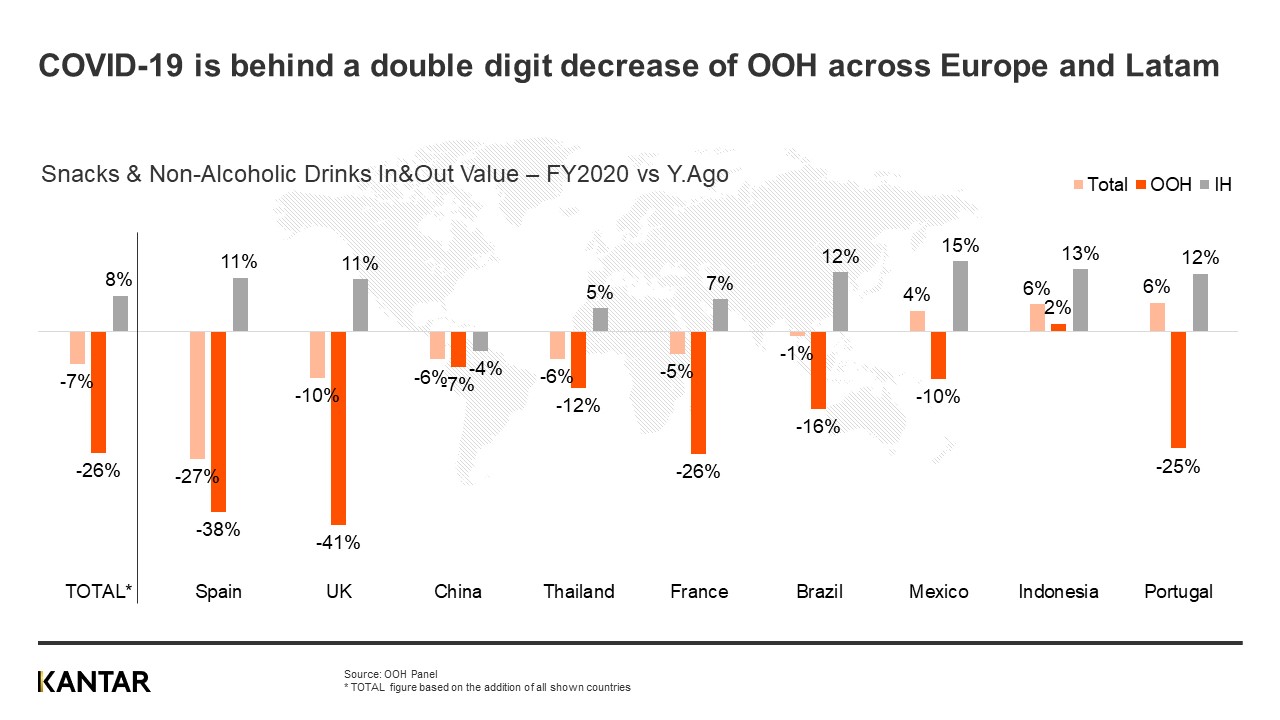
When looking at combined sales for both out-of-home (OOH) and in-home for the snacking and non-alcoholic beverages sectors, the overall picture is negative. OOH sales were down $22 billion (-26%), whilst in-home sales were up $8 billion (+8%) from the markets included in our analysis. In eight out of nine markets, OOH sales declined, which led to combined in-and-out sales being down in Spain, Great Britain, China, Thailand, France and Brazil.

graph ooh 1

Mexico and Portugal are markets where in-home sales compensated for a double-digit fall in OOH sales, whilst Indonesia was the only market where OOH sales remained in growth. There are a couple of reasons behind this. In Mexico and Indonesia, snacking accounts for more OOH spend than beverages, and it was the latter that drove the overall decline globally. In Portugal, OOH accounts for the lowest proportion of combined in-and-out spend, less than 20%.

As a result of this decline, OOH share of sales has fallen from 44% in 2019 to 35% in 2020. This fall in share is seen everywhere except for China, and the most significant falls happened where the disparity between OOH and in-home sales is most remarkable, in the UK and Spain, which both saw the importance of OOH sales fall by 14 percentage points.

Beverages driving the OOH decline

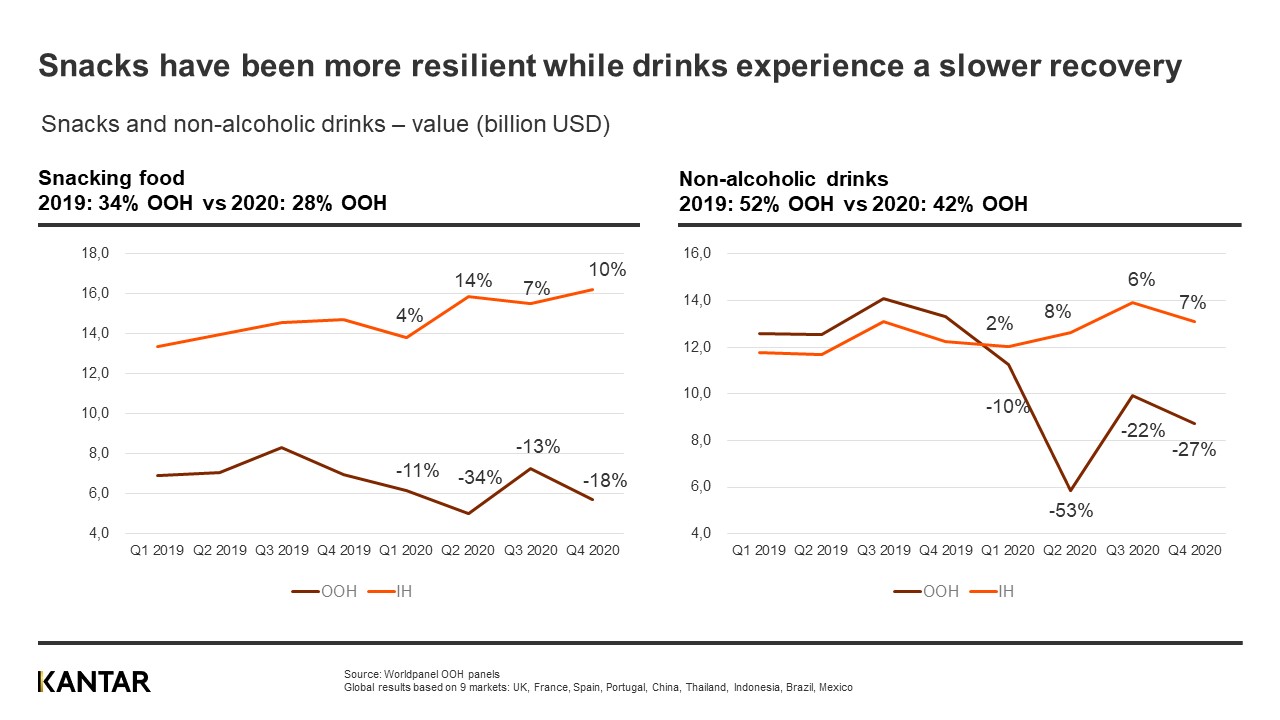
With non-alcoholic beverages accounting for 64% of OOH sales before 2020, this sector’s performance always has the most significant impact on the OOH picture. By the end of 2020, OOH beverages sales had declined over 30%, whilst in-home sales only increased by 6%, meaning total sales fell 14%. OOH snacking, on the other hand, also suffered a double-digit decline in sales (of 18%), but with in-home sales increasing over 8% and making up two-thirds of sales (before 2020), this growth was enough to see snacking remain flat in 2020.

Beverages were hit hardest during the first lockdown period (Q2 2020), with OOH sales more than halving in these three months. While neither sector bounced back fully in any quarter in 2020, the recovery was better for snacking in Q3, and at the same time, in-home sales accelerated to double-digit growth in both Q2 and Q4.

graph ooh2

Looking at specific categories within beverages, carbonated soft drinks and coffee (which had the highest reliance on OOH) suffered the most significant in-and-out decline at -16% and -22%. At the opposite end, within snacking, we have chocolate and salty snacks, the two categories with the lowest reliance on OOH for overall sales, both remaining in growth at 4% and 5%, respectively.

Alongside the reliance on OOH sales, even if all OOH occasions switched to in-home, the beverages sector is always going to suffer more due to prices. The cost of the average beverage occasion is 1.20€ OOH vs 0.20€ in-home, meaning that a shopper needs to enjoy a drink six times in their home to contribute as much in value terms as buying one drink outside their home.

Hotel, restaurant and cafe sales down $15 billion

When we consider OOH sales, we have four distinct channels: two of which are pure OOH – horeca (hotels, restaurants and cafes) and “impulse” (vending machines, street vendors, gas stations), and two which play in-and-out of the home – modern trade and traditional trade.

In terms of spend, 60% of OOH comes from the pure OOH channels (41% for horeca and 19% for impulse), and these two were understandably hardest hit by COVID-19 given the lockdown restrictions across countries over the course of 2020. Sales were down 36% in horeca and 24% in impulse, meaning their decline was behind 85% of the $22 billion loss in OOH sales, with horeca accounting for most of this.

Although the channel landscape is unique by country, the impact and decline of horeca meant the channel lost share almost everywhere and dropped to 41% in 2020, down from 48% in 2019. France was the only country where the OOH decline was worse for impulse and traditional.

The channel is particularly relevant in Europe, representing over 50% of OOH spend in all four markets. Outside of Europe, modern trade is the most crucial channel in Thailand, China and Mexico, whilst in Brazil, it is impulse and for Indonesia traditional trade.

Modern trade was the channel that saw the biggest gain in share in 2020, increasing share to 58% (from 53% in 2019) when looking at total in-and-out spend, and now accounting for over one quarter of OOH sales.

This shift to modern trade provides manufacturers with a further opportunity to win the OOH occasion, particularly in Europe. Within the modern trade channel, OOH accounts for 16% of snacking and beverages spend across markets, whilst in Mexico, Thailand, Indonesia, and China, that level is 40% and higher. In Europe, the share of OOH remains below 10% despite the shift to the channel caused by COVID-19.

Out-of-Home will return

The impact of COVID-19 on OOH sales was perhaps apparent and expected, but now more than ever, OOH data is essential to understand the complete 360° picture for your brand and category. As lockdowns ease, OOH sales will return, but the question remains: how quickly? We will be updating the trends seen here every quarter, and if you want to understand more about the specifics behind the data, do get in touch to discuss how we can analyse specific countries, categories, channels and brands.