Brands that are more attractive and available to more people this year than last will grow, regardless of whatever else is going on in the world.
Two brands that have consistently delivered growth by attracting more and more people to buy them every year are Dove and Nivea – two of only four brands to grow their reach in all eight editions of our annual Brand Footprint publication.
As a part of the business that investigates over time the methods (and the people) that have caused markets, categories, and brands to grow or decline, we tend to concentrate on the effectiveness of trade marketing initiatives – the short term.
However, we wanted to highlight these two brands’ underlying positioning – the vital longer-term view – and how important the advertising has been in creating the necessary conditions to develop and execute successful trade initiatives.
In his excellent case study for the 50th Anniversary of the Effies, marketing expert and columnist Mark Ritson makes a strong argument about the success of Dove’s communications. He explains that the “Campaign for Real Beauty” has been successful due to its perfect balance between long- and short-term investment and its emotional and rational appeal.
We have examined how the “Real Beauty” campaign goes beyond a marketing strapline. It has fundamentally changed the positioning of the Dove brand.
How Dove Has Created More Purchase Occasions
Dove has transformed itself from a moisturizing soap bar, to a fully formed beauty brand that can cover a whole range of personal care needs, in just two decades. This change is evident in the UK, where over 150 different Dove products, across 10 different toiletry categories, are bought every four weeks.
The strategy is to give buyers additional options across traditional category lines. Dove can say to shoppers: “If you don’t like our bar soap, how about our body lotion, shampoo or deodorant?”. There will even be a small number of buyers who buy Dove in every format. But pursuing these shoppers isn’t a wise move.
The ‘halo’ brand advantage of these Dove-only shoppers is minimal, compared to simply competing across significantly more personal care occasions. And for those brands who want to win more occasions, consider this. Dove is now competing in 60% of all personal care buying occasions every day. If it had remained as just a soap bar brand, it would be in only 5%. This brand repositioning hasn’t happened overnight – the “Real Beauty” campaign started in 2004.
There is little doubt that without it, Dove’s consistent penetration growth across the world – it is now sold in 80 countries – would have been much less likely.
The brand’s future growth poses interesting questions. Will it continue and stretch into more personal care occasions? Or will it try to compete more effectively in particular areas? Dove’s launch of a men’s range has different positioning.
Could a specific “Real Beauty” push for men be a way forward?
Dove And Nivea Show Similarities Despite Differing Strategies
It is interesting to compare Dove with Nivea, another beauty brand that is not only seen in the skincare aisle but also in sun cream, deodorants, and shower gels.
It also has a strong men’s range that competes across many male categories like shaving foam which continues the brand’s long positioning of caring for your skin. It is interesting to compare size and reach by showing the penetration and frequency of Dove and Nivea by country. We see a classic “double jeopardy” pattern appearing. When Dove or Nivea has a smaller presence in a country, it is down to the fact they have fewer buyers who also buy the brand less often. Penetration has a much greater range globally – from under 5% to over 70% buying the brand at least once a year. If either brand wants to grow in a country, they will need to find more buyers in one year than the year before. If they find a way to do that, increased loyalty is likely to occur as well.
This is because when marketing campaigns attract more buyers, all types of buyers are affected.What we also see is that the two brands are remarkably similar despite their different approaches. Dove wins the overall country reach and penetration battle, but only just. Dove also has, on average, a higher average frequency of purchase, but this is due to the different mix of categories as opposed to one brand being stronger than another.
In the countries labelled in the chart above, frequency is higher than expected given the penetration, which is due to how the category is purchased there. For example, in Indonesia or India, a high proportion of the soap and shampoo category is sold in sachets, which creates a faster repeat rate.
Drawing On A Deep Heritage
When looking at the penetration within selected countries with large populations, we can better understand both brands’ heritage. It is no surprise that the markets where the brands have a deeper connection are a point of strength. The locations where future growth is most likely to be found are clear too. These are two highly successful established beauty brands that position and market themselves differently, with different geographical strengths and weaknesses to grapple with. Arguably, the only thing they have in common is that they both decided that the brand wasn’t just a moisturizing soap or skincare brand.
That decision is the reason why they are now the size they are today, and why they have the potential to grow more in the future. Dove and Nivea both have the necessary attributes of a brand that could effectively compete across a wide variety of different beauty categories.
And they both provide great examples of what can be achieved by brands who want to win through more purchase occasions. Given that the beauty and personal care sector struggled in 2020, will both brands have maintained their 100% record for year-on-year growth? We will find out this and much more when we launch the 2021 edition of Brand Footprint in May.
10 private conglomerates that need to be formed in Nigeria if we are to end our perpetual import dependency and start producing what we consume as well as start exporting.
[1] The Fulani Cattle Company
This subject needs no further introduction. We need all the wealthy Fulani livestock owners to pool their resources together to form a massive company that will operate ranches, dairy companies, leather tanneries, abattoirs and animal feed compounders. It should turn Nigeria into a major exporter of milk, beef, animal; feed compounds and leather goods like bags, shoes, belts, wallets, etc
[2] Man of God PLC
Nobody in Nigeria has deep pockets like our evangelical clergymen today. I want to see them merge all their financial arms into one massive conglomerate with the likes of Oyedepo, Adeboye, Joshua, Ashimolowo, Okotie, Oyakhilome, Oritsejafor, Suleiman, etc on its board of directors. This company should become an engineering giant operating steel mills, power plants, equipment manufacturing factories, shipyards, machine tool plants, etc
[3] Arewa Textile and Clothing Company
We have livestock to produce leather and we have cotton to produce clothes, yet we do not have one Nigerian brand that manufactures our wide array of African clothing like the agbada, isi agwu, danshiki, kaftan, fancy shoes, etc. This company should be floated on at least three global stock exchanges and should be competing with the likes of Gucci, Luis Vuitton, Georgio Armani, Balenciaga, Dior Homme, Givenchi, etc
[4] Air Peace Nigeria
Given how much of a mess we have made of both public and private airlines in Nigeria, the one ray of hope in this sector is Allen Onyema. I want to see his company merge with one international player like maybe Ethiopian Airlines and them attract say a 20% holding from an international operator like KLM, Virgin or BA. Turn it into a genuine global airline that can compete with the likes of Air France, Lufthansa, Emirates, etc
[5] Dangote Industries
For me, Aliko Dangote is the one shining light in a country where our so-called industrialists are shamelessly content with importing goods and distributing them. This is a man who went on the international money markets to borrow $12m to help fund his $20m refinery in Lekki. I would like to see him step up his presence in the global cement and sugar markets but also branch out into other areas like timber & furniture, food processing, property development, etc
[6] Innoson Motors
Any year one economics student will tell you that it is impossible to provide enough cars for 200m people relying on imports. Never has happened and never will happen. Nigeria needs an indigenous car manufacturing capacity. We have to build Innoson up to at least the level of say Fiat, Lada, Citroen, Mazda, Peugeot, etc. There are currently 12m cars in Nigeria. If demand doubles over the next five tears, where do we expect to get the automobiles from?
[7] NNPC
This is the epitome of corruption in Nigeria. To make matters worse, it has got to be the most inefficient and incompetent company on the world. None of the refineries it is responsible for are operational and it is costing Nigerian money by the day. This company needs to be privatized, floated on the Lagos, London, New York, Frankfurt, and Tokyo exchanges, and delve into high-end manufacturing producing goods like aviation parts, railway carriages, machine tools, locomotive engines, etc
[8] Oranmiyan Confectionery Company
Nigeria, Ghana, Ivory Coast, and Cameroon account for about 80% of global cocoa production but less than 10% of the global $140bn chocolate industry. It is time to have our own Mars, Nestle, Cadbury, etc that will serve as a vertically integrated company, liaising with producers of cocoa, milk, sugar, coconuts, groundnuts, cashews, coconuts, etc and modifying the process from farm to shop floor. We produce everything that goes into chocolate products but yet have no chocolate brand
[9] Blessed Fruit Company
Nigeria can easily step up her production of fruit like pineapples, papaya, bananas, oranges, mangoes, guava, etc, and become the world’s largest producer. However, to realize maximum gains from this, we need to start processing and canning our produce locally and exporting finished products. I would like to see our pastorprueners run this company because it is highly ethical. Nothing stops this company from branching out into other areas of food processing like say manufacturing plantain chips, processing yam and cassava and moving into edible oil production, etc
[10] Ohaneze Retail Company
Now, all my Igbo friends have got to come here and give an account of themselves, especially those from Nnewi, Abriba/Ohafia, and Orlu. You guys retail goods in every nook and cranny of the world but alas, you do not have one retail brand? Na which kind of self-destruction be this abeg? Shame on you for not having a retail giant that can compete with the likes of Sainsbury’s, Tesco, Asda, Walmart, Cosco, Ikea, etc.
Let us set ourselves a target of creating these 10 companies, each with a market capitalization of at least $50bn by says 2030. I want to see each of these companies floated on the Lagos, London, Tokyo, Frankfurt, and New York stock exchanges and run like genuine multinationals.
According to the selected food price watch data released by the National Bureau of Statistics (NBS) for February 2021, major consumer staples showed significant increases between February 2020 (when the land border was still closed) and February 2021 (when the land borders had been partially reopened).
The steep price increases across the food items are also consistent with the increase in food inflation from 14.90% in February 2020 to 21.79% in February 2021. Specifically, a common tuber vegetable, Yam, increased significantly by 128.30% y/y. Also, rice which is the most widely consumed food staple showed a substantial increase in the two variants; local sold loose (up 22.15% y/y) and imported high quality sold loose (up 29.67% y/y). However, we also note a significant decrease in some food items such as sweet potato (down 34.42% y/y).
The rise in food prices which has been the major driver of the rising inflationary pressure is due to supply chain disruptions, incessant attacks on farmers by herdsmen in the food processing regions and high input costs such as fertilizers. In the last MPC meeting held last week, the apex bank noted its interventions to boost food production, particularly through its various agricultural programmes.
Food shortages linger brandspurng
However, structural issues around the food supply chain if not resolved would continue to outweigh the expected results from these interventions. Recently, a 6-day strike action embarked upon by the Northern cattle and foodstuff dealers under the auspices of the Amalgamated Union of Food and Cattle Dealers of Nigeria (AFUCDN) led to a spike in prices of food items within the affected period.
Considering the fact that we are approaching the planting season amidst unresolved insecurity challenges and expectations of flood in many areas of the country, we expect food prices to continue to rise. Besides, the impact of the devaluation of the naira will put further pressure on imported food inflation. The government needs to put food security at the forefront to ensure all measures are taken to avert a food crisis.
In 2020, healthcare providers and insurers in Kenya were compelled to hasten the execution of their digital service offerings.
Findings from the Ajua Quarter 4 Customer Loyalty Industry Report indicate that more healthcare providers are directing their efforts towards improving their digital platforms.
Customers in Healthcare reported on some of the efforts by healthcare providers that have enabled them to reduce contact, access online consultation, make cashless payments, and much more.
This data is also supported by a recent report done by Ajua in partnership with Carepay which revealed an increasing demand for mobile healthcare services in Kenya. Over 37% of Kenyans currently use mobile platforms to access healthcare. However, over 90% of Kenyan consumers would like to receive more healthcare services through their phones.
Digital adoption in other industries is also causing a ripple effect. The most notable industries being Banking, e-commerce, and mobile money providers. These industries have already been establishing efficient mobile services such as mobile wallets.
This has caused a notable shift in customers expectations, with more consumers opting for a healthcare provider who offers digitally-driven service, particularly among the youth.
Similarly, the insurance industry underwent a significant transformation in 2020, the biggest change being the transition from physical to digital services. As a result of the pandemic, consumer trust in the insurance industry declined slightly owing to two main reasons. Firstly, many consumers in the market did not have as much money available to spend.
The second is that the insurance sector fell out of favour with the public due to the refusal to cover any COVID-19 related complications. The sector is in the process of slowly rebuilding trust with customers.
When insurance customers were asked what they enjoyed most about the service they received from their favorite insurers, they mentioned accessibility of service through online platforms as one of the key drivers for choosing their insurers.
NHIF customers were particularly delighted by the introduction of online self-service which made it possible to access services quickly and anywhere. One customer shared, “We didn’t have to visit the offices since everything went digital, we pay through MPESA and receive insurance covers through emails.”
To conclude, in order to run an efficient business, healthcare providers need to analyze their customer data. This will not only enable them to establish the low-hanging fruits that can be improved upon along their customer journey but also help them to carry out predictive analyses and deliver more personalized service at scale.
The sixth season of Nigeria’s foremost singing competition, Nigerian Idol premiered last night, Sunday, March 28 with an explosive first episode.
Last night, 25 contestants made it to the first day of the auditions with the judges, and they came from various walks of life. From fashion designers to lawyers, entrepreneurs, comedians and even professional musicians.
From the start, the judges – Obi Asika, Seyi Shay and DJ Sose – had their work cut out for them. Obi Asika was calm and introspective and DJ Sose’s poker face scared many of the contestants. However, it was Seyi Shay’s blunt judgments and giggles that haunted the contestants.
After the first six contestants breezed out of the doors with their golden tickets, things went downhill from there. Each contestant that came up afterward did not live up to the judges’ expectations including Azubuike Uzoepu who claimed to have performed with the legendary 2baba at a Fashion Show in Onitsha; and Michael Macauley, a professional musician that came on the show to promote his recently released EP.
While some people got sympathetic ‘Nos’ and admonishments to come back next year, some others like 17-year-old Mayowa were advised to just quit altogether. He was however praised on his songwriting skills. Chigozie Oleka on the other hand was nervous after receiving a negative response from the judges. His subsequent pleas caused DJ Sose to storm out of the set.
The most impressive performances of the first day came from fashion designers, 30-year-old Azigalobari and 23-year-old Faith Mac, the younger sister of former 2011 Nigerian Idol finalist Naomi Mac. They greatly impressed the judges and got their golden tickets.
A total of 13 out of the 25 people that auditioned last night got golden tickets to proceed to the next round, the theatre week, where they will battle against each other to make it to the next stage.
The auditions continue next week Sunday, April 4 on Africa Magic Showcase (DStv ch 151) and Africa Magic Urban (DStv ch 153) and Africa Magic Family (DStv ch 154 & GOtv ch 2) from 7pm.
Nigerian Idol season 6 is sponsored by Bigi Drinks and Tecno Mobile. The show will be available to customers on DStv Premium, Compact Plus, Compact, Confam, Yanga and GOtv Max and Jolli. Visit www.dstvafrica.com or www.gotvafrica.com and download MyDStv or MyGOtv Apps to pay your subscription or switch your package.
You can also watch Nigerian Idol Season 6 via the DStv app on multiple devices at no additional cost. The app is available for download on iOS and Android devices.
For more information, visit www.africamagic.tv/nigerianidol. You can also follow the official Nigerian Idol social media pages for news and updates with the hashtag #NigerianIdol on Twitter @nigerianidol, Instagram @nigerianidol, and Facebook www.facebook.com/nigidol
A new Juniper Research study found that the number of eSIMs installed in connected devices will increase from 1.2 billion in 2021 to 3.4 billion in 2025; representing a growth of 180%.
eSIMs are modules that are embedded directly into devices; providing cellular connectivity and storing multiple network operator profiles.
The new research, eSIMs: Sector Analysis, Emerging Opportunities & Market Forecasts 2021-2025, independently assessed eSIM adoption and demand in the consumer sector, industrial sector, and public sector, and predicts that the consumer sector will account for 94% of global eSIM installations by 2025. It anticipates that established adoption of eSIM frameworks from consumer device vendors, such as Apple and Google, will accelerate the growth of eSIMs in consumer devices ahead of the industrial and public sectors.
Consumer Market Key to Fulfilling eSIM Potential
The research found that global eSIM deployments across all consumer verticals will increase by 170% over the next four years, with widespread adoption reliant on backing from network operators. It urges device manufacturers to place pressure on operators to support eSIM frameworks and accelerate market maturation.
However, fragmentation of hardware vendors in the cellular IoT device market will require each vertical to adopt a combination of wireless technologies, hardware, and management tools. In turn, it predicts that specialist vendors will emerge that provide robust eSIM form factors for industrial environments.
eSIM Opportunities Across Industrial Sectors
The study identified three key areas of focus for eSIM adoption in the industrial sector:
1. Oil and Gas
2. Manufacturing
3. Logistics
It suggests that the development of rugged form factors will position vendors well to capitalize on the market, as eSIM installations in these verticals grow from 28 million units in 2021 to 116 million by 2025.
Research author Scarlett Woodford noted: ‘Ensuring convenience for the end-user must remain the top priority for eSIM management platform providers. To do so, they must provide a level of service comparable to that found with traditional SIM deployments.’
JAMESON IS BRANCHING OUT WITH A CRAFTED SKINCARE RANGE DESIGNED TO LEAVE YOUR SKIN TWICE AS SMOOTH.
Jameson Irish Whiskey has announced the unexpected launch of a skincare range called Beatha.
The new skincare line is designed for both men and women and is said to be specially crafted to leave the skin hydrated, revitalised and “twice as smooth”. The products are made using Jameson whiskey, barley (which is beneficial for skin and hair) and “other quality skin ingredients”, Jameson says in a statement.
Getting the brand in the hands of consumers
According to the 243-year-old premium whiskey brand, the move into beauty comes at a time when the liquor industry has been faced with many challenges on how it can reinvent itself in the midst of uncertainty. Jameson says it has acknowledged the call for the industry to pivot and sees this as “a major game-changer” that it anticipates consumers will be excited about.
“We are incredibly proud of our new Beatha offering which we believe will expand our territory in such a profound manner. Not only is the beauty space one that is ever commercially thriving through demand, it also contributes meaningfully to consumers’ lives which is what we are about as a brand,” says Beatrice Marfleet, marketing manager of Jameson and Irish Whiskeys.
Marfleet adds, “Jameson is also a brand that has a strong base with women and this offering would not only reach them but would ensure that should there ever come a time the industry needed to shut down again, we would always be able to get our brand in the hands of the consumer.”
Skin trio
The Beatha range includes a Restorative Facial Mousse, a Hydrating Facial Oil and a Beard Oil. Jameson is launching this skin trio with TV host and model Ayanda Thabethe.
“I am super excited to announce my partnership with Jameson that has been months in the planning. This skincare range comprises some of my favourite products that I have been using over the years but is different because of our secret ingredients to ensure all my beloved supporters get to experience the Beatha magic,” says Thabethe.
In furtherance of its commitment to promoting oral health and hygiene, leading consumer goods company, Procter & Gamble (P&G) Nigeria, through its Oral- B brand, partnered with the Federal Ministry of Health to celebrate this year’s World Oral Health Day through community outreach in the Jiwa Community in the Federal Capital Territory, Abuja.
The outreach will offer oral health awareness, free dental checks, and a month’s supply of Oral B toothpaste and toothbrushes to members of the Jiwa Community.
The long-standing partnership between P&G, Oral B, and the Federal Ministry of Health strengthens Oral-B’s commitment to healthier, stronger teeth and Procter & Gamble’s purpose of touching and improving the lives of people in the communities where it operates.
Commenting on the initiative, the P&G Senior Director for Africa, Global Government Relations & Public Policy, Dr. Mrs. Temitope Iluyemi, revealed that Procter & Gamble is excited to continue the partnership with the Federal Ministry of Health to promote oral health and hygiene in Nigeria, stating that the Oral B brand has over the years partnered with dentists across the country to elevate the role of oral health of over 10 million Nigerians through its Mobile Dental Clinic Program.
“Oral hygiene should not be overlooked, most especially in terms of its effects on the general health and nutrition of people. Effective oral care reduces infection and promotes health, thus the need to drive awareness. The World Oral Health Day presents an opportunity to amplify this oral health drive which our brand has actively driven through the year.” Dr. Mrs. Iluyemi said. She further encouraged Nigerians not to underrate the effect of poor oral hygiene as it can negatively affect confidence and social skills. “Oral health is very essential to human’s general health and wellbeing”, she explained.
While commending P&G for its efforts in promoting oral health, the Director of Dentistry Division of the Federal Ministry of Health, Dr. Bola Alonge, in her remarks noted that “proper oral health practices are important to ensure good general health. A lot of people have not had dental checks. As a result, we need to leverage this World Oral Health Day to drive oral health sensitization at the grassroots especially in areas with limited access to quality health care.
She added: “This is why we partnered with P&G and Oral-B on this community outreach where dentists will be available to conduct free oral health check for community members who will also a month supply of Oral-B toothpaste and Oral B toothbrush. The outreach will also include oral health training for the community leaders and other members”.
As a company, Procter & Gamble has reached millions of Nigerians through its citizenship programs. The Oral B Mobile Dental Clinic Program is committed to reaching 10 million more Nigerians with free dental checks over the next four years. Also, the P&G’s Children Safe Drinking Water program (CSDW) has provided hundreds of million liters of safe drinking water in Nigeria helping to prevent possible death and disease from contaminated water.
Rolls-Royce has officially started building the world’s largest aero-engine, UltraFan, which will help redefine sustainable air travel for decades to come.
Work on the first module is underway at our dedicated DemoWorks facility in Derby, UK, and the demonstrator engine, which has a fan diameter of 140 inches, will be completed by the end of the year.
The engine is the basis for a potential new family of UltraFan engines able to power both narrowbody and widebody aircraft and deliver a 25% fuel efficiency improvement compared with the first generation of Trent engine.
That performance improvement is crucial to achieving aviation sustainability. Gas turbines will continue to be the bedrock of long-haul aviation for many years, and UltraFan’s efficiency will help improve the economics of an industry transition to more sustainable fuels, which are likely to be more expensive in the short-term than traditional jet fuel. The first test run of the engine will be conducted on 100% Sustainable Aviation Fuel.
Significant investment has been made to develop the UltraFan demonstrator and associated technologies by Rolls-Royce and a variety of funding agencies, including the Aerospace Technology Institute and Innovate UK (United Kingdom), LuFo (Germany) and Clean Sky Joint Undertaking (European Union).
UK Business Secretary, Kwasi Kwarteng, said: “The UltraFan project is a perfect example of how we are working with industry to deliver green, sustainable flight for decades to come. Backed with significant government support, this project represents the scale of ambition for Britain’s crucial aerospace sector.
“Companies like Rolls-Royce are playing a critical role as we build back greener from the pandemic and we are committed to giving the whole aerospace sector the support it needs to innovate and reach new heights.”
Chris Cholerton, Rolls-Royce, President – Civil Aerospace, said: “This is an exciting moment for all of us at Rolls-Royce. Our first engine demonstrator, UF001, is now coming together and I’m really looking forward to seeing it built and ready for test. It is arriving at a time when the world is seeking ever more sustainable ways to travel in a post-COVID 19 world, and it makes me and all our team very proud to know we are part of the solution.
“I am delighted that the UK and German governments have supported us in making these significant ground-breaking technology investments. The Aerospace Technology Institute and LuFo programs, as well as the EU’s Clean Sky, have all helped bring us a step closer to realizing the enormous environmental and economic benefits of UltraFan.”
As the engine build starts, other key parts are already coming together for delivery to Derby. Work is underway on UltraFan’s carbon titanium fan system in Bristol, UK, and its 50MW Power Gearbox, which is powerful enough to run 500 family cars, in Dahlewitz, Germany.
UltraFan is part of Rolls-Royce’s IntelligentEngine vision – for example each fan blade has a digital twin which stores real-life test data, allowing engineers to predict in-service performance. When on test at Rolls-Royce’s new £90m Testbed 80 facility, data can be taken from more than 10,000 parameters, detecting the tiniest of vibrations at a rate of up to 200,000 samples per second. Data that helps us understand our engines and further improve them.
Key engineering features of the engine include:
A new, proven, Advance 3 core architecture, combined with our ALECSys lean burn combustion system, to deliver maximum fuel burn efficiency and low emissions.
Carbon titanium fan blades and a composite casing that reduce weight by up to 1,500lb per aircraft.
Advanced ceramic matrix composite (CMC) components that operate more effectively in high-pressure turbine temperatures.
A geared design that delivers efficient power for the high-thrust, high bypass ratio engines of the future.
Nigeria is currently mired in the throes of a worsening unemployment tide.
As you read this, the situation is so bad that out of every three Nigerians you encounter, one of them is unemployed. Numbers-wise, Nigeria’s unemployment profile currently stands at about 33.3%.
The data above is backed up by the latest statistics released by the National Bureau of Statistics (NBS). The report released on Monday, March 15, 2021, Monday, March 15, makes for grim reading. It showed that Nigeria’s unemployment rate rose from 27.1 per cent in the second quarter of 2020 to 33.3 per cent in the fourth quarter of 2020.
In layman’s terms, the foregoing translates to about 23.19 million unemployed people and this does not take into account millions of underemployed Nigerians.
Part of the NBS report reads as follows: “During the reference period, the computed national unemployment rate rose from 27.1 per cent in Q2, 2020 to 33.3 per cent in Q4, 2020, while the underemployment rate decreased from 28.6 per cent to 22.8 per cent. A combination of both the unemployment and underemployment rate for the reference period gave a figure of 56.1 per cent.
“This means that 33.3 per cent of the labour force in Nigeria or 23,187,389 persons either did nothing or worked for less than 20 hours a week; making them unemployed by our definition in Nigeria. This is an additional 1,422,772 persons from the number in that category in Q2, 2020. Using the international definition of unemployment, the rate was computed to be 17.5 per cent.”
Photo By Venture Africa
But this is not the full picture of the worrisome unemployment trend in Nigeria.
Nigeria now boasts the unenviable status of being the country with the second-highest unemployment rate in the world, second only to a fellow African country, Namibia, which has the world’s highest unemployment statistic with 33.4 per cent. In achieving this unwanted feat, Nigeria recently surpassed South Africa on a list of 82 countries whose unemployment rates are tracked by Bloomberg.
Meanwhile, the situation seems to be headed for an even more worrisome trajectory, with the nation’s fast-growing population expected to see Nigeria become the third most populous country in the world by 2050, with over 300 million people. This is according to projections by the United Nations.
Also, economists and other experts expect Nigeria’s unemployment profile to soon overtake that of Namibia and become the world’s highest. The prediction is premised on the fact that more people are expected to join the labour market as population growth continues to outpace output expansion in Nigeria and as more graduates join the list of those eligible to work.
In the middle of this doom and gloom, many analysts and other commentators have posited that government alone cannot solve the unemployment conundrum, despite its status as the biggest employer of labour.
Indeed, the overwhelming position is that 21st Century economies are built on the spirit of private enterprise, with government expected to support and provide the enabling environment for the private sector to thrive, and in so doing unleash the power of entrepreneurship in creating more employment opportunities for the teeming youth population.
The foregoing calls to mind the yet-untapped potentialities of the e-Commerce sector in reversing Nigeria’s disastrous unemployment profile and specifically, the laudable efforts of a company like Konga, a world-class Nigerian-owned player which has defied a myriad of hurdles and challenges that come with operating in difficult terrain like Nigeria.
I visualize a company like Konga to be possibly the largest employer of quality human capital in Nigeria with the next five years and maybe the highest single taxpayer if given a chance to survive by the government during this incubation period.
Things have changed globally and our government and policymakers must pay attention and support companies like Konga that shall alter the destiny of Nigerians in the very near future. It is clear the current owners have shown in a short period that they are not infants and have the required passion and capacity in the marketplace. Let me use Konga to explain the new economy:
In Konga, Nigeria has a gem that has provided a lifeline for many families and still continues to create a host of employment opportunities, despite building up its own infrastructure and with little or no institutional support.
Having taken a critical look at the Nigerian e-Commerce sector in the course of my academic thesis, I remain convinced that if Nigeria had at least three other entities as dedicated to the empowerment of the Nigerian youth as Konga, we would be telling a different story in terms of our current unemployment nightmare for our brilliant youth population.
Konga runs a fusion of online and offline retail which has delivered so much value to Nigerians, employment-wise. The management of the company, which came under new ownership in 2018, has hardly hidden its desire to saturate every nook and cranny of Nigeria with its presence, by citing at least one Konga store in each local government in the country. Going by the current number of local governments in Nigeria, we are looking at a whopping 774 physical stores – a very ambitious project by any stretch of the imagination.
Already, Konga is on its way to achieving this feat which would make it arguably the biggest employer of labour in Nigeria. Even with the number of stores powered by technology it has at the moment across various states in Nigeria which currently stands at less than 50, Konga is creating direct and indirect employment opportunities for thousands of Nigerians. These stores are manned by Nigerians through and through – with Konga also particularly embracing the policy of employing indigenous members of the community/states in each of its store locations.
To its credit, the company also runs its own internally-owned logistics company through which many have secured gainful employment, with a huge number of staff and other essential delivery personnel regularly being employed to manage Konga’s growing fleet of trucks, buses, cars, and motorcycles. This is not to mention other existing subsidiaries within the Konga group including its CBN-licensed mobile money platform, KongaPay, and online travel agency, Konga Travel which has created massive opportunities for many.
In July 2020, the media was awash with news that Konga had relaunched YUBOSS, its reseller scheme under the new name – Konga Affiliate. Through this scheme, Konga extended an offer of creative employment to millions of smart unemployed and under-employed Nigerians, by giving them an opportunity to earn an unlimited income by partnering with the company. The initiative further offers successful affiliates, some of whom reside in unreached and under-served parts of the country, a chance to rise through the ranks and become part-owner of a Konga franchise store.
There is no doubt that very few organizations in Nigeria can provide such opportunities for correcting the worrisome unemployment statistics staring us in the face.
Also, in Konga, Nigeria boasts a world-class platform that has continued to incubate and nurture the country’s growing army of tech developers, creative artists and other digital natives.
With an in-house tech structure that can rival that of any blue-chip company in the world, Konga provides a fitting ground where many of Nigeria’s talented but restive youths find expression in exhibiting their digital skills and influencing the growth of the fintech and other allied sectors with their apps and other inventions.
Till date, Konga has nurtured thousands of digital netizens in its never-stopping conveyor line, with many of them eventually taking their skills to other foreign countries – Germany, Canada, Russia, among many others, all of whom have come to rely on and feed off Konga’s supply line of digital talents.
Why has the Federal Government of Nigeria, or the Chief Executives of various state governments, not for once considered partnering with Konga even for the selfish interest of empowering citizens of their own states, you may ask?
Despite being an economist, I take an avid interest in e-Commerce, which remains, in my opinion, a futuristic sector that has the capacity to bring Nigeria shoulder-to-shoulder with the rest of the advanced world. However, a deep understanding of the immense economic power of e-Commerce, lacking as it is, on the part of political office holders in Nigeria, is one of the major leadership deficits we endure here.
This is one of the reasons why leaders in Nigeria have consistently failed to leverage the immense employment-generating potential of an e-Commerce engine such as Konga.
But it is time to wake up and smell the coffee!
As highlighted earlier, government alone cannot solve Nigeria’s unemployment challenge. This is where tested and trusted, tech-driven, ethical platforms such as Konga comes in or other Nigerian-focused companies, especially those that can do more with a little institutional support.
In the United States and other advanced economies, governments have taken advantage of the sheer power of e-Commerce in empowering its citizens. To bring this reality into stark relief, let’s compare some figures from a global e-Commerce standpoint.
Amazon, headquartered in the United States remains the world’s biggest e-commerce platform. Its founder, Jeff Bezos has occupied and still jostles for the position of the world’s richest man. He is presently in the second position after Tesla’s Elon Musk. The stock of Amazon has more than quintupled over the last five years, catapulting Bezos from a mere multibillionaire to the world’s first centi-billionaire and, later, the first person worth more than $200 billion.
This is in spite of the fact that Bezos lost a significant portion of his net worth after his divorce in 2019, which left his ex-wife MacKenzie Scott with around 25% of their Amazon holdings. Amazon enjoys tax breaks from the United States government.
During the lockdown occasioned by the COVID-19 pandemic, Amazon reportedly employed over 100,000 Americans as it positioned itself as an ‘essential service during the pandemic, serving the needs of needy Americans who required essential supplies such as food, groceries, meds, and other gadgets delivered to them in the safety of their homes.
Asian giant, Alibaba had 117,600 employees as at March 2020 but it has also seen its staff strength rise significantly, especially during the lockdown. Even in the face of a recent fallout between its founder, Jack Ma, and the Chinese government, Alibaba still enjoys the confidence of the government and the Chinese people.
In the case of Konga, my inquiries from the company’s executive management revealed that the lockdown posed a tough period for its business with a well-publicized series of restrictions from the government. Through it all, the management insisted none of its staff would be sacked and even embarked on a nationwide campaign to feed thousands of families using its staff for two weeks as its own form of palliatives.
Nigeria’s unemployment outlook is dire but a lot can be done, if only we can leverage the power of e-Commerce and an established, world-class structure such as Konga.
As Dr. B.B Usman stated: ‘‘This is why regional e-Commerce economic platform blocs like Alibaba, Konga, and others are emerging to demonstrate that the analog economic model is dead, especially in the face of digital transformation.
“The digital economy is here and Africa must empower her e-Commerce entrepreneurs; not only with litmus packages but by granting them 10-year tax holiday to fast-track the creation of youth employment; while boosting regional wealth.’’
Now is the time to act and reverse the future of millions of hopeless Nigerian youths!
We use cookies on our website to give you the most relevant experience by remembering your preferences and repeat visits. By clicking “Accept”, you consent to the use of ALL the cookies.
This website uses cookies to improve your experience while you navigate through the website. Out of these, the cookies that are categorized as necessary are stored on your browser as they are essential for the working of basic functionalities of the website. We also use third-party cookies that help us analyze and understand how you use this website. These cookies will be stored in your browser only with your consent. You also have the option to opt-out of these cookies. But opting out of some of these cookies may affect your browsing experience.
Necessary cookies are absolutely essential for the website to function properly. This category only includes cookies that ensures basic functionalities and security features of the website. These cookies do not store any personal information.
Any cookies that may not be particularly necessary for the website to function and is used specifically to collect user personal data via analytics, ads, other embedded contents are termed as non-necessary cookies. It is mandatory to procure user consent prior to running these cookies on your website.


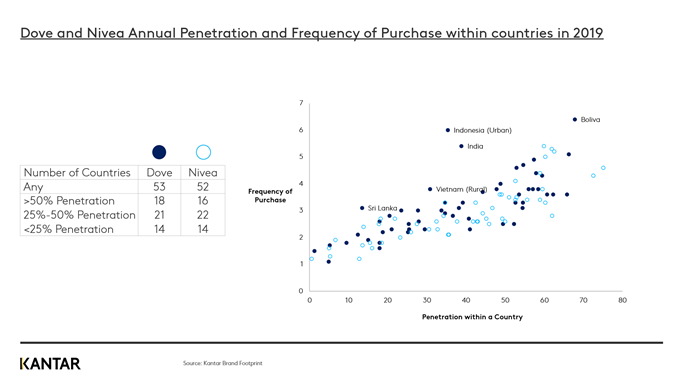 We see a classic “double jeopardy” pattern appearing. When Dove or Nivea has a smaller presence in a country, it is down to the fact they have fewer buyers who also buy the brand less often. Penetration has a much greater range globally – from under 5% to over 70% buying the brand at least once a year. If either brand wants to grow in a country, they will need to find more buyers in one year than the year before. If they find a way to do that, increased loyalty is likely to occur as well.
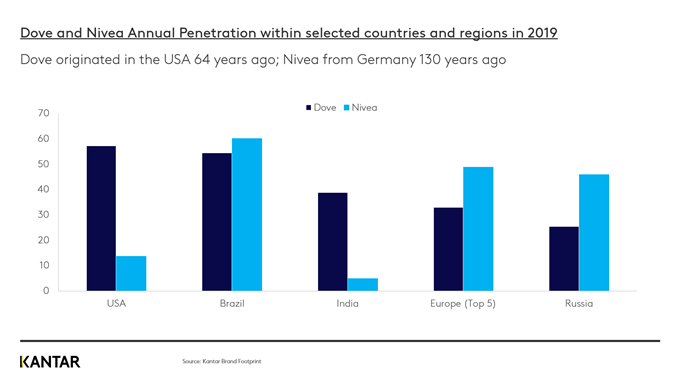 These are two highly successful established beauty brands that position and market themselves differently, with different geographical strengths and weaknesses to grapple with. Arguably, the only thing they have in common is that they both decided that the brand wasn’t just a moisturizing soap or skincare brand.


