GAC Motors Empowers the 1st Nigeria Governors Investment Forum

In a bid to foster transnational investments between Nigeria and China, the first edition of the Nigeria Governors’ Investment Forum was held in Guangzhou, China. Governors from 9 states in Nigeria, which include Alhaji Abdul’aziz Abubakar Yari of Zamfara State; Chief Okezie Ikpeazu of Abia State and Chief Dr Samuel Ortom of Benue State. Other dignitaries are Mr. Oloko Shakirudeen Adewale, Consul-General of the Nigerian Consulate-General in Guangzhou, Mr. Cai Chaolin, Vice Mayor of Guangzhou, Mr. Zeng Qinghong, President of GAC Group, and Mr. Yu Jun, General Manager of GAC Motor, other officials and representatives of the business community were present at the China-Nigeria cooperation, trade and development forum.

Participants from the two countries conducted in-depth discussions and case sharing on the theme of the forum “sustainable cities and livelihood”. GAC Motor GA8 and GS8, which were designated as the official vehicles for the forum, greatly impressed the delegates with their luxurious and comfortable ride experience, original design, exquisite craftsmanship and state-of-the-art technologies.

Speaking at the forum, the Vice Mayor of Guangzhou, Mr. Cai Chaolin, stated that Nigeria as the largest economy in Africa and Guangdong are highly complementary to each other in areas such as manufacturing, agriculture, cultural exchanges and infrastructure development being situated along the “Belt and Road” and there is vast potential for cooperation between the two countries.

“The Guangzhou Municipal Government has always attached great importance to all-round cooperation with Nigeria. We believe this forum will be a great opportunity for China and Nigeria to further their long-standing friendship, and construct a new bridge for investment activities between the two nations”.

“With the GAC Group as a leading investment enterprise, we are speeding up the development of our overseas marketing and service system, and taking internationalization as a key development strategy. He hopes that in the future, more and more high-quality Chinese enterprises such as GAC Group will bring better products and services to Nigeria, so as to further strengthen bilateral exchanges and cooperation”.

Also Speaking during the forum, President of GAC Group, Mr. Zeng Qinghong, delivered a speech titled “GAC’s global planning with sustainable development as the basis and the ‘Belt and Road’ Initiative as the driver” introducing to the forum participants the achievements and main business sectors of GAC Group, while emphasizing GAC’s sincere willingness to offer high-quality products and services to Nigerian consumers.

“GAC Group’s private brand GAC Motor has developed stable sales channels in Nigeria and achieved outstanding sales records. GAC Motor’s entry into the local market has brought consumers greater ride experience and higher quality of life. With automobiles as a bridge, GAC Motor has not only benefitted Nigeria with high-quality products and services, but has also brought management expertise and technologies there, thus increasing employment and enabling resource integration, technological innovation and sustainable development.” He said.

More than 380,000 GAC Motor vehicles were sold last year, registering an increase of 96%. With a compound annual growth rate of 85% for 6 consecutive years, it has achieved leapfrog development. In the first quarter of this year, the accumulated sales volume of GAC Motor vehicles exceeded 121,000, up by 68.4% year on year, making the brand a leading light among its peers in terms of growth speed and profit generation. Among them, the sales volume of the champion model GS4 was up by 35.5%, firmly keeping the runner-up title in the domestic SUV market. It was also the first brand that surpassed the sales threshold of 500,000 units among SUVs in the price range of RMB 100,000. The advanced higher-end GS8 was highly sought-after, always in short supply. Over 10,000 GS8 SUVs were sold alone in March, making a significant breakthrough of a monthly sales volume of over 10,000 vehicles only after half a year of its launch in the market. It was the best sales record among Chinese SUV brands in similar price range, and broke the price ceiling on Chinese brand vehicles, making the model a leader of high-end vehicles with increasing sales volumes.

At the forum, the Chinese officials and governors from Nigeria studied carefully GA8 and GS8 showcased at the venue. GS8, with its original design of a tough exterior and soft interior, luxurious and cozy inner facilities and rich high-tech equipment, was a particular eye-catcher. Nigerian delegates all expressed their hope to see the introduction of GS8 and more new-energy vehicles to Nigeria. Besides, they also wish to see more GAC Motor investment in Nigeria to drive current cooperation further.

GAC Motor will continue to provide consumers with more desirable products and services, spare no efforts in building GAC Motor into the leading auto brand in China, and endeavor to be a world-class brand with the strongest brand value and influence deeply cherished by consumers.

With its high quality and product strength, GAC Motor has made initial breakthroughs in the overseas markets, with Nigeria being a leading one. At the same time, GAC Motor is actively planning its global strategic layout. Current, preparation for the GAC North America R&D Center is progressing. GAC Motor plans to enter into the North American market no later than 2019.

How Uber Has Impacted The Business World

Uber is more than an alternative to a taxi service. It introduced the world to the feasibility of a new method of doing business, and about how a person can work within the world on their own terms. It has shifted a paradigm in a highly unexpected way, and the full impact of its presence may not be known for some time.

With that in mind, there are certain key points that have already become notable in the business landscape and are brought to the forefront by companies like Uber.

Here is an exploration of how Uber has already impacted the world we live in, and one prediction of what may be possible for the future.

A Great App Is The Key

People are inundated with new apps on a daily basis through their app store of preference, so most users have learned to tell the difference between an excellent piece of software and a piece of rubbish. Part of Uber’s success is in the design of the app, with some users turning to Uber for rides multiple times a day. If the experience was more frustrating, users would have abandoned the platform for something new. Its popularity supports its solid design.

That being said, Uber offers a service that people can use as well. Even the flashiest app won’t convince the masses to pay for something they don’t need…or, at least, not for long.

On the other side, a poorly made app may be a company’s downfall. Expectations regarding what can be accomplished in this area have skyrocketed, and customers are willing to abandon a loser when they see one. If you are looking to stay connected to your clients while they are on the go, you cannot afford to neglect your app. It just is not something you can ignore.

You Don’t Have to Own Anything to Win in Business

Uber does not own a single vehicle. Not one car, one truck, or one SUV. Uber serves as a platform for connecting those that do have vehicles with people who need rides, and that is basically it. The trick is, it does it well. The app allows drivers and riders to connect quickly, providing a precise time of arrival for each party. It also handles the financial side of the transaction, ensuring that payments are processed properly (for a small fee, or course).

While a large company without any actual offerings may bring about memories of the “dot com” era of the 90s, Uber has found a way to make that work by offering the kind of service people didn’t realise was missing from their lives until it took the marketplace by storm.

With Clear Requirements, You Only Need to Provide Minimal Oversight

Uber driver requirements may be considered basic, but they are clear. Additionally, drivers set their own schedules, completely removing the need to manage the idiosyncrasies that come with having actual employees.

While the concept of connecting contractors, freelancers, or other forms of the self-employed is nothing new, this is another area where Uber takes the kinds of precautions necessary to provide everyone with a minimum level of security without having actually to hire drivers themselves.

You Don’t Even Have to Explain Your Pricing in Entirety

While Uber does explain how its base rates are applied, allowing a person to estimate the cost of their ride, it does not fully explain the concept of “surge” pricing beyond the basics of supply and demand. Granted, Uber was chastised for charging higher rates during a blizzard based on this price model (and has since vowed not to take advantage of natural disasters), it has left its formula intact for predictable surges, such as after a large sporting event.

The Prediction: Uber May Help Determine the Success of Self-Driving Cars

If you want to see an example of a company that could seriously profit from the self-driving car, Uber would be one of them. While this would mean they would need to acquire the vehicles as business assets, it does help eliminate the costs associated with paying a driver.

Instead of only taking a cut of the fee for managing the transaction, Uber could keep the fee in its entirety. Depending on the selling price of the self-driving car, the math could actually work out in Uber’s favour as it will be able to maintain an entire fleet that does not have to sleep to keep an appropriate level of safety on the road.

While this won’t be the only factor of the self-driving cars success (the general public would also have to be comfortable with the idea of using them), Uber could certainly make them feel more mainstream…and isn’t that half the battle for introducing new technology in the first place?

(Lifehack)

Jumia Mobile Week 2017: Race for Best Mobile Deals in Nigeria

Jumia Mobile Week 2017  is a 7 days event where smartphones are sold at a discounted price. The 2017 edition kicks off on the 24th of April 2017 and ends on the 30th April 2017. Here’s everything you need to know.

What Is Jumia Mobile Week?

Jumia Mobile Week Megathon is the biggest mobile event in Nigeria , offering huge discounts on a wide range of smartphones in the market. During a 7 day period , Jumia (in partnership with phone brands) offers  huge discounts on smartphones in the market. This is a big opportunity for mobile enthusiasts to get their “dream smartphone” at a low price.

Mobile week was first introduced in 2015 and this is the 3rd edition.

Is It Only Smartphones?

Jumia Mobile Week is all about Smartphones , however , there maybe discounts on Tablets and Mobile Accessories.

Following previous offers , the 2017 edition will feature products from Tecno , Infinix , Innjoo , Motorola and many more brands. However , it isn’t clear how much discount will be offered and the exact products that will be discounted. More details is expected to be released before the first day of the event (24th April , 2017).

As an Add-on , every smartphone you buy on Mobile Week comes with a FREE 4G MTN SIM and you also get 20% bonus on your data plan everytime you recharge in the next 3 months.

Also , when you buy a device worth over #20,000 , Jumia gives you #6,000 cashback voucher which can be used on your next purchase.

How To Shop On Jumia Mobile Week 2017

Jumia Mobile Week 2017 starts on 24th April 2017  and ends on the 30th of April 2017.

To shop , visit Jumia (using the links below) , watch out for flash sales / deals , place your order and Jumia will deliver to your doorstep. You can access the event by  using the links below :


(Specspricenigeria)

Mind Control: Facebook users to type directly from the brain in years to come

Facebook is working to create a data input method that does not rely on a keyboard but instead allows the user to type directly from the brain.

The company made its intentions known in a two-day developer’s conference in San Jose, California, US.

During the conference, Regina Dugan, vice president of engineering unit, explained how the new data input method will function.

“In a few years time we expect to demonstrate a real-time silent speech system capable of delivering 100 words per minute or about five times faster than a person can type with a smartphone,” she said.

Dugan also heads Facebook’s hardware research unit known as building eight, which has more than 60 scientists and engineers working on the new keyboardless typing method.

The input method would enable users to send text messages or emails to a friend without taking out a smartphone to type.

Dugan also tried to calm consumers at the conference, saying the California-based social media giant is not aimed at detecting a person’s thoughts, but only what the person intends to type.

“We are not talking about decoding your random thoughts, that might be more than any of us cared to know,” she said.

Dugan referred to research at Stanford University, which has allowed a paralysed woman to type at about eight words per minute directly from her brain.

“But the current method requires invasive surgery in which an array of electrodes is implanted to receive data where the brain would normally control the person’s motor functions, that simply won’t scale, so we will need new non-invasive sensors,”. Dugan said, referring the surgery process.

“While the company may need years to produce a mass-scale device, any advances in the research have potential to be a huge breakthrough in human communications,” she said.

“Even something as simple as a yes-no brain click would fundamentally change our capability,” she added.

Facebook is considering wearables such as caps that can read data through the human skull.

Successful Marketers Go Through This Model Every Time When Making Decisions

0

If you are new to the term marketing mix, this refers to a foundation concept that determines how brands target customers and achieve their sales objectives. It includes the so-called 4Ps (product, price, promotion and place), which cover broad levels of marketing decision-making and strategy.

What Are the Origins of the Marketing Mix?

The basic premise of marketing has existed for more than 1000 years, but more advanced theories began to emerge in the early 20th century. As a growing number of businesses formed and competition was intensified across multiple markets, however, the need for more strategic thinking emerged and it was in 1960 that the contemporary marketing mix was first published.

This provided a framework for marketing management decisions, while the 4Ps established guidelines that could help to increase efficiency and ROI. This is best applied to product marketing, and it is interesting to note that an expanded version has been developed for brands that are bringing services to market. This includes 7Ps, with the original four complimented by process, people and physical evidence.

The 4Ps Explored

To understand the application and importance of the 4Ps, we need to look at each one in detail. For example:

Product

The focal point of your marketing efforts, product refers to an item or range that meets an existing consumer need or gap in the market. This will drive a number of core marketing decisions, particularly those pertaining to design, packaging, labeling, returns and the management of your product’s life-cycle. These represent strategic elements of your marketing campaign, as they will dictate costs, drive sales and establish your profit margin per unit sale.

The importance of your product cannot be underestimated, while it is crucial that it is designed with a clear focus and to fulfill a specific purpose. As Seth Godin once said; “Don’t find customers for your products, find products for your customers,” and this underlines the process that you should follow when defining your product’s proposition.

Here are some questions to consider when conceiving your product and bringing it to market:

  • Does it Meet a Need or Fill a Gap in the Market?
  • Does it Solve a Pertinent Consumer Problem?
  • Can it Be Made and Sold for a Profit?

Price

Price usually refers to the amount that a customer pays for your product, while during the concept stage it can be applied to the amount consumers are prepared to sacrifice to for a specific type of product. This is important as it dictates the value proposition of your product and the amount that you should spend on developing it, as it offers a clear insight into how it is perceived in a real-time market.

The retail price that you can sell at will ultimately determine the ROI of your marketing campaigns, while it also underlines the basic purpose of marketing products in the first place. According to Alex Way, the managing director of travel specialists Justflybusiness.co.uk, “brands must also be more savvy and flexible on their pricing structure, while focusing their attention on providing as much tangible and intangible value to their customers”.

Here are some questions to consider when appraising the price of your product:

  • What Profit Margin Does Your Price Allow For?
  • Can the Market Bear Your Proposed Price Point?
  • Do you Have a Tiered Strategy that Includes Wholesale and Retail Prices?
  • Have You Included Rebates for Distributors?
  • How Will Consumers Will be Able to Pay for Your Products?

Promotion

Promotion refers to your core marketing communications, comprising elements such as PR, advertising, direct marketing and sales promotions. It drives decisions relating to the precise nature of each campaign, as you look to create a balanced and integrated campaign that effectively targets specific customer segments and utilizes relevant messaging. Obviously, there is a greater focus on digital marketing in the modern age, but traditional channels such as print and billboard advertising also remain relevant.

Ultimately, it is not the channel that determines the success of your marketing efforts, but the content that drives them. This is a thought echoed by marketing guru David Ogilvy 2, who reinforces the idea that while it is important to target customers through relevant channels you must focus primarily on the messaging used to engage audiences.

Here are some questions to consider when driving individual promotions:

  • What Marketing Channels Do Your Target Audience Use?
  • How Can You Use These Channels to Effectively Showcase Your Product?
  • What is the Core Message That You Want to Communicate?
  • How Often Should You Communicate on Each Platform?

Place

Place refers to the access that customers have to your product, and drives decisions pertaining to distribution. These include the primary delivery method of your product, and the options that will create a seamless and convenient journey for consumers. This is the aspect of marketing that has changed the most in the digital age, with an increasing number of products now sold online and across a global consumer network.

So while the 4Ps are more important than ever and traditional concepts like selective distribution remain key, the notion of place has evolved to include online stores, social media platforms and even influencer blogs.

Here are some questions to consider when leveraging place in your campaigns:

  • Have You Afforded Your Products as Much Market Coverage as Possible?
  • Have you Considered All Potential Channels Where Your Product Can be Referenced and Sold?
  • Have you Determined a Viable Strategy in Relation to Inventory?
  • How Will You Ship Online Products Once They Have Been Sold?

The Extend 7Ps: How Does This Change the Landscape?

Aside from the changing nature of place, the 4Ps have remained fairly consistent over time. As you can see, however, they are not necessarily suited to the marketing or sale of products, which is why Booms and Bitner proposed extending this model to 7Ps in 1981 3and including process, people and physical evidence as part of the mix. There has been further proposals for extension of the model since this time, but the majority of service providers continue to persist with the 7P strategy.

So, let’s explore this in closer detail and determine how these impact on your strategy:

Process

While process has direct links to place, it refers specifically to how your service is delivered from the back-office perspective to the point of sale. This differs from place in that the delivery of your service is usually performed in the presence of the customer, so there must be a keen focus on the quality of service, the speed of delivery and the nature of the interaction that your representatives have with customers.

Here are some questions to consider when considering process:

  • Which Areas of Your Service Involve Human Interaction?
  • Can the Speed of Your Service be Improved by Automation Without Impacting on its Quality?
  • Have You Strived to Simplify the Customer Journey?

People

This is arguably one of the most important elements of your marketing campaigns, whether you are selling products direct to consumers or delivering a professional service. People buy from people after all, so the success of your venture relies on the recruitment and retention of the right people in your marketing and sales departments. This applies to alllevels of the businesses infrastructure, from field operatives to strategic managers.

Here are some questions to consider when managing the people in your marketing teams:

  • Do you Have a Profile of the Type of Marketer You Want to Recruit?
  • Do You Have Your People in the Right Positions?
  • Can You Leverage the Personality of Your Staff to Enhance Your Marketing Efforts?

Physical Evidence

Finally, we have physical evidence, which relates to the corporeal elements that are included in the service that the consumer pays for. This applies even if the bulk of what the consumer purchases is intangible, and it may include examples such as beauty treatments, virtual documents (sent through email) and a haircut. These manifestations are evidence of the service provided, while they can also be used to drive future campaigns and support the quality of your brand as a whole.

Here are some questions to consider when managing the physical evidence and the manifestation of your service:

  • Is Your Service Designed to Deliver the Best Possible Outcome?
  • Have You Factored in Intangible Elements When Costing Your Service?
  • Do You Leverage the Physical Evidence of Your Service to Drive Your Marketing Drives?

In Summary: What Are the 4Cs and How Do They Relate?

As you can see, these principles create separate frameworks that can help brands to successfully market both products and services. You may also have heard about the 4Cs, however, which has provided an alternative outlook for brands and one that has particular relevance in an age where customers have more influence than ever before.

In simple terms, the 4Cs force you to change your perspective as a marketer, as you adopt a consumer-centric outlook and consider your campaigns through the eyes of consumers. This provides a stark contrast to the business-focused nature of the 4Ps, and many experts believe that exploring both simultaneously helps you to create more rounded and effective marketing campaigns.

Here is a breakdown of the 4Cs :

Clients

The alternative to product, client asks you to consider a specific consumer need or demand that exists in the market. This insight then drives the design of your product, which serves as the solution to the issues that you strategically identified.

Costs

Similar to price, costs relates to the financial development of your product and the impact that this has on customers. The most important aspect of this is appraising the total cost to the consumer, and whether or not this delivers the requisite value.

Communication

This refers to all interactions between your brand and its customers, and more specifically the way in which primary, secondary and tertiary messaging is perceived. The idea of this is to determine how clearly your core message comes across, and whether or not you are effectively engaging target segments.

Convenience

This relates directly to place, as it refers to how and where customers want to purchase your products. Once again, there is heavy focus online here, particularly as customers continue to gravitate towards virtual shopping and fluid e-commerce model (experts estimate that global online sales will reach a staggering $1.915 trillion 4 by the end of 2017).

Clearly, there is a strong relation between the 4Ps and the 4Cs, with the latter simply considering similar marketing elements and decisions from a consumer-centric viewpoint. The difference between the two concepts is defined by the outlook of marketers, of course, with one driving business-focused decisions and the other executing strategies based on the needs of customers.

Given the consumer-centric nature of marketing in 2017, however, it makes sense to apply both while making balanced decisions that optimise savings and increase your ROI simultaneously.

Love this article? Share it with your friends on Facebook, Twitter, Google+, Whatsapp and LinkedIn (Icons below)

(Lifehack)

Naira gains momentum, closes at 390/dollar

The naira recorded a major gain on Wednesday, closing at 390 per United States dollar at the parallel market, up from 405/dollar on Tuesday.

This came barely 24 hours after the Central Bank of Nigeria announced the injection of $280m into the various segments of the Forex market and the commencement of its weekly $20,000 sale to licensed Bureau De Change operators.

Before closing at 405/dollar on Tuesday, a day after the Easter holidays, the local unit had closed flat at 410/dollar for seven consecutive days.

As a result, currency analysts had expressed concerns over the exchange rate resistance to the CBN’s continued dollar supply into the forex market aimed at bridging the gap between parallel and official exchange rates.

Last week, some currency analysts predicted the naira would appreciate this week if the central bank sustained its interventions in the market.

Some experts, however, expressed doubt that the CBN possessed the stock of forex to wage the currency war against speculators.

But the regulator has assured the market participants that with the external reserves currently at $30bn and with oil hovering above $50/barrel, it will sustain the regular dollar injections.

The local currency had closed at 375/dollar about three weeks ago amid record dollar injections by the central bank.

Last week, commercial banks could not purchase $39m out of the $100m offered for sale by the CBN on Thursday due to shortage of naira.

A breakdown of the CBN’s $280 intervention on Tuesday showed that invisibles such as Business Travel Allowance, Personal Travel Allowance, medical bills and tuition received $80m, while the Small and Medium Enterprises window received $100m. Together with the wholesale bid auction of $100m, the CBN sold $280m into the market.

The bank’s spokesman, Mr. Isaac Okorafor, said the CBN was committed to supplying forex to genuine bank customers.


(Punchng)

SUZUKI Mobile Mechanic Workshop Launched In Nigeria By Boulos

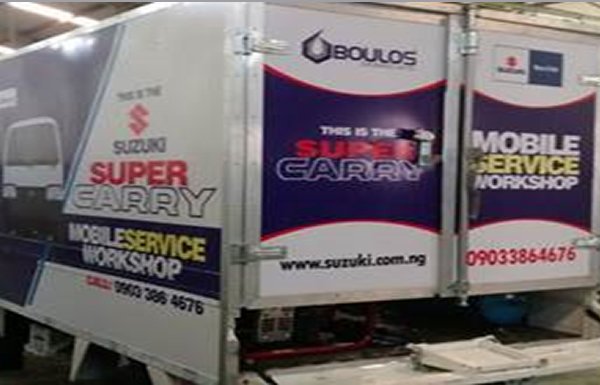
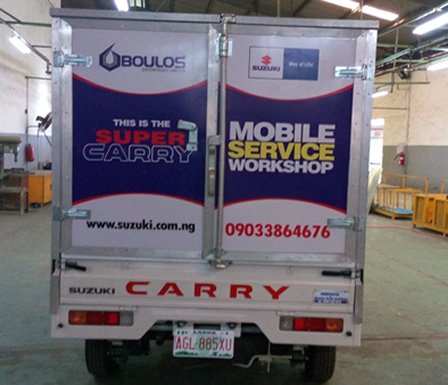
The new SUZUKI mobile workshop to service the Suzuki Super Carry vehicles was launched on 18th May. In a first for Nigeria it will enable the purchaser of the new Suzuki Super Carry to have their vehicles serviced on their doorstep or distribution centres. The Mobile Mechanics and Repair Suzuki (MMARS), is fully equipped with compressor, trolley jack, maintenance table, Suzuki specific tooling, torque wrenches, secure tooling cabinet and two Suzuki qualified technicians. It will initially be utilised in Lagos and surrounding areas.

Joseph Fayose national Sales Manager for Suzuki Nigeria said: “MMARS further reinforces our promise to maintain the lowest downtime for any commercial vehicle product in Nigeria. The Nigerian Suzuki Carry is assembled and manufactured by Nigerians for Nigerians, likewise the MMARS was designed and built here in Lagos, we are justifiably proud of it and know it will prove invaluable to companies and small business people who need their vehicles to be working 24 hours a day”.

Titi Olodun, the Marketing Manager went on to explain that the Super Carry is the most tried and trusted 1 tonne van in the world, sold in 192 countries it was launched in 1961 and this is the 12th generation. It is also one of the most reliable in the world and here in Nigeria the launch price at Naira 4.3 million is two million less than any other competitor’s vehicle.

The pick-up version will be available only to special order only. As the Van and Refrigerated units will be the best sellers. The engine of the vehicle is the tried and tested Suzuki 1.2 litre petrol, which is also fitted to the Suzuki Swift, Vitara, Splash, Baleno, Kizashi and many others. In fact, it is so reliable that other manufactures buy the engines from Suzuki for use in their vehicles. The suspension has been especially designed for Nigerian roads, raising the ride height to a level that allows the vehicle to tackle water impediments and settle on the trailing arms and leaf spring suspension without bottoming out.

The Super Carry is backed by a comprehensive warranty and dealer service representation across Nigeria. Additionally, Boulos stocks over $5 million spare parts at any one time, so there is never a worry for spare parts. This moment marks the continuation of more than 57 years of representation of SUZUKI in Nigeria by Boulos Enterprises.

suzuki-mobile-workshop

suzuki-mobile-workshop

Titi Olodun, the Marketing Manager for Boulos Enterprises Ltd said:

The assembly line is 1,132 square metres long, there is an additional 1,200 square metres where fabrication of a range of custom made bodies for the Suzuki are being manufactured, these include refrigerated units, vans, six seater people carriers, tippers, hoppers, pick-ups, mobile shops and many other body options. The new facilities will be equipped with state of the art modern manufacturing tools and equipment, with associated infrastructure built to the exacting standards of SUZUKI Japan. This venture not only protects the jobs of Nigerians, but has also sets in place a clear manufacturing base here in Lagos. We are truly honoured to have created the first ever 4-wheel vehicle assembly/production facility in Nigeria for SUZUKI.’’

suzuki mobile workshop

The Super Carry is initially launched with four bodies: VAN, HIGH TOP VAN, REFRIGERATED VAN AND the PICK-UP (special order only). As production increases the rest of the other 21 body options will be built and made available.

Further information on BOULOS:

Boulos Enterprises Limited (BEL) was incorporated in 1964 by the Boulos brothers Anthony and Gabriel Boulos. The initial trading business was started with Suzuki in 1959. The focus of their business initially, was trading and incorporation of general merchandise including some brands of motorcycles from Western Europe. After a few years, they concentrated on the importation of the “Suzuki” brand of motorcycles and outboard motors from Japan and since then it remained a leading motorcycle and outboard motors distribution and assembly company in Nigeria.

The continued growth in Suzuki motorcycle business stimulated the company to establish the first assembly plant in the country at Oregun, Ikeja Nigeria in 1969 existing till date to assembly motorcycles from Completely Knocked Down (CKD) to Fully built up (FBU) by Nigerian staff. It is worthy to note this was implemented at the initiative of the company as all other competitors in the country were still importing fully built up motorcycles.

The ban of fully built motorcycles gave the company the impetus to embark on a manufacturing/assembly plant. Considering the bright future of automobile business in Nigeria and the level of technology, the company embarked on the construction of a phased integrated motorcycles manufacturing complex located at its present 25-acre plot at Ogba Industrial Scheme Ikeja. The present integrated plant has an installed capacity of 150,000 units for motorcycles assembling per annum on a single 8-hours shift per working day. Additionally, Carry D700 AND p400 commercial tricycles are assembled at the factory/plant. Boulos also distribute Suzuki OBM marine engines from 9hp to 300hp, all of which are 4-stroke.

The Super Carry, motorcycle and tri-cycle plant assembling facilities has an independent service utilities backed up system. 0ver 320 full time Nigerian staff are employed.

suzuki-mobile-workshop

suzuki-mobile-workshop


Suzuki has over 45,000 employees worldwide and 35 main production facilities in 23 countries and 133 distributors in 192 countries including Boulos in Nigeria, which makes the Boulos Ikeja, Lagos factory the oldest Suzuki production plant in the world outside of Japan. (something special!)


(Autojosh)

LAGOS To Introduce Public Utility Levy (PUL)

0

THE ENVIRONMENTAL TRUST FUND

Established as a funding mechanism to aid in the tackling of crucial environmental issues and the implementation of the CLEANER LAGOS INITIATIVE.

(Drainage remediation, drainage alignment, drainage construction, residential & street sweeping collections, The Ward Street Sweepers management, labour supply, drainage management, and equipment replacement).  Environmental issues such as erosion, poisoning of ground water, educational and training initiatives for recycling and sustainability efforts etc.

The Trust Fund will be primarily funded by government and the Public Utilities Levy.

The Public Utilities Levy (PUL) is a property-based charge, payable by property occupants for the management of solid & liquid waste, wastewater and environmental intervention for Lagos State.

  • PUL funds will be managed independently in a trustee account (ENVIRONMENTAL TRUST FUND) and will only be used to support public utilities (water projects, integrated waste management services, comprehensive sewage and waste water treatment)
  • Full transparency and accountability of funds utilization by SEC regulated trustees with minimal intervention from the government.
  • The PUL is NOT a TAX.
  • PUL will REPLACE all service fees/payments paid to LAWMA/PSP operators.
  • Paying the PUL is a civic duty that will aid in the improvement of utility services provided by the State.

ARE SOLAR POWER SYSTEMS WORTH IT?

As our lives become increasingly dependent on electricity to keep our needs, it seems that we must be careful how we get a profitable renewable.  While other forms of “green energy” are only practical on a commercial level, solar panels are easy to install-power for residential consumers and businesses.  Sunshine is a natural source of clean energy that is abundant and free worldwide so there is little reason not to enjoy.

Nigeria’s #1 provider of premium quality solar power on site

Simply switching to solar panels for 50 percent of its electricity, emissions overall average consumers will be reduced when calculated weekly or monthly, helping to conserve energy for future generations in a clean and safe environment, while saving thousands of Naira for homes and businesses in the long term.

While this may seem like an expensive investment installation of solar energy systems, the average life of the solar system is more than 25 years, during which you are less dependent on a grid. In fact, if installed optimally in the right conditions, the solar panels can create the surplus electricity you will ever need.

At the first change solar panels, many consumers decide to buy 1.5-3kw system, which accounts for about 25-40 percent of its current energy consumption. While this may not seem like much, the amount of electricity generated even a panel can lead to annual savings in electricity bills. In a few years, solar power has completely paid for itself and has 20 years to reduce energy costs for consumers.

A common concern about solar energy is that the cloudy regions receive good sun and force the end user to use only electricity from the grid of the utility company. Although there is a reduction in the amount of electricity produced during cloudy days, the panels installed optimally will collect enough energy to be a worthwhile investment.

If the solar system is not able to gather enough electricity to power your home, the houses are without electricity. As a precaution, all solar panels will be able to store excess electricity to use  because they are able to draw from the battery bank connected to ensure that a home is never without electricity.

Although the use of solar energy appears to be an expensive investment, it’s a great way to save money, even for residential users. The long-term savings from the solar panel to move not only help to maintain a healthy environment for future generations, but also economically benefit  you , the end user.


AWPS Renewable Energy Ltd is Nigeria’s #1 provider of premium solar power.

Click on our link to select a solution http://atlanticwastepower.com/store/, we also offer customized solutions

Here are the Kantar smartphone market share numbers for February 2017

Displaying Picture5.jpg

Displaying Picture4.jpg

For smartphone market share watchers, here are analyst company Kantar’s latest numbers for the smartphone market share for the 3 months ending February 2017.

The numbers show market share gains for Android in the important Chinese market, at the expense of iOS. In Europe iOS gained 2.7%, seemingly gobbling up most of the 3.3% market share vacated by Windows Phone. In UK, Germany and USA iOS made significant gains, likely reflecting the strength of the OS in richer markets.

Kantar notes:

The latest smartphone OS data from Kantar Worldpanel ComTech shows that Android OS share in urban China in the three months ending February 2017 was greater than at any time in the previous year, accounting for 86.4% of smartphone sales compared to 77.1% in the same period one year earlier. Android share also rose slightly in EU5 from 74.3% to 75.2% of smartphone sales in that region, but declined three percentage points in the US, from 58.9 to 55.9%.

Europe’s big five markets include Great Britain, Germany, France, Italy, and Spain.

“Android has achieved continuous growth in China since last February, with its strongest year-on-year gains coming in the three months ending February 2017, when its share rose 9.3 percentage points,” said Lauren Guenveur, Consumer Insight Director for Kantar Worldpanel ComTech. “As we’ve seen in the past, this was due to a strong sales period around Chinese New Year, which is always a busy promotional season, particularly for local brands. Huawei, Oppo, Meizu, Vivo, and 360 all posted year-on-year growth.”

“In the three-month period ending February 2017, iOS accounted for 13.2% of smartphone sales in urban China, a decline of 8.9 percentage points from 22.1% a year earlier. This marks iOS’ lowest share since the three-month period ending July 2014,” reported Tamsin Timpson, Strategic Insight Director at Kantar Worldpanel ComTech Asia. “That said, iPhone 7 and iPhone 7 Plus remained the top selling devices in the region, accounting for 8% of smartphone sales. By comparison, iPhone 6s and 6s Plus accounted for 14% of smartphone sales in the three months ending February 2016.”

“While Android continued to make gains in EU5, growth slowed to just 0.9 percentage points between February 2016 and February 2017, while iOS gained 2.7 percentage points to capture 21.8% of smartphone sales,” said Dominic Sunnebo, Business Unit Director for Kantar Worldpanel ComTech Europe. “Growth for Android was strongest in Spain, where Android accounted for 92.2% of smartphones sold, a 2.2 percentage point increase from February 2016. Samsung and Huawei, the top Android vendors in Spain, experienced modest year-on-year declines, while local brand BQ and China’s Xiaomi each grew six percentage points over the past year. Android’s share fell modestly in Great Britain, shrinking by 0.5% points to 55% of smartphone sales.”

In the US, Android dropped to 55.9% of smartphone sales in the three months ending February 2017, marking another period of year-on-year decline that began in the second quarter of 2016. iOS accounted for 42% of smartphones sold in the US, up 3.7 percentage points from 38.3% the previous year. iPhone 7 and iPhone 7 Plus remained the top-selling smartphones in the US where they have been in the lead since the three months ending November 2016. Although Google Pixel was not expected to be a game changer in its first iteration, there were hopes that it might soften the drop in Android sales that typically occurs around an iPhone launch.

Among US consumers intending to purchase over the next six months, 23% indicate that they will consider a Google Pixel. But since its release, Pixel has not been able to surpass 2% of smartphone sales, in part because supply constraints have limited its availability.

“The February period is always a challenging time to report on consumer behaviour and plans, since many people put purchases on hold following the holidays, waiting for the latest phone announcements from Mobile World Congress,” Guenveur said. “The much-anticipated March 29 announcement of the Samsung Galaxy S8, combined with the somewhat unexpected launch of the (PRODUCT) RED iPhone 7 and iPhone 7 Plus, and the capacity upgrade to iPhone SE a week before that, may mean that the remainder of Q1 and Q2 could yield some interesting, even unpredictable, shifts in the market.”


(Mspoweruser)