Localised Innovation helpful to us in recession says Procter & Gamble Boss

Managing Director of Procter & Gamble Nigeria, Mr. George Nasser, has stated that the company is coping with recession in the country by localising its innovation to meet the yearnings of Nigerian consumers in these trying times.

From market realities, prices of P&G products that command reasonable market share in their various categories have increased astronomically in recent months. And this subsequently is believed to have had impact on the company’s income.

While speaking with MARKETING EDGE, Nasser admitted that the company lost some market shares in the tick of the recession as consumers search for cheaper products. But further explained that P&G has been able to recover by coming up with innovative products that meet consumers needs in smaller packs while maintaining the same global quality.

Image result for procter and gamble

He stressed that the company will rather give the consumer a smaller pack option than tampering with the quality of its product in other to cut price. “Yes, for a short time we lost some volumes but we will not short change the consumer by selling 90g in a 140g pack. If you are using 140g Oral-B you will see that the paste inside is exactly the same quality and quantity specified on the pack. We don’t play with the value to reduce price.

“At times like this when things are tough, you either introduce smaller sizes to be more affordable or you offer a very big pack that offers more and save cost. For instance on Oral-B, those who cannot pay for the 140g, we introduced a 90g, specifically for the Nigerian market with the same quality. The Always Thick was also an innovation we had with Nigeria in mind. We have Always Ultra and Always Thick. The thicker one is less expensive than the Ultra. If the consumer cannot afford the Ultra but still want protection, they can go for the thicker one. We at P&G respect the consumer right; we don’t play with the consumer. If we change the size, we make it clear and communicate it,” he said.

Beyond the products, Nasser also revealed that the company is also navigating the hard times by reducing its dependence on importation. According to him, the company now does all its packaging locally. He said, “we are working very hard to localise our raw materials. We work with our suppliers, they brought the right machine and they produce in Nigeria instead of importing from china. Now, 100% of our packaging materials are local.”

P&G is the biggest US investors outside oil and energy in Nigeria. In 2015, the company launched its Pampers plant worth $300M in Agbara, Ogun State.

(Marketingedge Nigeria)

U.S. imposes electronics ban on flights from major Middle Eastern and African Airports

0

Airlines flying directly from eight countries in the Middle East and Africa to the U.S. must prevent passengers from carrying almost all electronic devices in the cabin, according to new security restrictions from the Trump administration.

Passengers will have to check in any devices bigger than a smartphone — including iPads, Kindles and laptops — before clearing security or boarding, U.S. officials said, citing terrorism concerns.

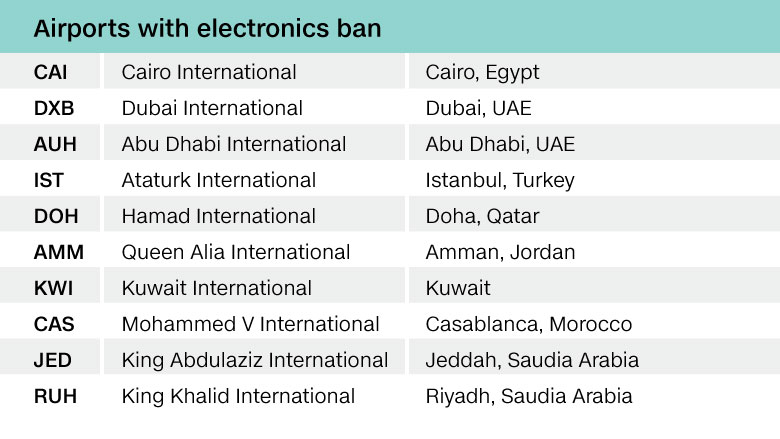
The open-ended ban will affect more than 50 flights from 10 airports, including major global hubs like Dubai and Istanbul, according to senior administration officials. The nine airlines affected by the ban were notified of the procedures by the Transportation Security Administration at 3 a.m. ET Tuesday and must comply within 96 hours.

Top international carriers — like Emirates Airline, Qatar Airways and Turkish Airlines — are among those that will have to implement the ban.

The U.S. officials said intelligence “indicates terrorist groups continue to target commercial aviation” by “smuggling explosive devices in various consumer items.” The officials declined to provide specific information on the threat or why these particular airports were selected.

“Just evaluating all the intelligence, we believe that the threat is still prominent against aircraft and airports,” an official said.

U.S. airlines not affected

The 10 international airports covered by the ban are in Cairo, Egypt; Dubai and Abu Dhabi, U.A.E.; Istanbul; Doha, Qatar; Amman, Jordan; Kuwait City; Casablanca, Morocco; and Jeddah and Riyadh, Saudi Arabia.

The nine airlines are Egyptair, Emirates Airline, Etihad Airways, Kuwait Airways, Qatar Airways, Royal Air Maroc, Royal Jordanian Airlines, Saudi Arabian Airlines and Turkish Airlines.

The officials said U.S. carriers are not affected because none of them fly from the airports in question to the U.S.

The ban involves some of the widest reaching aviation security measures taken since the terrorist attacks on September 11, 2001.

It means all laptops, cameras, tablets, e-readers, portable DVD players, electronic gaming devices and travel printers or scanners will have to be kept in the cargo hold for the duration of the flight.

Royal Jordanian Airlines told passengers Monday that medical devices were still allowed.

Concerns over airport screening

If the airlines don’t comply with the order within the 96 hour time frame, “we will work with the FAA to pull their certificate and they will not be allowed to fly to the United States,” one senior U.S. official said.

Another official, speaking separately from the senior administration officials, said there’s no specific plot authorities are aware of, but the U.S. has been considering such a ban for some time.

The official said the move is partly based on intelligence that they believe indicates Al Qaeda in the Arabian Peninsula is close to being able to hide explosives with little or no metal content in electronic devices in order to target commercial aircraft.

It’s a particular concern at these airports because of screening issues and the possibility of terrorists infiltrating authorized airport personnel, the official said. Flight and cabin crews are not covered by these new restrictions.

In February 2016, a bomb hidden inside a laptop detonated aboard a Daallo Airlines flight out of Mogadishu, Somalia. The bomber was killed and a hole was blown in the side of the fuselage. The aircraft landed safely.

Global hubs affected

The new ban affects some of the largest airlines at the busiest hubs in the world:

airport electronics ban table

Implementing a ban on most electronics in the cabin will fall to the airlines to figure out.

Lithium battery concern

Under the new restrictions, the electronic devices — many of which have lithium ion batteries — will now be carried in the belly cargo deck of the airplane, underneath the passenger cabin.

Aviation safety experts and regulatory agencies have long warned about that batteries shipped in bulk could cause a fire and spark a chain reaction that could bring down an aircraft. The International Civil Aviation Organization advised global regulators last year to ban carrying bulk shipments of such batteries in the cargo holds of passenger jets.

Two Boeing 747 crashes — a UPS freighter in 2010 and an Asiana Cargo plane in 2011 — happened after fires broke out in the cargo holds. Those were traced to palettes of lithium ion batteries the planes were carrying.

But electronics spread out across a person’s luggage pose far less of a threat than palettes of lithium batteries, according to a U.S. aviation official.

The Trump administration has worked with the FAA to distribute best practices to the airlines to safely handle the electronics, an official said.

A State Department official said embassy officials spent Monday notifying relevant countries and airlines.

(CNN)

N500 FREE airtime for everyone as Zoto celebrates one million users!

We’re excited to share that you’re one of the ONE MILLION users now recharging with Zoto! To keep enjoying the best recharge experience, start by accepting our appreciation

In celebration of this milestone;

We are giving all our users N500 free airtime, you’re only required to upgrade your Zoto app to the latest version, once that is done, open the app.

We’ve made it that easy, by simply opening your app, you get N500 bonus!

We are celebrating with you for sticking with us; this past year has been one of delightful milestones. Zoto was the number one shopping app on playstore, averaging a 4.6 approval rating and now, one million users- but there’s more!

After you’ve claimed your N500 bonus, you’ll also get 50% off your next transaction.

Image result for ZOTO APP

Remember ,All existing and new users of Zoto Mobile application will be eligible for the N500 free airtime with immediate effect and for a short period of time.

So, spread the word,  Zoto is now one million users strong!

Consumers spend N2. 04tr to access telecoms services, says NCC

0

Gives reasons for brokering Etisalat’s N200b debt pact with banks

The Nigerian Communications Commission (NCC) has said that consumers spent N2. 047 trillion ($6.6 billion) in 2016 to access telecoms services. This is a rise of $1billion above the N1.737 trillion ($5.6billion) spent the previous year.

The Executive Vice Chairman of the commission, Prof. Umar Danbatta disclosed this yesterday at the opening of NCC’s year of consumers in Asaba.

Danbatta explained that the commission, with the Central Bank of Nigeria (CBN) prevented the takeover of Etisalat by a consortium of local lenders over an alleged loan of N200 billion in the interest of the telco’s over 20 million customers.

He reaffirmed the commitment of the two regulators to ensuring that the alleged N200 billion loan default payment issue by Etisalat was amicably resolved in the interest of the industry, and the nation’s investment climate.

According to the NCC’s chief, though the matter had not been resolved, negotiations would continue among all the parties. He stressed: “Let me assure that there is no cause for alarm over the matter. The regulators are on top of the situation and details of the resolution would be made available within next couple of weeks.”

Danbatta said the NCC and the CBN had to intervene particularly in a manner that business operations of all the parties involved would not be jeopardized.”

He maintained that NCC considers consumers as very important hence it intends to inform and educate the consumers with the sole intent of protecting and empowering them to make the right decisions.

(Guardian Nigeria)

AMCON sells Keystone Bank to Sigma Golf, Riverbank Investment

The Asset Management Corporation of Nigeria (AMCON) has sold Keystone Bank Limited, the last of the three nationalised banks to Sigma Golf Nigeria Limited and Riverbank Investment Resources Limited. It hinted that the new owners were a consortium of local investors.

The corporation noted yesterday that the new beneficiaries emerged preferred bidder after the acquisition of the bank’s shares. The new development came after regulatory approvals from the Central Bank of Nigeria (CBN) and Securities and Exchange Commission (SEC).

AMCON, however, added that the completion of the transaction was now subject to the fulfillment of the conditions in the Sales and Purchase Agreement (SPA) executed between the bad debt company and the consortium.

The corporation said the process leading to the acquisition started with interest shown by 18 parties cutting across local and international investors. “The emergence of the Sigma Golf-Riverbank consortium resulted from a rigorous and competitive bidding process, which was coordinated for AMCON by Citibank Nigeria Limited, its affiliates and FBN Capital (Joint Financial Advisers) as well as Banwo & Ighodalo and Crosswrock Law (Joint Legal Advisers).”

After the inquest carried out by the Mallam Lamido Sanusi-led CBN in 2008, three of the 24 national banks that scaled the 2005 banking consolidation – Afribank Plc, Spring Bank Plc and Bank PHB failed a stress test.

These were, subsequently, nationalised by a special purpose vehicle that emerged in AMCON, imposing a new administration and rebranding them as Mainstreet Bank Limited, Enterprise Bank Limited and Keystone Bank Limited.

Keystone Bank was incorporated by the Nigeria Deposit Insurance Corporation (NDIC) on August 3, 2011, after the takeover, while AMCON eventually capitalised it before appointing a board and an executive management team to lead the financial institution.

According to AMCON’s Head of Corporate Communications, Jude Nwauzor, as at April 2016, Keystone Bank had a staff strength of 1,753 employees, network of 154 branches, nine cash centres and 315 Automated Teller Machines.

(Guardian Nigeria)

Hacked websites on the rise, says Google

Google painted a bleak picture of cybersecurity trends Monday, saying the number of websites hacked rose 32 percent last year, with little relief in sight.

“We don’t expect this trend to slow down. As hackers get more aggressive and more sites become outdated, hackers will continue to capitalize by infecting more sites,” Google said in a post on its webmaster blog.

Google, which inserts security warnings when it detects hacked sites, said most of those warned can clean up their pages, but that 61 percent are not notified because their sites are not verified by the search engine.

“As always, it’s best to take a preventative approach and secure your site rather than dealing with the aftermath,” the blog said. “Remember a chain is only as strong as its weakest link.”

The news comes amid growing concerns over cybersecurity in the wake of massive hacks affecting Yahoo, the US government and major e-commerce firms.

Google said certain website hacks often follow similar patterns — some insert “gibberish” on a page, while others create Japanese text that links to fake brand merchandise sites.

“Hacking behavior is constantly evolving, and research allows us to stay up to date on and combat the latest trends,” Google said.

(guardian.ng)

Total partners FRSC on safety campaign

0

TOTAL Nigeria Plc in partnership with the Federal Road Safety Corps, FRSC and state traffic authorities is currently implementing the road safety cubes campaign with the aim of educating Nigerian children within the ages of six to 12 on road safety guidelines as well as proper behaviour on the road while going to school. Managing Director, Mr. Jean-Philippe Torres, said “We are fully committed to reducing road accidents and its associated risks as our major channel of petroleum products distribution is via road transportation.

This is because at Total, safety comes first and is fundamental in our core values.” He explained that these safety cubes were designed to make the learning of safe road behaviour a fun experience for children, adding that they contain teaching kits for simulated, interactive and practical lessons which include road tracks, road signs, lesson guides, work books, safety exercise books, and certificates to be issued to students at the end of their training.

The campaign that commenced in 2013 as one of Total Group’s corporate social responsibility strategy, has been implemented in Lagos, port-Harcourt, and recently in Kaduna and Kano states. The campaign started with the donation of 13 safety cubes for children in Saint Georges Primary Schools, Falomo in Ikoyi, Lagos. So far, the road safety cube training has covered 1,018 pupils in Kaduna.  Also, on February 14, 2017, the Kano sector command of the FRSC distributed five safety cubes to five schools.

(vanguardngr)

Lagos Govt denies levy on digging of bore-holes for domestic purpose

0

The Lagos State Government on Friday assured Lagosians that the new Environmental Protection and Management Law initiated by the Governor Akinwunmi Ambode-led administration was done in the overall interest of all Lagosians to ensure cleaner environment and public health safety in the State. In a press release signed by the Commissioner for Information and Strategy, Mr. Steve Ayorinde, the State Government explained that the Law was in tandem with the reforms in the Environment Sector, aimed at charting a new direction in recognition of the fact that water, sanitation and hygiene are non-negotiable requisites in a mega city like Lagos.

According to the Commissioner, the rapid growth of Lagos, its dream of 24-hour economy and government financial limitations have made it pertinent to make investor-friendly Laws that will attract the desired investment into the Sector. “With the Cleaner Lagos Initiative, the government reassures all and sundry of its determination to clean the environment in our state and we are already taking the necessary steps in that direction,” he said. While stressing that the Government will not be frustrated in its determination to achieve a cleaner Lagos by seeming vested interests working against the reforms, Ayorinde gave assurance that all issues pertaining to the Cleaner Lagos Initiative are being addressed, especially in the crucial area of waste management.

“The government is aware of the complaints by well-meaning citizens over delays being experience in the area of waste collection. The Ministry of the Environment, the Lagos State Waste Management Authority (LAWMA) and our ‘sanitation gangs’ are on top of the situation and will not give in to the sabotage by those who are opposed to the reforms”, Ayorinde stated. He also clarified that there was no such thing in the law that seeks to criminalise individuals sinking boreholes, stating that only boreholes dug for commercial purposes require license or payment and this is not a new practice as it has been in existence since. “The position of the Law today as provided in sections 253 and 259 of the Environmental Management and Protection Law as it relates to construction of borehole or well has not changed from what it used to be.

“First, Landlords are free to dig or construct boreholes in their houses without any permit or licence, provided that the regulation on location of such bore-hole is followed, that is the bore-hole, or well must not be sited near soak away or septic tank,’’ he explained. The Commissioner stated that Licence is required only by landlords that intend to construct a borehole or a well for commercial or industrial use, “meaning that if you dig or construct to sell or for industrial use, you need location permit”. He added that in order to make it accessible to citizens, the Law has been uploaded online and can be accessed on http://laws.lagosstate.gov.ng – A Law to Consolidate all laws relating to the environment for the management, protection and sustainable development in Lagos State and for connected purposes.

He urged Lagosians to team up with the Government to work for the realization of its development agenda and sustainability goals, particularly as they relate to the reforms in the Environment Sector where the people are the direct beneficiaries of the 27,500 new jobs being provided through this initiative; a cleaner state, and all-year-round drainage management for effective and efficient flood control, among others as contained in the Environmental Law.

(vanguardngr)

What is FinTech?

Financial technology—FinTech for short— describes the evolving intersection of financial services and technology.

The term can refer to startups, technology companies, or even legacy providers. The lines are blurring, and it’s getting harder to know where technology ends and financial services begin.

The term FinTech is often tossed around in the media and in casual conversation. And while many use the term, its specific meaning often gets lost somewhere along the way.

Startups use technology to offer existing financial services at lower costs, and to offer new tech-driven solutions. Incumbent financial firms look to acquire or work with startups to drive innovation. Technology companies provide payment tools. These can all be seen as FinTech.

Look beyond the name and you’ll see some of the most exciting industry developments in a generation. We caught up with Haskell Garfinkel and Dean Nicolacakis, PwC’s US FinTech Practice co-leads, to better understand the FinTech ecosystem.

Questions and Answers

Q. Who’s doing this? What does a typical FinTech company look like?

A. When people think of FinTech, they often focus on startups, breaking into areas that banks and other legacy financial institutions have dominated. But we think about all the players in a larger FinTech ecosystem, which we refer to as the As, Bs, Cs, and Ds:

  • As are large, well-established financial institutions such as Bank of America, Chase, Wells Fargo, and Allstate. We sometimes refer to these as “incumbents.”
  • Bs are big tech companies that are active in the financial services space but not exclusively so, such as Apple, Google, Facebook, and Twitter.
  • Cs are companies that provide infrastructure or technology that facilitates financial services transactions. This broad group includes companies like MasterCard, Fiserv, First Data, various financial market utilities, and exchanges such as NASDAQ.
  • Ds are disruptors: fast-moving companies, often startups, focused on a particular innovative technology or process. Companies include Stripe (mobile payments), Betterment (automated investing), Prosper (peer-to-peer lending), Moven (retail banking), and Lemonade (insurance).
  1. In a recent presentation, Haskell referred to “FinTech as a verb.” What exactly did he mean by that? A. FinTech isn’t static. We see it as the evolving intersection of financial services and technology. When we talk about the As, Bs, Cs, and Ds, we think of them as sectors in motion, all moving toward each other over time.

    For example, financial institutions are becoming more technology focused. At the same time, big tech companies are offering peer-to-peer payment solutions over social networks and email.

    Meanwhile, disruptors are providing financial services that, until recently; you could get only from banks or financial advisors.

  1. Where have you seen the most disruption in financial services so far? A. FinTech disruptors started by offering products and services in payments and peer-to-peer lending. Because of this, these have been the most disrupted areas to date. We can think of this as “FinTech 1.0,” in which new market entrants have focused largely in the business-to-consumer (B2C) space.

    Q. What do you see unfolding over the next 12 months?

    A. Looking forward, we expect FinTech disruptors to continue to expand into other areas within financial services.

There’s a lot of interest in areas like marketplace lending, credit underwriting, digital cash, treasury functions, deposits, and bill payments.

We also anticipate a lot of activity in the roboadvice and wealth management space over the next year.

Perhaps more importantly, we predict a lot of FinTech innovation in the next 12 months in the business-to-business (B2B) space. You can think of this as “FinTech 2.0.” Here, expect tech innovations like blockchain to come on line.

As they do, they’ll start to radically alter business processes and drive down costs. We’re already witnessing a lot of firms exploring how they can apply these breakthrough technologies. Done right, there are some real efficiency gains to be had.

Q. What should incumbents do about all this? Do they need a FinTech strategy?

  1. We see incumbent banks, asset managers, and insurance companies looking for way s to play defense and offense at the same time. And that’s reasonable. You have to know how a disruptive FinTech development could hurt y our business, even as you’re looking for ways to take advantage of the technology.

The disruptors themselves take different approaches. Some target specific niche areas of the industry. Others are using new technologies, such as blockchain, in way s that will cross a lot of boundaries.

For incumbent financial institutions to succeed, they’ll have to do three things well:

  • Continuously scan the environment to identify new threats and opportunities.
  • Quickly understand the effect that emerging trends and technologies could have on their business.
  • Come up with solid strategies to react— from acquiring or working with FinTech startups to building their own innovative solutions.
  1. Do you have any recommendations for the longer term?
  1. Every one needs to recognize that this isn’t going away .It’s the “new normal.”Over the long-term, financial institutions are going to have to make some fundamental changes. They’ll need to:
  • Become more agile. Incumbents tend to have long planning and delivery cycles. They’ll need to change this as they incorporate emerging technology into their businesses and partner more with disruptors.
  • Manage the business from the “inside out” instead of from the “outside in.” FinTech offers amazing potential, but that can actually be a distraction. Institutions have to start with their own needs in mind, rather than working backwards to figure out how to use the latest technology.
  • Change the way they approach innovation. Most incumbents still struggle with finding and implementing innovative ideas. There are ways to do it well, though. In fact, they can learn from disruptors. Once you’ve figured out how to test-and-learn, a lot of other things fall into place.

(PWC)

New comedy movie, ‘Basira In London’ set to hit Nigerian cinemas March 24

0

Nollywood has witnessed notable comedy flicks that have broken box office records in recent times. Notable among such are The Wedding Party, A Trip to Jamaica and Wives on Strike. It is on the heels of this that new movie by London based producer, Philippa Abraham, ‘Basira In London’ will be hitting the Nigerian cinemas from March 24, 2017.

Image result for eniola badmus

‘Basira In London’ was first premiered in the United Kingdom in August, 2015 to a sold out crowd in all of its six showings at the Odeon Cinemas. Anticipation has hit the roof as to when it will be premiered in Nigeria and fans will have the opportunity of seeing the movie. Thankfully, that expectation will be met from March 24, 2017 when all cinemas nationwide will start showing the movie. ‘Basira in London’ is a hilarious comedy-drama that tells the story of an African woman (Eniola Badmus) who relocates to London with great expectations.

The culture clash and her efforts in trying to fit in make this film ‘unmissable’. The movie gives stamp to the premise, ‘you can take a girl out of Nigeria but you cannot take Nigeria out of the girl’. The movie stars favourite Nollywood big girl, Eniola Badmus, Jason Adedeji-Abraham, Destinee Anthony, Tolu Yesufu, and Theodora Ibekwe-Oyebade. The movie is produced and directed by Philippa Chiedu Abraham, who also starred in the movie.


(vanguardngr)