



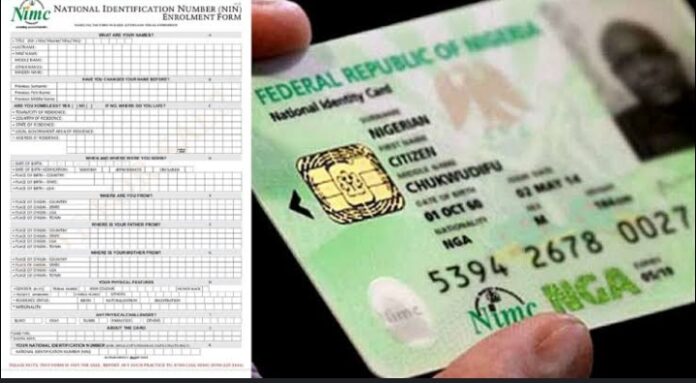
In 2024 (January–September), the average number of people registering for National Identity Numbers (NINs) was 648,888, a decrease from 1.05 million in 2023. This slowness coincides with the ongoing SIM-NIN linking project and a service upgrade intended to increase the NIN database capacity from 100 million to 250 million.
The National Identity Management Commission’s Director General, Abisoye Coker-Odusote, revealed on Monday that 110 million Nigerians currently own NINs, a 2.48 percent rise from the 107.34 million she had previously declared in May 2024.
At an event in Abuja honouring the National Day of Identity with the subject “Digital Public Infrastructure: Enabling Access to Services,” she made this statement: “The role of DPI has become indispensable to Nigeria’s economic development, as it offers a framework that connects citizens to essential services such as social welfare, healthcare, education, and financial inclusion. At the forefront of this transformation is NIMC, responsible for the National Identification Number, which has enrolled over 110 million Nigerians.”
The overall number of NIN enrolments as of December 31, 2023, was 104.16 million. Nevertheless, the commission has only met 25.96% of the 2.5 million monthly enrolment goal set by the federal government.
The government’s National Development Plan 2021–2025 outlined its goals in detail. In three years, 100 million Nigerians are expected to be registered, according to the plan.
According to the plan: “The latest of these is the Nigerian Communications Commission linking SIM Registration Data to the National Identity Number Database. NIMC plans to register an additional 100 million people in three years and has embarked on a massive registration drive. The plan is to enroll 2.5 million people monthly for the next three years.”
Technical difficulties have impeded the strategy, and continuous server updates are making things worse, BrandSpur technology and information news reports.
The National Association of Telecoms Subscribers of Nigeria (NATCOMs) President, Adeolu Ogunbanjo, stated that the SIM-NIN linking exercise, which was supposed to end on September 14, 2024, has also been impacted by server outages.
He had this to say: “Telco officials could not upload to the NIMC server, and subscribers were turned back.”
The Federal Government imposed a 30-day deadline for citizens to link their NINs with their SIM cards and outlawed the sale and registration of new SIM cards in December 2020. Almost 66.01 million lines were still unlinked as of August 2024, despite several extensions having been granted since then.
Ogunbanjo blamed these delays on a variety of issues, including NIMC network outages. He brought up the fact that during the most recent deadline, the NIMC was unavailable for almost five days. Even though the problems seem to have been fixed, subscribers continued to experience delays.
Continuing, he went on to say: “We are requesting a one- to two-week extension due to the hiccups earlier in the month. NIMC has resolved the issue, but subscribers were affected.”
The NIMC insists that its servers were never down despite these interruptions.
According to Kayode Adegoke, the
Commission’s Head of Corporate Communications, in a recent statement: “NIMC wishes to inform the general public that National Identification Number (NIN) enrolment, verification and authentication, modification of data and other services are going on seamlessly to meet the needs of Nigeria for the NIN-SIM linkage deadline.” All the same, NIMC is updating its systems right now.
The DG of NIMC, Coker-Odusote, recently verified: “We have started to work on upgrading the capacity across all boards from the network infrastructure perspective to software licensing areas. We are working on that to increase the capacity that we have. We are trying to ensure that we increase it from 100 million to 250 million.”
