



By Franklin O.O
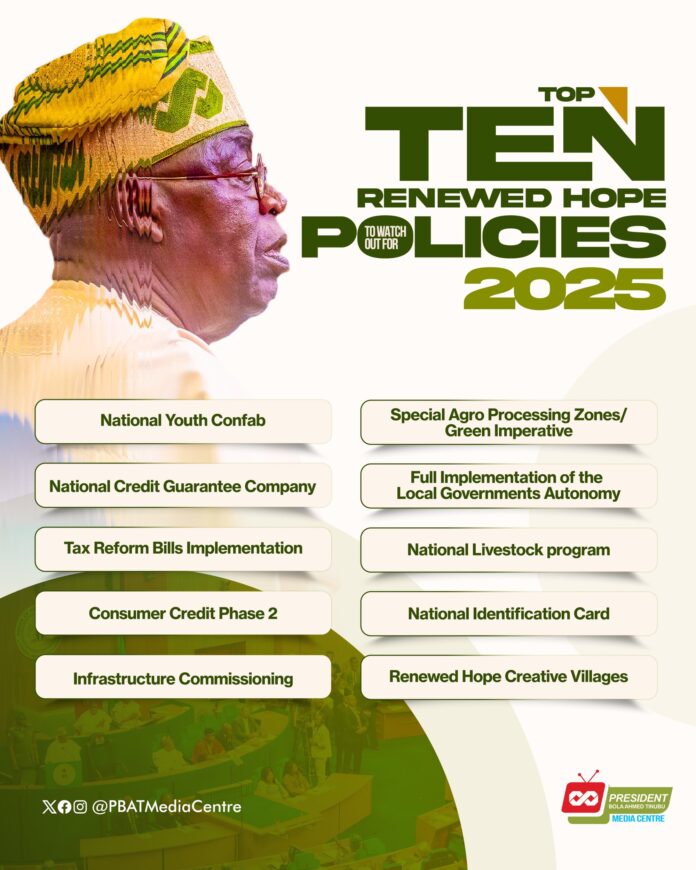
It is crucial to give you a preview of some of the policies that could influence 2025 as we begin the year’s business cycle on the path to a Renewed Hope.
It is expedient to look out and key into the following:
1. The National Youth CONFAB
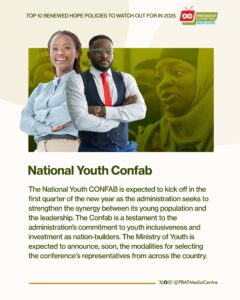
As the administration looks to improve the coordination between its youth and the leadership, the National Youth CONFAB is anticipated to begin in the first quarter of the new year. The administration’s dedication to young inclusivity and investment as nation-builders is demonstrated by the Confab.
The procedures for choosing representatives throughout the nation to attend the conference are anticipated to be announced shortly by the Ministry of Youth.
2. The National Credit Guarantee Company

Before the conclusion of the second quarter of 2025, the National Credit Guarantee Company is anticipated to be established by the Renewed Hope administration. To raise the output of the national economy, this company will help the administration further consolidate and expand credit availability for individuals and important economic sectors.
3. Implementation of Tax Reform Bills

Over the next months, it is anticipated that the tax reform proposals currently being discussed on the National Assembly floor will be ratified, and that implementation will start in earnest.
In addition to improving Nigeria’s ability to collect taxes, the legislation seeks to address several fundamental issues facing the economy, including poverty, unemployment, inflation, and low revenue, as well as enhancing the nation’s reputation as an easy place to do business.
4. Phase 2 of Consumer Credit

As the general public begins to take advantage of the advantages it offers, the Consumer Credit Scheme—a key project of President Bola Ahmed Tinubu’s administration—is anticipated to reach new heights. Tens of thousands of civil servants have already benefited from the first phase of the program, which will now be expanded to the general public as the administration works to improve access to consumable goods that will boost industrialization, lower corruption, and raise people’s standard of living.
5. Commissioning of Infrastructure
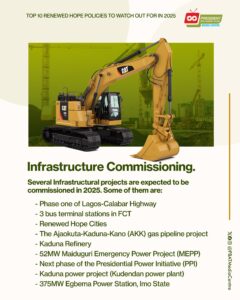
In 2025, several infrastructure projects are anticipated to be put into service, and they are:
- Phase one of the Lagos-Calabar Highway
- Three bus terminal stations in the Federal Capital Territory,
- Renewed Hope Cities
- Ajaokuta-Kaduna-Kano (AKK) gas pipeline project
- The next stage of the Presidential Power Initiative (PPI)
- 52MW Maiduguri Emergency Power Project (MEPP)
- Kaduna Refinery
- Egbema Power Station, Imo State, 375 MW
- Kaduna Power Project (Kudendan Power Plant)
6. The Green Imperative and Special Agro Processing Zones
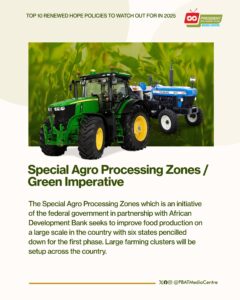
With six states selected for the first phase, the Special Agro Processing Zones initiative, a collaboration between the federal government and the African Development Bank, aims to increase food production nationwide.
Across the nation, significant farming clusters will be established. Through the establishment of centres throughout the 774 Local Governments, the Green Imperative aims to guarantee that farmers at the grassroots level have access to extension services, such as instruction on the use and maintenance of contemporary equipment and mechanized farming.
7. Full Implementation of the Local Government Autonomy

Autonomy If all goes according to plan, the Supreme Court’s ruling on local governments’ autonomy should be fully enacted in the upcoming year. Since it allows the FG to transmit allocations directly to the Local Governments without state intervention, as is now possible, this is anticipated to enhance governance at the local level.
8. The National Livestock Program
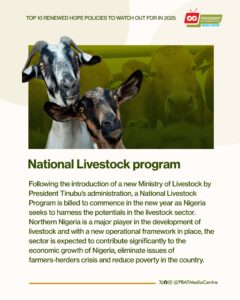
A National Livestock Program is scheduled to start in the new year as Nigeria looks to capitalize on the livestock industry’s potential, following the establishment of a new Ministry of Livestock by President Tinubu’s administration. The livestock industry plays a prominent role in Northern Nigeria, and with a new operational framework in place, it is anticipated that the sector will greatly contribute to Nigeria’s economic growth, resolve the farmers-herders dispute, and lessen poverty in the nation.
9. Introduction of New National Identification Card

It is anticipated that the National Identity Management Commission’s new AFRIGO card will be made available to the general public in the upcoming year. Access to government services improved financial inclusion and restored trust in the nation’s identification system are all made possible by the card that also provides payment options.
10. Renewed Hope Creative Villages

To boost the creative sector and protect historic locations, plans have been finalized to create “Renewed Hope Creative Villages,” or creative villages of the arts, in every state in Nigeria. The project would work with state governments to find historic sites and turn them into centres of creativity.
This one-stop shop will assist the government in utilizing the industry’s ability to protect historic locations nationwide, generate thousands of employment, and build a sector that has the potential to significantly boost economic growth.
