




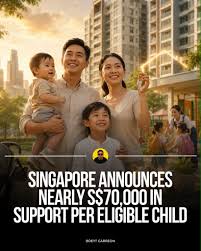
Singapore has unveiled a major expansion of financial support for children, with eligible Singaporean families set to receive benefits worth nearly S$70,000 (about US$55,150) per child from birth to age 17 as the government responds to a record-low fertility rate.
Prime Minister Lawrence Wong announced the new SG Child Support Package during Singapore’s National Day Rally on Sunday, with the programme scheduled to begin paying out from April 2027. The package will replace the existing Baby Bonus Scheme and Large Families Scheme and extend government support well beyond the early years of childhood.
The Brandspur Banking News Desk reports that the new package will provide up to S$62,000 in new support, alongside about S$7,500 in existing benefits, according to the Singapore government. Every eligible Singapore citizen child aged 17 and below will receive the same level of support regardless of birth order or whether the child is being raised by a single parent.
For babies born from April 1, 2027, the package includes a S$10,000 cash payment, distributed in two instalments during the first year. Children will also receive S$2,000 in annual Child Credits from age one through 16, amounting to S$32,000. Other benefits include a S$5,000 Child Development Account grant, up to S$5,000 in government co-matching and a S$10,000 top-up to the Post-Secondary Education Account at age 17.
The policy marks a significant shift in how Singapore distributes family assistance. Existing arrangements provide different levels of support depending on birth order, while the new package is designed to give children the same core benefits regardless of whether they are firstborns or part of larger families. Support will also continue through the teenage years rather than ending largely around the early childhood period.
More than 610,000 children aged 17 and below, living in about 380,000 households, are expected to benefit. The government says the changes are intended not only to provide financial relief but also to make raising children more manageable over a longer period.
The move comes as Singapore confronts one of its most serious demographic challenges. Its total fertility rate fell to 0.87 in 2025, down from 0.97 a year earlier and the lowest level recorded by the government. More than one in five Singapore citizens is now aged 65 or above, highlighting the speed at which the population is ageing.
Singapore is therefore pairing direct financial assistance with measures aimed at reducing the pressure on working parents. Under the new childcare leave arrangement, a working parent with one Singaporean child aged 12 or below will receive eight days of childcare leave annually, rising to 10 days for two children and 12 days for three or more. For a couple raising three primary-school children, that would amount to 24 days between them, compared with four days under the current arrangement.
The government also plans to progressively reduce fees at government-supported full-day childcare centres to S$150 a month by 2030. Infant-care fees are similarly targeted at S$300 a month. The measures are intended to address some of the continuing costs of raising children beyond the point when a baby is born.
Also read: https://brandspurng.com/2026/02/19/baby-product-sales-boom-despite-lower-sa-birth-rates/
Singapore’s policy reset reflects growing concern that financial incentives alone may not be enough to reverse declining birth rates. Government officials have previously pointed to workplace pressures, changing social attitudes, the cost of raising children and the difficulty of balancing employment with family responsibilities as factors influencing decisions about marriage and parenthood. A government workgroup established earlier this year is reviewing the country’s broader marriage and parenthood policies.
The scale of the latest intervention underlines the economic and social stakes for Singapore. With fewer children entering the population and the proportion of older citizens rising, the government is seeking to make family formation less financially and practically demanding while acknowledging that the decision to have children ultimately remains a personal one.
