




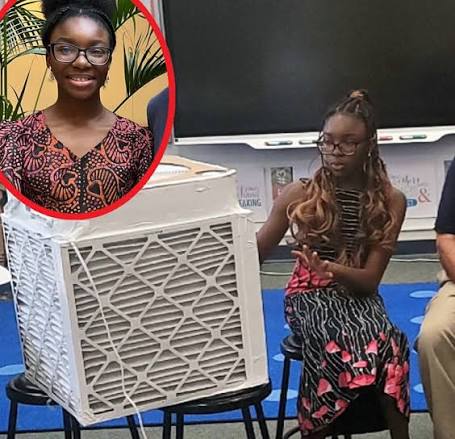
A low-cost classroom air filtration project championed by Nigerian-American student Eniola Shokunbi has secured $11.5 million in state funding for deployment across public schools in Connecticut, United States.
The funding was approved by Connecticut’s State Bond Commission in October 2024 and will support the University of Connecticut’s Indoor Air Quality Initiative in providing materials for the construction and installation of individual classroom air purifiers.
The project traces back to Shokunbi, who was a fifth-grade pupil at Commodore MacDonough STEM Academy in Middletown when she became involved in building a Corsi-Rosenthal air filter with classmates and researchers from UConn. Brandspur Brand News reports that the low-cost design was developed around readily available materials rather than expensive commercial purification equipment.
The device uses a box fan, four air filters and duct tape, with cardboard forming part of its structure. UConn says the system can be built for about $60, making it a relatively inexpensive option for improving indoor air quality in classrooms.
Shokunbi’s interest in the project grew from concerns about airborne illnesses in schools. She contacted UConn’s Indoor Air Quality Initiative and invited researchers to work with pupils at her school. The university subsequently worked with the students to build and test the devices.
The project later received scientific scrutiny from the US Environmental Protection Agency. UConn reported that an air filter built by the pupils was tested at an EPA facility using a non-pathogenic virus surrogate, with the testing designed to assess the device’s ability to remove airborne particles.
UConn’s subsequent reports state that the low-cost filtration technology can reduce airborne viruses by more than 99 per cent under the tested conditions. The university has since incorporated the technology into a broader indoor air quality programme aimed at Connecticut’s public schools.
The $11.5 million allocation is not a personal grant to Shokunbi. It is state funding awarded to UConn to administer the purchase of materials and support the construction and installation of the air filtration systems in public-school classrooms under the Supplemental Air Filtration for Education programme, known as SAFE-CT.
The initiative brings together several parts of UConn, including its schools of education, engineering, nursing and medicine, reflecting the project’s focus on both STEM education and indoor public health.
For Shokunbi, the development represents the expansion of a school-based idea into a statewide programme. What began with pupils building an inexpensive air-cleaning device has become part of a publicly funded effort to provide classroom filtration across Connecticut.
UConn has described the project as a way of giving schools access to practical, affordable indoor air-quality measures, while also exposing students to hands-on science and engineering.
The Nigerian connection has also drawn attention to Shokunbi’s achievement, with the student emerging from a classroom experiment to become part of a wider effort to address airborne health risks in schools.
