




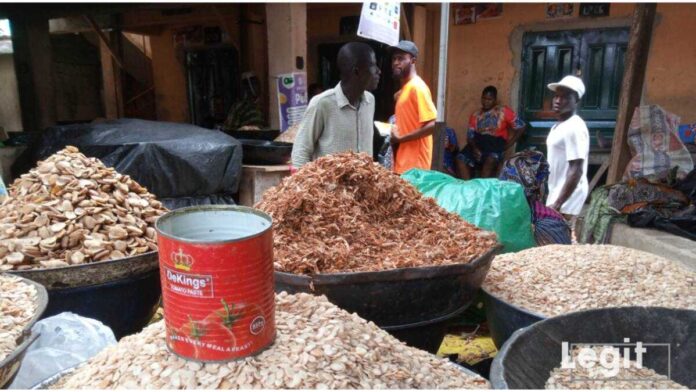
The price of egusi jumped by 29.73 per cent in Lagos in September, even as a wider range of staple foods became cheaper across major markets, according to a monthly survey of food prices.
The average price of a big bag of egusi rose from N370,000 in August to N480,000 in September. The latest figure is also 118.18 per cent higher than the N220,000 recorded for the commodity during the corresponding period last year.
The movement in egusi prices contrasted with the broader direction of the Lagos food market. Brandspur Banking News Desk reports that 36 of the 67 food items tracked across Mushin, Daleko, Mile 12 and Oyingbo markets recorded price declines in September, compared with 27 in August.
Only 16 commodities became more expensive during the month, down from 18 in August, while 15 retained their previous prices. The changes suggest that improved supplies are beginning to ease pressure on several household staples, although individual commodities continue to face supply and distribution challenges.
Among the items that recorded notable increases were tomatoes and vegetable oils. A big basket of oval tomatoes rose from N70,000 to N80,000, while round tomatoes increased from N40,000 to N45,000. Power Oil in the 2.6-litre size climbed from N9,750 to N10,800.
Local vegetable oil also increased, with the five-litre size moving from N10,500 to N11,000 and the 25-litre size rising from N59,900 to N61,000. Palm oil similarly became more expensive, with the five-litre size rising from N8,000 to N8,500.
The survey attributed the increase in egusi partly to difficulties moving produce from farming communities to urban markets and insecurity in some producing areas. Traders also pointed to large-scale purchases by wholesalers, which can reduce the volume available to smaller distributors in open markets.
The price picture was considerably better for several staples. A 50kg bag of white or yellow maize fell from N50,000 to N40,000, while yellow garri declined from N21,000 to N18,000. White garri dropped from N22,000 to N19,500.
Pepper prices also fell sharply, with the average cost of a big bag dropping by 20 per cent to N80,000 and the medium size declining by 11.11 per cent to N40,000.
Other notable reductions were recorded in sweet potatoes, Oloyin beans, brown beans, Royal Stallion short-grain rice, Honeywell wheat and Indomie noodles.
Traders said increased arrivals from producing states had improved the availability of cereals, legumes and root crops. However, consumers remain cautious, with some buyers purchasing smaller quantities as household budgets remain under pressure.
The September figures come as Nigeria’s headline inflation eased marginally to 15.39 per cent in August from 15.43 per cent in July, while food inflation fell to 19.57 per cent. Lagos continued to record stronger price pressures, with headline inflation reaching 23.7 per cent and food inflation hitting 30.9 per cent in August.
The latest market movements therefore offer a mixed picture for Lagos households. Some everyday staples are becoming more affordable as supplies improve, but sharp increases in commodities such as egusi, tomatoes and cooking oils continue to show how quickly food costs can diverge across categories.
