
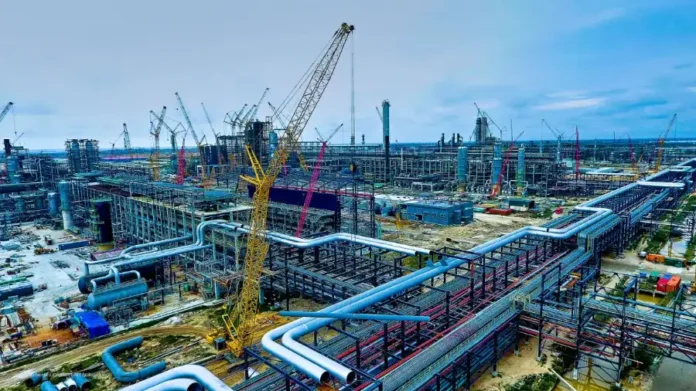
Dangote Refinery will make its debut on the Nigerian Exchange (NGX) on Tuesday, December 1, 2026, when 125.46 billion shares of Dangote Petroleum Refinery and Petrochemicals FZE are admitted to the Main Board at a reference price of N525 per share.
The listing follows the Securities and Exchange Commission’s approval of the company’s share allotment plan on November 23, clearing the way for investors who took part in the heavily oversubscribed initial public offering (IPO) to trade their holdings for the first time.
According to Brandspur Business News, the public offer, which ran from September 14 to October 27, attracted bids for 11.15 billion shares worth about N5.85 trillion from 3,779,362 investors in 121 countries. For anyone holding an allotment, or planning to buy once the market opens, here are seven things to know before trading begins.
Read also: Full List: 32 Banks, Fintechs Approved For Dangote Refinery IPO
1. Dangote Refinery Starts Trading On Tuesday At N525
Trading in Dangote Refinery shares is scheduled to begin on Tuesday, December 1, 2026. The N525 offer price will serve as the listing reference price, the starting point from which the first day’s trading will be measured.
The shares will trade on the NGX Main Board, where most of Nigeria’s largest listed companies, including the banks, telecoms operators and cement makers, are quoted. Investors will buy and sell through licensed stockbrokers or investment platforms connected to the exchange.
2. It Will Be Africa’s Largest Listed Company
At N525 per share, the 125.46 billion shares give Dangote Refinery a market value of about N65.8 trillion. That figure is expected to make it the largest listed company in Africa by market capitalisation and the most valuable stock on the Nigerian Exchange.
Its arrival will also significantly increase the weight of the oil and gas sector on the NGX, which has historically been dominated by banking, telecoms and industrial goods stocks.
3. Small Investors Got Everything They Asked For
The SEC-approved allocation structure favoured smaller investors. Applicants who subscribed for up to 10 million shares were eligible for full allotment, while applications above that threshold were scaled down proportionally.
About 3.2 million retail investors who applied for 100 shares or fewer were among those expected to receive their full subscriptions. The scale-back affected only 41 large institutional and high-net-worth investors whose individual applications exceeded 10 million shares. Although the initial offer comprised 4.1 billion shares worth N2.15 trillion, a 30 per cent over-allotment option expanded the final distribution to roughly 5.2 billion to 5.33 billion shares, worth about N2.73 trillion.
4. Refunds Go Back To Your Bank Account
Applicants who received fewer shares than they paid for are entitled to refunds of their unallotted subscription funds. These refunds are to be paid into the bank accounts linked to their applications.
Investors who were scaled back should check their bank statements and their allotment notices, and contact their issuing house, stockbroker or receiving agent if refunds have not arrived.
5. Check Your CSCS Account Before You Try To Sell
For successful subscribers, the most important step before trading is confirming that allotted shares have been credited to their Central Securities Clearing System (CSCS) accounts. The CSCS is the electronic depository that holds investors’ securities and settles transactions on the exchange.
Shares that have not been credited cannot be sold. Investors should confirm their holdings with their stockbroker or on their investment platform before placing any sell order. Those who want to increase their holdings can also buy additional shares once secondary-market trading starts.
6. N525 Is Not A Guaranteed Price For Dangote Refinery Shares
The N525 reference price is not a guarantee of what the shares will trade at. Once the market opens, the price will be set by supply and demand on the exchange, and it can move above or below the offer price.
Allottees may therefore face an early decision on whether to hold their shares or sell part of their position. That choice depends on individual circumstances, including investment goals, time horizon and appetite for risk. Investors who are unsure should seek advice from a licensed financial adviser or stockbroker rather than react to early price swings.
7. Watch The NGX All-Share Index And The Refinery’s Earnings
Because of its size, Dangote Refinery is expected to influence the NGX All-Share Index significantly. Movements in its share price could become a major driver of the overall market, and portfolio managers tracking the index will need to account for it.
Beyond the debut, attention will turn to the company’s performance and expansion plans. According to figures in its listing information, the refinery reported N19.47 trillion in revenue for the first half of 2026 and $4.73 billion in net profit between January and September. It plans to raise refining capacity from 700,000 barrels per day towards 1.4 million barrels per day by 2029, and there has been discussion of a possible secondary listing on the Johannesburg Stock Exchange.
The Bottom Line
The December 1 debut marks a defining moment for Nigeria’s capital market, bringing one of Africa’s largest industrial projects into public trading and giving millions of first-time investors a direct stake in the country’s energy value chain. For allottees, the immediate priorities are simple: confirm your CSCS credit, check any refund due and remember that the opening price is only the beginning of price discovery.
