
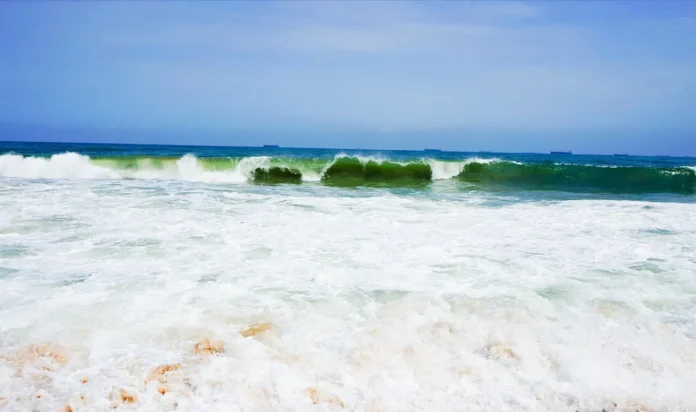
Lagos subsidence is no longer only a story for climate scientists: as the city enters its busiest Detty December season, a new satellite study showing that Lagos is sinking by about five millimetres a year is raising fresh questions for beach clubs, short-let operators, waterfront developers and property buyers.
The study, titled Sinking Cities: Latent Flood Risk in Africa’s Coastal Megacities and led by Virginia Tech researchers including Oluwaseyi Dasho and Manoochehr Shirzaei, examined land movement in 20 African coastal cities using radar data from the European Space Agency’s Sentinel-1 satellites. Only Alexandria, Egypt, recorded a higher median rate of sinking than Lagos.
For a city whose festive economy leans heavily on its coastline, the timing matters. Brandspur Brand News notes that the findings raise questions not only about long-term environmental risk but also about how property owners, tourism operators and businesses communicate safety to customers.
Read also: Lagos Orders Flood-Prone Residents To Move To Higher Ground As NiHSA Issues 7-Day Alert
Where Lagos Subsidence Hits Hardest
The sinking is not uniform. Central districts were relatively stable, while rapidly urbanising eastern and western outskirts recorded faster subsidence, with groundwater extraction, construction on loose coastal sediments and the settling of reclaimed land identified as likely contributors. That puts parts of the Lekki-Ajah corridor and other low-lying coastal locations, where much of the city’s new hospitality and residential development is concentrated, firmly in focus. The researchers estimated that about 2.59 million Lagos residents and 528,079 buildings were exposed to extreme coastal water levels in 2020, figures that could rise to more than 4.07 million people and 848,203 buildings by 2100.
The study’s city-wide figures should not, however, be read as evidence that every neighbourhood or property is sinking at the same rate. Risk is highly location-specific.
What It Means For Beach Clubs And Waterfront Venues
For beach clubs, resorts and waterfront venues preparing for the December rush, the immediate issue is customer confidence rather than imminent danger. Visitors may ask more questions about safety as the study draws attention to the coastline’s vulnerability.
Operators that publish clear information about emergency procedures, weather monitoring, evacuation routes and available protective infrastructure are likely to reassure guests more effectively than those that ignore the conversation. Event organisers booking beachfront venues may also start asking for such details as part of their due diligence.
Short-Lets Face A Disclosure Test
Short-let apartments along the coast are a major part of Lagos’ festive accommodation market, serving returning diaspora visitors and tourists. As flood risk becomes a bigger part of public conversation, hosts and platforms may come under pressure to be more transparent about drainage, past flooding and access during heavy rain or high tides.
Clear, honest listings could become a competitive advantage. Guests who are caught out by flooding are unlikely to return, and negative reviews spread quickly during peak season.
Property Buyers Should Ask Harder Questions
For buyers and investors, the study reinforces the importance of location-specific checks. Elevation, soil conditions, drainage, flood history and whether a site sits on reclaimed land should all be part of the assessment, alongside geotechnical surveys that show whether stronger foundations are required.
Developers marketing waterfront and reclaimed-land projects may increasingly be expected to explain what they are doing to manage these risks. Insurers and lenders could also begin to price flood exposure more carefully over time.
The Kuramo Claim: An Old Story Resurfacing
Claims circulating online about tourists boycotting Lagos beaches because of an ocean surge also need context. The reports refer to an incident at Kuramo Beach on August 18, 2012, when an Atlantic Ocean surge struck waterfront settlements, killing residents and prompting evacuation orders from the Lagos State Government.
There is no evidence of a fresh, city-wide beach boycott in November 2026, and the 2012 incident should not be presented as a current emergency. Coastal erosion and flood risks, however, remain genuine concerns.
A Long-Term Business Risk
For the state, the findings strengthen the case for closer monitoring of groundwater extraction, stricter controls on building around wetlands and floodplains, better drainage and investment in coastal protection. For businesses, they are a reminder that the coastline that powers Lagos’ festive economy is itself changing slowly. How operators, developers and buyers respond now could shape the value of coastal assets for decades.
