Obstacles In Accessing COVID-19 Vaccines Cause Consumer Confidence To Slide

0

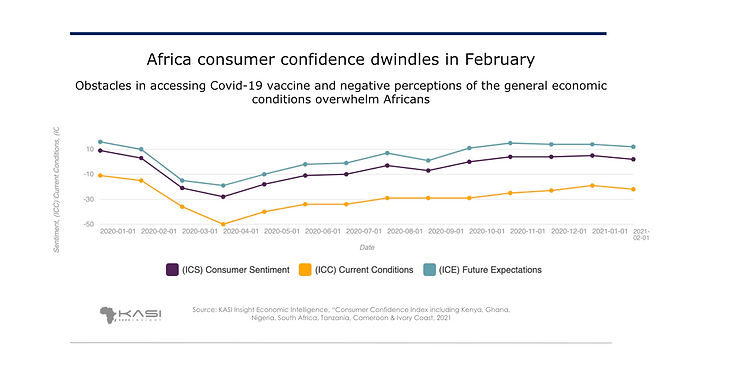
Africa’s consumer confidence dwindled in February by 3 points after a modest improvement in the previous month. The index dropped from 5 to 2 indicating that households are still plagued by economic concerns.

Both the index of current economic conditions and index of future expectations shrunk by 3 and 2 points respectively thus causing the decline of the overall global index.

Despite several African states securing Covid-19 vaccines through the COVAX facility offered by multilateral agencies, the quantities procured thus far by governments are not adequate to sufficiently inoculate the majority of Africans unlike some countries in the West that have secured enough doses to vaccinate their citizens multiple times.
Last week, Kenya’s Ministry of Health stated that “the country aims to inoculate about 15 million people nationwide, about 30% of the country’s population, by the end of June 2023” (Reuters, 2021).

This goal is certainly underwhelming! Moreover, there are growing concerns of a 3rd wave because of the deadlier strains and the potential of super-spreader events over the Easter holiday. Due to this, the Kenyan government, for example, has extended the Covid-19 curfew for an additional 2 months including a ban on political gatherings and limits to church attendance.

Data from the Africa CDC shows that, as of 21st March 2021, there were a total of 4,114,437 cases with 109,893 deaths and 3,681,648 recoveries. These numbers are from a total of 39,829,115 tests administered in the continent.

Households indicate pessimism on general economic conditions and job prospects despite a slight improvement in expenditure.

The negative perception of the current economic conditions and future expectations is mirrored on the sub-indices tracking the financial and economic situation among households. Purchasing power and discretionary spending indices both had a modest improvement of a single point while the personal financial situation index climbed by 3 points.

However, the magnitude of these gains was outweighed by the magnitude of the losses in the remaining sub-indices hence the downturn in consumer confidence. Households’ perception of the general economic conditions for both the city and country waned by 5 and 6 points respectively.

Furthermore, the job prospects index slipped by 5 points while the household income index sunk by 3 points. With countries including Ghana and Ivory Coast instituting new lockdown measures in February and a slow roll-out of the vaccine in the continent, the optimism that one would have expected across households in 2021 is yet to be realized.

Tanzania’s consumer confidence plummets following mismanagement of Covid-19 while consumer confidence in Cameroon advances.

Among the countries tracked, Tanzania was the worst performer for the month. Consumer confidence in Tanzania endured a sharp downturn of 26 points falling from 31 to 5.

The slump in Tanzania’s consumer confidence can be attributed to the backpedaling of both its indices of future expectations and current economic conditions which slid by 28 and 21 points respectively.

Every single one of Tanzania’s sub-indices focusing on the economic and financial situation of its households regressed in February. Household income and general city economic conditions both equally suffered the largest depression of 43 points while the personal finance index had the smallest descent of 3 points.

Tanzania’s handling of Covid-19 has been appalling compared to her counterparts. Reportedly, swaths of people have succumbed to the disease but the government has been secretive on the figures. Unfortunately, on March 17th, the country lost its President, John Pombe Magufuli, to a pre-existing heart condition which, according to some sources, was triggered by coronavirus but the Tanzanian government has denied such claims. This event may have detrimental effects on future consumer confidence.

Cameroon’s consumer confidence enjoyed positive momentum in February as the index expanded by 7 points rising from -1 to 6. The increase in its consumer sentiment can be fully attributed to the index of future expectations which surged by 10 points (from -1 to 9) while the index of current economic conditions stagnated at 0.

This improvement comes after months of spending five of the last 6 months in negative territory owing to, among others, continued separatist violence between English-speaking states and the French-majority.

Furthermore, after talks with multilateral lending institutions, Cameroon finally received a debt-service deferral extension for 2021 freeing up funds for the fight against Covid-19. Apart from the discretionary spending index which dampened by 9 points, every other sub-index for Cameroon heightened in February.

The household income index underwent the largest hike of 18 points climbing to 10 from -8. General economic conditions in the city and country both advanced by 11 points while job prospects expanded by 9 points. Finally, the personal financial situation and purchasing power for households in Cameroon strengthened by 3 and 5 points respectively.

With limited access to vaccines and cases still on the rise, there is a need for retailers to ensure a safe and convenient shopping experience for consumers.

Concerns surrounding Covid-19, especially vaccine accessibility, have led to a weakening of consumer confidence among households. Clearly, the outlook on economic conditions and job prospects have been negatively affected as indicated by this month’s data. Even though consumers have reported spending this month, their expenditure has been negated by the pessimistic perception of the general economic conditions.

From this, the expectation is that retailers and operators in the hospitality, leisure, and entertainment industry will face headwinds until households become vaccines are more accessible and governments subsequently ease restrictions. Also, with dwindling job prospects, we anticipate that household expenditure will favor essentials rather than luxuries.

As such, it is imperative for retailers to devise mechanisms that will enable them to weather these headwinds. Some coping mechanisms will be focusing on customer experience as consumers will be looking for safety and convenience while others will be on survival.

Businesses can employ cashless payment systems or other e-commerce related services that will be safe and convenient. Retailers, particularly those in the discretionary space, could also use promotions/discounts so as to try and keep themselves afloat despite their businesses possibly already being in a murky situation.

Is Culture A Deciding Factor When It Comes To COVID-19 Vaccine Acceptance In Africa?

The impact of the 2019 Coronavirus on the African continent has been devastating, not only to the people and their livelihoods but also to the economies. One year later, as of 21st March 2021 according to Africa CDC, Africa has had 4.1 million cases out of which 3.7 million have recovered while 109,922 have died.

However, not all countries have been reporting their figures therefore the number of infected and who have died is speculated to be bigger than what is reported.

African’s have always been skeptical about vaccines, mainly due to their safety and origins with most viewing them as the developed nation’s way of subduing Africans.

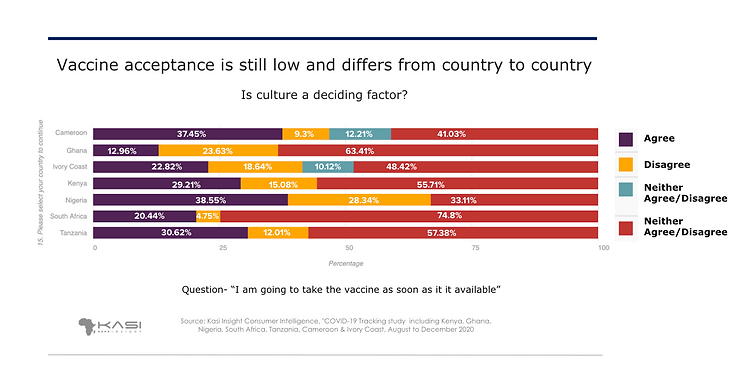
According to the Kasi Insight Covid-19 tracker conducted last year from the month of August to December, more than half of respondents from Ghana, Kenya, South Africa, Cameroon, Tanzania, and Nigeria were unsure of taking the vaccine when it became available. However, when each country was compared to another there were significant regional differences.

From the above graph, we can see that a total of 56.75% of people in Cameroon, Ghana, Ivory Coast, Kenya, Nigeria, South Africa and Tanzania surveyed are unsure (red and green bar) if they will take the vaccine when it becomes available. While 27.32% agreed to take the vaccine and 15.93% said they will not.

However, if we look at each country individually we see that out of the seven countries surveyed, there are noticeable differences between some countries. Nigeria and Cameroon had the highest willingness (purple bar) to take the vaccine with 38.55% and 37.45% respectively compared to South Africa and Ghana who were largely unsure about taking the vaccine; neither agree nor disagree, with 74.8% and 63.41% respectively. This indicates that a huge chunk of the population was hesitant about taking the vaccine once it became available.

This brings the question, do cultural differences play a role? Africa is diverse in its cultures and traditions thus bringing about different ways of handling situations compared to other nations. If we take a look at Nigeria for example, being a Muslim-dominated country and very diverse in culture, they seem to be the most willing country to take the vaccine with 38.55% of the people surveyed agreeing compared to the other countries.

However, when we look at the francophone countries such as Cameroon and the Ivory Coast, we can see a stark difference in vaccine acceptance with 37.45% agreeing in Cameroon while only 22.82% are willing to take the vaccine in the Ivory Coast.

The African way of life is very community-oriented as well which is apparent in their funeral procession, weddings, and so forth. Is this why social distancing, wearing masks, and even lockdowns have been unsuccessful? Being deeply rooted in their beliefs has guided their actions for centuries. This is apparent with how Africa responded to Covid-19 by using more natural remedies to cure and/or prevent one from getting the virus without much success.

This action alone is enough to point out that Africans are wary of western vaccines if not medicine. One size truly does not fit all but for Africans, Covid-19 seemed more of a western disease than an African one hence the failure to contain it.

According to Devex key concerns of people with regards to the vaccine include not having enough trust in the safety of the vaccine, denial that the virus exists or that they personally are at risk of catching it, that the vaccine can actually give a person COVID-19 or that the vaccine was developed and manufactured too fast.”

With a continent that is deeply rooted in its culture, traditions, and beliefs we can see how the above concerns are fueling vaccine skepticism.

This leads to the second question; does the origin of the disease play a role as well? For a disease that did not originate from Africa, African’s are having a tough time adjusting to the measures needed to control and reduce the infection rates. If we take a look at Ebola, which originated in West Africa and has a higher mortality rate than Covid-19, its spread was contained really well.

However, the nature of the disease could have had something to do with it. Unlike Covid-19, Ebola is spread through contact with an infected person, hence easier to isolate and quarantine cases. Wherewith Covid-19 you can easily spread the virus without being symptomatic and with Africa being community-oriented, Covid-19 has spread like wildfire. Therefore the nature of the Covid-19 virus has disrupted the African way of life thus making the measures necessary to contain it unsuccessful.

A lot of work needs to be done by the government and health ministries in educating the population about the nature of the virus and what the vaccine means for their future economic prospects. There seems to be a lot of misinformation about the efficacy and effectiveness of the Covid-19 vaccine and if the governments fail to convince people to take it, it could hinder their recovery efforts and thus affect their GDP in the long run.

What this indicates as well is that trusted sources to provide messages and information are needed to reach the people such as churches, mosques, etc so as to increase vaccine acceptance. Governments need to take into account different channels and community avenues to reach a wider audience but they also need to address community concerns so as to change people’s vaccine perceptions.

This does not mean the private sector or brands bear no responsibility. In order for businesses to meet their consumer demands, they need to understand what their customers want. This also means educating their customers about the vaccine and what that would mean for their livelihoods and for the business. Collaboration between the public and private sectors is key in increasing Africa’s vaccine acceptance however effective and consistent communication is paramount if Africa is looking to recover in the near future.

This pandemic has brought to light on a global scale the various weaknesses that the African continent and its constituent countries face. From the insufficient health services and lack of resources to not having the infrastructures in place to produce our own vaccine let alone the funds required to keep the economy afloat in such crises.

This pandemic has highlighted how debt-driven the continent is and how dependent it is on outside help. Africa has the capacity and resources to do better and persevere but the solution to the problems lies with its people and governments. Systemic changes need to be made for Africa to come out strong in the face of adversities. Such changes start with the people especially when it comes to taking safety measures and their view on vaccines.

Fintech In Nigeria: Untapped Opportunities Emerging From The Pandemic

0
  • Overall demand for financial products has shifted significantly during the COVID-19 pandemic. Notably, demand for insurance and investment products grew the most.
  • Back in April 2020, there was a contraction of opportunities for insurance products, mobile money, day-to-day banking, loans, and investments as lockdowns and restrictions slowed economic activities.
  • On the other spectrum, there was an expansion of opportunities for saving accounts, cards, and saving pockets as people were gearing up for tough times ahead.

Last week Kuda a Nigeria fintech that wants to serve every African on the planet by offering a digital banking experience, raised $35M Series A from investors just 5 months after raising a $10M seed round. The mobile-only bank claimed 650,000 customers and over $500M in transactions on its platform.

This latest investment comes on the back of the $170M Series C raise by Flutterwave, another Nigeria fintech that focusing on building the payment infrastructure for Africa, valuing the company at $1B. Agboola, the founder of Flutterwave says his company grew more than 100% in revenue within the past year due to the pandemic.

It also contributed to its compound annual growth rate (CAGR) of 226% from 2018. The startup claims over 500,000 users and over 20,000 merchants on its platform. Since the beginning of the year, fintech startups from Nigeria have received over $250M in funding.

Amid this increased interest from the investment community in the Fintech space in Nigeria,

new data from Kasi Insight confirms that COVID-19 had a significant impact on the demand for financial products. In fact, between April 2020 and November 2020 demand for the overall category grew 5% with insurance and investment products growing the most at 19% and 16% respectively according to the Kasi Category Tracker, a measure based on a survey of 5,500 Nigerian adults. The survey which is part of the Kasi Covid-19 tracker was conducted between Feb. 2020 and Dec. 2021.

Kasi Category tracker estimates the demand for a category by computing the difference between the percentage of consumers purchasing more of your products and the percentage of consumers purchasing less of your products.

A year ago while Nigeria was getting its first case of COVID-19, consumer demand and purchase intent for financial products such as insurance, mobile money, day-to-day banking, loans, and investment was negative meaning a majority of consumers were looking to purchase less of these products as a result of the pandemic.
 

Among the products with slowing purchase momentum, we had insurance with a gap of -16, and investment products had a gap of -5. On the other end, consumer demand and purchase intent for saving pocket, cards, and saving account was positive meaning a majority of consumers were looking to purchase more of these products as a result of the pandemic.

Our data shows that seven months later, consumer demand and purchase intent for financial products have shifted significantly. Amongst the products that saw an acceleration of the demand, insurance products’ demand grew 20% followed by investment products at 16%. On the other end, the pandemic also resulted in slowing demand for saving pockets that saw a drop of 20%.

As a result of the pandemic, consumers are now looking to deploy savings accumulated to investment products to generate higher returns. Due to the negative economic impact of the pandemic (job loss, lockdowns, slow economic activity), people have limited ways to save additional cash today than they did back in April.

 
The shift in demand for insurance products can be a deal-breaker for the insurance industry in Nigeria. The country ranked 62nd in the world when it comes to insurance penetration and has a total premium volume of $1.64 billion. Insurance premium penetration rates of 1% of GDP, ranked 87th in world terms, and an average premium per capita of $9.4, reflect a market that is in development according to a PWC report.
 

Moreover, analysts from AM Best believe that Nigeria’s insurance market offers significant potential despite the headwinds. They cite obstacles to insurance market growth that include low consumer awareness, lax enforcement of mandatory coverage laws, and new proposed capital requirements.

According to Kasi data, COVID-19 seems to have raised awareness of insurance products amongst consumers in Nigeria. With an urban population of approximately 100M people, a 20% growth in demand for insurance products due to COVID-19 can translate into millions of potential new customers for the industry.

While a lot of investment has gone to Fintech that focuses on building the payment infrastructure and digital banking to target the unbanked and the increasing cashless post-COVID-19 normal, the demand for insurance products is picking up and there is an opportunity to innovate and capitalize on this untapped market as businesses recover from the pandemic. Insurtech startups like Casava, Autogenous and CompareIN are well-positioned to disrupt the market.

2021 World Water Day: NBC Reaffirms Commitment To Sustainable Water Management

0

Nigerian Bottling Company Limited (NBC), a leading consumer packaged goods company and a member of the Coca-Cola Hellenic Bottling Company (CCHBC), has joined the world to celebrate the 2021 World Water Day with a commitment to sustaining safe and sustainable water stewardship at its 8 manufacturing plants spread across the country.

This commitment was reiterated by the company at a series of events held in collaboration with stakeholders across Kano, Abuja, Asejire, Lagos, and Owerri to commemorate the day.

The bottlers of Coca-Cola brands in Nigeria also pledged to continue with its resolve to secure water availability for communities in water risk areas, while aggressively driving initiatives that support sustainable water practices in Nigeria.

2021 World Water Day: NBC Reaffirms Commitment to Sustainable Water Management-Brand Spur Nigeria
From left, Baale of Osegere Village, Chief Raimi Akinsola; Quality Assurance Manager, Nigeria Bottle Company (NBC), Mr. Tijani Salau; Baale of Olukeye Village, Chief Lateef Bakare; Environment and Systems Manager (NBC), Mrs. Olufunke Ogundipe and Chairman, Water Corporation of Oyo State, Dr. Adebayo Adepoju during the 2021 World Water Day commemoration event organized by NBC at Asejire, Ibadan.

The commemorative event which held in Asejire, Ibadan, on Monday, brought key stakeholders and community leaders together, to highlight the value of water and the role of every stakeholder in managing the valuable resource. The event was attended by Chairman, Water Corporation of Oyo State, Dr Adebayo Adepoju; Baale of Osegere Village, Chief Raimi Akinsola and Baale of Olukeye Village, Chief Lateef Bakare.

At other events held in Kano State, Imo State, Lagos State and the FCT, NBC further supported the Imo State Water and Sewage Corporation, Kano State Water Board, the Lagos State Ministry of Environment and Water Resources and the Federal Capital Territory Water Board respectively with activities aimed at helping to improve their operations, processes, and delivery to the public.

Commenting on this year’s World Water Day themed ‘Valuing Water’, Public Affairs and Communications Director, NBC, Ekuma Eze, said that, “Since NBC was established 70 years ago, sustainability has continued to be integrated into every aspect of our business, as we look to create and share value for all our stakeholders.

“We continuously invest in our communities, working together on key environmental and social issues”. He also explained that the company’s articulated ‘Mission 2025’, its sustainability commitment, was designed to achieve sustainable growth, with Water Stewardship as a main pillar, adding that ‘Mission 2025’ is fully aligned with the United Nations Sustainable Development Goals (SDGs) and targets.

2021 World Water Day: NBC Reaffirms Commitment to Sustainable Water Management-Brand Spur Nigeria
From left, Quality Assurance Manager, Nigeria Bottle Company (NBC), Mr. Tijani Salau; Baale of Olukeye Village, Chief Lateef Bakare; Chairman Water Corporation of Oyo State, Dr. Adebayo Adepoju and Environment and Systems Manager (NBC), Mrs. Olufunke Ogundipe during the 2021 World Water Day commemoration event organized by NBC at Asejire, Ibadan.

Furthermore, Eze said, “Water is material to us because it is the most important ingredient we have in our products. Therefore, we aim to be a good steward of water resources in our communities by using water in a socially equitable, environmentally sustainable, and economically beneficial way. Therefore, our approach is to reduce our water consumption through stretch reduction targets, recycle wastewater to the levels supporting aquatic life and replenish water by giving back water to underserved communities.

It will interest you to know that all our Plants have functional Effluent Treatment Plants, where process water is treated to support aquatic life before discharging it into government approved sites. We started building our multimillion-euro effluent water treatment plants at a time it was not yet a regulatory issue in Nigeria.

We also help to secure water availability for communities in water stressed areas. For example, in 2019 we partnered with Kano State Water Board to upgrade infrastructure of the Water Board which improved access to potable water for over 1 million people in the state. We have also constructed boreholes in several communities in Lagos, Enugu, Edo, Akwa Ibom, Kwara, Benue, Kaduna, Oyo, Borno, Abuja and Rivers.

In furtherance of its water stewardship agenda, NBC has also partnered with the USAID Nigeria E-WASH program from 2020, to boost the technical capacity of six state water boards across the country.

To validate our water stewardship strategies, all NBC manufacturing plants have been certified by the prestigious Alliance for Water Stewardship (AWS) standard” Eze said.

World Water Day is celebrated every year to emphasize the importance of water and galvanize global efforts for the sustainable management of water resources.

American Fast-Food Franchise, Burger King Set to Open Outlets in Nigeria

3

International burger franchise, Burger King has announced interest and plans to open outlets in Nigeria.

This was revealed by Antoine Zammarieh, the Franchisee of Burger King in Nigeria. He stated that the hamburger maker in a show of interest in the Nigerian market had signed a development agreement for the Nigerian market.

Antoine Zammarieh said,

“It is with great pleasure that we announce our signing of a development agreement with Burger King for the Nigerian market. I believe this would be a tremendous step towards giving more confidence to the Nigerian market and consumers in general, especially during these hard times. I always believed in Nigeria and in its people. I am confident this venture will go a long way and prove successful for Burger King, Nigeria and our company.”

American Fast-Food Franchise, Burger King Set to Open Outlets in Nigeria Brandspurng

Founded in 1954, Burger King is the second-largest fast-food hamburger chain in the world. The original Home of the Whopper, our commitment to premium ingredients, signature recipes, and family-friendly dining experiences is what has defined our brand for more than 50 successful years.

Tony Elumelu Foundation Releases 2020 Annual Letter

0

The Tony Elumelu Foundation (TEF), Africa’s leading philanthropy committed to empowering African entrepreneurs, has released its 2020 Annual Letter titled “THE POWER OF ENTREPRENEURSHIP AMIDST UNCERTAINTY”.

The report, which was delivered in the form of a personal letter from TEF Founder, Mr Tony O. Elumelu CON, reiterates that equipping young people with the tools and the opportunities to succeed through entrepreneurship, is the only sustainable, dignified way to create a path to prosperity for all.

Launched across TEF’s digital platforms, the Annual Letter showcases remarkable achievements that include supporting a growing and dynamic entrepreneur ecosystem of 1 million Africans, expanding strategic partnerships to scale the existing TEF Entrepreneurship Programme to reach more small businesses across all 54 African countries, and other milestones by the Foundation to mitigate the effects of the pandemic and provide support for young entrepreneurs.

The 2020 Annual Letter begins with reflections from the Founder dating from the inception of the Foundation and its raison d’être, to the global pandemic, “In 2020, the world stopped, but we did not. When we launched the Tony Elumelu Foundation in 2010, we did something new in Africa – we “democratised” luck. In my own entrepreneurial journey, I knew luck had played an important role, and I was determined that others, many others, would get those same chances. We created an institution with a single focus: young African entrepreneurs.”

Through its digital hub, www.tefconnect.com, the Tony Elumelu Foundation successfully supported millions of Africans, addressing the unique needs of an entrepreneurial community that continues to be challenged by the pandemic. “We curated world-class training, offered expert-led masterclasses with institutions such as Yale University, and brought project management skills and mental health coping mechanism to African entrepreneurs, taking care of their mind and spirit, as we assisted them to restructure their business for the new normal.”

The Letter further narrates 2020 highlights including TEF’s €20 million partnership with the European Union and the Organisation of African and Caribbean States (OACPS) to support more than 2,500 women entrepreneurs: “The statistics on female entrepreneurship in Africa are chastening – women make up 58% of the continent’s self-employed population but earn 34% less profits on average. Our goal is for more women to participate in economic development, realise their full potential and accelerate economic inclusion.”

Other notable accomplishments include the TEF-UNDP Mali Entrepreneurship Programme rolled out in the middle of conflict, political instability and insecurity in the Sahel country: “Over 1.7 million people have been displaced by violence in Mali since 2012. Our Entrepreneurship Programme demonstrates that entrepreneurship is the singular most effective tool to creating jobs, opportunity, economic hope, stability, peace, sustained growth and poverty reduction.”

Now in its 7th year, the US$100 million TEF Entrepreneurship Programme has empowered over 9,000 young African entrepreneurs from 54 African countries with world-class business training, mentorship, non-refundable seed capital of $5,000 and global networking and market opportunities.

In 2021, the Tony Elumelu Foundation, will identify, train, mentor and fund over 3,500 entrepreneurs across Africa.  The Programme remains open to all entrepreneurs across the African continent, both new start-ups and existing businesses operating in any sector. Applications end March 31. All aspiring beneficiaries are encouraged to immediately apply on www.tefconnect.com.

Click here for the full TEF 2020 Annual Letter

Marginal Decline In The Stock Market, NSE ASI Sheds 77 Points

The Stock Market declined by 0.20% at the close of today’s trading session. At 39,216.20 points, the market is down by 2.62% from year to date. The market capitalization reduced by the same magnitude from ₦20.56tn to ₦20.52tn.

The Consumer Goods sector advanced by 0.51%, following price gains in stocks like GUINNESS (9.89%). The Industrial and Banking sectors also grew today by 0.08% and 0.48% respectively. There were losses in the Insurance sector on the back of price drops in stocks like WAPIC (-7.27%) and AFRINSURE (-4.76%); as well as in the Oil and Gas sector which declined by 0.20%.

The market breadth fell from 1.92x. to 1.54x, signaling a less positive investor sentiment in today’s market.  The volume and the value of trades in the market moved in different directions: the volumes grew by 9.37%, while the value declined by 26.21%, as investors traded a total of 250.32 million units of shares valued at ₦2.79bn in 3,746 deals.

Fixed Income Market

The bond market saw a lot of activity today in both directions. The FGN-APR-2024 bond yield compressed by 46bps to 7.51%, while the FGN-FEB-2028 increased by 37bps to 10.50%. Most longer-term bonds saw their yields increase, for instance, the FGN-APR-2037 increased by 11bps to 11.57%

Treasury bill yields remained stable for the 91-day, 180-day, and 365-day instruments at 2.80%, 4.62%, and 6.65%

Market Snapshot

  • Marginal Decline in the Stock Market, NSE ASI sheds 77 Points
  • Mixed Activity Along the Yield Curve, Long Term Bond Yields Sustain Rise
  • Dow Rises Amid Data Showing Subdued Inflation
  • Brent Crude Maintains Steady Rise, Closes at $64.70 Per Barrel
  • Parallel Market Exchange Rate Moves from ₦486/$ to ₦485/$

FCMB Reports 31.1% Rise in Profit to ₦19.6B in 2020, Proposes 15K Final Dividend

26 MARCH 2021: FCMB Group Plc announced its Audited Group Results for the full-year ended 31 December 2020.

The gross earnings and profit after income tax recorded by FCMB for the year ended 31 December 2020 was N199.44billion and N181.25billion respectively.

The Directors of the financial group affirm that the FCMB is strategically poised for continued growth and development.

Further Earnings Analysis by Brand Spur revealed the following:

  • Gross revenue of ₦199.4 billion for the twelve months ended December 2020, was a 10% growth from ₦181.3 billion for the same period the prior year.
  • Net interest income rose by 20% Year-on-Year from ₦76.0 billion, for the full year 2019, to ₦90.8 billion for the full year 2020.
  • Non-interest income of 37.8 billion, for the twelve months ended December 2020, a 9% Year-on-Year increase from ₦34.8 billion for the same period the prior year.
  • Operating expenses rose 10% Year-on-Year to ₦84.3 billion for the full year 2020.
  • Net impairment loss on financial assets increased by 62% Year-on-Year to ₦22.3 billion, for the twelve months ended December 2020, from ₦13.7 billion for the same period the prior year.
  • Profit after tax (PAT) of ₦19.6 billion, for the full-year 2020, rose 13% Year-on-Year.

Financial Position:

  • Loans and advances grew, 15% Year-on-Year and 4% Quarter-on-Quarter to ₦822.8 billion in December 2020.
  • Total assets increased 23% Year-on-Year and 1% Quarter-on-Quarter to ₦2.06 trillion in December 2020.
  • Customer deposits rose by 33% Year-on-Year and 5% Quarter-on-Quarter to ₦1.3 trillion in December 2020.
  • Assets Under Management grew by 23% Year-on-Year to ₦495.2 billion in December 2020.

FY20 Key Ratios:

  • Capital Adequacy Ratio – 17.7%.
  • Liquidity Ratio – 34.2%.
  • Non-Performing Loans (NPL) to Total Loans Ratio – 3.3%.
  • Cost to Income Ratio – 65.6%.
  • Net Interest Margin – 8.1%.
  • Earnings per share – 98 kobo

Proposed dividend

The Board of Directors recommended a cash dividend of 15 kobo per issued and paid-up ordinary share for the year ended 31 December 2020 (2019:14kobo). This is subject to approval at the Annual General Meeting. Payment of dividends is subject to withholding tax at a rate of 10% in the hand of recipients.

Ikeja Hotel Posts N6.72Billion Loss for 2020

The Group Financial Statements for the Year Ended, December 31, 2020, reported a Loss After Tax of N6.72billion. This performance reflected the full impact of the Covid19 Pandemic, which shut down the economy, especially the hospitality business, from March 2020.

The lockdown for seven months of its Hotel assets brought down unprecedentedly room sales to their lowest ebb in history.

Secondly, the value of one of the Subsidiaries’ Assets amounting to N5.1billion was impaired (Investment Property N4.63billion, work in progress N473million) due to notice of revocation issued by the Lagos State Government on the Investment Property. The Company has however challenged this in Court, and hopeful that the case will be resolved in its favour.

Despite this result, the Company remains solvent, and the fundamentals remain strong. With strategic responses of the Board of Directors and Management, coupled with the availability of Covid-19 Vaccine, the business will hopefully steadily pick up.

Barring any unforeseen circumstances, Ikeja Hotel is set to return to its leading position as the Nigerian hospitality business’s flagship.

United Capital to Raise Fresh N100B Capital As Shareholders Approve N4.2bn Dividends

At the Annual General Meeting of the Shareholders of United Capital Plc, held on Tuesday, March 23, 2021, at the Lagoon Restaurant, Ozumba Mbadiwe Street, Victoria Island, Lagos, the following resolutions were proposed and approved by the Shareholders:

  1. The Audited Financial Statements for the year ended December 31, 2020 and the Report of the Directors, Auditors and Audit Committee thereon.
  2. A dividend of N4.2 billion at 70 kobo per ordinary share of 50 kobo to all shareholders whose names are registered in the Company’s Register of Members as of March 5, 2021.
  3. The approval of the re-election of Mr. Sonny Iroche and Sir Stephen Nwadiuko as Independent Non-Executive Directors.
  4. The approval of the appointments of Mr. Oladipupo Fatokun and Hajiya Sutura Aisha Bello as Independent Non-Executive Directors.
  5. The authorization of the Board of Directors to fix the remuneration of the Auditors for the financial year ending December 31, 2021.
  6. The election/re-election of the following as members of the Statutory Audit Committee:

6.1 Mr. Oladipupo Fatokun – Directors’ representative;
6.2 Sir. Stephen Nwadiuko – Directors’ representative;
6.3 Mr. Paul Olele – Shareholders’ representative;
6.4 Pastor Alex Adio – Shareholders’ representative; and
6.5 Mrs. Faith George-Usman – Shareholders’ representative.

Disclosure of the remuneration of the Managers on page 52 of the Annual Report was duly noted by the Shareholders.

The approval of the remuneration of the Non-Executive Directors fixed at N45.5million cumulatively for the financial year ending December 31, 2021.

9. The Directors be and are hereby authorized to raise additional capital of up to N100,000,000,000 (One Hundred Billion Naira), through the issuance of tenured bonds, notes, commercial papers, debt instruments, or loans in any currency by way of bond issuance, note issuance, book building or other methods and whether in one or more tranches; the pricing and terms of such issuance to be determined by the Directors as they deem appropriate subject to obtaining the approvals of relevant regulatory authorities.

10. The Directors be and are hereby authorized to appoint such advisers, professionals and parties that they deem necessary, upon such terms and conditions that the Directors may deem appropriate with regard to the aforementioned issuances.

11. The Board of Directors be and are hereby empowered and authorized to carry out as it deems appropriate and in accordance with any relevant laws thereto, any actions, including but not limited to reorganization, restructuring, reconstruction and business arrangement exercise and actions for the Company as may be necessary to achieve a competitive business advantage across the Group and/or comply with any legislation and/or directives and guidelines from the Securities and Exchange Commission.

12. The Directors be and are hereby authorized to appoint such advisers, professionals and parties that they deem necessary, upon such terms and conditions that the Directors may deem appropriate with regard to the aforementioned business arrangements.

13. The Directors be and are hereby authorized to take all steps and do all acts that they deem necessary for the successful implementation of the above-stated resolutions.