Xiaomi, Oppo Set To Capture Third And Fourth Spots In UK Smartphones

0

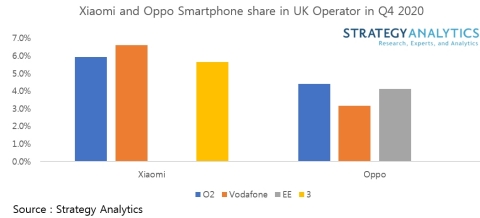
According to the latest research from Strategy Analytics, Xiaomi and Oppo, two leading Chinese OEM’s, are rising rapidly by working closely with UK operators, O2, Vodafone, EE/BT, and Three.

The two OEM’s are expected to win high-single-digit volume share in Q1 2021.

Xiaomi and Oppo Smartphone Share in UK Operator in Q4 2020 (Graphic: Business Wire)Xiaomi and Oppo Smartphone Share in UK Operator in Q4 2020 (Graphic: Business Wire)

Woody OH, Director at Strategy Analytics, said, “Xiaomi and Oppo are cementing their smartphone market share in UK, being no.3 and no.4 OEM ahead of Huawei.

“The two Chinese vendors are prioritizing shipping their 4G and 5G-capable smartphones directly to operators in the UK. Operators are ramping up 5G service coverage across the country and prioritizing the sourcing of price-competitive 5G smartphones while Huawei is out of the game.”

Neil Mawston, Executive Director at Strategy Analytics, noted, “The UK smartphone market was dominated by Apple, Samsung and Huawei until 2019. However, Xiaomi and Oppo have been very quick to seize on the opportunity presented by Huawei’s geopolitical problems. UK operators need a mix of innovative OEMs to provide affordable high quality 4G/5G devices to support the transition to the next generation 5G technology.”

Rajeev Nair, Senior Analyst at Strategy Analytics, noted, “Xiaomi and Oppo achieved mid-single-digit share at each operator that they are working with in Q4 2020. We expect their share to get up to high-single-digits in Q1 and Q2 2021.”

Nigeria’s Debt Rises To N32.92 Trillion In FY 2020 On Foreign Debt

According to Debt Management Office (DMO), Nigeria’s total public debt stock surged by 20.12% to N32.92 trillion as of December 2020 (from N27.40 trillion as at December 2019).

The increase in the country’s total debt stock was chiefly due to a 40.82% rise in external debt to N12.71 trillion (or USD33.35 billion at N381.00/USD) as at December 2020 from N9.02 trillion (or USD27.68 billion at N326.00/USD) in December 2019 –essentially multilateral.

Nigeria received USD3.54 billion worth of loans from IMF, USD2.86 billion from AfDB, and an additional loan of N1.43 billion from IDA within the period under review.

Also, the depreciation of the Naira against the greenback exacerbated external debt; year-on-year, Naira depreciated against the USD by 16.87% to close at N381/USD as at December 2020. Hence, external debt service payments rose to N560.36 billion (or USD1.51 billion) in FY 2020 from N414.00 billion (or USD1.33 billion) printed in FY 2019.

Given the sustained rise in external debt and the drop in total exports, the stock of external debt as a percentage of exports jumped to 101.25% in 2020 from 47% in 2019.

Further breakdown of the total external debt stock in FY 2020, showed that Multilateral loan accounted for 53.78% (USD17.93 billion) of which loans from International Development Association (IDA) was USD11.12 billion while loan from IMF was USD3.54 billion.

Bilateral loan accounted for 12.17% (USD4.06 billion) of which loan from China (Exim Bank of China) was USD3.26 billion while loan from France was USD0.50 billion in FY 2020.

Commercial loans accounted for 34.05% (USD11.36 billion) of which Eurobonds was USD10.87 billion while Diaspora bond was USD0.30 billion. Local debt stock increased by 9.96% to N20.21 trillion in FY 2020 (from N18.38 trillion in 2019).

Breakdown of the domestic debt figure showed that FG’s domestic debt stock rose to N16.02 trillion in 2020 (from N14.27 trillion in 2019).

Domestic debt service payment increased by 13.25% to N1.88 trillion in 2020 from N1.66 trillion recorded in 2019.

Snapshot on African Economy as @March 26, 2021

Anglophone West Africa 

Ghana

  • The rating agency, Fitch assigned Ghana’s (B/Stable) proposed senior unsecured foreign-currency bonds a ‘B’ rating. Fitch highlighted the bond’s sensitivity to certain factors such as public finances, external finances, and the general macro-environment in Ghana.
  • Ghana’s central bank held its benchmark interest rate for a sixth consecutive meeting as it monitors the impact of new tax measures on inflation. Ghana’s central bank chooses to keep benchmark interest rates constant amid galloping inflationary pressures.
  • Ghana has received 167,000 doses of the 7 million doses of the Covid-19 vaccines, donated to the African Union’s vaccination program by telecoms Giant MTN.
  • Redbird, a Ghanaian health start-up that allows easy access to convenient testing for doctors and patients, announced that it had raised a $1.5 million seed investment.

Nigeria

  • The Debt Management Office of Nigeria (DMO) held its Mar-2020 bond auction. FGN bonds worth N150.0bn were auctioned across three tenors. The bonds were oversubscribed by 1.2x. Stop rates closed marginally higher across all tenors as marginal rates closed at 10.5% (prev. 10.25%), 11.5% (prev.11.25%) and 12.0% (prev.11.8%) for the FGN Mar-2025, FGN Mar- 2037 and FGN Jul-2045 respectively.
  • The Central Bank of Nigeria (CBN) held its second monthly policy meeting of the year. As expected, the CBN held all monetary policy rates constant.
  • Leading Nigeria cement player Dangote cement released its audited FY2020 financials; the result showed revenue increased by 16.0%, y/y, whilst PAT was up by 37.7% y/y in the period under review. The firm proposed a N16 per share dividend payment.
  • Lafarge Africa also reported an 8.0% y/y growth in revenue and a 98.8% y/y increase in PAT in 2020. The firm proposed a N1 per share dividend payment to its shareholders.
  • Lastly, Stanbic IBTC released its audited financials for FY-2020. The result showed the firm’s Gross earnings remained flat, printing a 0.3% growth y/ y. However, PAT increased by 10.9% y/y in the period under review. It announced a dividend payment of N3.60 per share and a bonus issue of one for every six shares (1 for 6) held in the company. At the current price of N52.90, it implies a total yield of 23.5%.

Gambia

  • A recent world bank report on Covid-19 impact on remittance inflows showed that 84.3% of households in the Gambia experienced a drop in remittance inflows between Mar-2020 and Sep-2020. On the flip side, only 1.3% of households saw an increase in remittance inflows in the period under review.
  • The Gambian central bank sold 750bn worth of Dalasi 2024 bonds at a 10.0% yield. The investor appetite for the paper was strong as the offer was oversubscribed by 1.7x

Francophone West Africa (WAEMU)

Ivory Coast

  •  The Ivory coast disclosed that 40.0% of its food sector support program had been implemented. The program aims to increase local food production to ensure food security
  • At a conference titled ‘French Water Tour’, France and the Ivory coast looked to Increased bilateral relations between themselves. The two countries looked to strengthen cooperation and promote their expertise to boost their economic exchanges.
  • In a meeting held by Koffi Komenan Geoffroy, the executive director of the Onion Interprofession of Côte d’Ivoire (IOCI), he stated that the national production of onions does not cover 5.0% of domestic needs, which is an estimated at 120,000 tonnes per year. The remaining 95.0% are imported. At this meeting, he disclosed that the country’s medium-term production goals were to increase production to at least 30.0%.

Senegal

  • In a bid to strengthen their bilateral relationship, officials from Senegal and Sierra Leone met earlier this week at the Senegalese Presidential Palace. The meeting focused on strengthening cooperation and exploring investment opportunities between the two countries.
  • Protests continued in Senegal, as a youth in the past week were out again on the streets, this time protesting the bleak job opportunities in Senegal. Increased demonstrations in the past two months will affect Senegal’s ability to attract FPI flows in the short-term.

East Africa

Rwanda

  • Rwanda’s Covid-19 vaccination process could cost up to $120.0m with short term costs standing at $47.0m according to the Ministry of Finance and Economic Planning. The vaccination process, which commenced in March is expected to cover at least 7.8 million people representing 60.0% of the population by June next year.
  • According to the Minister of Environment, Rwanda is set to privatize at least 80.0% of state-owned forests by 2024 for better forest management and value addition.
  • Rwanda Minister for Health made it known that at least 97.0% of the Covid vaccines that were received in the country have been administered as the first shot, to high-risk groups.

Kenya

  • The African Development Bank and Equity Group Holdings (EGH) have signed a $100.0m (Kshs 11 Billion) loan facility to support the commercial bank’s expansion across Eastern and Central Africa, enhancing its ability to serve small and medium enterprises as it grows.
  • A bid to remove the deputy leader of Kenya’s ruling Jubilee Party, William Ruto, has been put on ice.

Uganda

  • Uganda Interest rate dropped to an industry average of 17.4%, according to the Ministry of Finance. The drop follows the Bank of Uganda’s sustained monetary policy stance, which has seen the Central Bank maintain accommodative rates since April last year.
  • Health workers implementing Covid-19 guidelines at Mirama Hills on the Rwanda-Uganda border have gone on strike over non-payment of their allowances by the Ministry of Health for more than six months. The strike has crippled businesses and ensuing traffic at the border point.

Tanzania

  • Following the sudden death of now former President of Tanzania, John Magufuli, his former Vice President, Samia Suluhu Hassan has been sworn in as President in line with constitutional requirements becoming the first female president in Tanzania.
  • Foreign reserves in Tanzania surprised the upside at the start of 2021. The country’s forex holdings rose to $5.2bn at the end of Jan-2021, from $4.8bn at the end of Dec-2020.
  • The current account deficit in Tanzania widened from $54.0m in Jan2020 to $83.0m in Jan-2021. Tanzania’s positive terms of trade shock is coming to an end, as the price of gold is under pressure and global oil prices have risen sharply.

South Africa

South Africa

  • South Africa’s Producer Price Index (PPI) surged to 4.0% y/y in Feb-2021 following a 3.5% y/y print in Jan-2021. On a m/m basis, PPI grew by 0.7% in Feb-2020 following a 0.8% rise in January. Higher fuel costs and expected electricity price hikes expected to continue to drive factory prices higher.
  • On the other hand, consumer inflation slowed to 2.9% y/y in Feb-2021 from 3.2% y/y in Jan-2021. This is the lowest growth in the CPI since June 2020 (2.2% y/y). Noteworthy to mention, it marks the third time in the past year that consumer inflation has fallen below the SA Reserve Bank’s mandated range of 3.0% – 6.0%.
  • At its Monetary Policy Committee (MPC) meeting, the MPC held its benchmark interest rate at 3.5% in a unanimous vote by members of the panel. The committee raised its inflation forecast for the year. This is the fourth consecutive meeting the MPC has chosen to hold its policy rate.
  • South Africa’s plans to vaccinate two-thirds of its population has suffered a severe setback due to acute shortages of shots. This comes as the National Coronavirus Command Council considers whether to introduce more restrictions ahead of the upcoming holidays.

Zimbabwe

  • According to an emailed statement from the Zimbabwe National Statistics Agency (ZNSA), Zimbabwe’s exports in Jan-2021 fell to $282.9m from $488.3m in Dec-2020. Imports also dropped to $460.3m in Jan-2021 with the Trade deficit printing at $177.4m.
  • Furthermore, the ZNSA stated that consumer inflation for March slowed to 240.6% in Mar-2021 from 321.6% in Feb-2021. On a m/m basis, prices rose 2.3% in Mar-2020 compared to 3.5% in Feb-2020.

Angola

  • According to health authorities in Angola, 87,022 of its population (or 0.3% of its population) have been vaccinated as at 24-March. The vaccination exercise which began on 2-February is initially focused on health workers, teachers at all levels of education, senior citizens over the age of 65 with comorbidities, employees of the Defence & Security bodies, people with sickle-cell disease and chronic renal shortage.
  • According to health authorities in Angola, 87,022 of its population (or 0.3% of its population) have been vaccinated as at 24-March. The vaccination exercise which began on 2-February is initially focused on health workers, teachers at all levels of education, senior citizens over the age of 65 with comorbidities, employees of the Defence & Security bodies, people with sickle-cell disease and chronic renal shortage.
  • According to a report from Private Investment and Export Promotion Agency (AIPEX), Angola has received 345 proposals for Foreign Direct Investment (FDI) valued at $3.4bn.

Mozambique

In the ongoing terrorism war, insurgents attacked the town of Palma, less than 25km from Total SE’s $20.0bn liquefied natural gas project raising uncertainty about work resuming after attacks at the end of last year prompted the company to evacuate staff.

Zambia

  • Zambia’s annual inflation accelerated for a seventh straight month in March to a 5-year high as food prices surged and the depreciation of the currency made imports more expensive. Inflation surged to 22.8% y/y in Mar-2021 compared to 22.2% in Feb-2021. Food inflation climbed to a record 27.8% y/y.
  • At its recent Treasury auction, the Bank of Zambia sold bills worth ZMW59.5m, ZMW103.8m, ZMW52.4m, ZMW752.2m across the 91-day, 182- day, 273-day and 364-day tenors. The stop rates printed at 14.0%, 16.0%, 20.0%, and 25.8% respectively.
  • According to the Zambian Central Statistics Office, the country’s trade surplus narrowed to ZMW8.1bn in Feb-2021 from ZMW9.3bn in Jan-2021.

Central Africa (CEMAC & Congo DRC)

Cameroon

  • The African Development Bank (AfDB) reported that Cameroon’s public debt size is troubling in its 2021 forecast on African economies. By September 2020, the stock of public debt had risen from 12.0% of GDP in 2007 to 45.8% of GDP (about two-thirds are foreign and one-third domestic), according to the bank.
  • The General Directorate for the Economy and Public Investment Programming announced that save for aluminium, all of Cameroon’s raw materials exported in January 2021 saw major price changes on foreign markets.
  • The Yaoundé-Nsimalen international airport, situated on the outskirts of Cameroon’s capital, recently acquired a power plant from the French firm Ineo Energy & Systems. The electricity grid has a capability of 680 KVA x 2 and costs XAF4.8bn.

Gabon

  • The agents of the Bank of Central African States (BEAC) embarked on a strike in Gabon due to the non-payment of the Differential Residence Allowance (IDR) for the benefit of workers stationed in Gabon since January 2021. Starting 22-March, there will be a three-day alert.
  • Despite the pandemic in 2020, Total Plc, Gabon made a net profit of $87.0m, compared to $50.0m the previous year. Despite the operational limitations imposed by the Covid-19 pandemic, the company kept its activities running at all its locations.

Congo

  • The United Nations Industrial Development Organization (UNIDO) has pledged support for the advancement of manufacturing in the Democratic Republic of Congo (DRC), with the aim of improving the country’s industrial sector.
  • The new Petroleum Code was enacted in 2015 to aggressively transform the country’s energy sector by providing clear and attractive policies for foreign investment and is set to increase energy developments and associated economic growth dramatically.

Structural Changes Needed to Improve Unemployment

According to the recent labour force data released by the National Bureau of Statistics (NBS), Nigeria’s unemployment situation continues to worsen with the unemployment rate standing at 33.3% at the end of Q4-2020. Unemployment has been steadily rising over the years as efforts to curtail it have proved abortive.

The recent Covid-19 pandemic has further exacerbated the unemployment levels with fiscal and monetary measures implemented to support the economy inadequate to curb job losses.

Structural Changes Needed to Improve Unemployment Brandspurng
Sources: NBS, United Capital Research

In July 2020, the Federal government approved the creation of a N75.0bn Nigerian Youth Investment Fund (NYIF) to support enterprise among 68 million young Nigerian between the ages of 18 and 35. The Federal Government also announced plans to initiate a N2.0trn stimulus package and survival fund for Micro Small and Medium Enterprises (MSMEs) to stay afloat during the Covid-19 crisis.

However, the data released by NBS shows that this age group has the highest unemployment rate even though a lot of interventionist schemes have been directed towards that age group. This clearly explains that like many fiat-backed interventions, they are inadequate as long as structural issues remain.

To truly resolve the unemployment situation, we reckon several structural issues need to be resolved.

First, a revamp of policy frameworks (Regulatory and Economic) that influence the business environment must be implemented. In addition, the institutions designed to implement these policies must be strengthened to adequately enforce them and prevent volatile policy backflips.

Furthermore, under-tapped sectors like mining should be opened for private sector participation. These measures will help galvanise private sector investments and drive the establishment of business which ultimately leads to improved job creation and accelerated economic growth.

Mercedes-Benz to source CO2-free electricity from Solar, Wind and Hydropower from 2022 Onwards

Another milestone towards CO2-neutral production and implementation of Ambition 2039

  • Together with the energy supplier Enovos and the Norwegian energy producer Statkraft,
    Mercedes-Benz is expanding its green power portfolio in Germany: the green power mix is made up of solar, wind and hydropower.
  • Electricity is generated, for example, in a solar park near Ingolstadt and by more than 200 wind turbines throughout Germany as well as from hydroelectric power plants, so that the green electricity supply is guaranteed at all times.
  • The cooperation will enable CO2-free electricity to be purchased from renewable energy sources from 2022 and forms the basis for CO2-neutral production.
  • In Germany, in addition to the production plants for cars, vans, trucks and buses, all other Daimler locations are also supplied with green electricity. This includes the headquarters and administrative locations.

Mercedes-Benz to source CO2-free electricity from Solar, Wind and Hydropower from 2022 Onwards

Mercedes-Benz is expanding its green power portfolio in cooperation with the energy supplier Enovos and the Norwegian energy producer Statkraft. This means that from 2022 onwards, the company will purchase electricity in Germany which comes exclusively from renewable sources. A green power supply contract ensures the purchase of electricity from renewable energy sources at all times.

The CO2-free electricity from solar, wind and hydro sources is generated in various power plants, most of which are located in Germany. These include a part of a solar park with a size of 60 football pitches near Ingolstadt and 24 wind farms with a total of more than 200 wind turbines.

Mercedes-Benz to source CO2-free electricity from Solar, Wind and Hydropower from 2022 Onwards

The electricity generated from this is roughly equivalent to the amount consumed by 65,000 households annually. The intelligent mix is supplemented by electricity from flexible hydropower plants.

The generation of green electricity is synchronised to follow patterns of consumption so that a supply from the grid with green electricity can be guaranteed on a quarter-hourly basis. In many previous green power contracts, feed-in to the grid takes place purely on an annual balance basis.

A green power concept of this type and scale is so far unique in Germany. It enables the subsidy-free construction of the solar park as well as the continued operation of the wind turbines, which will no longer be subsidised under the Renewable Energy Sources Act (EEG) from this year.

In 2018, Mercedes-Benz was the first major industrial customer in Germany to secure the long-term continued operation of six wind farms in northern Germany after the end of the EEG subsidy through a similar concept. The first Mercedes-Benz locations are already being supplied with this CO2-free electricity.

“The global production of Mercedes-Benz will be CO2-neutral at its own plants starting in 2022. As of next year, electricity purchased for our plants will also come exclusively from renewable sources – in other words, 100 percent green electricity worldwide.

The expansion of the green power portfolio in Germany is an important basis for this”, says Jörg Burzer, Member of the Board of Management of Mercedes-Benz AG for Production and Supply Chain Management.

In Germany, green electricity procurement is ensured not only for passenger car production plants but for all Daimler locations. This also includes the German van, truck and bus plants as well as the central and administrative units – more than 100 locations in total. The company is thus making a significant contribution to the expansion of renewable energy in Germany and to the energy transition.

Ambition 2039 and CO2-neutral production

Mercedes-Benz pursues a sustainable, integrated business strategy. The company looks at the entire value chain: from development, supplier network, production, to the electrification of products and beyond, and how renewable energy is used by electric vehicles.

With Ambition 2039, Mercedes-Benz is pursuing the goal of a fully connected and CO2-neutral vehicle fleet in 2039 – eleven years earlier than required by EU legislation. The company envisages that more than 50 percent of its passenger car unit sales will be accounted for by plug-in hybrids or all-electric vehicles by 2030.

An important milestone is a CO2-neutral production in all Mercedes-Benz AG’s own plants worldwide as of 2022. To achieve climate-neutrality, Mercedes-Benz will seek to reduce or avoid emissions generated during Mercedes-Benz vehicle production or for the energy supply of the plants.

The purchase of green electricity is an important part of this. From 2022 onwards, all of Mercedes-Benz AG’s own production plants worldwide will therefore exclusively procure electricity from renewable sources. To implement CO2-neutral production, the company relies not only on the use of green electricity but also on a continuous increase in energy efficiency and the implementation of a sustainable heat supply.

Daimler Trucks & Buses is also setting the course for “green” production: All European plants aim to have CO₂-neutral production and a CO2-neutral energy supply by 2022. Daimler Trucks North America (DTNA) plans to achieve CO₂-neutral production at all of its manufacturing sites by 2025, with the Portland Truck Manufacturing Plant having already achieved CO₂-neutral production by 2020.

All other Daimler Trucks & Buses plants worldwide will follow. In concrete terms, this means that the existing truck and bus plants will only obtain their purchased electrical energy from renewable sources.

PMS Price: Between Subsidy and Survival

CSL Research – According to a Business Day report, Group Managing Director (GMD) of Nigerian National Petroleum Corporation (NNPC), Mele Kyari, noted the corporation can no longer bear the over N120bn monthly subsidy on Premium Motor Spirit (PMS) also known as petrol.

He noted that the NNPC pays between N100 billion and N120 billion a month to keep the pump price at the current levels. According to him, the landing cost of petrol with current fundamentals comes to N234/l but the corporation sells the product at N162/l.

He puts daily consumption at 60million litres, all imported by NNPC. He noted that negotiations with labour unions and civil organisations were ongoing as the President has given the corporation the mandate to work out appropriate pricing.

So far, in 2021, crude oil prices have continued to rise, implying an increase in the landing cost of PMS. In 2020, a steep decline in global crude prices triggered by the global pandemic completely wiped out the subsidy via significantly lower landing costs, paving the way for a reduction in the pump price of Petrol in mid-March and paved the way for talks of deregulation.

The PPPRA announced a reduction in ex-depot price to N113/litre and the official pump price to N125/litre. Between June and November 2020, the price of petrol was revised four times, rising from N121.50–N123.50 per litre in June to N140.80-N143.80 in July, N148-N150 in August, N158-N162 in September and N165-N170 in November.

Without a doubt, an attempt to revise the price to the current N234/l implied price will be strongly resisted by the populace who have been hard hit by two recessions and a pandemic in the last five years.

Unlike the time the government attempted to increase fuel prices (under the Goodluck Jonathan administration in 2012), there appears to have been little in the way of unanimous opposition to the many hikes that have been implemented under the Buhari administration.

On May 11, 2016, petrol pump prices were hiked by around 68% from N87/litre to N145/litre and many assumed this signalled full deregulation. This wasn’t the case however as the subsidy regime was still in place. The exchange rate factored into the landing cost of fuel was between N280 and N285/US$1.

A steep devaluation in the currency and an increase in crude prices in the international market-implied an increase in the landing cost which necessitated the continuation of the subsidy regime, which was now booked as under-recovery losses in the books of NNPC.

We note that deregulation of the oil sector remains a politically sensitive discourse. Deregulating the downstream sector which would many times involve raising the pump price of petrol with increasing oil price is always a challenge in a country where the subsidy on petrol prices is seen as the only source of social security.

We have always expressed concerns that the current timing by the government to get rid of the long-standing subsidies is inopportune and the government may be forced to return to the subsidy regime given the effects of the pandemic, increasing food inflation and the recent hike in electricity tariffs on the already squeezed Nigerian consumer.

Average Price of 1kg of Yam Tuber Increased by 28.11% YoY in Feb 2021 – NBS

Prices of selected food items including eggs, tomatoes, yam, rice increased year-on-year in February data from the National Bureau of Statistics (NBS) have shown.

The NBS in its selected food price watch data for February 2021 reflected that the average price of 1 dozen of Agric eggs medium size increased year-on-year by 15.62% and month-on-month by 1.46% to N518.30 in February 2021 from N510. 84 in January 2021 while the average price of a piece of Agric eggs medium size (the price of one) increased year-on-year by 20.50% and month-on-month by 2.47% to N47.35 in February 2021 from N46.21 in January 2021.

Average Price of 1kg of Yam Tuber Increased by 28.11% YoY in Feb 2021 - NBS Brandspurng
REUTERS

According to NBS, the average price of 1kg of tomato increased year-on-year by 11.33% and decreased month-on-month by -7.07% to N269.18 in February 2021 from N289.66 in January 2021.
Also, the average price of 1kg of rice (imported high quality sold loose) increased year-on-year by 21.02% and decreased month-on-month by -2.57% to N537.37 in February 2021 from N551.57 in January 2021.

Similarly, the average price of 1kg of yam tuber increased year-on-year by 28.11% and month on month by 3.47% to N242.82 in February 2021 from N234.67 in January 2021.

GTBank — Staying Resilient In A Turbulent Year, Release FY 2020 Results

Earlier, Guaranty Trust Bank (“GUARANTY” or “The Bank”) released its FY2020 results, showing a 4.6% y/y increase in Gross Earnings (GE) to N455.2bn, amid pressure on interest and non-interest income due to extreme regulatory environment and weak economic activities occasioned by the global public health crisis.

Also, PBT and PAT improved 2.8% y/y and 2.3% y/y to N238.1bn and N201.4bn respectively, amid sustained operational efficiency and solid balance sheet position.

Steady Top-line Growth Despite Harsh Macro Environment

GUARANTY’s GE rose 4.6% y/y to N455.2bn in FY-2020, notwithstanding obvious challenges in the regulatory and macro environment. A further inspection indicated that GE was driven by an uptick in Interest Income (up 1.5% y/y to N300.7bn) and Non-Interest Income which was buoyed by a 37.6% y/y surge in Other Income despite pressure on Fee & Comm. Income which fell to N53.2bn (vs. N62.52bn).

An evaluation of the drivers of interest income revealed that this was supported by interest income from Loans & Advances as well as Investment Securities. However, weaker Fee & Comm. Income reflects the impact of regulatory ruling on e-banking transaction charges at the beginning of the year. Notably, e-banking income fell 24.8% to N11.7bn,
bank charges slumped 49.0% to N3.8bn and corporate finance fees tumbled 59.1% to N1.8bn.

Notably, GUARANTY sustained its stellar NIM performance despite lower asset yields (down 86bps to 11.1%), as improvement in cost of fund (down to 1.2% in FY-2020 from 2.3% in FY-2019) more than offset pressure on yields. NIM thus steadied at 9.3% (vs. 9.3% in 2019) as Interest Expense reduced by 27.0% y/y to N47.1bn amid record low-rate environment in 2020. The impact of the COVID-19 pandemic was reflected in the impairment charges which jumped c.300% to N19.6bn, triggered by an increased probability of default due to macroeconomic weaknesses.

Profitability Improves Despite Cost Inflation:

GUARANTY’s Cost to Income ratio came in at 38.2% (higher than 36.1% in 2019) following a 12.6% jump in OPEX to N147.4bn.

Management attributed this to VAT increase, border closure and naira devaluation which pressured headline inflation in 2020, as well as increased regulatory cost (AMCON & NDIC amid a surge in total assets & deposits).

Also, administrative expense rose due to COVID-19 donations. Nevertheless, PBT and PAT rose 2.8% and 2.3% to N238.1bn and N201.4bn respectively, thanks to revenue stability and cost-efficiency. Overall, profitability ratios weakened marginally as ROA and ROE moderated to 4.6% and 26.8% respectively.

Asset Quality Tested By Negative Impact Of COVID-19:

Total Assets expanded 31.5% y/y to N4.9tn, supported by investment securities which surged 26.8%y/y to N1.04tn, driven mainly by the newly introduced CBN special bills.

Also, the loan book expanded 10.7% to N1.6tn despite COVID-19 induced concerns.

Additionally, the cash balance settled at N745.6bn, up 26.0% y/y. In terms of asset quality, the NPL ratio reduced marginally to 6.3% in FY-2020 from 6.5% in FY-2019, amid proactive measures to contain the negative impact of COVID-19 on risk assets, especially Individuals, Oil & Gas, SMEs, and General Commerce-related loans. Some of the measures taken include the implementation of CBN’s directive of the 1-year moratorium and rate reduction on all CBN intervention facilities, insurance on retail loans, and deferral on SME loans.

Also, management noted that a significant portion of upstream oil & gas sector loans have been hedged against price movements. However, Cost of Risk rose to 1.2% from 0.3% following a spike in loan loss provisioning in the face of macroeconomic fragilities. Overall, Capital Adequacy Ratio (CAR) remains well above regulatory limit at 22.9% while NPL coverage ratio stood at 128.7%. Notably, Total deposits Liabilities surged 36.8% y/y to N3.6tn.

Update On Business Reorganization:

According to highlights from investors and analysts call o nthe FY-2020 scorecard, we know that shareholders have approved the Holdco Structure.

The Bank noted that the process is in the final stage of regulatory approval, as such, operations in 2021 will run as an HoldCo for at least half of 2021. On succession, management noted that all succession plans have been completed and corporate reorganization has been designed to sustained efficiency such that a total number of Board members for the HoldCo (8) and the Bank (7) will be close to the current number of board members.

All announcements will be made once final approval and licensing have been secured. In term of operations, the Bank sees GTBank exNigeria contributing 30.0% of GE over the next three years as the HoldCo structure will help strengthen the Bank’s diversification strategy.

Before now, management had hinted that the structure will include the Bank (GTBank Nigeria), Banking Subsidiaries (Gtbank UK, West & East Africa), Asset management & PFAs as well as the FinTech/Payment service business. Based on the latest information, management is confident that all of this will progress accordingly.

Valuation & Outlook– We Maintain A positive Bias For GUARANTY:

At a target price of N39.9/share, we retain our BUY rating on GUARANTY.

This is based on earnings stability, operational efficiency, prudent risk management strategy, robust profitability, dividend consistency, and a stable corporate governance outlook.

Give or take, we expect GUARANTY to sustain its solid NIM and COF positioning due to its huge and growing retail customer deposit base. Also, the bottom-line will continue to be supported by the bank’s outstanding CIR ratio which is expected to stay below the 40.0% threshold in 2021.

The total dividend for FY-2020 comes to N3.0/share with a current yield for the final dividend of N2.7/share printing at 8.7%.

We expect the bank to sustain a DPS of at least N3.0/share in 2021. PE and PB ratios stand at 4.4x and 1.1x, which is well below 3-year historical averages of 5.3x and 1.6x, presenting an attractive entry point. We retain our TP for GUARANTY at N39.9/share after updating our model for recent information.

Compared to a current price of N31.2/share, this implies a 27.9% upside for the stock and consequently, we maintain our BUY

How Ecommerce Logistics Networks are growing Brands Businesses in Nigeria

The logistics and supply chain sector are one of the fastest-growing industries in Nigeria. According to a report by the Logistics and Supply Chain Industry published in 2018, the sector is recording a year-on-year growth.

The report showed the Nigerian logistics sector was valued at N250 billion, which represents a rise of N50 billion from 2017.

Infrastructure investment is key to the growth of the logistics industry, but there’s an obvious regional and national deficit in Nigeria’s Logistics infrastructure which hinders trade for micro and small businesses. This is despite the operation of local and foreign private companies like UPS, FedEx, DHL, Red Star, and the Nigerian Postal Service in the industry.

In recent times, the industry has witnessed new industry players especially ecommerce companies with technology wherewithal, and whose services are filling the market deficit and having a huge impact on SMEs. The likes of Jumia, Konga, Gokada, Opay have redefined the Nigerian logistics space to fit the demands of the digital community.

In 2020, the leading ecommerce player, Jumia opened up its logistics network and technology infrastructure to third party businesses to service the facility deficit in the sector and the move is being embraced by SMEs and even large scale businesses. According to the Company’s 2020 Q4 report, the pilot conducted in 2020 saw Jumia ship almost half a million packages on behalf of more than 270 clients including large corporates such as banks, FMCG companies, mobile network operators as well as SMEs from a broad range of industries.

Speaking on the impact of logistics services on seller customer relationships in today’s business world, Gloria Igoche, Head Supply Chain, Zaron Cosmetics said getting goods across to customers has become easier and ending in a win-win situation. “There’s hardly a place that Jumia doesn’t go to. So our customers either in the rural or urban areas can get our products at low cost and very fast. So it has been more businesses for us; we are happy and our customers are happy,” she said.

On how affordable logistics services are improving customers’ experience in Nigeria, Omolara Adagunodo Head of Advertising, Jumia Nigeria said Jumia is extending its services to further help SMEs penetrate rural customers with ease and affordability. She said: “Jumia Logistics offers logistics services within Lagos and delivers to all 36 states of Nigeria at the lowest cost. We offer end-to-end logistics services including warehousing, and last mile services. With us you also enjoy the privilege of pay on delivery and a tracking system from start to finish.”

According to the company, individuals and enterprises can engage the Jumia logistics service by visiting the nearest Jumia drop-off station, register pay and drop off the package. From then on, Jumia takes over the process with delivery confirmation sent to the sender. The company said it also offers special service delivery for their party individuals or businesses that ship at least 30m packages per week.

It is expected that with more infrastructural investment by private companies, coupled with the much-needed government support, Nigeria’s logistics and supply chain will be able to optimize the huge rural and urban markets available in Nigeria to attain its enormous economic potential.

Written By Adedoyin Giwa

HealthPlus Secures Undisclosed Capital To Restructure Operations

0
  • HealthPlus secure funding from existing majority shareholders two years after receiving $10 million
  • The funding is expected to expand the pharmaceutical’s outlets in Nigeria and aid its restructuring
  • Alta Semper offered the capital at a time the investor and Health Plus founder are in a court battle

Health Plus has secured more funding from the majority investor, Alta Semper. The undisclosed amount was disbursed to expand the operation of the Nigerian pharmaceutical company.

The retailer has over 70 outlets in Nigeria, and the investment was infused to increase Health Plus’ footprint in the local market, adding another branch to its operation.

The recent expansion comes amid a leadership tussle between Alta Semper and Bukky George, the founder of the pharmacy. Both parties are at loggerheads regarding control of the operation and currently have an ongoing court case.