Rebound In Stocks, NSE ASI Up By 0.98%

At the close of today’s trading session, the NSE ASI had grown by 0.98% from yesterday’s position. The index closed upwards at 39,085.78 points, although its year-to-date performance is still in the red at -2.94%.

The market capitalization also grew by the same magnitude, gaining ₦199bn to settle at ₦20.45 trillion.

Despite STANBIC’s 9.99% price gain, the Banking sector declined by 0.21%, thus recording a loss for the second consecutive day. The Insurance sector also lost 0.56%, following price decline in stocks like WAPIC (-9.09%) and LASACO (-0.78%).

The Oil and Gas sector gained 0.68%, following gains in OANDO (8.86%), while the Industrial and Consumer Goods sectors gained  0.65% and 0.73% respectively.

Investor sentiment improved from yesterday, as illustrated by the increase in market breadth market from 0.95x to 1.25x, as 20 stocks advanced in price while 16 stocks declined.

The volume and the value of transactions in the market declined by 11.81% and 4.72%, as investors traded a total of 361.90 million units of shares valued at N5.70bn in 4,018 deals, in contrast to the 410.37 million units valued at 5.98bn which was traded in the previous session.


Fixed Income Market

The yields in the bond remained stable across tenors, with slight movements in yield of longer termed bonds. There was a marginal decline in the yield of FGN-APR-2023 from 6.43% to 6.42%, and some increase in the FGN-JUL-2030 bond yield from10.59% to 10.72%.

In the NTB market, the yields on the 91-day and 181-day bills remained stable, while the 364-day bill  increased by 29bps to 6.65%

Market Snapshot

  • Rebound in Stocks, NSE ASI up  by 0.98%
  • Yields  Rise for Longer Term Bonds
  • S&P 500, Dow Jones Rise as Powell Signals Confidence in Recovery
  • Oil Prices Jump on Suez Ship Grounding
  • Naira remains stable against the USD at the Parallel Market, Closes at N486/$

MoneyGram Launches New Business Line

MoneyGram International, Inc., a global leader in cross-border P2P payments and money transfers, today announced the launch of ‘MoneyGram as a Service,’ a new business line that enables other companies to access its leading global money transfer network through its powerful API-driven infrastructure and best-in-class technology.

With this launch, enterprise customers can now leverage the Company’s core capabilities as productized service offerings to meet their various business needs and quickly add services and scale.

The new business line represents a significant growth opportunity for MoneyGram as it enters a market estimated to be $17 billion in 2024 with a CAGR of about 24% over the forecast period.

“Today, we enter the next phase of our digital transformation as we open our modern, mobile, and API-driven platform to new businesses and use cases by launching MoneyGram as a Service,” said Alex Holmes, MoneyGram Chairman and CEO.

“In response to strong market demand, we’ve developed this processing model to provide third-party access to our vast network, and we are thrilled to open our platform to G-Coin. This partnership is part of our strategy to capture new revenue by monetizing our capabilities, and we’re excited about the innovative potential of blockchain-driven digital assets as we continue to lead the evolution of digital P2P payments.”

The launch begins with the successful integration of a partnership with Emergent Technology Ltd, the owner and operator of the G-Coin digital token, to enable quick and easy cash funding and payout of the purchase and sale of digital gold. The partnership utilizes MoneyGram’s new business line to provide consumers with expanded access to G-Coin tokens at thousands of new point-of-sale locations. G-Coin makes it possible for individuals to own fractions of a Responsible GoldTM kilobar to save, send, or spend gold like fiat currencies.

G-Coin’s digital innovation combined with MoneyGram’s unique global platform will make digital assets more accessible to millions of consumers.

G-Coin Brings Gold into the Digital Age

A G-Coin token is the title of ownership to conflict-free and responsibly sourced gold that is stored in a secure vault. The one-to-one link between G-Coin tokens and physical gold effectively offers a stable instrument for currency hedging. G-Coin runs on a custom-built, third-generation blockchain that also provides a trusted ecosystem for a faster, Anti Money Laundering (AML) and Environmental, Social, and Governance (ESG) compliant medium of exchange.

“We created the G-Coin token to give physical gold utility and make it more accessible to the mass market, both as an alternative store of value as well as a stable medium of exchange”, said Brent de Jong, Chairman and Founder of G-Coin.

“This partnership with MoneyGram, a leader in global money transmission, confirms that digital assets are rapidly integrating into mainstream financial services and gives us the additional cash-in and cash-out infrastructure to reach global markets”.

With a shared goal of financial inclusion, the MoneyGram and G-Coin integration provides customers who previously had few opportunities to own and utilize gold, with a fast and easy way to purchase or sell the digital gold token in cash.

The MoneyGram retail footprint and cash-in and cash-out capabilities provide the infrastructure to make G-Coin accessible to millions. The service is planned to be available in select MoneyGram locations across the U.S. beginning in April, with plans to expand to international markets later in 2021.

BBNaija Organisers Announce N90m Grand Prize For Season 6 Winner

MultiChoice Nigeria, the organizers of BBNaija, has disclosed the grand prize for the forthcoming season six of the reality TV show, saying it’s N90 million.

The official organizers on Wednesday, March 24, announced that it is offering customers on its DStv and GOtv platforms the opportunity to be among the first to be auditioned for the sixth season of the Big Brother Naija reality show.

“We’re giving EARLY ACCESS into this year’s #BBNaija auditions. All you have to do is stay connected and renew your @dstvnigeria and @gotvng subscriptions to be qualified for this.

“BBNaija hopefuls who are 21 years or older and of Nigerian nationality with a valid Nigerian passport, will get an early audition when they pay on either DStv Premium, Compact Plus, Compact, Confam, Yanga package or on GOtv Max or Jolli package between Wednesday, March 24 and Wednesday, March 31, 2021”.

While a release date for the new season is yet to be confirmed, the new season will see its winner take home N90 million worth of prizes.

Recall the previous season saw Laycon win prizes worth N85 million including a cash prize of N30 million.


Dangote Cement Revenue Breaks ₦1tn Amid 15% Increase In Cost Of Sales

Dangote Cement Plc (DANGCEM) FY-2020 shows a 15.98% growth in revenue from ₦891.97bn to ₦1.03tn.

The remarkable growth in revenue during an economically turbulent year may be attributed to the export concession that was granted to Dangote Cement while the borders were closed to trade.

Cost of Sales also increased by 15.26%, however, the Net Finance Cost was substantially reduced by 72.83%. The Firm’s Gross Profit and Operating Profit grew by 16.52% (₦596.23bn) and 28.96% (386.73bn) respectively, compared to the ₦511.68bn and ₦299.89bn recorded in 2019.

Finance Income Growth Facilitates a Growth in Profit
The Profit before Tax grew by 49.04%, from ₦250.47bn to ₦373.31bn. Despite a 94.65% increase in Taxation, Profit After Tax advanced by 37.68% from ₦200.52bn to ₦276.07bn in the current period.

This was supported by a 292% increase in finance income, resulting from a low yield environment that increased income from their financial assets.

Motorcycle “Okada” Commuters Paid More in February 2021 – NBS

0

According to the National Bureau of Statistics (NBS) report for the month of February 2021, the average fare paid by commuters for journey by motorcycle per drop increased by 2.86% month-on-month and by 97.68% year-on-year to N266.74 in February 2021 from N259.33 in January 2021.

Further analysis revealed that states with the highest journey fare by motorcycle per drop were:

  • Taraba – N436.20
  • Yobe – N425.02
  • Kogi – N400.12

While states with the lowest journey fare by motorcycle per drop were:

  • Adamawa – N86.47
  • Katsina – N140.12
  • Kebbi – N155.90
Motorcycle “Okada” Commuters Paid More in February 2021 - NBS Brandspurng
Photo by Tomsadventures

The Transport fare watch report for February 2021 covers the following categories namely bus journey within the city per drop constant route; bus journey intercity, state route, a charge per person; airfare charge for specified routes single journey; journey by motorcycle (Okada) per drop; and waterway passenger transport.

Other highlights of the Transport fare Watch report

  • The average fare paid by commuters for bus journey within the city increased by 2.60% month-on-month and by 78.08% year-on-year to N361.31 in February 2021 from N352.15 in January 2021.
  • States with the highest bus journey fare within the city were Zamfara (N620.15), Bauchi (N530.10) and Ekiti (N475.25) while States with the lowest bus journey fare within the city were Oyo (N190.45), Abia (N208.55) and Borno (N250.72).
  • Average fare paid by commuters for bus journey intercity increased by 1.13% month-on-month and by 39.85% year-on-year to N2,372.87 in February 2021 from N2,346.41 in January 2021.
  • States with the highest bus journey fare intercity were Abuja FCT (N4,500.88), Sokoto (N3,350.60) and Lagos (N3,340.60) while states with the lowest bus journey fare within the city were Bayelsa (N1,650.32), Bauchi (N1,690.80) and Enugu (N1,700.00).
  • Average fare paid by air passengers for specified routes single journey decreased by -0.02% month-on-month and increased by 17.97% year-on-year to N36,458.11 in February 2021 from N36,463.65 in January 2021.
  • States with the highest air fare were Delta/Lagos (N38,600.00), Anambra/Bayelsa (N38,500.00), Bauchi (N38,400.00) while States with the lowest airfare were Akwa-Ibom (N32,500.00), Sokoto (N33,600.00), and Gombe (N35,000.00).
  • The average fare paid by passengers for water way passenger transport increased by 1.00% month-on-month and by 39.63% year-on-year to N794.02 in February 2021 from N786.19 in January 2021.
  • States with the highest fare by waterway passenger transport were Rivers (N2,299.35), Delta (N2,280.33) and Bayelsa (N2,258.49) while states with the lowest fare by waterway passenger transport were Borno (N240.55), Gombe (N297.23) and Abuja FCT (N340.22).

LAFARGE Advanced Revenue By 8.25%, PAT Surged By 98.75%

Earlier this morning, Lafarge Africa Plc (WAPCO) released its FY-2020 scorecard, according to the report, WAPCO  grew its revenue by 8.25% to N230.57bn in FY-2020 compared to the N212.99bn generated in FY-2019.

For the record, the COVID-19 induced lockdown impact was greatly felt in the construction industry during the first half of the year. WAPCO revenue growth was buoyed by the significant recovery in H2-2020 after the contraction witnessed in Q1 and Q2.

Specifically, the company recorded a 9.14% increase in the sales of cement to N226.18bn despite a significant 25.47% decline in revenue from aggregates and concretes segment of the business.

Cost Management Effectiveness Buoyed Operating Profit

Following a 3.92% decline in cost margin, gross profit increased by 20.17% from N55.95bn to N67.24bn in the reporting period. This was also supported by a marginal 0.58% decline in operating expenses which led to a 30.83% growth in operating profit. Notably, WAPCO generated N67.24bn gross profit in contrast to the N55.95bn realized in FY-2019. Similarly, operating profit increased from N34.91bn in FY-2019 to N45.68bn in FY-2020.

Share of Profit in Joint Ventures (JV) Turns Positive

During the period under review, WAPCO realized a total of N433.15mn in the JV with Continental Blue Investment (CBI) Ghana contrary  to the  previous years of losses. Specifically, the Group has a 35% interest in CBI, a company involved in development, financing and operation of a cement grinding plant in Ghana.  As at 31 December 2020, the carrying amount of the Company’s investment in Continental Blue Investment (CBI) was N379.4 billion, adjusted by the share of profit in 2020 after recognizing prior years accumulated losses.

Profit After Tax Surged by 98.75% to N30.842bn

As a result of the impressive topline performance, profit before tax advanced by 109.99% to N37.57bn with the profit after tax  also improving by 98.75% to N30.84bn. Consequently, EPS from continuing operations advanced by 98.96% to N191.00. In summary, the company declared a N1.00 dividend to be paid on May 25, 2021.

Evaluate PR TweetChat: Measurement And Evaluation Agency Addresses Industry Issues

0

P+ Measurement Services, Nigerian foremost Independent PR measurement and Evaluation Agency, is inviting Public Relations and Communications professionals to join the 16th Edition of its Evaluate PR TweetChat event.

The event will have communications and media monitoring experts share their experiences, advice, insights, and quotes on Media Measurement, Monitoring, and Evaluation in a Question and Answer session.

This event promises to be enlightening and educative as it would feature the Founder of Acumen Media Management, South Africa, Tonya Khoury, and PR and communications Lead at Cars45, Nigeria, Bemigho Awala, who together would provide insights into the theme of the event.

 The one-hour event holding between 1pm – 2pm (WAT) is scheduled to take place, Friday, 26th March 2021. To join in the conversation, kindly use the hashtag #EvaluatePR

Africa Displays Pockets Of Positivity Amidst COVID-19 Fallout

The latest NielsenIQ Africa Prospects Indicator (APi) report Recalibrating for an Unprecedented Future which looks at the prospects of key countries across Sub-Saharan Africa (SSA) has revealed that despite the unprecedented times in which we live, there are pockets of positivity to drive businesses through the COVID-19 storm.

Commenting on the results of the tenth edition of the APi NielsenIQ Global Intelligence Unit Executive Director Ailsa Wingfield says; “As countries deal with second and third waves and virus mutations, the evidence of significant economic, employment and social effects are manifesting in permanent, changed consumer behaviour as lingering pandemic effects have shaped adjusted circumstances, attitudes and needs  that will persist in 2021.”

Top country prospects

To understand the broader context of this phenomenon, the APi ranks the top country prospects in SSA based on combined economic, business, consumer and retail indicators. Kenya has achieved top spot in the latest report amidst the 2020 pandemic period, with its annual economic growth outlook positive at +1%, owing to Kenya’s more diversified economy, and more favourable business and consumer indicators.

The second-highest-ranking country is Tanzania which achieved the biggest change in rank, rising to second place. After reclaiming the top position at the end of 2019, Nigeria drops to third place, with its economic prospects having been dampened by lower oil prices, increased fuel prices and rising inflation, together with weaker retail prospects.

Ghana is in joint third position and is expected to continue its long-term advances and outperform the regional economic growth average in 2021, buoyed by rising demand for its commodity exports and supportive macro-economic conditions which will facilitate investment and private consumption increases.

South Africa drops one place in the top five, having operated under severe containment measures with one of the strictest global lockdowns impacting the GDP contraction by 6% year-

on-year into the third quarter of 2020.  Cote d’Ivoire, Uganda and Cameroon rankings remained unchanged amidst the pandemic period.  While the Ivorian GDP growth forecast is amongst the highest in the region, it is offset by weak consumer prospects with 69% of retailers reporting a decrease in consumer spending and only 11% of consumers willing to try new products.

The weak business outlook also poses a challenge for Uganda and Cameroon as companies may look to de-prioritise operations in these markets to reallocate resources to top priority markets. Wingfield points out that; “Despite weaker business and economic outlooks also characterising the more established economies of Nigeria, Kenya and South Africa, the reality is that serious investors have to focus on them if they are to achieve significant growth in the region.”

The importance of these proven prospects is borne out by the fact that ‘own business growth expectations’ (how businesses rate their own prospects) have fallen across SSA but are more optimistic than country growth expectations. The biggest differential between these two indicators is in South Africa and Kenya, a clear indication that businesses in these two markets remain firm in their view that favourable growth is achievable, despite adverse macro factors.

In addition, only one in five companies expects value growth declines in the next year. The majority of businesses forecast muted growth between 0 and 5%, but one third (36%) of businesses are more optimistic, predicting their own business growth levels ahead of 5% in 2021 and a sizable 17% of businesses anticipate growth ahead of 10% in 2021 – predominantly in West Africa. 

Key challenges

However, turning this optimism into reality will require the elimination of a variety of bottlenecks. For example, the APi report cites overcoming supply constraints as the top factor that has impacted business performance amidst the COVID-19 pandemic and will be key to achieving any significant growth upturn. Closely related to this is product availability and out of stock issues, followed by retail closures and slow reopening.

Wingfield comments; “Many of these factors will remain obstacles in 2021 as resources and logistics remain constricted, especially for imported products. Manufacturers and retailers could face further share fallout as consumers substitute brands and stores for available alternatives, however, this could also work in favour of local origin brands and products, and informal retail.”

Within this reality, a key question will be how businesses pivot and position themselves to overcome these challenges to achieve growth, what level of growth they will aim for and what they intend to focus on to achieve this growth? The APi report shows that the largest proportion, one in five companies, is initiating a strategic business refocus or reprioritisation to reboot their performance in the year ahead.

Sixteen percent are adjusting their route to market/channel/distribution focus and 14% will modify their price and promotion strategies and rationalise their product portfolios to only the most needed products, while only 5% are looking to increase their technology and online investments, despite the massive move to online shopping.

Basket unusual

A critical part of any business success is the needs and wants of the consumers who drive its growth. Income impacts have driven spend redistribution, with consumers compelled to rethink what goes into their baskets as they seek to stretch their spend further while merging old and new needs.

These adjustments reflect a fundamental consumption reset, with consumers carefully evaluating their overall spend and the products that make up their “usual” basket composition. Evidence of this is that across SSA the proportion of consumers spending more in-store has dropped to just 12% (from 21% pre COVID-19), and those willing to try new products has dropped to only a quarter of consumers.

“No matter whether consumers are constrained, insulated or gain access to a vaccine in 2021, they will remain less optimistic about what the future holds. Decisions will be made to adjust the purchase habits shoppers have had in place for years, alongside the current reality where health and value priorities compete for side by side. This will impact where consumers shop, what they buy, why they buy and how much they are willing to spend in 2021 and well beyond,” Wingfield concludes.

2021 UTME: JAMB Announces Registration Date, Makes NIN Compulsory

1

The Joint Admissions and Matriculation Board (JAMB) has announced registration dates for the 2021 Unified Tertiary Matriculation Examination (UTME) and Direct Entry (DE) registration.

The exam body in a statement issued in Bwari, FCT, by its Head, Public Affairs and Protocols, Dr. Fabian Benjamin, on Wednesday said the registration exercise will start on Thursday, April 8 and end on Saturday, May 15, 2021.

“Registration will take place in 700 centres across the country; the list is available in all the state offices of JAMB and on its website at www.jamb.gov.ng.

“Candidates are also to note that the registration for Direct Entry applicants will run concurrently with that of UTME candidates.

“There will be no extension of time for the sale of the UTME or DE application documents.

“Mock examination will be held on Friday, April 30 for those who indicate interest and are registered before April 24.

Fabian also announced that UTME will hold from Saturday, June 5 to Saturday, June 19, 2021.

NIN Compulsory For 2021 UTME Registration

According to the spokesperson, NIN is mandatory for participation in the 2021 registration exercise.

The NIN, which is a unique number that identifies individuals, is issued by the country’s National Identity Management Commission (NIMC) upon enrolment.

“For any person to be registered for UTME/DE, he/she must supply his/her National Identity Number (NIN). It is therefore mandatory for participation in the 2021 Registration Exercise,” the statement reads in part.

JAMB had in the past made the NIN mandatory for the candidates willing to register for its examinations but later announced the cancellation of the policy following the harrowing experiences of the candidates at the various registration centres.

The exam body explained that information regarding the registration processes and requirements would be made available on the board’s official website and also advertised in the electronic and print media from April 5.

Why British Leadership Remains Critical To Ending Neglected Tropical Diseases

0

Since the dawn of medicine, the UK has been a pioneer and world leader in preventative medicines like vaccines, antibiotics, and Neglected Tropical Disease (NTD) treatments.

It started with Lady Mary Wortley Montagu’s introduction to deliberately inoculating people with a mild case of the disease in the eighteenth century and was followed decades later by Edward Jenner’s creation of the first smallpox vaccine. The field of tropical medicine was created by Scottish parasitologist Sir Patrick Manson in the nineteenth century.

Manson discovered that an insect (e.g. a mosquito) can serve as an intermediate host for a developing parasite, radically advancing the knowledge of tropical diseases including malaria, and NTDs like lymphatic filariasis, schistosomiasis, leprosy, and loa loa.

The recent reduction to the United Kingdom’s foreign aid budget forces some difficult decisions that could jeopardize this illustrious history. My hope is that one of those decisions is to honor the legacy of the U.K.’s historic commitment to NTDs. A cut to NTD program funding would be a setback for millions of people around the world, at a time when the possibility of seeing an end to these diseases is so tangible.

NTDs are a group of diseases that sometimes kill people but more often destroy their quality of life through malnutrition, disfigurement, blindness, and other severe ailments. These diseases affect 1.7 billion people worldwide, most of whom live in areas with limited resources such as poor access to clean water and sanitation.

Infected children often cannot attend school; adults struggle to work and this affects their earning potential. As the CEO of the END Fund, a philanthropic organisation focused on ending the five most prevalent NTDs, I can say with certainty that NTDs perpetuate a cycle of poverty, sickness, and suffering; they rob millions of men, women, and children of the opportunity to reach their full potential.

In the past 40 years—and at an accelerating pace—more progress has been made against NTDs than any other time in human history and leadership from the U.K. has been at the heart of this progress.

This surge is the result of several factors, including effective drugs (donated by pharmaceutical companies) and the unflagging work of organisations to distribute these drugs and help implement disease interventions. The number of people at risk of NTDs has been reduced by 600 million people in the last decade alone, and 42 countries have eliminated at least one NTD.

We are so close to seeing a world free of the burden caused by NTDs. The new World Health Organization (WHO) 2030 NTD Roadmap ratified last November charts an ambitious path to NTD elimination over the next decade. A reduction in aid would jeopardize progress when the finish line is just on the horizon.

Currently the U.K.’s foreign aid commitment for NTDs is about £220 million to 2022, a mere 0.6% of the aid budget per annum. On the granular level, the cost to treat or prevent the five most prevalent NTDs is less than 50 pence per person per year, on average. Each pound invested in NTD treatment in endemic countries yields £19 – £30 worth of economic benefit, which unlocks the door to health and future prosperity.

A recent study by the Economist Intelligence Unit (EIU) found that meeting parasitic worm infection elimination targets for four African countries (Ethiopia, Rwanda, Zimbabwe, and Kenya) would yield £3.7 billion in productivity gains by 2040.

The U.K.’s ability to strengthen the local economy of so many nations is one of the major reasons why the commitment to NTDs should not be reduced. The recent emphasis on initiatives such as the U.K. – Africa trade will yield greater benefit if the global economy is strengthened.
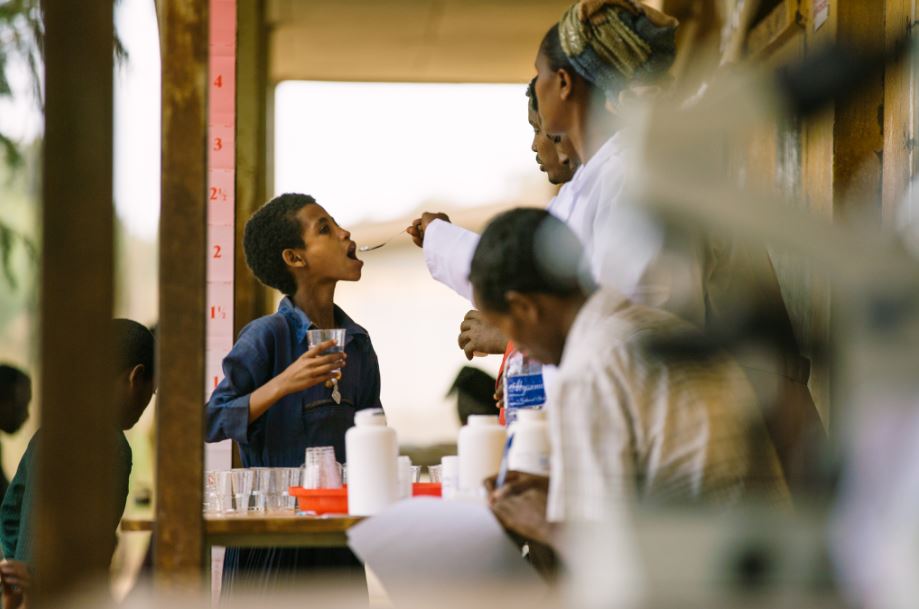
Many British entities, some of which are listed below, have and continue to contribute to the field of NTDs:

● British non-governmental organisations are leading the fight against NTDs: the Schistosomiasis Control Initiative Foundation, Sightsavers, Leprosy Mission (which Diana, Princess of Wales worked with since 1989), Mentor Initiative, LEPRA, Uniting to Combat NTDs, and others.

● Many of the most impactful British philanthropies are invested in the fight to end NTDs: Children’s Investment Fund Foundation, Power of Nutrition, Virgin Unite, and Wellcome Trust.

● The oldest and most esteemed schools of tropical medicine are British: London School of Hygiene & Tropical Medicines, Imperial College London, Liverpool School of Tropical Medicine.

● British institutions, such as the Natural History Museum and the Wellcome Trust, provide crucial support and resources for NTD research.

● The Queen Elizabeth Diamond Jubilee Trust’s Trachoma Initiative provided 26.6 million antibiotic eye treatments and 104,020 sightsaving operations.

● British pharmaceutical GlaxoSmithKline has donated over 10 billion tablets of albendazole to protect over 900 million people from intestinal worms and lymphatic filariasis.

Owing to the U.K.’s long tradition of altruism, contributions to this field have never slackened. It is, therefore, critical that British leadership stays the course in this movement to end NTDs over the coming decade. ‘

A funding reduction would be a devastating chapter in the U.K.’s proud history as a global leader that has been a bedrock of funding, a font of knowledge and a reliable source of action.

Even in a world wracked by COVID-19, to divert funds from NTDs will be to lose critical progress and relinquish leadership status. It will bring a premature conclusion to what is due to seal the great British success story of ending NTDs in this decade. That is why I call on the UK government to maintain NTD funding.

Distributed by African Media Agency (AMA) on behalf of the END Fund