Digital Adoption In Africa Supersedes Other Regions — Report

A new report by Boston Consulting Group called Digital Challenge in Africa, reveals that although Africa currently trails other regions in terms of digital adoption and maturity, the pace of adoption and infrastructure buildout is happening faster on the continent than any other region in the world.

“The Covid-19 crisis has also focused minds, accelerating digital adoption among consumers and digital transformation among companies,” says Jan Gildemeister, managing director and partner at Boston Consulting Group, Johannesburg.

“For success going forward, we believe that companies and governments need to coordinate on three fronts: creating scale, nurturing and attracting digital talent, and building ecosystems and innovation hubs to improve access to financing options, regulation and technology.”

To get to the stage where companies and governments are able to fully coordinate on these fronts, it is going to be critical to close the digital gaps that persist; arising from limited digital service penetration, a lack of digital skills, little trust in digital service providers, weak connectivity coverage and the high cost of data.

“For instance, only 40% of African consumers have 3G coverage compared to 72% worldwide, and connection speeds and digital service quality in Africa are relatively inferior,” says Gildemeister.

These challenges extend to African companies too. Organizations across the continent have the lowest average digital maturity globally; driven by management’s struggle to narrow digital priorities, cultural resistance to adopting digital, insufficient digital capabilities and a lack of organisational agility.

Strong Desire To Bridge Gaps

However, there is a strong desire on the continent to bridge these gaps, and there is already some positive momentum.

Infrastructure and demand are growing steadily and more rapidly than elsewhere in the world, and the lack of digital maturity actually offers an opportunity to leapfrog legacy technologies and business models – with the growth and popularity of mobile money a good example of the ability to leverage innovation.

Companies are accelerating digital momentum as they recognise the correlation between digital maturity and performance, and the pandemic has accelerated digital adoption and transformation both for consumers and companies.

“One industry where this shift is quite apparent is banking. Many African consumers have already adjusted their day-to-day banking behaviour because of the pandemic. For example, 46% of surveyed South Africans said they are considering making a permanent shift to digital banking,” says Gildemeister.

What’s Necessary To Build On The Momentum

To build on this momentum, it will be necessary to achieve scale both at the individual operations level of companies and governments, as well as at the broader market level for economic viability, profitability and sustainability.

It will also be important to attract and retain digital talent through specific employee value propositions (EVPs) for digital to address issues that really matter to digital talent, starting with learning and skills development programmes.

This will need to be matched by the building of digital ecosystems that nurture entrepreneurship and startups: currently, for instance, there are only 2,000 startups in South Africa, a low number for one of Africa’s main economic hubs.

Entrepreneurs and startups in the country are hampered by regulatory red tape, lack of access to funding and strategic partnerships, information inadequacy, complex intellectual property rights, and corporate governance limitations.

Creating a strong ecosystem will require improving access to finance and markets, regulations that support innovation, the development of infrastructure and platforms at scale, and leveraging larger players that drive ongoing development.

T-bill Yields Expand As Funding Pressures Persist, DMO Raises 1-Year Rate At PMA

FGN Bonds

The FGN Bond market remained bearish in today’s session, with yields rising by c.14bps on average following weak economic indices from earlier in the week.

We noticed improved offers across the FGN bond curve as bids drifted wider in anticipation of an uptick in yields at the FGN bond auction as well as the MPC meeting scheduled for next week.

We expect interests to remain relatively weak at current levels, with little activity expected ahead of the monthly primary auction scheduled for next week.

Treasury Bills

The T-bills market remained bearish as tight system liquidity lingered in the Money Market. We saw offers on some selected maturities, mostly at the short end of the curve, as banks remained pressured by double-digit money market rates.

At the PMA, the DMO sold a total of N61.89Bn in maturing treasury bills across the three maturities on offer, c.N14.82Bn more than on offer. The stop rate for the 364-day closed higher by c.50bps, while the rates on the 91- and 182-days remained unchanged at 2.00% and 3.50%. Demand remained healthy at the auction, with an average bid-to-cover ratio of 2.81X.

We expect the CBN to float an OMO auction tomorrow, keeping in line with the recent trend, despite tight system liquidity levels.

Money Markets

Rates in the money market hiked further by c.270bps due to the strained high system liquidity. The OBB and OVN rates consequently ended the session at 12.67% and 13.50%.

We expect rates to trend higher in tomorrow’s session, as we anticipate another OMO auction by the CBN to manage excess system liquidity.

FX Market

Supply in the I&E FX window improved from export proceeds as traded volumes improved by 359% d/d (c.$148.54mio traded). Participants were bided between N390.00/$ and N412.00/$, although the closing rate remained unchanged at N409.75/$.

At the parallel market, the cash lost N2.000k on the day to close at N483.00/$ while the transfer rate remained stable at N494.00/$.

Eurobonds

The SSA sovereign space pared gains today, in contrast to US stocks and bonds, coming off the US FED’s meetings where it raised its growth forecast and cooled down fears for rate hikes in the interim. Yields on the NIGERIA Sovereigns curve expanded by c.7bps on the average to close the session.

The NIGERIA Corps also had a relatively negative session, as sellers offloaded most of the tracked papers for most of the session. The longer-dated FBNNL 2025s and ECOTRA 2026s led the losers’ chart, as yields on both papers increased by c.05bps.

Three Top US Home Improvement Retailers Generated Nearly $55 Billion In Sales In Q4 2020

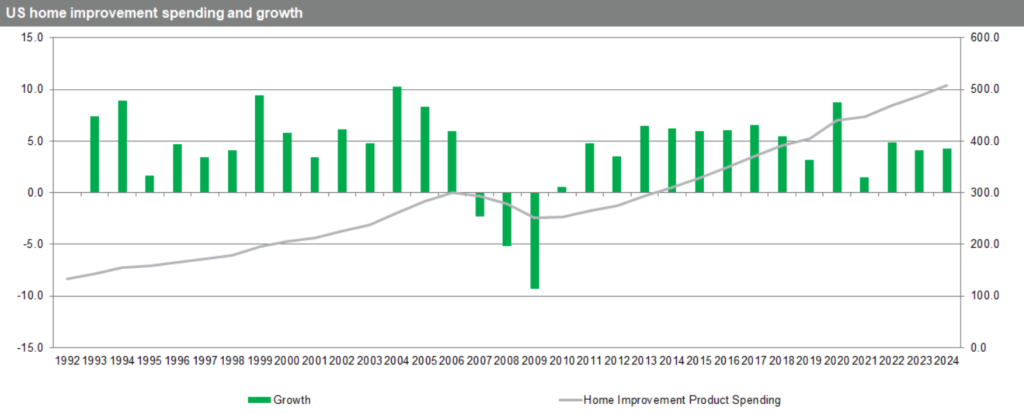
The home improvement sector was among the few bright spots in the US economy in 2020. According to the research data analyzed and published by ComprarAcciones.com, product sales in the space rose by 8.7% year-over-year (YoY) to $440 billion.

It is interesting to note that prior economic recessions were not as kind to the market. For instance, during the 2008/2009 recession, the sector experienced three years of declines in consumer spending. As a result, the industry posted double-digit losses.

Regardless of supply chain bottlenecks and other challenges, some businesses in the US home improvement market thrived in 2020. For top players in the space, the year of uncertainty culminated in a market-beating Q4.

The top three home improvement chains in the US sold goods worth a cumulative $54.67 billion in the three-month period. Comparatively, their collective sales for a similar period in 2019 amounted to $41.88 billion.


Home Depot, the largest store chain in US home improvement, beat analyst estimates during the period courtesy of a 25% YoY gain in sales. The growth drove revenue up from $25.78 billion in Q4 2019 to $32.26 billion in Q4 2020. In the US market alone, same-store sales shot up by 25%. Overall, the company posted a 24.5% increase in same-store sales against an expected 19.2% according to Street Account analysts.

Home Depot’s net income soared to $2.86 billion, equivalent to $2.56 per share. That was a significant increase from the previous year’s $2.48 billion ($2.28 per share). It was also slightly higher than Refinitiv’s estimate of $2.62 per share.

Average purchase per customer rose by 11% YoY to $75.69 while sales per square foot surged by 24% to $528.01. Transactions worth more than $1,000 similarly rose by 23% YoY.

Digital sales increased by 83% in Q4, and by 86% for the full year. About 60% of online sales during the year were fulfilled through the store. For the full year, Home Depot posted an increase of 20% in net sales to $132.1 billion.

Lowe’s Net Sales Rose by 28% to $20.31 Billion, Ace Hardware’s Up by 39.2% to $2.1 Billion

Lowe’s, which ranks second in the sector, had an equally impressive quarter, reporting an increase of 28.1% in same-store sales. Street Account analysts had projected a 22% rise.

Its net sales grew to $20.31 billion against an expected $19.48 billion. Net income nearly doubled, from $509 million (66 cents per share) to $978 million ($1.32 per share). That was higher than Refinitiv analysts’ estimated $1.21 per share.


There was also an increase of 16% in all its merchandising departments and a 19% jump in all regions of the US. Online sales shot up by a remarkable 121%. During the quarter, online sales and sales at US stores that had been open for at least a year grew incrementally each month. They rose from 23.8% in November to 28% in December and 35.7% in January 2021. For the full year 2020, net sales totaled $89.6 billion.

On the other hand, Ace Hardware, the third largest US home improvement chain, also posted record revenue in Q4 2020. Following an increase of 39.2% YoY, its total sales reached $2.1 billion. Net income rose by $39.6 million to reach $43.1 million as US same-store sales shot up by 28.7%.

For the full year, Ace Hardware’s revenue rose to $7.8 billion, up 27.9% from $6.1 billion in 2019. Net income jumped 125.7% to 316.9 million. There was an increase of 25.9% in same-store sales, 14.7% in average transaction size and 272% in online sales.


Home Improvement Sales to Rise by 4.1% in Q1 2021, Dropping to 1.7% by Q3 2021

According to research data by Harvard University, annual spending on home renovation and repair is set to increase by 4.1% in Q1 2021. However, by Q3 2021, growth is projected to taper off to about 1.7%.

Annual expenditure on home renovations and repair is expected to increase from $332 billion to $337 billion by the second half of the year.

Based on a survey carried out by Lowe’s in December 2020, 40% of consumers said they had started a hobby in home improvement. Around 59% said that they planned to continue spending some money that they used to spend on other things prior to the pandemic on home improvement.

Notably though, Lowe’s cautioned that demand would gradually taper off, resulting in total annual sales of $86 billion in 2021. Admittedly, the big numbers industry players posted during the pandemic could lead to tough comparisons in coming quarters.

However, Home Depot pointed to a potential increase in purchases by larger pro customers. Pros account for 45% of Home Depot’s sales compared to Lowe’s 20% to 25%.

Active Voice Subscribers Declined by -0.32% in Q4 2020 – NBS

1

A total of 204,601,313 subscribers were active on voice as against 205,252,058 in Q3 2020. This represented a -0.32% decrease in voice subscriptions Quarter-on-Quarter.

The National Bureau of Statistics (NBS) disclosed this in its latest Telecoms data for Q4 2020 report released on Thursday.

Similarly, a total of 154,301,195 subscribers were active on the internet as against 151,512,122 in Q3 2020. This represented a 1.84% growth in internet subscriptions QoQ.

Further Breakdown:

  • Lagos State has the highest number of subscribers in terms of active voice per State in Q4 2020 and is closely followed by Kano and Ogun States
  • Bayelsa and Ebonyi States have the least number of subscribers.
  • Lagos State has the highest number of subscribers in terms of active internet per State in Q4 2020 and is closely followed by Kano and Ogun States respectively
  • Bayelsa and Ebonyi States have the least number of subscribers.

Also, the report stated that “MTN has the highest share of subscriptions. This is closely followed by AIRTEL, GLO, and EMTS (Etisalat) respectively.”

MoneyGram Set To Join Pay+Mobile Wallet To Expand Digital Presence In Middle East

0

MoneyGram International, Inc. (NASDAQ: MGI), a global leader in cross-border P2P payments and money transfers, today announced it signed an agreement to launch its leading international money transfer capabilities on Pay+, a mobile wallet powered by Ooredoo Oman and the National Bank of Oman (NBO).

Pay+ is a first-to-market development that will empower consumers in Oman to make deposits, withdrawals, bill payments, and local and international money transfers.

This partnership will give customers the ability to use the mobile wallet to transfer money in near real-time with access to the MoneyGram global distribution network which spans over 200 countries and territories.

“Consumer demand for real-time payments and mobile wallets continues to surge, so this expansion with one of our largest and fastest-growing digital partners is yet another milestone on our journey to lead the evolution of digital P2P payments,” said Alex Holmes, MoneyGram Chairman and Chief Executive Officer.

“As our digital partners are increasingly looking to utilize our modern, mobile and API-driven infrastructure, this integration through Pay+ will provide scale to its existing digital offerings and instant access to our cross-border payments and money transfer services.”

This strategic partnership expansion will build upon the strong momentum MoneyGram has already developed in the Middle East market and further accelerate digital growth as the Company plans to expand its customer-centric capabilities to Oman, one of the largest markets in outbound international remittances.

“This major, first-to-market, development will change the way customers transfer money,” said Ian Dench, Chief Executive Officer at Ooredoo. “Pay+ was designed with customer needs in mind and together with our partners, MoneyGram and NBO, the ground-breaking mobile wallet will continue to set standards in the Sultanate’s evolving digital payments ecosystem.”

“As we successfully execute our strategy to accelerate digital growth and expand access to mobile wallet capabilities, consumers around the world are seeing the value in our digital transformation,” said Grant Lines, MoneyGram Global Chief Revenue Officer. “Through this upcoming launch, we are doubling down our efforts in key send corridors such as Oman and, in turn, providing new and innovative technologies and more digital payment options to consumers around the globe.”

The partnership is expected to be live for consumers in April 2021.

All The Highlights And Excitement From The Nigerian Idol Season 6 Pre-Show

Nigerian Idol, the popular reality singing competition is back and better.

The sixth season of the show premiered last Sunday on DStv 198 and GOtv 29 with a pre-show featuring the nationwide auditions for this season’s musical adventure. Viewers at home can rate these auditions and see if the Judges agree with their ratings when Episode One premieres Sunday, 28 March.

The pre-show kicked off to a roaring start, with the good and not-so-good renditions of popular and original songs by the Nigerian Idol hopefuls.

Nigerian Idols (show starts boy) Brandspurng All The Highlights And Excitement From The Nigerian Idol Season 6 Pre-Show

Shadrack John hit a few right notes with his rendition of Andre’s Day’s “Rise Up”, but Ejike Ernest’s version of Bruno Mars’ “Just The Way You Are” didn’t register at all. Clinton from Lagos put in a good shift with his cover of Labrinth’s “Jealous, Chiemerie handed in a version of “Versace On The Floor” that almost sounded like the original, and Fubarata from Ikorodu ran with “Because You Love Me” in a manner that Celine Dion would have been proud of, but Dotun from Ogba failed to put in any real effort with his version of Labrinth’s “Jealous”.

Daniel Ikechi from Ile-Ife struggled for confidence as he delivered his own song called “Nande Baby”, and Merit created an atmosphere similar to a worship session with her cover of Travis Greene’s “You Made A Way”. Obed failed to evoke any major feels as he attempted Marvin Gaye’s “Sexual Healing”, and Ozioma’s facial expressions were just as hilarious as his rendition of a Christmas carol. Favour lit up the room with his guitar as he took his first shot at stardom, and Nicole held her own as she covered Timi Dakolo’s “Great Nation”

Amos from Benin failed to provide any sort of melody, Aisosa mixed up his lines, and Damilola went way off-key with her singing. Chris Daniels sounded like he mistook the auditions for a karaoke session, and Rosemary struggled with her notes too, but Beyonce – yes, there is a contestant named Beyonce – did a good job with her performance. Akunna also shone with her performance of James Arthur’s “Smells Like Roses”, but the same could not be said for Daniel Canus.

The Nigerian Idol pre-show is on 24 hours on DStv 198 and GOtv 29. Viewers can give their assessment of the auditions from the comfort of their couch. To rate the auditions, visit africamagic.tv/nigerianidol to express your opinion of the performances from the pre-show.

Nigerian Idol Season 6 is hosted by IK Osakioduwa, and judging this year’s contestants will be three of Nigeria’s music industry veterans: Obi Asika, Seyi Shay and DJ Sose.

Nigerian Idol season 6 is sponsored by Bigi Drinks and Tecno Mobile.

Viewers can watch Nigerian Idol Season 6 via the DStv app on multiple devices at no additional cost. The app is available for download on iOS and Android devices.

Empowering Women In Critical Sectors To Challenge The Status Quo

0

By Lamin Manjang

Although women’s rights have seen a significant positive change in the last decade, it remains a critical topic of conversation across various sectors in different parts of the world.

According to the United Nations (UN) Secretary-General António Guterres, “Progress towards equal power and equal rights for women remains elusive. No country has achieved gender equality, and the COVID-19 crisis threatens to erode the limited gains that have been made.”

Women’s global economic development role provides significant progress and impact, charting new opportunities for women to continue to change the status quo. Even though we continue to record very many successes by women, there is still a lot more that can be achieved, especially in representing more women in the workforce.

According to the United Nations (2020), only 50% of working-age women are in the labour market for more than twenty years. This means that more women need access to resources and opportunities to break stereotypes resting in labour market positions. As a Bank, one of the ways we commit to addressing this is how we strategically continue to support some of the UN Sustainable development goals that empower women, especially in this new-normal era.

I echo the words of the UN Secretary-General, António Guterres “The Decade of Action to deliver the Sustainable Development Goals and efforts to recover better from the pandemic offer a chance to transform the lives of women and girls, today and tomorrow…”.  We see this as an invitation to work collaboratively with the United Nation as corporate organisations and individuals to achieve growth and sustainable progress for women.

In line with this year’s International Women’s Day theme, #ChooseToChallenge, our forward-thinking approach to initiatives and programs continues to deliver sustainable value for women, especially in a country like Nigeria, where women account for 49.34% of the total population.  We see that the fewer income-generating opportunities for the larger population may leave women in an even more financially vulnerable position, hence our motivation to set up various initiatives such as the Women in Technology Incubator program, which launched in Nigeria 2019, following successful launches in New York, Kenya and the UAE

This program aims to support female entrepreneurship with the call for increased gender representation and diversity in tech and for more opportunities for women to develop entrepreneurial and leadership expertise. Also referred to as Women in Tech, the incubator supports early-to-mid stage professionals in technology and business sectors to have the requisite domain knowledge, experience, and perseverance to deliver results. Other markets equally running the program include Pakistan, Bahrain, Zambia, and Ghana

Our goal is to enhance women’s role through business incubation and generate business outputs that improve existing business and women entrepreneurs’ capacity. Additionally, this program promotes and creates awareness about women business incubation globally and strengthens cooperation and network building between the various incubators.

This ripple effect will cause an increase in the investment that different incubators receive, therefore integrating and developing more women who are part of this program. It has also created awareness about incubation challenges specific to Nigerian women and outlined various activities required to improve women-led enterprises’ technological infrastructure and structural support for Women Incubation. To date in Nigeria, we have invested over $250,000 in this program and are committed to doing more to sustain the program for posterity

We understand that investing in Nigerian youth through education and creating productive and remunerative employment is the only way to support this growing demographic. Additionally, SCB sees the need to do its part in empowering the estimated 600 million adolescent girls in the developing world. Hence, the introduction of our Global Goal programme to Nigeria in 2011.

Goal tackles female empowerment by imparting adolescent girls in rural communities with life skills through sports training in partnership with leading global non-profit organisations. We have strategically designed this programme for girls between 12 and 18 who live in under-served communities by enrolling them in sessions typically offered weekly for ten months. The girls are being taught critical facts about health, communication, rights, and managing their finances. All this is done to understand how to share the knowledge with their friends, family, and communities.

To ensure that more girls are taught these essential skills, girls who complete the Goal programme and display exceptional leadership qualities are invited to become Goal Champions, making them eligible to receive training to deliver the Goal curriculum to their peers. Since its inception in 2006, the Goal programme has reached more than 525,000 girls and young women worldwide.

Without gender equality, efforts to empower women will only go so far. For example, our global Futuremakers initiative is set-to up tackle this and promote financial inclusion across our markets. We aim to raise US$50 million between 2019 and 2023, needed to empower the next generation to learn, earn and grow. This augments our desire to continuously #ChooseToChallenge as a Bank.

Our method is simple; to contribute to Sustainable Economic Growth by investing in strategic leadership training programmes under the youth’s employability project. Globally, we recently partnered with Young Business International (YBI) to support young entrepreneurs hit by the economic impact of Covid-19. The project is part of our Futuremakers by Standard Chartered global initiative to tackle inequality.

Bringing it home to Nigeria, our implementation partner,  FATE Foundation, will provide holistic support through various initiatives, including Digital Transformation Workshop, Resilience-building Series, and Remote Consulting & Advisor services to be delivered virtually by our employees to 2,000 entrepreneurs across Nigeria. We will specifically target entrepreneurs between the ages of 18-35, who the crisis has hardest hit.

Between 2019 and 2020, we had also invested over USD50,000 in work-ready employability project training and equipping nearly 200 Nigerian youths with skills and resources to aid their career development journeys. Empowering the future is a gift that keeps on giving, and for us, we intend to continue to do this for a very long time.

For every woman or girl-child not empowered economically, our work is not done. We will continue to grow our current programmes and initiatives, partner with similar organisations, and start new ones in areas we have not yet covered. We strive for equal representation as we #ChooseToChallenge this year and always.

 Lamin Manjang is the Chief Executive Officer of Standard Chartered Bank Nigeria Limited

Excitement as Konga set to roll out best deals from top brands

Mouth-watering deals, unmatched discounts, daily Flash Sales, Treasure Hunts, free shipping and exclusive app-only deals are among the many exciting offers lined up for customers of Konga, Nigeria’s leading composite e-Commerce giant, as it brings together the biggest global brands in the market on its platform for a much-anticipated campaign.

Known as Battle of the Brands, the exciting campaign kicks off on Friday, March 26 and will run till Wednesday, March 31, 2021.

Exclusive to Konga, Battle of the Brands will see shoppers treated to the biggest offers and deals from an array of top brands dominating segments cutting across Computing, Mobile Phones, Fast Moving Consumer Goods (FMCG), Home & Kitchen, Electronics, Fashion, Beverages, Wine & Spirits and much more. The weeklong fiesta will see Konga feature star brands from various categories on a daily basis, with the best offers and deals from each brand highlighted for the benefit of potential shoppers.

Battle of the Brands Brandspurng1

Accordingly, the campaign will offer each brand a unique opportunity to take advantage of the heightened interest from eager shoppers and the massive traffic expected at Konga to put their best foot forward, showcase new offers, expose their biggest deals, roll out or launch new products and extend the best discounts on existing products.

Kenny Oriola, Vice President, Konga Online, says Battle of the Brands is a time for the best brands to stand up and be counted.

‘‘Battle of the Brands is a time to decide who the best brands offering the biggest deals in the market are. Our customers have long waited for this campaign and many of them have expressed huge anticipation to see what each brand has to offer. As a top brand, you certainly do not want to disappoint your loyal customers.

‘‘This is the time to show off the biggest deals and best offers as that is what shoppers are looking forward to. As a globally-renowned brand, you deserve to be seen on Battle of the Brands. We expect to see shoppers treated to a number of exclusive offers, mouth-watering deals, huge price slashes or even new products from the brands we have lined up for this campaign. Therefore, we are putting all our assets at the disposal of these brands in order to ensure that potential shoppers are satisfied,’’ he stated.

Meanwhile, the Konga website is expected to wear a new look as the countdown to the campaign draws nearer.

Battle of the Brands will run from Friday, March 26 and end on Wednesday, March 31, 2021.

Ericsson appoints Sena Erten as Head of People for Market Area Middle East and Africa

Ericsson today announced the appointment of Sena Erten as Vice President and Head of People at Ericsson Middle East and Africa and a member of the market area leadership team.

In her new role, Sena will work to realize the company’s people vision in the market area, inspire and guide the business towards a world-class employee experience that is people-centred, adopting the latest digital technologies, and leading the way in driving our company culture.

Ericsson appoints Sena Erten as Head of People for Market Area Middle East and Africa Brandspurng
Sena Erten, Vice President and Head of People, Ericsson Middle East & Africa | Brand Spur Nigeria

In a fast transforming industry, Sena will drive Ericsson’s people transformation in the region through innovative leadership, attracting and retaining the best talents and helping Ericsson to win in the talent marketplace while creating a compelling employee experience.

Fadi Pharaon, President of Ericsson Middle East and Africa said:

“People are at the centre of everything we do at Ericsson. I am delighted to welcome Sena into her new role. Her extensive knowledge and experience will further strengthen our people function.

In a high-paced industry, pushing the envelope of technology, Sena will work to address the fast-changing competence development needs of our company by unlocking the human potential, upskilling and reskilling talents, enabling us to stay ahead of the market and adding value to our customers.”

Sena brings 20 years of human resources and executive experience to Ericsson, rooted in a passion for people development, building diverse and inclusive cultures and high-performing, empowered organizations.

On the occasion of her appointment, Sena says:

“I am excited to join the Ericsson family and be part of the team; realizing Ericsson’s vision of an intelligent, sustainable and connected world. I look forward to driving the company’s people strategy in the region, realizing the talents’ full potential while building a culture of excellence and supporting our teams in finding new and effective ways to engage, lead and collaborate.”

Ericsson enables communications service providers to capture the full value of connectivity. The company’s portfolio spans Networks, Digital Services, Managed Services, and Emerging Business and is designed to help our customers go digital, increase efficiency and find new revenue streams.