Amazon Gets Go-ahead To Build Two More Data Centres In Dublin

0

Amazon has secured planning permission for two new data centres in north Dublin, despite objections from environmental groups which expressed concern that it would place further pressure on limited energy supplies and have an adverse environmental impact.

Dublin City Council has approved an application made by Amazon through Colliers Properties for permission to construct two new data centres on a 3.75-hectare site in Clonshaugh Business and Technology Park.

A division of the US multinational, Amazon Web Services, already has a data centre at the same location.

The new data centres will be housed in two new two-storey buildings which will have a gross floor area respectively of 12,875m² and 1,445m² on a site of the former Ricoh building which is earmarked for demolition.

The larger building will have two additional mezzanine levels.

A dozen emergency generators will also be located in adjoining compounds.

Amazon has estimated that between 15 and 58 staff will work at the data centres over a 24-hour period, while up to 400 staff will be employed during the construction phase of the project.

Energy consumption levels of data centres

The development by Amazon comes at a time when the energy consumption levels of data centres have come under renewed focus due to concerns over capacity issues among energy providers.

Official figures showed data centres accounted for 14% of all electricity demand in the Republic last year with Eirgrid estimating they could account for 29% by 2028.

Members of South Dublin County Council are currently locked in a row with the planning regulator after they imposed an effective ban on all future developments of new data centres in its administrative area.

Earlier this year Eirgrid said it would not be providing any new grid connections for data centres in the Dublin region until 2028 due to capacity constraints.

However, the Commission of Regulation of Utilities ruled out a moratorium on new data centres but said the location of future facilities and their ability to generate their own power supplies would need to be assessed on a case-by-case basis.

In its application, consultants for Amazon said the company was committed to building a sustainable business “for our customers and the planet”.

Amazon’s wind farm projects

Amazon told council planners that its new 115-megawatt wind farm project in Galway which became operational this year would support the company’s data centres in the Republic and add to its existing wind farm projects in Cork and Donegal.

Amazon said the three wind farm projects combined were projected to deliver 229MW of renewable energy capacity each year and reducing emissions by 366,000 tonnes of CO₂ per annum — the equivalent of powering 185,000 homes for a year.

The company said it was committed to offtake 100% of the power from its renewable energy projects without relying on additional public funding through the Public Service Obligation levy.

It pointed out it was the first company in Ireland to sign up for unsubsidised Corporate Power Purchase Agreements.

Through the use of an innovative cooling solution, Amazon said the two new data centres would use as little as 264m³ of water for cooling annually.

Amazon said its operations in Ireland sustain 8,700 jobs including 3,100 direct staff and another 3,900 working for contractors.

Increases to Ireland’s economic output

The company claims it increased economic output in Ireland by almost €7.5bn over the past decade and directly invested €4.4bn over the same period.

On data centres, Amazon said it had increased its spend with Irish contractors 14-fold since 2015 to €228m.

Amazon said its investment in data centres in Dublin city supported more than 2,300 jobs in 2020 and benefited from €80m in capital expenditure.

Environmental group, Not Here Not Now, which opposed the development of the new data centres, said the proposed use of diesel emergency generators would result in fossil fuels being used to power them on occasion.

The group, which is campaigning for an end to fossil fuel exploration, said it was crucial that data centres are powered directly by onsite renewable energy generation such as rooftop solar farms or new offsite generation such as offshore wind farms.

Not Here Not Now also claimed it was crucial that Dublin City Council considered the cumulative impact of the energy demand of all Amazon’s data centres in Ireland on a nationwide basis.

Lack of information on power rating

Another environmental group, Gluaiseacht, claimed the lack of information about the power rating of the proposed new data centres made it “unclear how big of a energy guzzling monster is being added to the national grid”.

In its ruling Dublin City Council said the proposed data centres were compatible with the zoning of the site and noted there were several other data centres within the business park including an existing permission for one on the same site.

While the new data centres would have some net impact on the area, council planners ruled they would not have any significant adverse effects either on their own or in combination with existing data centres.

One of the conditions of the grant of planning permission requires Amazon to pay a development contribution of almost €1.3m to the council.

Snap Says Snapchat+ Now Has 1 Million Subscribers, Introduces New Features

0

Snap said today that the company’s paid subscription plan Snapchat+, which launched in June, now has more than 1 million users across the globe.

The firm also introduced new features like priority replies to celebrities, new post view emoji, Bitmoji backgrounds and custom app icons to its subscribers.

Last month, a report from Sensor Tower noted that Snap already registered $7.3 million in in-app revenue within 30 days of Snapchat+ launch — with the paid tier estimated to contribute more than $5 million of that sum. The analytics firm said that while the $3.99 monthly plan was a top choice, many folks also opted to get six-month or 12-month subscriptions priced at $21.99 and $39.99 respectively.

Since its launch, the company has also introduced new features for subscribers like access to Snapchat for Web.

New Snapchat+ features

With the new feature drop, Snapchat will surface subscribers’ replies above non-paid users’ replies to stories posted by the platform’s celebrated creators known as Snap Stars.

Image Credits: Snap

The other new features are purely visual: For example, users can now select a custom emoji to sign off their Snaps. Once a friend views their snaps, the emoji will appear on the timeline next to the subscriber’s avatar.

Image Credits: Snap

What’s more, Snapchat+ users can now access exclusive backgrounds for their Bitmoji avatars, and custom icons for the Snapchat app.

Snapchat+ was first launched in the United States, Canada, the United Kingdom, France, Germany, Australia, New Zealand, Saudi Arabia and the United Arab Emirates. And since then the company has expanded its availability to countries like India, Kuwait, Qatar, Oman, Bahrain, Egypt, Israel, Sweden, Denmark, Norway, Netherlands, Switzerland, Ireland, Belgium, Finland and Austria.

CITIC Telecom Announces 2022 Interim Results

Overall development reaches a new height with record-high operating results
Profit attributable to equity shareholders up 7.1% year-on-year to HK$572 million
Interim dividends HK6.0 cents per share up 9.1% compared with the same period last year

HONG KONG SAR – Media OutReach – 17 August 2022 – CITIC Telecom International Holdings Limited (“CITIC Telecom” or the “Group”; stock code: 1883), Asia-Pacific leading multinational internet-oriented telecommunications enterprise providing comprehensive services, reported profit attributable to equity shareholders of HK$572 million for the six months ended 30 June 2022, representing a year-on-year increase of 7.1%, or 7.6% if excluding the effect of investment property valuation.

The Group reported HK$4,393 million in revenue from its principle telecommunications services business, representing a year-on-year increase of 10.0% compared to the corresponding period of last year. Total revenue amounted to HK$4,977 million, an increase of 3.8% year-on-year. Basic earnings per share was up 6.9% to HK15.5 cents.

The Board declared an interim dividend of HK6.0 cents per share for 2022, an increase of 9.1% as compared to the corresponding period of last year.

Mr. XIN Yue Jiang, Chairman of CITIC Telecom, said, “During the first half of 2022, against the manifold challenges posed by complicated and austere international situations and the impact of the pandemic, staff members of the company strived forward against adverse conditions in a united effort with confidence and diligence in fulfilment of its mission. We seized opportunities for development with an unwavering focus to explore new markets, businesses and customers with our full force. Meanwhile, the Group has continued to enhance its technological innovation and our technology and innovation regime has been fortified with an increase in R&D investment. The Group has enhanced its platform capability, broadened its scope of service as we took our overall corporate development to a new height and reported yet again record-high operating results.”

The Group has maintained a healthy financial position and a stable cash flow. As at 30 June 2022, the Group recorded cash and deposits of approximately HK$1,721 million, sufficient to meet its financial obligations and contractual capital commitments in the coming 12 months.

Business Highlights

Companhia de Telecomunicações de Macau, S.A.R.L. (“CTM”) completed 5G roaming tests with overseas network carriers in full preparation for the launch of 5G service. As at the end of June 2022, CTM had an approximate 46.4% share of Macau’s mobile market, and 47.5% share of the 4G market in Macau, as it continued to uphold its leading position in the Macau market. During the period, stable progress has been made in 5G development, as the Group completed 5G roaming tests with 68 overseas network carriers.

Revenue from internet business increased as driven by rising business internet requirements and an increase in revenue from fiber broadband service. The Group’s internet services revenue amounted to HK$649 million, representing a year-on-year increase of 7.5%, mainly driven by rising business internet requirements and the service upgrade by existing customers and the year-on-year increase of around 2.1% in the number of broadband users to over 200,600 subscribers. Moreover, the Group has seized the development opportunity for data centres, as Phase III (B) of CITIC Telecom Tower Data Centre has launched its service in the market and smoothly commenced business, while the data centre businesses in Beijing, Shanghai and Guangdong have also reported sound progress.

International telecommunications business recorded a substantial growth due to a surge in revenue from messaging services. Revenue from international telecommunications services amounted to HK$1,715 million, representing a year-on-year increase of 33.3% as compared to the corresponding period of last year. Due to the continued increase in demand from corporate messaging delivery, messaging services revenue surged 44.3% to HK$1,206 million when compared to the corresponding period of last year, and voice services revenue increased by 14.8% to HK$496 million, as compared to the corresponding period of 2021.

Continuing to drive digital and intelligent development of corporations, and deeply cultivate the enterprise service market. CITIC Telecom International CPC Limited (“CPC”), a subsidiary of the Group, has optimised the deployment of its global network and infrastructure facilities to build a safe and stable global network, as CPC now operates more than 160 PoPs in the global network, with the services covering more than 150 countries and regions, having added new PoPs in Wuhu, Anhui and Zhaoqing, Guangdong. Moreover, CPC has enhanced its competitiveness in the cloud computing market with the commencement of the public cloud MSP business and the launch of the SmartCLOUD™ Container Services. While 19 cloud computing service centres supported by the 10 leading cloud computing solutions, the Group has formed a cross-regional, global operating network for cloud computing services.

Engaging in a full effort to explore new markets in Southeast Asia, and reported steady increase in the number of customers served. During the period, Acclivis Technologies and Solutions Pte. Ltd., a subsidiary of the Group, successfully secured a new contract for the construction of ICT facilities in Malaysia, rendering robust support for the expansion of the Group’s business scale in Southeast Asian new markets. Moreover, in the continuous effort to expand into the regional market, the Group successfully secured an ISP license in Indonesia.

Development Strategies

Looking forward, the Group will drive commercialisation of the digital sector and digitalisation of the industrial sector for vigorous engagement in the development of the digital economy in active response to market changes, playing a more significant role in the process of allowing enterprises to “reach out” and “bring in”. Meanwhile, the Group will also strengthen cooperation with strategic partners, and seek global expansion with full force to fortify the position as an international hub for telecoms services.

As for the 5G construction, the Macau SAR Government published the 5G tender announcement on 30 June 2022. CTM will support the SAR Government with full force and vigorously participate in the 5G tender to ensure the instantaneous launch of 5G commercial services, expedite customer upgrades and improve customer experience to maintain its leading position in Macau’s communication industry.

The Group will enhance regional expansion and the promotion of smart-city applications by actively extending the reach to Guangdong-Macao In-depth Cooperation Zone in Hengqin. The Group will also seize the opportunity presented by the gradual resumption of business and travel in the Southeast Asian countries, striving to expand the customer base, increase the recurring revenue from telecoms services and management services, and explore large-scale ICT projects to further expand the Group’s business scale.

The Group will also step up with development in technology and innovation. The Group will construct a technology research and development regime based on “ICT-MiiND” development strategy with a special focus on innovation in new frontiers such as cloud-net integration, digital transformation and industry applications to enhance the cloudification, internet-based operation and intelligentisation of the corporation through digital transformation, in a full effort to develop a “cloud, network, smart and security” platform and accelerate the deployment and development in corporate digital transformation and economic digitalisation.

Mr. XIN Yue Jiang, Chairman of CITIC Telecom, said, “The Group will continue driving technological innovation and ensure quality remains its priority. It will support the construction of ‘Digital Macau’ with the 5G network, broaden the smart city capabilities with 5G applications, expand into international markets with high-quality cross-border services, accelerate the digital transformation with the ‘cloud, network, smart and security’, and create new core competitive edges through technological innovation. In addition, it will solidify its foundation in the Chinese mainland market, using Hong Kong and Macau as a base and connection, accelerate the expansion and coverage of the international market, and strive to transition from Asia-Pacific leading to world-leading position, so as to create better returns for shareholders.”

Hashtag: #CITICTelecom

About CITIC Telecom International Holdings Limited (stock code: 1883)

CITIC Telecom International Holdings Limited was established in 1997 in Hong Kong, and it was listed on The Stock Exchange of Hong Kong Limited on 3 April 2007. As one of the largest international telecommunications hubs in Asia Pacific, the Group provides full-scale international telecommunications services to carrier clients around the globe, and integrated enterprise services in Southeast Asia through its wholly-owned subsidiary Acclivis Technologies and Solutions Pte. Ltd. CITIC Telecom International CPC Limited (“CPC”), the Group’s other wholly-owned subsidiary, provides end-to-end information and communications technology solutions to international corporate clients and business clients. CPC is one of the most trusted partners of these clients in the Asia-Pacific region and provides a full range of ICT services to major enterprises and multinational corporate clients in Mainland China through its subsidiary China Enterprise ICT Solutions Limited. The Group holds 99% equity interest in Companhia de Telecomunicações de Macau, S.A.R.L. (“CTM”). CTM is one of the leading integrated telecommunications services providers in Macau, and is the only full telecommunications services and ICT services provider in Macau. With a leading position in the market, CTM plays an important role in the ongoing development of Macau. As at the end of June 30, 2022, the Group has established branch organisations in 22 countries and regions, the number of staff is close to 2,500 with over 160 PoPs and business serving more than 150 countries and regions, connecting to over 600 operators globally, and serving around 3,000 multinational corporations and 40,000 local companies around the globe. CITIC Group Corporation, a large multinational conglomerate headquartered in the People’s Republic of China, is the ultimate holding company of CITIC Telecom.

For more information, please visit:

Latest US Dollar To Naira || Black Market Rate Today August 17, 2022

What is the Dollar to Naira Exchange rate at the official CBN rate, aboki fx, and the black market? How much is the Dollar to Naira exchange rate today, 17th August 2022? You convert your dollar to Naira at these rates, or you convert your dollar to Naira at the most recent, official CBN rate, black market, or parallel market rate.

How Much is Dollar to Naira and the official Exchange Rate Today, 17th August 2022?

Please keep in mind that the Central Bank of Nigeria (CBN) does not recognize the parallel market (black market) and has recommended individuals interested in Forex contact their respective banks before proceeding.

The parallel exchange rate (black market rate) is always different from the CBN rate. The exchange rate between the US dollar and the Nigerian Naira significantly impacts the Nigerian economy.

As the Naira falls in value, inflation takes over the economy, which usually impacts the inhabitants. The Central Bank has stated that the Nigerian economy needs a significant turnaround and has asked Nigerians to work toward this goal, such as increasing exports.

The black market rate for dollars is frequently higher than the Central Bank of Nigeria (CBN). The CBN Exchange rate is the rate at which you can purchase or sell dollars for Naira on the CBN dollar-to-naira website, cbn.gov.ng.

The dollar to naira bank rate is the rate you use when you buy something from a foreign website with your Naira MasterCard or Debit card from a Nigerian bank. These rates are almost always cheaper than those available on the black/parallel market.

Dollar to Naira Black Market Rate Today, 17th August 2022

Dollar to Naira (USD to NGN) Black Market Exchange Rate Today
Selling Rate 680
Buying Rate 677


Cryptology Asset Group Shares have been Listed on Xetra

VALLETTA, MALTA – EQS Newswire – 17 August 2022 – Cryptology Asset Group (ISIN: MT0001770107; Ticker: CAP:GR), a leading European holding company for crypto assets and blockchain-related business models, is pleased to announce that Cryptology’s shares have been listed on electronic trading venue, Xetra, Germany’s leading trading venue for listed companies. mwb fairtrade Wertpapierhandelsbank AG will act as the Designated Sponsor.

Cryptology’s listing on Xetra comes on the heels of the recent news that Cryptology had begun a share buyback program in July, as well as an announcement of a planned up-listing to the Regulated Marker of the Börse Dusseldorf.

CEO Patrick Lowry said “Cryptology shares are, in my opinion, the best way to get holistic exposure to the growth of Bitcoin and crypto markets for European investors. A listing on Xetra means more investors will be able to access Cryptology shares, enhancing trading liquidity.”

Now listed on Xetra, Cryptology shares also trade on several German exchanges including Börse Düsseldorf, Gettex and Tradegate. In order to even further increase trading liquidity and open up to new shareholder groups, Cryptology is currently exploring an international listing as well as planning an up-listing to the Regulated Market of the Börse Dusseldorf, tentatively scheduled for November of this year.
Hashtag: #CryptologyAssetGroup

About Cryptology Asset Group p.l.c.

Cryptology Asset Group (ISIN: MT0001770107; Ticker: CAP:GR) is a leading European holding company for crypto assets and blockchain-based business models. Founded by Christian Angermayer’s family office, Apeiron Investment Group, and crypto-legend Mike Novogratz, Cryptology is the largest publicly traded holding company for blockchain- and crypto-based business models in Europe. Noteworthy portfolio companies include crypto-giant and EOSIO software publisher B1, leading HPC provider Northern Data, commission-free online neobroker nextmarkets, and crypto asset management group Iconic Holding.

Android 13 Releases Today For Google Pixel Smartphones

Google has released Android 13 for Google Pixel smartphones, following months of developer previews and beta releases. It’s an update that polishes a lot of the changes that Android 12 brought to the table, while also introducing a ton of small, helpful features across the board that aims to improve privacy, security, and usability. Alongside the update, the company has also announced that Android 13’s source code is now available in AOSP.

What’s new in Android 13?

Android 13 has a ton of new stuff, though a lot of them are smaller, incremental improvements. There are a lot of smaller improvements across the board that pertain to different elements of the Android system, so here are some of our favorites!

XDA VIDEO OF THE DAY

App notification requests

Android 13 app notification request

Apps can no longer just send you notifications without asking, and they’ll need to request the notification permission. You can then deny access to an app if you don’t want it to give you notifications, reducing the chance of unwanted spam. Be careful what apps you deny notification permissions to though!

App language preferences

For those who may be multilingual, app language preferences might just be the best addition in Android 13 for your uses. You can choose a specific language just for some particular apps. For example, let’s say your native language is German, and your phone is in German. However, maybe an application’s translations into German are weird or are incorrect, it might just be easier to set the language of the app to another language that you understand, and may be more likely to have correct translations.

You can now copy content including images, text, video, and URLs, and paste it onto your tablet. This can be used for photo creation purposes, or even just transferring a URL quickly and easily from one device to another.

New media controls

Android 13 has a few key updates for your media controls. These media controls are still located between the quick settings menu and the notification panel, but the widget itself is a lot bigger now. It also has a squiggly progress bar now. Cool!

Currently, all the applications on your Android device can access the files on your phone’s storage with the READ_EXTERNAL_STORAGE permission. This permission, however, will allow the apps to access all kinds of media files on the storage. For instance, an audio-playing app will have access to your photos with this permission, which is quite unnecessary. But Google is changing this by introducing three new permissions with Android 13:

  • READ_MEDIA_IMAGES (for images and photos)
  • READ_MEDIA_VIDEO (for videos)
  • READ_MEDIA_AUDIO (for audio files)

If a particular application requests access to more than one media file type, then you’ll see a single dialog for granting both permissions like this:

Android 13 beta 1 media access request

More Material You color options

Android 13 adds several new colors and theming options to the Wallpaper & style app on Pixel devices. You can now choose from four pages of wallpaper colors and basic colors, taking the total number of both wallpaper colors and basic colors to 16. In contrast, the Wallpaper & style app previously only offered four colors each.

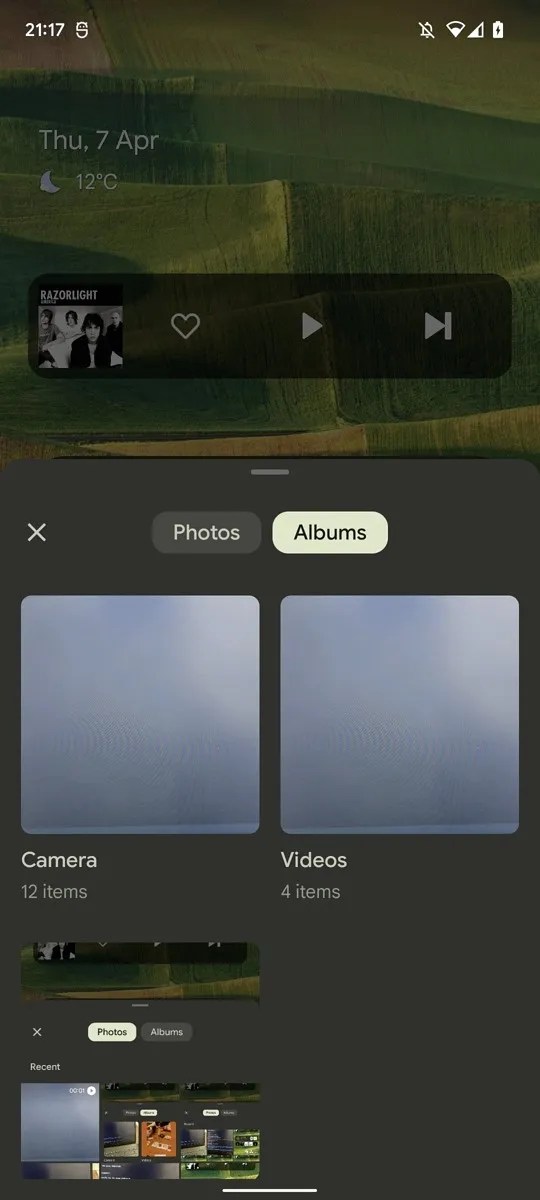
Photo Picker API

The new Photo Picker API is an extension of Google’s already-existing document picker. It works by leveraging the Android system to select documents on the device that are then selectively shared with the app in use, rather than the app having wider storage access to the files on the device itself. This way, an app can access photos or videos on your phone while also not having wider access to the rest of your phone. Photo Picker is also rolling out to older Android devices through a Google Play services update.

What we’ve shown above isn’t all that’s new, but they’re some of our favorite features so far. We’ve documented everything you can expect to find in Android 13 already, and it covers everything that we found in each beta and developer preview.

Which Google Pixel phones are getting upgraded to Android 13?

  • Google Pixel 4/4 XL
  • Google Pixel 4a/4a 5G
  • Google Pixel 5/5a 5G
  • Google Pixel 6/6 Pro/6a

If, for whatever reason, you don’t receive the update once it starts rolling out, or you don’t want to wait for Google’s rollout of the update, then you can manually install it. If you’ve unlocked the bootloader of your device, you can manually install the device OTA image or factory image, or use Google’s web-based Android Flash Tool to automate the process. In any case, download the Android 13 image for your device, and then you can install it too.

When will other phones get the Android 13 update?

Since Google’s major OEM partners have already had pre-release access to the source code, their engineers have already begun the process of forking the OS to add custom features and UI tweaks. Smaller OEMs, independent developers, and other entities without pre-release access can today take a look at the Android 13 source code to analyze or rebase their work on top of the new release. Unfortunately, we can’t offer a definitive timeline for when every OEM will release an Android 13 update for their devices, but we can list some of the devices we suspect will get the update soon based on whether or not a beta update has already been made available.

  • Samsung Galaxy S22/S22 Plus/S22 Ultra
  • OnePlus 10 Pro
  • Asus Zenfone 8
  • Lenovo Tab P12 Pro
  • Nokia X20
  • OPPO Find X5/Find X5 Pro/Find N
  • Realme GT 2 Pro
  • Sharp Aquos Sense6
  • Tecno Camon 19 Pro 5G
  • Vivo X80 series
  • Xiaomi 12/12 Pro/Pad 5
  • ZTE Axon 40 Ultra

Of course, we don’t know exactly how close each OEM is to releasing a stable update for these devices, but we know some are very close.

Samsung, as always, is doing its own thing. The company announced its One UI 5 beta a while back, but then randomly dropped the beta in select countries without any warning. The first One UI 5 beta has a ton of cool changes that we outlined in our hands-on.

In Google’s announcement post, the company confirms that devices from “Samsung Galaxy, Asus, HMD (Nokia phones), iQOO, Motorola, OnePlus, Oppo, Realme, Sharp, Sony, Tecno, Vivo, Xiaomi and more” will be receiving the update “later this year”, though it’s unclear if that refers to a stable update or a beta release.

Looking to Android 14 and beyond

With this release, Google will now set sights on Android 14 — and beyond. We don’t know what to expect really, aside from the fact that its codename appears to be “Upside Down Cake“. It’s not clear yet if the company will be working on an interim release à la Android 12L, but we’ll have to wait and see.

African Liquefied Natural Gas Makes Sense For Europe, Now And Going Forward By NJ Ayuk

0

In the months since the European Union declared it would reduce its reliance on Russian oil following that country’s invasion of Ukraine, there’s been a lot of talk about the new opportunities this moment is creating for Africa’s natural gas industry. I myself have been part of that conversation, and I stand by my past statements.

Africa’s capabilities are considerable, as the African Energy Chamber (AEC) makes clear in our State of African Energy Q2 2022 Report.

What’s more, certain developments within Europe are putting African natural gas producers in a stronger position than they have been in before with respect to being able to fight for— and win — a larger market share. Quite simply, there are gaps in the European gas market that weren’t there in the past — gaps that urgently need to be filled. The existence of those gaps means that there’s more room for African gas now than there used to be, particularly liquified natural gas, which is easy to store and transport. As our report notes, 50% of the 2022-25 cumulative gas flows from Africa’s top-10 producers are expected to be exported as LNG.

And, the interest in African LNG is not likely to be a momentary blip. Going forward, new technologies and shifting geopolitical conditions should make it easier for African producers to maintain market share in Europe.

In short, things are changing.

More Room in The Market Right Now

For decades, Russia was the EU’s single largest provider of gas, delivering at least a quarter to a third of its total consumption. According to International Energy Agency (IEA) data, the figure was even higher in 2021, when it supplied 155 billion cubic meters (bcm) of gas, equivalent to 45% of total imports and 40% of total consumption.

The numbers for 2022 are bound to be different. The volume of Russian gas flowing into European markets started going down significantly not long after the start of the war in Ukraine. In April 2022, the share of Russian gas in total EU imports was reported to be 31%, down from 45% in April 2021. There’s no reason to believe the number has gone back up since then, since April was the last month that Russia was willing to accept payment from most EU customers in U.S. dollars or euros instead of using special ruble-denominated accounts that are subject to sanctions. Indeed, ever since Russia’s new payment requirement has taken effect, European customers have had to learn to live with abrupt cut-offs or reductions in pipeline gas deliveries, with their Russian supplier Gazprom citing payment difficulties or failure to resolve technical problems as reasons for the disruptions.

Since the end of April, these kinds of cut-offs have happened to Poland and Bulgaria, they’ve happened to Finland, and they’ve happened to Germany and all the other countries served by the Nord Stream I network. More cut-offs are likely before the end of the year, and no one knows exactly how much they’re going to affect the total volume of Russian gas shipments to Europe. The upshot, though, is that in 2022 the volume of delivered gasis sure to be quite a bit lower than the 2021 figure of 155 bcm.

And that’s where African gas starts to come into the picture.

If the EU doesn’t have enough Russian gas this year, it will have to make up the deficit somewhere else in order to endure the next heating season. And in part, it’s been trying to do so by importing more LNG from established large-scale producers such as the U.S. and Qatar. The EU has also been buying more LNG from smaller-scale producers such as Peru. But it’s also reached out to gas-producing states in Africa. Italy, for instance, has negotiated the purchase of additional gas from Algeria in 2022 and is also looking to buy more gas from Egypt and Angola in the short term.

More Room in The Market for The Years to Come

And European buyers aren’t just treating African gas as a quick fix — as something to cover the gap for the time being. Italy expects Algeria to keep supplying extra volumes beyond 2022, and it’s also talking to Angola, Egypt, and the Republic of Congo about more extensive deals. Germany is looking to cement ties with Senegal in light of that country’s future gas production, which is on track to start next year. The EU has signed a trilateral memorandum of understanding (MoU) with Israel and Egypt in the hope of boosting future gas imports from the Eastern Mediterranean region.

What’s more, the EU has sent Matthew Baldwin, the European Commission’s deputy director-general for energy, to Nigeria to discuss the possibility of increased gas supplies. Baldwin, who leads the EU’s Energy Platform Task Force (EPTF) — set up in May 2022 to help cut Europe’s dependence on Russian oil and gas — waxed enthusiastic about Nigeria’s contribution to the EU’s gas supply in an exclusive interview with Premium Times. He noted that the West African country already accounted for 14% of the EU’s LNG imports, suggested that the figure might rise to 30% or more in the long term, and described Nigeria as a supplier that European gas buyers could count on.

“We need more gas from Nigeria as a result of the terrible war of aggression Russia has mounted on Ukraine,” Baldwin declared. “We can no longer count on gas coming from the Russian Federation, and we want to build a new partnership with countries like Nigeria with whom we have an already well-established partnership to obtain more gas and LNG from you on good commercial terms.”

The Window of Opportunity Will Remain Open

It is somewhat tempting to meet these statements with skepticism, given that the EU has talked about gas supply diversification for more than 20 years and has done relatively little to make that diversification a reality. Yes, Brussels has supported initiatives such as the Southern Gas Corridor (SGC), which began delivering gas from Azerbaijan to Italy in 2020. However, in the time it took to bring that project to fruition, Gazprom managed to plan one larger pipeline across the Black Sea (South Stream), scrap that plan, draw up a plan for another larger pipeline (TurkStream), and then execute that plan, all while working on an even bigger subsea pipeline to Germany, Nord Stream 2.

I believe, however, that such skepticism would be misplaced at this time. The EU is no longer working in a context where the benefits of supply diversification are theoretical and abstract; it’s now a concrete and immediate matter. For policy reasons, the EU wants to deny Russia access to revenue from gas sales and strip its status as a normal commercial partner. For practical reasons, European gas buyers need to find a way to make up for the supplies missing from Russia. And for both policy and practical reasons, Brussels wants to deny Moscow the opportunity to continue using gas supplies as a blunt instrument with which to threaten Europe in the future.

The change isn’t going to be immediate. It will take time to reduce Russia’s profile in the EU’s energy mix. But the process of supply reduction is underway, and it has already opened up new opportunities for African gas producers to acquire market share in Europe. I expect those opportunities to last beyond the near term, as the EU attempts to establish a new combination of gas suppliers to replace Russia over the next few years.

I also hope Africa’s emerging gas producers take advantage of new LNG technologies such as the modular Fast LNG solutions offered by New Fortress Energy (NFE), a U.S.-based company, to meet European demand for gas. With these technologies, they won’t have to wait as long or spend as much money to begin producing the LNG that European consumers are clamoring to buy. They can start in two years or less, rather than waiting five years or more, as is common with more conventional onshore projects.

Between these new technologies and the EU’s new policy stance, the African gas sector is likely to look very different within just a few years. I encourage you to read the State of African Energy Q2 2022 Report and find out more for yourself.

NJ Ayuk, Executive Chairman, African Energy Chamber (www.EnergyChamber.org)

Prince Holding Group Chairman Chen Zhi Recognized Once More as Entrepreneur of the Year

PHNOM PENH, CAMBODIA – Media OutReach – 17 August 2022 – Prince Holding Group’s Chairman, Chen Zhi, bagged a Gold Stevie® Award in the Entrepreneur of the Year – Conglomerates category for the second consecutive year at the prestigious 19th Annual International Business Awards®. The Group also secured Bronze Stevie® Awards for Company of the Year categories and COVID-19 Most Valuable Corporate Response. The Group has secured a record haul of ten awards this year.

What The Birth Of NNPC Limited Means For Nigeria’s Oil And Gas Industry

Recall that the Nigerian government recently made an official announcement confirming the complete transformation of the Nigerian National Petroleum Corporation (NNPC) into NNPC Limited.

NNPC LTD is a brainchild of the Nigerian Petroleum Industry Act (PIA) which was passed into law in August 2021 [1]. The NNPC was a state-owned and controlled corporation licensed to operate in the country’s petroleum industry which utilized the country’s fossil fuel and natural gas reserves by partnering with foreign oil companies.

The new NNPCL, while still wholly owned by the State, is intended to operate as a fully commercial venture without government funding (besides the initial capitalization) or control and is expected to be regulated by the Companies and Allied Matters Act 2020 [2]. In addition, NNPCL will now declare dividends to shareholders while retaining 20 percent of profits to grow its business [3].

NNPCL is expected to sometime in the future [4], invite the public to purchase shares to raise equity capital for the business of the company especially as it would no longer have access to state funds in line with the objective to commercialise the corporation.

It is also expected that NNPCL would eventually achieve trading status on global stock exchange markets like its counterparts, including Saudi Arabia’s Arabian American Oil Company (ARAMCO) Brazil’s Petróleo Brasileiro (Petrobras) to name a few. NNPCL will also no longer be concerned with issues of petrol pricing and subsidy, neither will it continue to remit funds into the Federation Accounts Allocation Committee (FAAC) such that the company funds can be used to further its business rather than issuing national payouts.

Yet, while the introduction of the NNPCL promises to be advantageous to the country’s energy industry, realistically speaking, there are certain challenges that need to be promptly and properly addressed for the new NNPCL to function effectively and achieve its objectives. To mention a few, continued government influence, NNPC’s transfer of liabilities to NNPCL, corporate governance issues are at the top of concerns.

Government influence concerns

Unlike its state-owned counter parts Saudi’s Aramco and Petrobras of Brazil, the former NNPC had a structure that largely depended on government funding thus making it less competitive and less attractive to global investors especially International Oil Companies (IOCs) who were uncomfortable doing business with the Corporation due to fears of undue government influence, grotesque policies and unnecessary bureaucratic delays. While the new NNPCL is promised to be fully independent of government control, it remains wholly owned by the government and its initial capital will be completely provided by the government per the provisions of the PIA [5]. Section 53(5) of the PIA also provides that all shares of the company held by the government will not be transferable or mortgaged unless approved by the government and the National Economic Council. To own is to control in any business enterprise so it is unclear how government influence would be avoided in NNPCL when it is wholly owned and capitalized by the government. A better approach would be to provide for a mechanism that splits the shares between the government and the public in a particular ratio such that while the government may understandably retain controlling shares to protect national interest [6] there are checks and balance measures in place to avoid arbitrariness.

Furthermore, the PIA incorporates an automatic transfer of all existing employees under the former NNPC into the new NNPCL with no vetting procedure for these employees in place. Section 57(1) under discuss states as follows:

Upon incorporation of NNPC Limited under section 53 of this Act, employees of NNPC and its subsidiaries shall be deemed to be employces of NNPC Limited on terms and conditions not less favourable than that enjoyed prior to the transfer of service and shall be deemed to be service for employment related entitlements as specified under any applicable law.

This means that NNPCL will have substantially the same employees as the former NNPC which is tantamount to pouring new wine into old wineskins. It is understandable that the law makers were wary of leaving the employees of the former NNPC redundant upon the transition. However, the automatic retention of former NNPC staff is counterproductive because NNPCL essentially inherits its all of its predecessor’s employees, some of whom are controversially unqualified and redundant thereby stunting its growth potential.

The PIA goes further to provide for the appointment of a Board of the NNPCL whose appointment shall be done by the President of the country [7]. Another interesting provision is Section 58(2)(r) which provides that the Board should among others consist of ‘six (6) non-executive members with at least 15 years post-qualification cognate experience in petroleum or any other relevant sector of the economy, one from each geopolitical zone’ effectively politicizing the appointment of these individuals to the board as opposed to appointments strictly based on merit. Perhaps realizing that the previous provisions on appointment to the new NNPCL Board may be inconsistent with the new NNPCLs  ‘no government influence’ mandate, the law makers included a proviso in Section 58(5) stating that the provisions of the section would only apply where NNPCL remains wholly owned by the government after which the composition would then be determined by the new shareholders after sale of shares to the public. This may appear to resolve the evident problem, however the shares of the new NNPCL will not be made available to the public until an unknown time in the future which is not specifically stipulated under the Act.

Although NNPCL’s Chief Executive Officer intimated that the company would be ready for an Initial Public Offering (IPO) mid 2023, this is not set in stone as factors such as governmental and bureaucratic delays in organization may extend this timeline. Afterall, it did take almost a year to fully effect the provision to incorporate the new NNPCL as opposed to the 6 months timeline stipulated in the PIA. In any case, even if there are no delays in the estimated timeline for the sale of shares to the public, the IPO process, appointment of new Board members and other corporate procedure could take months at the earliest to effect. This means that the NNPCL would still be run by old NNPC officials pending formalization of all corporate procedures thus making the new NNPCL ‘government’ run for at least the foreseeable future. Effectively, this results in NNPCL failing its first mandate as a fully commercialized company i.e to be free of government influence and control.

Transfer of liabilities

Another concern is the provision of the PIA which transfers liabilities from the old NNPC to the new NNPCL. This is provided for under Section 54(1):

the Minister of Petroleum and the Minister of Finance shall within 18 months of the effective date determine the assets, interests and liabilities of NNPC to be transferred to NNPC Limited or its subsidiaries and upon the identification, the Minister shall cause such assets, interests and liabilities to be transferred to NNPC Limited.

Further provisions of the section discuss issues of assets that would remain with NNPC or the government, actions that may be brought against NNPCL, NNPC or the government etc. However, the mechanism for the determination of which assets and liabilities would pass on to NNPCL and which would be dealt with by the old NNPC/Government are not stipulated in the PIA, leaving much to the discretion of the Minister for Petroleum and Finance with some assistance from the Attorney General of the Federation in peculiar circumstances. Section 54(2) states as follows:

Assets, interests and liabilities of NNPC not transferred lo NNPC Limited or its subsidiary under subsection (1), shall remain the assets, interests and liabilities of NNPC until they become extinguished or transferred to the Government and six months following the determination under section 54 (1) of this Act, the Minister, the Minister of Finance and the Attorney-General of the Federation shall develop a framework for the payment of the labilities not transferred to NNPC Limited and if such determination for which assets, interests and liabilities to be transferred has not been concluded within the stipulated period of 18 months, all the assets, interests, liabilities of NNPC is deemed to be transferred to NNPC Limited after 18 months from the effective date.

A spruce way to deal with the inherited assets and liabilities from NNPC would have been to make provision for the creation of an SPV to specifically deal with these issues, especially with respect to the liabilities rather than burden the NNPCL with the old NNPC’s mammoth liabilities in its formative years when it should be focused on its growth. It is hoped that the Ministers would devise suitable mechanisms to deal with these in the most efficient and least invasive way possible.

Corporate Governance considerations

As a corporate entity, NNPCL will be governed by Nigeria’s corporate laws as enshrined in the Companies and Allied Matters Act (CAMA). Of particular importance are some of the corporate governance principles contained in CAMA which are there to ensure international best practice in the day-to-day operations of Nigerian corporations including provisions on separations of the role of Chairman and Chief Executive Officer, appointment of Independent Directors, limitation of multiple directorships, disqualification from appointment as a director, disclosure provisions among others. It is expected that upon the IPO of NNPCL, it would become a Public Limited Liability Company (Plc) and thereby subject to more stringent corporate governance and disclosure policies even beyond the statutory requirements under CAMA [8].

Some of the corporate governance sections under CAMA include provisions which state that every public company must have at least three (3) independent directors appointed in line with the required qualifications stipulated; [9] Directors may not serve on the board of more than five (5) public companies at a time; disqualified directors now include directors that were removed from the Board; [10] and attendance of Board meetings is now a factor for re-election [11]. On its disclosure obligations, NNPCL is expected to ensure that information on the Memorandum and Articles of Association of the company is accessible to the public and potential investors. The shareholding structure [12], shareholders [13], authorized share capital, exact date of incorporation e.t.c all need to be fully disclosed to the public to ensure compliance with the provisions of the PIA and CAMA. Records of the minutes of the meeting where the first directors are appointed, board resolutions for the nomination of the Chairman e.t.c all need to be public knowledge to ensure complete transparency and fulfil all international best practice disclosure obligations.

Worthy of note is Section 60-63 of the PIA which attempts to cater for some corporate governance concerns of the new NNPCL. However, the provisions seem to be merely advisory and no liabilities are imposed for any failure to carry out such responsibilities. Thus, recourse is to be had to CAMA and its regulatory body, the Corporate Affairs Commission (CAC) for the enforcement of these provisions in addition to the provisions of CAMA.

Conclusion

On the whole and having considered some salient issues with respect to the new NNPCL, there are some who believe that the transformation of the NNPC into NNPCL is merely a name change and that there would be no material difference from the old structure especially as the NNPC has operated as a highly institutionalized corporation for the last 45 years. Whether they are right or wrong, only time will tell.

However, it is important to remain optimistic that with the right corporate administration, NNPCL can create an environment that would not only grow the country’s economy but also attract both local and foreign investment thereby making it a major player in the global energy market.


[1] Section 53(1) of the PIA states that ‘The Minister shall within six months from the commencement of this Act, cause to be incorporated ender the Companies and Allied Matters Act, a limited liability company, which shall be called Nigerian National Petroleum Company Limited (NNPC Limited)’
[2] Section 64 of the PIA lists the objectives of the NNPCL.
[3] Section 53(7) of the PIA
[4] NNPCL’s Chief Executive Officer at the official announcement of the new NNPCL intimated that the company would be ready for an Initial Public Offering by mid 2023. Retrieved from https://bit.ly/3c1Hk1V on August 1, 2022.
[5] Section 53(2-4) of the PIA states that ‘The Minister shall at the incorporation of NNPC Limited, consult with the Minister of Finance to determine the number and nominal value of the shares to be allotted, which shall form the initial paid-up share capital of NNPC Limited and the Government shall subscribe and pay cash for the shares (3) Ownership of all shares in NNPC Limited shall be vested in the Government at incorporation and held by the Ministry of Finance Incorporated and the Ministry of Petroleum Incorporated in equal portions on behalf of the Federation and the Ministry of Petroleum Incorporated is incorporated under the provisions of the Eighth Schedule to this Act (4) The Ministry of Finance Incorporated and the Ministry of Petroleum Incorporated in consultation with the Government, may increase the equity capital of NNPCL.
[6] Section 1 of the PIA provides that the property and ownership of petroleum within Nigeria and its territorial water, continental shelf and exclusive economic zone is vested in the Government of the Federation of Nigeria.
[7] Section 58(2) of the PIA.
[8] That is, Nigerian Code of Corporate Governance (NCCG) issued in 2018 by the Financial Reporting Council of Nigeria (FRCN) and the Securities Exchange Commission Guideline’s (SCCG) and revised reporting template issued in 2021.
[9] Section 275 of CAMA 2020.
[10] Section 283(c) of CAMA 2020.
[11] Section 284(2) of CAMA 2020.
[12] In compliance with section 53(2) which provides that The Minister shall at the incorporation of NNPCL consult with the Minister of Finance to determine the number and nominal value of the shares to be allotted, which shall form the initial paid-up share capital of NNPCL and the Government shall subscribe and pay cash for the shares.
[13] In compliance with Section 53(3) of the PIA which states that ownership of all shares in NNPCL shall be vested in the Government at incorporation and held by the Ministry of Finance Incorporated and the Ministry of Petroleum Incorporated in equal portions on behalf of the Federation and the Ministry of Petroleum Incorporated is incorporated under the provisions of the Eighth Schedule to this PIA.

Averting An African Food Crisis: The African Emergency Food Production Facility By Dr. Akinwumi Adesina

It didn’t take long for Russia’s war in Ukraine to impact Africa. Already grappling with soaring inflation and still recovering from the Covid-19 pandemic, Africa now faces a shortage of at least 30 million metric tons of food—especially wheat, maize and soybean imported from Russia and Ukraine.

Fertilizer price hikes of over 300% make it increasingly difficult for African farmers to grow enough wheat, maize, rice and other crops. A growing number of people in Africa can no longer afford the price of bread.

Africa is struggling to mitigate a conflict-induced famine that could throw some 30 million Africans into catastrophic levels of food insecurity. It could deepen economic stress, and political unrest. With millions struggling to buy food, fuel and fertilizer, anti-government protests are a real possibility.

From the onset, the African Development Bank realized the strategic need to tackle the devastating impact of the war on Africa’s food security. It was important to prevent unrest and even more human suffering. In May, the Bank established a $1.5 billion African Emergency Food Production Facility. In less than 60 days, it put into action $1.13 billion-worth of programs under the facility, and across 25 African countries. Half a dozen more programs are expected to get underway by September as more governments apply to the facility.

The African Emergency Food Production Facility will deliver climate-adapted, certified wheat and other staple crop seeds—and increased access to agricultural fertilizers—to 20 million farmers. Over the next two years, the facility will allow farmers to produce 38 million additional tons of food—a 30% increase in local production—worth an estimated $12 billion. To facilitate even greater global investment in Africa’s agricultural sector, the facility will also support enhanced governance and policy reforms.

While this is a strong start, Africa needs the international community to fill a $200 million financing gap for the facility. President Joe Biden has endorsed the African Emergency Food Production Facility, and this is welcome support, as is his support for the African Development Bank’s Africa Disaster Risk Financing Program.

To help African governments pay drought and flooding insurance premiums and respond better to food insecurity caused by climate change, the Disaster Risk Financing Program, is a much-needed futures element of the Facility.

To boost agricultural production in Nigeria, Tanzania and Côte d’Ivoire, the Japan International Cooperation Agency has recently partnered with the African Development Bank to co-finance African Emergency Food Production Facility programs. International development agencies and a growing coalition of nations are also supporting the Africa Emergency Food Production Facility.

Launched in 2018, the African Development Bank’s successful flagship Technologies for African Agricultural Transformation (TAAT) program is delivering technologies in the form of climate-resilient crop varieties—seeds that are resistant to drought, high temperatures or pests, for example.

In Ethiopia, thanks to TAAT-funded, heat-tolerant wheat seeds, the country boosted cultivated farmland from 50,000 hectares to 675,000 additional hectares in just four years. TAAT’s climate-smart seeds allow the wheat crop to thrive in Ethiopia’s arid, lowlands where ordinary wheat varieties do not generally do well.

More locally grown wheat has reduced Ethiopia’s dependence on wheat imports. By embracing TAAT, the country did not need to import wheat, for the first time, this year. With the Bank’s continued support, Ethiopia will become a wheat exporter in 2023. It will export more than a million metric tons of wheat to Kenya and Djibouti. That is enough food to feed 10 million people for 12 months.

The African Development Bank knows what works.

TAAT has already reached 12 million farmers. We are calling on our international partners and governments to join us as we scale up TAAT through the new African Emergency Food Production Facility.

Our commitment to helping Africa grow more food by adapting to climate change has earned the support of UN Secretary General António Guterres, who recently said the Bank’s allocation of half of its climate finance to adaptation is the standard for international development partners to follow. The US Department of the Treasury has endorsed the African Emergency Food Production Facility as part of the International Financial Institution Action Plan to Address Food Insecurity—a shortlisted guide of programs for donor nation consideration.

Africa does not need food aid to feed itself. Africa needs right investments and seeds in the ground.

The Africa Emergency Food Production Facility will provide an immediate solution to twin global challenges of conflict and climate change, and play immediate, medium and long-term roles in growing Africa’s agriculture sector as a foundation for resilient African economies.

Policy reforms will help trigger structural reforms needed for market-based input distribution and to produce crops more competitively.

Today and well into the future, the African Development Bank is delivering a proven plan to unlock Africa’s food production potential and see Africa become a breadbasket to the world.

Dr. Akinwumi A. Adesina is President of the African Development Bank Group