Uber drivers protest against 40% fare reduction

Uber drivers in Lagos yesterday took to the street to protest against 40 per cent fare reduction that the taxi service company introduced recently, a burden, which they claim is being passed on to the drivers.

“I spent N50,000 on fuel last week and UBER paid me just N80,000 when I was supposed to get double of that amount,” one of the drivers said.. The protest started with a peaceful walk from the National Stadium in Surulere yesterday morning, down to the company’s office in Lekki. The drivers claimed the firm, which launched its smartphone technology in Lagos as the fourth city in Africa to embrace the innovative scheme in July 2014, was being unfair to the drivers’ welfare.

With placards calling for halt to the current promo, reduction in fee to 10 per cent, proper verification and adequate security measures, one of the drivers, Olugbenga Steaven, said: “Uber doesn’t give drivers any car, it doesn’t buy fuel or maintain any vehicle, yet it takes 25 per cent of the driver’s earning.”

It would be recalled that an UBER driver was allegedly strangled to death in Lagos last month while his Kia Rio salon registration number KTU 594DM was purportedly stolen. Also, at the weekend, policemen foiled an attempt to rob an UBER driver at Oshodi.

Samantha Allenberg, who handles communications for the taxi firm in Africa, said the protest was caused by a lack of communication. “The 50 per cent off marketing promotion was entirely at the cost of UBER. Driver-partners did not have to pay for this promotion. Should any driver-partner have any questions or concerns about this campaign, they are welcome to contact us via our support channels.”


(GuardianNg)

Champion Breweries grows profit, market appreciates

Champion Breweries Plc grew its operating profit by 199 per cent for the 2016 financial year. The brewer said it was reaping from the performance of its portfolio, as the company recorded relative profit-propelled growth in its just-concluded financial year which ended on December 31, 2016.

Its operating profit grew from N207m recorded in 2015 to N618m.

The Chairman of the company, Dr. Elijah Akpan, while speaking at the company’s 41st Annual General Meeting in Lagos, said Champion Breweries recorded a substantial improvement in its trading results in the year under review compared to previous years.

“The trading results of the year under review shows substantial improvement compared to previous years. Revenue increased to N3.9bn from N3.5bn in 2015, The profit before tax was N637m as compared to N210m in 2015.”

Meanwhile, the Nigerian Stock Exchange market capitalisation appreciated to N9.132tn on Monday from N9.069tn as 267.637 million shares worth N3.257bn exchanged hands in 3,907 deals.

The NSE All-Share Index closed at 26,418.33 basis points from 26,235.63 recorded at the close of last week. The market recorded 26 gainers and 13 losers.

Naira hits 400/dollar on CBN’s investors FX window

The naira traded at 400 to the United States dollar in deals for investors on Monday, traders told Reuters, two weeks after the Central Bank of Nigeria introduced the Investors FX Window

The window was designed to allow investors, trade in the currency at market-determined rates.

Trading sources said investors were demanding rates above N400/dollar while locals were quoting rates as low as N350/dollar.

The sources said traders held a conference call last Friday with market regulator FMDQ OTC Securities Exchange to discuss the wide range of quotes on the naira for investors, although the meeting did not produce any resolutions.

FMDQ provides daily opening and closing quotes on the naira.

Traders, worried about illiquidity in the currency market despite making the exchange rate market-determined for investors, said no resolution was reached at the meeting.

“We have done deals around N400/dollar levels,” one trader said, adding that, “Some of the off-shores investors are insisting on N400/dollar.”

The CBN had in April said it would allow investors to trade the naira at market-determined rates, a move intended to improve the dollar supply and attract foreign investors who bolted from Nigeria at the start of the latest naira crisis.

The move introduced yet another exchange rate to the five existing ones. Still, analysts doubted it would be enough to draw more hard currency into the economy.

Investors have questioned the over-the-phone trading system for lack of price discovery and transparency.

Diageo is quietly building a digital powerhouse to recalibrate its brands for younger generations

After fits and spurts Diageo is making a concerted push to move with the times via a self-proclaimed Centre for Digital Excellence which will seek to make sure its roster of global brands appeals to a fresh generation of drinkers.

Drinks giant Diageo is assembling an international team of specialists to “lead it to the edge of digital,” and push forward its global marketing capabilities across the 180 countries it advertises in.

In the past few months alone, the group behind Guinness, Baileys, Smirnoff and other household names has posted around 10 ads seeking marketers to work within or in partnership with its new Digital Centre for Excellence.

At present, the roles advertised are focused in the UK and APAC, but previous listings have indicated openings in the US for a head of digital tech innovation. Other current vacancies include: marketing technology partner, global digital tech director and social insights manager.

From the openings posted so far, it appears the digital powerhouse will focus on innovation and data. The global digital tech director will head up a specific digital technology unit, while in South East Asia a regional media manager will be tasked with working with local markets and agencies “to craft and activate solid media ecosystems” for the brand. In London, the social insights manager will leverage value from social data, as well as managing how insight is delivered from social listening.

The drinks behemoth has been quietly building up its digital taskforce over the past nine months. Last summer, it promoted Isabel Massey from head of media and futures for Europe to global digital director with a remit to lead the marketing arm the Digital Centre of Excellence. Just a few weeks later it tapped former iProspect executive Ben Sutherland as chief digital officer, then Nestle’s digital exec Gawain Owen was wooed into serving as its first programmatic head of media. Ex-Mondelez and Carat digital partner Jerry Daykin was next to jump ship, and was named as head of digital media partnerships.

“With an audacious ambition, the Digital Centre of Excellence has been created to lead Diageo to the edge of digital and push forward our global marketing capabilities across 180 countries and 29 category-leading brands,” reads the blurb on the job descriptions.

A call for digital experts comes amid a more concerted push for the medium from the Irish-based firm across its portfolio in a bid to attract a younger, and more wide-ranging, audience.

In March, Diageo notably appointed R/GA as Guinness’ first digital agency of record with a brief to focus on online talkability, social reach and mentions. Some marketers have anticipated that a move towards social storytelling could help the 258 year-old brand broaden its appeal – but the need to do that isn’t a challenge faced by the Irish stout alone.

During the company’s 2016 earnings update in January, chief executive Ivan Menezes said that for the Smirnoff brand, a focus on recruiting millennials through activations centered around dance music helped stablise the vodka’s performance.

“There is more work to do however in recruiting and re-recruiting multicultural consumers as well as the Gen-X and baby boomer consumers, who are core to the consumer base,” he said at the time. To do this, Menezes said that on top of raising brand awareness, the group would use “targeted innovations” to promote the drink.

More recently, reports surfaced that Johnnie Walker was in early discussions with agencies about a mysterious digital project which Diageo said would have no bearing on Anomaly’s status as the whisky brand’s lead agency partner.

Menzes has told investors that in North America, the businesses’ largest and most profitable marketing, digital spend will be up fivefold in 2017as it continues its focus on the recruitment of millennial and multicultural consumers.

While there has been no official statement from Diageo on its new digital hub, the job postings hint that further digital evolution and a more refined approach is to be expected. A shift towards this follows on from the consolidation of its global roster of media agencies at the end of last year, which was orchestrated to deliver a “best in class” approach and incorporate its “data-driven” blueprint.

6 Insights Retailers Need to Drive Shopper Loyalty and Reduce Churn

0

Be sure to analyze all angles when considering shopper loyalty.

With a global turnover of $27 trillion projected by 2020, it’s no wonder why CRO (conversion rate optimization) is possibly the most measured action of eCommerce retailers. And since the average conversion rate for eCommerce continues to hover at 1.33 percent, according to Compass, any added advantage that leads to understanding shopper behavior can increase those conversions significantly.

Advanced behavioral analytics offers businesses this added advantage by collecting, storing, enriching and analyzing raw user data over time. This makes it possible for patterns to be revealed that lead to better insights of shopper loyalty, which businesses can use to drive higher engagement and reduce churn.

Here are six behavioral analysis tips that can help retailers get more insight into shopper behavior:

1. Analyze cart abandonment to encourage shoppers to purchase

The moment a shopper adds an item to their cart is the moment that makes or breaks them as a customer. Either they continue to purchase the item or they abandon their cart. The more a retail site understands about the process that led a shopper to abandon their cart, the greater the likelihood to drive higher conversions.

For example, shoppers may tend to add items to their cart a few days after abandoning, perhaps as a response to an email marketing campaign they received. Additional large groups of purchases a number of days after cart abandonment can reveal more insights into customer behavior and encourage further optimization.

2. Identify which retail items are the most popular

Beyond cart abandonment, a high-level report of the top 10 items shoppers add to their cart can give insight into the types of items shoppers are interested in purchasing, especially in comparison with items they may simply be browsing (i.e. luxury items they wish they could purchase). Businesses can also learn a lot about shopper behavior by analyzing the retention rate of shoppers who tend to purchase the most popular items. Retailers may find, for example, that loyalty is higher among shoppers who purchase luxury items.

3. Learn to spot the difference between lookers and browsers

While certain items might be popular because shoppers tend to purchase them, others may be popular because shoppers may tend to continuously view them. Shoppers may be likely to continuously view items that cost over a certain amount of money before purchasing them, since this is part of the consideration stage of the customer journey. Other shoppers may view items over a certain amount and never purchase them, since they are cautious shoppers, and the items are over their budget, for the time-being.

4. Examine shopper retention from a different angle

Retail businesses are constantly measuring shopper retention to learn what drives shoppers to repeatedly return to purchase on their site. Beyond simple cohort analysis of campaigns, for example, retailers can also examine retention of shoppers according to shopper type (VIP, first-time purchasers, occasional purchaser) or according to a particular behavioral segment.

For example, focusing on the “frequent shoppers” segment according to the different times they registered to the website can shed deep insight into shopper behavior, helping retailers optimize these shopper registrations in the future.

5. Path analysis of shoppers

What was the most popular path of shoppers? Did they mostly browse within one department or move between different departments? Did they add items to their cart after browsing each department, or did they wait until they were finished to add items to their cart and immediately purchase? Understanding the past behavior of shoppers allows retailers to offer effective next-best offers at the right time and increase loyalty and engagement in the future.

6. Examine the exit events of shoppers

Similar to understanding what drives shoppers to purchase, retailers also need to know what drives shoppers to churn or leave the site temporarily. Was it a better offer from another retailer? Was the offer delivered at the wrong time or to the wrong shopper segment? The ability to examine the last three steps shoppers took before exiting the site, for example, can offer deep insights into why shoppers didn’t complete their purchase. With these insights, retailers can adjust their offers or prices in response to their shopper behavior.

A golden opportunity not to be missed

Shopper behavior is dynamic, and it is crucial for retailers to be able to constantly monitor it from all angles. The ability to see sudden changes in behavior at a certain time for a specific campaign, and adjust accordingly, can mean a significant increase in revenue, and often, an edge over the competition. Behavioral analysis enables retailers to keep their finger on the pulse of their shoppers so they won’t miss this golden opportunity.

About the Author:
Guy Greenberg is the Co-Founder & President at http://www.cooladata.com/, a leading behavioral analytics platform. Before founding Cooladata, he was the co-founder and CEO of Gilon Business Insight, which was acquired by Ness Technologies in 2010. At Ness Technologies, Guy served as Senior Vice President for Global BI and Big Data, where he worked with some of the largest corporations in the world. With over 20 years of experience in big data and startups, he is an active angel investor and adviser of several Big Data startups. http://www.cooladata.com/

EXCITEMENT, ANTICIPATION AS ARIYA REPETE STORMS LAGOS, ADO-EKITI

Aspiring Fuji and Juju artistes in Lagos and Ado-Ekiti have expressed excitement and enthusiasm as Ariya Repete, the biggest Yoruba music talent hunt show storms both cities on Wednesday, May 10th, 2017 to discover new artistes in both genres.

Audition in Lagos holds at Marblefield Hotel and Event Centre in Oshodi while Midas Arena, Midas Avenue will play host to artistes in Ado-Ekiti.

Local artistes in both cities are already warming up to avail themselves of the opportunities presented by the talent hunt platform.

Tajudeen Usman, an aspiring Juju artiste based in Lagos revealed that he intends to storm the audition with great optimism. “I have been looking for an opportunity like this to express myself musically, especially in Juju music,” he said.

He further expressed his excitement and lauded Goldberg and Nigerian Breweries Plc for the inclusion of Juju music in the talent hunt show “which will represent the entirety of Yoruba culture through music,” he said.

Explaining the rationale behind the talent hunt platform, Emmanuel Agu, Portfolio Manager, Mainstream Lager and Stout Brands, Nigerian Breweries Plc explains that “the brand seeks to discover new talents in the two indigenous Yoruba music genres, which will in turn promote the culture and tradition of the people of South West Nigeria,” he said.

Winners in both category would get One Million Naira and a recording deal.

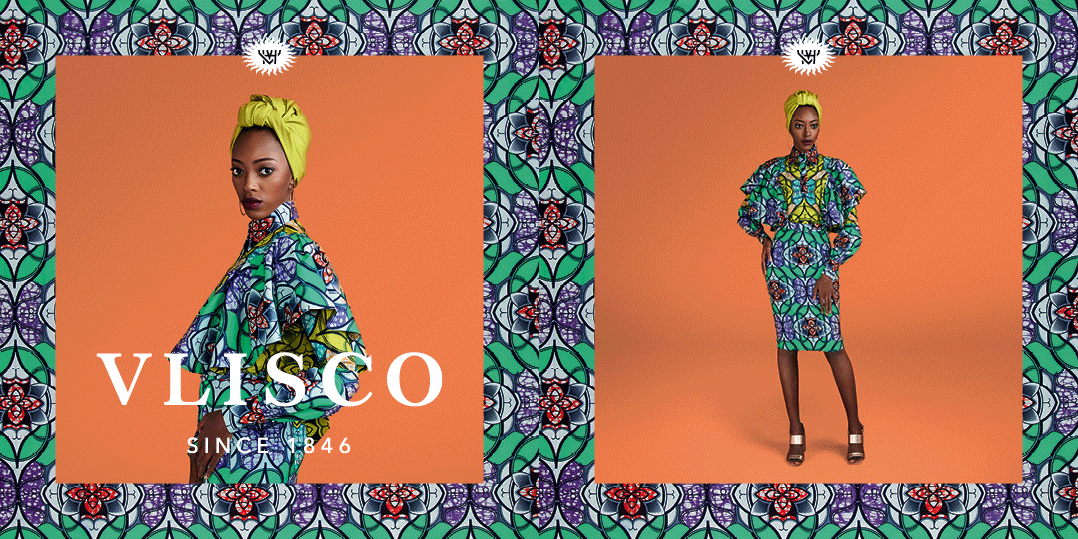
Vlisco Ramadan Campaign: Here’s Your First Look at the Campaign featuring Fatima Togbe as New Brand Ambassador

The Vlisco Ramadan campaign is here, starring Founder of Hayati Magazine, Fatima Togbe as one of the new Vlisco brand ambassadors for the year.

This year, they have decided to tell their story through women and the unique ways they express themselves through Vlisco fabrics.

Ariya Repete: Ten Artistes Selected for Quarter Finals in Osogbo, Abeokuta

A total of ten contestants, five each from Osogbo and Abeokuta, have made it to the quarter finals in the ongoing Ariya Repete, a talent hunt competition for Fuji and Juju music in the South-West.
 
The auditions that produced the winners were held in Osogbo and Abeokuta on May 3 and 5, 2017, respectively. 
 
In Oshogbo, three Fuji and two Juju artistes were selected while the reverse was the case in Abeokuta where three Juju and two Fuji contestants were chosen for the quarter final stage.
 
The Fuji artistes selected in Osogbo are Jimoh Azeez, lsmail Eriki and Wasiu Onilewura, while those from the Juju category were Leye Williams and Oluseun Adebayo. Those that made it at the selection party in the Juju genre in from Abeokuta are Alhaja Bukola Ahmed, Mayowa Ojo and Esther Iwalewa while Bolomope Saheed and Olajide Muiz qualified from the Fuji  genre. 
 
It was a night of fun as Antenna and Twinzobia, past Fuji t’o Bam winners and other artistes thrilled the audience with contemporary music from both genres. The judges also put up spectacular Juju and Fuji performances to the delight of guests. 
 
At the quarter finals slated for June 30th in Akure, winners from both cities will compete with others selected in Akure, Ibadan, Ilorin, Ijebu Ode, Ado Ekiti and Lagos. 
 
The semi-finals will take place on July 7th in Abeokuta with the grand finale scheduled for July 14th in Ibadan, Oyo State. In the quarter finals, artistes from the different locations would be reduced to 10 and this would be further pruned to five for the grand finale. 
 
 At the grand finale, a winner, each for Fuji and Juju will emerge with each clinching a grand prize of One million Naira (N1, 000,000) and a recording deal. 
 
Commenting on the initiative, Portfolio Manager, Mainstream Lager and Stout brands, Emmanuel Agu, said “the brand is using Ariya Repete to extend its drive to discover new talents in the two indigenous Yoruba music genres and the move is in line with its commitment to promote the culture of the people of South West Nigeria.
 
Ariya Repete, an initiative of Goldberg, from the stables of Nigerian Breweries Plc is an expanded music talent hunt platform that seeks to promote and develop indigenous Yoruba music that includes Fuji and Juju music genres.  

Understanding the Economics of Tourism in Nigeria

In most gatherings of experts in the travel & hospitality industry, tourism as a tool in diversifying the Nigerian economy has received the most attention and provoked lots of intellectual comments. This is not surprising at all considering the huge potential that this particular sector possesses.

In most developed and developing countries, tourism has enriched the economies of these countries thus becoming one of the major sources of income and a pillar of commerce. The decision to grow tourism into a consistent and sustainable means of income by these countries and to make it appealing to inbound and outbound tourists was not arbitrary, but rather deliberate and planned. Without a doubt, other countries like Nigeria are amazed to see the attendant economic implications this sector has birth.

We can achieve this feat or even better than these countries. We have an advantage: our population. In fact, if we can sell tourism to just Nigerians to a point where they can see the value proposition, it might become optional to sell to foreign tourists. Majority of the countries benefiting from tourism revenue such as Kenya, South Africa, Seychelles etc. do not have the kind of population density that Nigeria has. In fact, the total inhabitants of some of the countries only equal the total population of Lagos dwellers – which is over 20 million. So, we have the numbers, and the percentage of our population that has the purchasing power for tourism is above 30%, out of over 180 million Nigerians.

Nonetheless, influencing the government at the central to earmark some budget for the growth of this sector in the yearly fiscal budget might seem to be a herculean task. The reason is simple: we’re an oil-dependent economy. But the reality is hitting us hard in the face. The last few months have helped us as a country to reevaluate our sheer reliance on crude oil. Matter-of-factly, the government must have learnt a great lesson from the recession: dependency on one major source of income is bad for a growing economy like ours with a population that grows on an average of 2.3% yearly. We are yet to develop another sector to have little parity in terms of revenue being generated compared with the oil & gas sector. Exactly why we felt the pangs of the recession when it came through.

It’s very heartwarming to see that the government of the day is now tilting its focus towards expanding and developing other sectors that can ultimately support our mainstay. The recent comments of the Minister of Information, Culture & Tourism, Alh. Lai Mohammed at the Annual General Meeting (AGM) of the Nigerian Association of Tour Operators (NATOP) that is being led by Nkereuwem Onung, reassured all in attendance that tourism has now become a focal point for the government. According to the minister, policies at all levels have now been put in place to engender tourism growth. For instance, the committee on the Presidential Council on Tourism has been resuscitated. This is to engender the rapid development of the sector through policy directions. The committee will see to the implementation of the tourism roadmap and the festival calendar.

Also, policies on issuance of visas have been reviewed. Now, it will only take 48 hours to issue visas to foreign tourists who are interested in exploring our tourism sites. In addition, several partnership deals are being sought and relevant agencies involved in brokering the partnerships have since swung into action. Suffice to say, in the next couple of months, the narrative will no doubt be positive.

Something very interesting that the minister hinted on is the tripartite partnership involving the Ministry, the UN World Tourism Organisation (UNWTO) and global news leader, CNN. The objective of the partnership is to leverage on Nollywood to promote tourism in Nigeria. He described the move as a very strong and effective partnership – to use comparative advantage in film production through Nollywood – to promote tourism in the country. Although this is the first-of-its-kind partnership, the minister believes that this will push tourism from the back-burner to the mainstream of our economy. Promoting tourism through Nollywood is by far a great idea, considering it is one of our biggest exports to Africa and the world. So, there is no doubt that if well implemented and monitored, the impact will be great.

To make tourism profitable in Nigeria, there is a need for collaboration between the private sector and the government. The minister couldn’t have emphasized this more. In fact, government should only be involved at the initial stage of any tourism programme. For sustenance and continuity, it should be private sector led.

The former governor of Cross Rivers state, Dr. Liyel Imoke who was the guest speaker at the AGM used his state’s tourism success story as a case study to illustrate how to make tourism work within the Nigerian economic space. His hands-on experience added weight to his presentation. He cited the success of the Calabar International Festival which was created by his predecessor Donald Duke to buttress the claim that tourism has a higher chance of surviving and becoming the country’s mainstay. “With the right policy, vision, infrastructure, and attitude, tourism will become the country’s major revenue earner,” he said.

Two of the several challenges forestalling the growth of the sector are: duplicity of festivals & misrepresentation of Nigeria by Nigerians. Since the successful launch and continuity of the Calabar International Festival, we have witnessed the launch of similar carnival/festival in some states. For instance, there’s Abuja Carnival, Port Harcourt Carnival (Carniriv), Akwa Ibom Festival, and many more. While it is laudable to have these many festivals or carnivals, it’s important to verify the success rates of these festivals. It appears that Calabar Festival is still the only successful and consistent festival. It is indeed imperative for these festivals to be harmonized to stimulate patronage and reduce confusion associated with simultaneous holding of festivals in the country.

Lastly, fellow Nigerians, we too have a lot to do in consolidating the efforts of the various government parastatals in pushing the frontier of our tourism industry forward. Our major role will include representing and speaking well of Nigeria. This appears to be our greatest problem. We should stop running down our country especially those in diaspora. If we continue, foreigners – as much as we do not want to rely on their patronage – will be dissuaded from coming to visit our tourism sites. it’s crucial we start speaking well of our country.


Written by: Olukayode Kolawole

                      (Head of PR & Marketing for Jumia Travel, Africa’s number one hotel booking portal)

Standards Organisation of Nigeria Opens Seme Office

0

The Standards Organisation of Nigeria (SON) on Sunday inaugurated its Seme border office with assurance to intensify efforts at checking influx of substandard products into the country through land borders.

Director-General of SON, Mr Osita Aboloma, said at the ceremony that the new border office would strengthen the organisation’s surveillance at the land borders.

According to him, a sizeable amount of substandard products find their way into the country via land borders.

Aboloma said that the Seme office, near Badagry, was a product of a collaborative relationship between SON and other agencies, adding that some of the working tools were donated by stakeholders.

“All the departments of SON with different roles towards combating the influx of substandard goods are now here. We have our customer service, sampling and other departments here to serve Nigeria well.

“This is also part of our effort at creating an enabling environment for ease of doing business in Nigeria,” he said.

He promised that his organisation would continue to review and update its standards to ensure goods and services conformed to the minimum requirements of the Nigerian Industrial Standards (NIS).

The director-general said these steps were in line with the general retooling of SON targeted at efficient and enhanced service delivery.

He said, ‎ “Standardisation is a continuous process; we have to keep on renewing and updating some of them and we recently cleared a backlog of 114 standards to help people carry out their duties of production of goods and services efficiently.

“Also, very soon we will be reviewing standards for soft drinks, food and other related products.’’

Aboloma pointed out that emphasis in the agency’s bid to diversify Nigeria’s economy was by upgrading standards for agricultural products for export.

He said that the organisation was working on a product that would provide standards for Small and Medium Enterprises (SMEs) as a means of retooling the sector.

In his remarks at the inauguration, Deputy Comptroller, Nigerian Customs Service, (NCS), Mr Jubo Mohammed, commended the management of SON for establishing the facility.

Mohammed said that‎ the facility would help in reducing the influx of substandard goods into the country and enhance the collaboration between SON, NCS and other stakeholders in the interest of the nation’s economy.

“This will enable SON staff to conduct their duties in the most convenient way. I am assuring you of the cooperation of the NCS in achieving your mandate,” he said.