Power Supply to Nigerian Households Down by 7 Points In Quarter 1, 2017

0

New aggregated power poll results released by NOIPolls for the first quarter of 2017 revealed a decline in the state of power supply to Nigerian households to 30 percent in Q1, 2017 from the 37 percent obtained in Q4, 2016. The lowest power supply to households in Q1, 2017 was observed in the month of January 2017 at 21 percent. The drop was attributed to the shortage of gas to the power generating companies and low water levels at the hydro power stations. However, in February 2017, there was a surge in the power supply as it rose to 35 percent and it was also attributed to the increased amount of power supplied to the power generating companies.

For Q1 2017, the monthly average cumulative hours of power supply experienced was recorded as 7.5 hours in January which was the lowest, it went up to 9.8 hours in February which was recorded as the highest. The results obtained from the poll also revealed that for Q4, 2016, average daily power cumulative supply was 9.6 hours, while in Q1, 2017, it dropped to an average of 8.9 hours daily, indicating a 0.7-point decrease.

A cumulative power supply of 8.9 hours per day is a far cry from the standard 24 hours power supply which Nigerian households ought to be experiencing, thus further buttressing the issues inherent in Nigeria’s power sector. The Federal government had embarked on several power sector interventions in the past, which have failed to yield any sustained positive impact. Still in the bid to revive the power sector, the Federal Government in collaboration with the World Bank recently set out guidelines for the power sector recovery plans to create a viable sector that is privately run. While this is a welcomed strategy for the revival of the sector, it is imperative that the in the execution of the plan, constant evaluation with visible milestones within specific time frames are maintained. These are some of the key findings from the aggregated power sector poll conducted by NOIPolls for Q1, 2017. 

Background

It is no longer news that power generation and supply has continued to pose challenges to the economic and social lives of Nigerians. Although there are evidences of concerted efforts to make the power sector work at optimum level, the sector is still riddled with vast problems ranging from generation to distribution. Industry watchers have blamed majority of the crisis bedeviling the power sector on the monopolistic nature of the hydroelectric generating systems. Nigeria is blessed with diverse natural resources which developed nations use to generate abundant electricity but less attention has been paid to those options.

Nigeria is one of the least electrified nations and its current power generation, which continues to hover between 3,000 and 5,000 megawatts, cannot keep up with the population growth. According to a World Bank report, about 75 million Nigerians lack access to adequate electricity and Nigeria was ranked highest among the countries with electricity access deficit when energy access, efficiency and renewable are on the rise in many developing nations[1]. It is against this background that NOIPolls conducted its quarterly survey to assess electricity distribution to Nigerian households in the first quarter of 2017. 

Survey Findings

Nationwide Monthly Tracking of Power Supply

Monthly analysis of the state of power supply between January and March 2017 revealed that 35 percent of Nigerians reported an improvement in power supply to their household in the month of February. This state of power was maintained with a slight 1-point decline in March 2017 at 34 percent. Overall, the lowest power supply recorded in the first quarter of 2017 was experienced in the month of January, at 21 percent.

Monthly Tracking of Power Supply by Geo-political Zones

Results revealed that for Q1 2017, according to geo-political zones, the South-East region experienced the least improvement in power supply in January with 6 percent while the North-West region had the highest improvement in both February and March with 70 percent respectively.


Nationwide Average Quarterly Trend of Power Supply

Quarterly analysis of the state of power revealed 9 percentage point dip in power improvement in Q1, 2017 at 30 percent from Q4 2016 at 37 percent. Therefore, this result reveals a decline in power supply to households in the first quarter of 2017.

Nationwide Monthly Average Cumulative Daily Power Supply

February 2017 accounted for the month with the highest average cumulative daily power supply in the first quarter of 2017.  Nigerians surveyed confirmed that they had an average of 9.8 hours cumulative daily power supply in February, while the lowest average cumulative daily power supply in Q1, 2017 was seen in the month of January at 7.5 hours.

Quarterly Average Daily Cumulative Power Supply

On a quarter-to-quarter basis, the average daily cumulative power supply to households in Q1, 2017 declined to 8.9 hours when compared with the 9.6 hours obtained in Q4, 2016. This represents a 0.7-point decrease and shows that Nigerians enjoyed more power supply averagely in Q4, 2016.

In conclusion, these results show that despite decades of efforts by successive administrations to tackle the many challenges of electricity in Nigeria, they have yielded little or no sustained improvements. In Q4, 2016, 37 percent of Nigerians reported that power supply to their households has improved but in Q1, 2017, it reduced to 30 percent, representing a 7-points decrease. Also, the results revealed that the average cumulative daily power supply enjoyed by the individual households was highest in the month of February with 9.8 hours and this slightly declined to 9.4 hours in the succeeding month of March 2017. Although Q4, 2016 had 9.6 hours as the average cumulative power supply, this declined to 8.9 hours in Q1, 2017.

Finally, it is important that the power sector is revamped as many stakeholders have been clamoring over the years. If the country could dwell on the availability of adequate sunlight in the country and build solar powered energy hub and also bank on the availability of the large deposit of natural gas and build more natural gas plants to generate electricity, the country’s power problems will not only be resolved but the power sector would thrive and generate a lot of jobs which would in turn improve unemployment in Nigeria.


(Noi-polls)

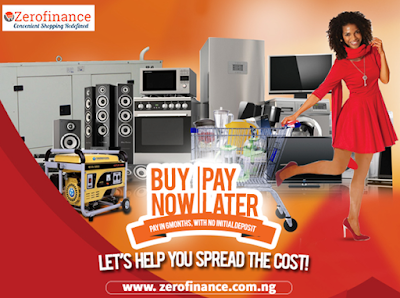
Shop now, pay later with www.zerofinance.com.ng

Zerofinance is Nigeria’s leading online retail store, providing quality branded home electronics, domestic appliances, computers, mobile phones and household furniture to customers with instalment payment options. We believe in choices and flexibility.

We believe that everyone should have the option to own their dream products without settling for less!  But more importantly, we believe in the flexibility of paying on your own terms, so we put you in the driver’s seat.  Our instalment payment options allow you to choose from a wide range of products without having to worry about big costs upfront.

Whether you want an upgrade to the latest technology, to indulge in the new comfortable home appliance or simply need to replace one of your essential office equipment you’re sure to find what you need in our diverse product catalogue with the option to spread the cost.

Across our full range of products you can choose to spread cost from the following options:


PayQart

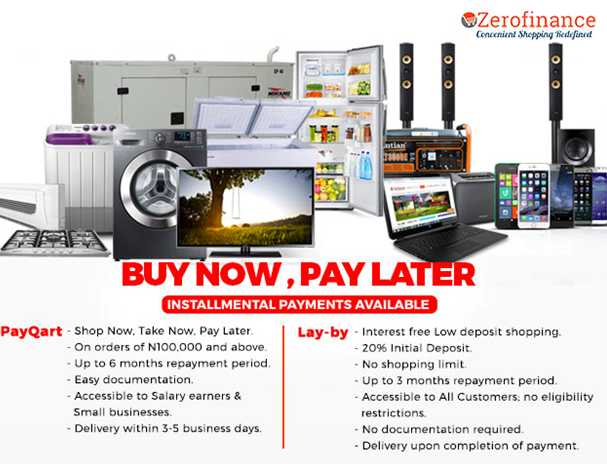
Our most popular flexible payment option that lets you shop now, take now and pay later, What’s more, we don’t even require any deposit upfront, just manageable monthly payments throughout your agreed payment term of up to six months. PayQart Option is accessible to Lagos customers in paid employment and small businesses/business owners

Lay-by (Low deposit Shopping scheme)

Our Lay-by option allows you to reserve products while you make easy payments over a period of three months. With a minimum down payment, we will keep the products for you at the retail price with no extra cost/fee and deliver to your doorstep upon completion of payment. This flexible payment option is open to all customers.

At Zerofinance you simply choose the product, select your preferred payment option & duration, provide some basic information and get instant pre-approval to split your payment up to 6months.
We are committed to providing transparency when making a purchase and are always on hand to offer advice and lend support where needed. There are no gimmicks so the total you see at checkout is always what you actually pay depending on your preferred payment option.
Pay on delivery or pay in instalments, the choice is yours when you shop with us.
To order simply log on to www.zerofinance.com.ng. You can also contact us on 0818 7571902, 01-6311319 or email hello@zerofinance.com.ng

Footwear brand, Keexs, launches ‘Ibile’ collection

0

The African unisex footwear brand will unveil ‘Ibile’ in a one of a kind arts and style exhibition.

The exhibition which is themed “Style and Culture” will showcase never-before-seen footwear concepts created by Jide Ipaye, the founder of the brand.

As the name depicts, Ibile means local, native or heritage in Yoruba and is also an acronym for the five founding regions in Lagos – Ikorodu, Badagry, Ikeja, Lagos Island and Epe.

The event is expected to attract fashion and arts enthusiasts as well as indigenous designers across the continent.

Ibile, which is inspired by different aspects of the Yoruba and Lagos culture; promises to bring a fresh urban feel to any outfit.

There would also be a live art showcase which will feature elements of music, dance and drama during the launch of ‘Ibile’.

Regarded as the first innovative and social footwear brand in Africa, Keexs was successfully launched through a global crowd funding campaign in 2015.


(Thecable.ng)

Airtel’s Life’s precious moments – 4 reasons this ad touches the hearts of Nigerians

0

I stumbled on this ad by Airtel, one of the leading telecommunication companies in Nigeria few hours ago and I was enthralled while it lasted. As a Nigerian, family is at the heart of most of the things we do and the ad’s narrative carefully weave the plot while nudging our emotional core as a people.

Despite our huge cultural differences; one of the common thread that bind us together is that communal living. That is why an Igbo man will not hesitate to travel all the way from UK to Ihiala in Anamabra State, all in a bid to be with his extended family during a festival.

Nigerians cherish and treasure the family – that is what majority of our ads are about, however, Airtel took it steps beyond the usual family plots to reveal the importance of data in ensuring that the bond remained strong no matter where are.

This ad has generated over 250,000 views on Youtube and 1.3million views on Facebook; Four reasons, this ad tugs at the heart of an average Nigerian includes:

  1. Going local or touching base with our roots – Tapping into the recent growing trend of ‘going local’ as many Nigerians especially youths are beginning to appreciate our culture and the need to stay true to self.
  2. Crisp and clear story telling; no ambiguity.
  3. The beautiful use of old time reality of how fathers are always proud to talk about their family members and boast of their accomplishments to their peers and friends.
  4. Blending entertainment with education; informing Nigerians about one of the core importance of Facebook.


Written by: Adegboyega Ajayi (Brand Enthusiast and Innovation Analyst)


Has the race to premiumise made spirits forget the mainstream? – Comment

It’s the last thing the English language needs, but could a companion term to the verbally-ugly ‘premiumisation’ pass into everyday use in the years to come? Is ‘mainstreamisation’ – a neologism arguably even more hideous than the p-word – here to stay? Richard Woodard thinks so.

I can’t remember exactly when I first heard a drinks executive use the word ‘premiumisation’ to describe trends in the US and other key markets (it was before the economic turmoil of 2008/9, that’s for sure). My first instinct was to recoil at this bastardisation of the English language. As time passed, however, the term has become a firm part of the industry’s lexicon.

Many of the fast-growing success stories of the age, from Grey Goose vodka to Hendrick’s gin, encapsulate the ‘drink less, drink better’ mentality
Despite the downturn of nearly a decade ago, the p-trend has come to be a dominant feature of modern industry thinking. Many of the fast-growing success stories of the age, from Grey Goose vodka to Hendrick’s gin, from The Macallan Scotch to Hennessy Cognac, encapsulate the ‘drink less, drink better’ mentality.

These products marry scale to high levels of profitability. But, that scale has its limits. For every Hendrick’s at less than 800,000 cases (2015 figures), there’s a Gordon’s at 4.5m; for every Grey Goose at 6.6m cases, there’s a Smirnoff at 26.5m.

The philosophy of Jean-Noël Reynaud, CEO of Marie Brizard Wine & Spirits, recognises this. The revamped French company has deliberately shunned premiumisation in favour of mainstreamisation, simultaneously playing to the strengths of its brand portfolio and recognising that not all consumers are desperate (or, indeed, financially able) to trade up.

Several factors underpin this thinking: the depressed macroeconomic picture in core market France (as well as elsewhere in the Eurozone and, further afield, in Japan and elsewhere); the crowded nature of the premium-and-above space, and the cost of participating in it; advertising restrictions that make it harder to make the emotional connection that engenders brand loyalty and increased spending.

If nobody in Scotch is offering the right product at the right price, consumers will leave the category altogether

It’s not just in France that consumers are feeling the pinch; in Brazil and South Africa, disposable incomes have shrunk, prompting a new quest for value for money. And, if nobody in, say, Scotch is offering the right product at the right price, consumers will leave the category altogether.

Nor should we become too fixated on one form of trading up – for instance, that of consumers swapping premium for super-premium. If you’re a drinker of cheap vodka in Poland or low-priced local hooch in China or Africa, value products such as Brizard’s William Peel Scotch or Sobieski vodka are badges of new-found affluence and status.

It’s also unrealistic to expect a consumer of low-priced vodka to make the leap straight to Grey Goose without stopping off at Smirnoff or Sobieski along the way – a point acknowledged recently by Pernod Ricard CEO Alex Ricard when discussing the company’s premiumisation strategy.

“In Africa,” he said, “we have the Passport standard Scotch brand. Its job is to recruit local spirits consumers into international, western-style spirits. Then, we can start trading them up into Ballantine’s Finest, to premium Scotch, and then super-premium Scotch or single malts.”

Passport’s recent performance – up 16% in 2015 to 1.8m cases (according to The IWSR) thanks to growth in markets such as Mexico – illustrates the point perfectly.

Another comment from Reynaud that resonates is his assertion that “you can drink less and better, but not necessarily at a more expensive price”. Trends in the US vodka market suggest that he’s on the money here. So-called ‘premium standard’ vodkas are on the march, thanks to a combination of affordable price-point, perceived higher production values and attractive, expensive-looking packaging. In 2015, Gallo’s New Amsterdam sold well over 3m cases in the US, becoming the market’s number four vodka brand in the process.

But, let’s not be misled here: It’s not that mainstreamisation is a new trend. It’s always been there, in all of the many forms and for all of the many reasons described above. It’s just that the premiumisation-driven drinks industry hasn’t been talking about it as much.

In the end, to use Reynaud’s words one last time, it amounts to this: “We have answered a very simple question: What does the consumer want? It’s true in any FMCG product, including alcohol, that the consumer wants a good product at a good price.”

Simple, really…


(Just-drinks)

Nigerians Can Now Get UK Visa On Same Day Of Application – UK Embassy

The British government has announced a special service for Nigerians which enables them get their UK visa on the same day of application.

British High Commissioner, Mr. Paul Arkwright disclosed this on Monday at the 40th anniversary of the Nigerian British Chamber of Commerce, NBCC, in Lagos.

Mr Arkwright while speaking at the event said that the British embassy has made provision for visa applicants in Nigeria to get their visa on the same day or within five days of application.

He noted that the embassy as part of its special services has reduced the maximum turnaround time for all classes of visa application to 15 days.

“We have introduced a same day visa service – at a cost – for visas in Nigeria.

“We have also introduced a service that means you get a visa within five days, at a lower cost than the same day process.

“Our turnaround time for all other visas is 15 days.

“The key thing, however, is that all visitors to the UK, whether they are from Nigeria or anywhere else, must respect the law and the length of time their visa says they can stay in the UK.

“In 2016, around 140,000 Nigerians applied for visas to the UK. Of those that applied for student visas, 90 percent were successful.

“For those that applied for other visas, around 70 percent were successful.

“There are as many as 250,000 Nigerian nationals or dual Nigerian-British nationals living in the UK at the moment.

“Some claim the total Nigerian diaspora in the UK is well over a million. We want Nigerians to come to the UK. They come to do business, to study, to see family and to invest in our economy.”

World Malaria Day: Kantar, partners sensitise 2,000 in Lagos

2

To mark this year’s World Malaria Day with the theme: End Malaria for Good”, Kantar companies in Nigeria in collaboration with the World Health Organisation, WHO, Rotary Club and Non-Such HMO is targeting over 1,000 Lagosians including 250 pregnant women for malaria awareness, testing and treatment.

Mosquito In a chat with Good Health Weekly in Lagos, the Research Manager Kantar TNS, Ms, Seun Tuyo said the companies came together to focus on prevention and awareness creation on malaria as a critical strategy for reducing the burden. Tuyo said the programme would hold simultaneously in their host communities of Maryland and Ojodu areas of Lagos State.

“We are targeting pregnant women, nursing mothers and children under five years. Rotary Club of Amuwo, District 910 has donated 250 nets and test kits and Non –Such Health Management Organisation, HMO, will provide support in the area of free testing and treatment as well as health talk on malaria prevention and control, how to use the nets, and administer anti-malaria drugs to those who tested positive to the disease.

We are also holding public awareness and educational rally in the host communities.” Noting that pregnant women and children were the most vulnerable group in terms of malaria burden she stressed the need to expand access to malaria treatment and prevention strategies. “Malaria is common in this environment. We live in communities and sometimes we find people coming down with more than three bouts of malaria attacks in a year and people continue to die. “One child dies every two minutes of something that could be prevented and treated.

There is need for massive awareness on malaria prevention and control. It saves money and lives.  When people have the knowledge that clean gutters and sleeping under treated nets will prevent malaria, they will do it.” Speaking, Assistant Manager, Kantar Millward Brown, KMB, Mr. Abidemi Junaid added that awareness creation was key to eradicating malaria. “With the message on how to control and prevent it, the target of reducing the burden would be achieved. Malaria is preventable and curable.”


Vanguardngr

THE INSPIRING STORY BEHIND RITE FOODS ONLINE SUCCESS

The online journey of Rite Foods on the Jumia Local platform is as novel as it is inspiring, given that the transition from Brick & Mortar stores to selling online can be a daunting task.

Rite Foods is the No.1 local manufacturer of food and beverage industry, run by Mr Seleem Adegunwa. It started in 2014 with the main aim of producing world class quality of food and beverage in Nigeria that is second to none in the global landscape.

For a Nigerian based beverage company with humble beginnings, Rite Foods has overcome the odds in an industry saturated with many International Brands. Their success is due not so much to what the company did prior to launch, but how it managed to thrive after launch.

They started with the traditional beef sausage rolls which had little competition, and then they observed that the beef rolls are mostly taken with beverages so they expanded to produce a world class variety of beverages that rivals international standards.

This prompted the launch of the regular beverages, but later came up with an interesting idea of having a blend of cocktail with different fruits, the tropical flavour and also an apple drink that actually tastes different from the regular apple drinks because of its unique taste like that of an apple juice. Today, Rite Foods encompasses the traditional sausage rolls and all non-alcoholic carbonated drinks including soda.

Rite Foods joined the Jumia Local platform in November 2016 and in less than 6 months they sold more than 300,000 bottles. Rite Foods has risen through the ranks and is now one of our best sellers since the launch of the Jumia Local platform.

Jumia Local is an initiative designed to push locally manufactured brands. It features the best and most sought after products on the website providing our customers the confidence that we only offer them top quality products that align with Jumia’s values.

THE MAIN CHALLENGES SO FAR

Starting a beverage industry that is undertaking all operations in Nigeria has been quite a challenge especially with consumers remaining very adamant to change especially with the mentality of not wanting to try out new brands. They have been able to win the hearts of Nigerians with top quality and their taste not differing from that of their giant rivals.

“In terms of hygiene and quality it can never be better because we use the best machinery, best practices and zero human interference” says Seleem Adegunwa

Being an industry that undergoes all operation in Nigeria they have been able to employ over 3000 youths which is an estimate of the number of youth corpers in one batch stream in Lagos in just three years of establishment. And not only did they create a large number of employment, they also provide them with staff accommodation within a stone throw from the office that makes working stress free.

“Rite Foods is committed to building a sustainable brand alongside community reducing environmental damage and providing inclusive work environment for employees”

Through the Jumia local Platform they have been able to push their brand all across Nigeria and have become a well trusted brand for beverage consumers in Nigeria.

(Jumia Blog)

JUMIA UNVEILS ITS THIRD WHITE PAPER ON NIGERIAN MOBILE TRENDS 2017

Introduction

Jumia Nigeria is pleased to present the 2017 edition of the Nigeria Mobile Trends Paper. This is the third white paper presentation from Jumia delving into mobile trends across Africa and specifically Nigeria. The study takes a look at the how the market has democratized mobile internet use, the consumer behaviors driving increased smartphone adoption and the role of mobile brands, mobile operators and m-commerce in creating a synergy of an enhanced customer experience.

This year’s Mobile Africa Study was carried out in 15 African countries which generate more than 80% of Africa’s GDP – Algeria, Nigeria, Morocco, Tunisia, Egypt, Mozambique, Ghana, Ivory Coast, Cameroon, Rwanda, Uganda, Tanzania, Kenya and Senegal.

Africa Mobile subscriptions and Internet penetration

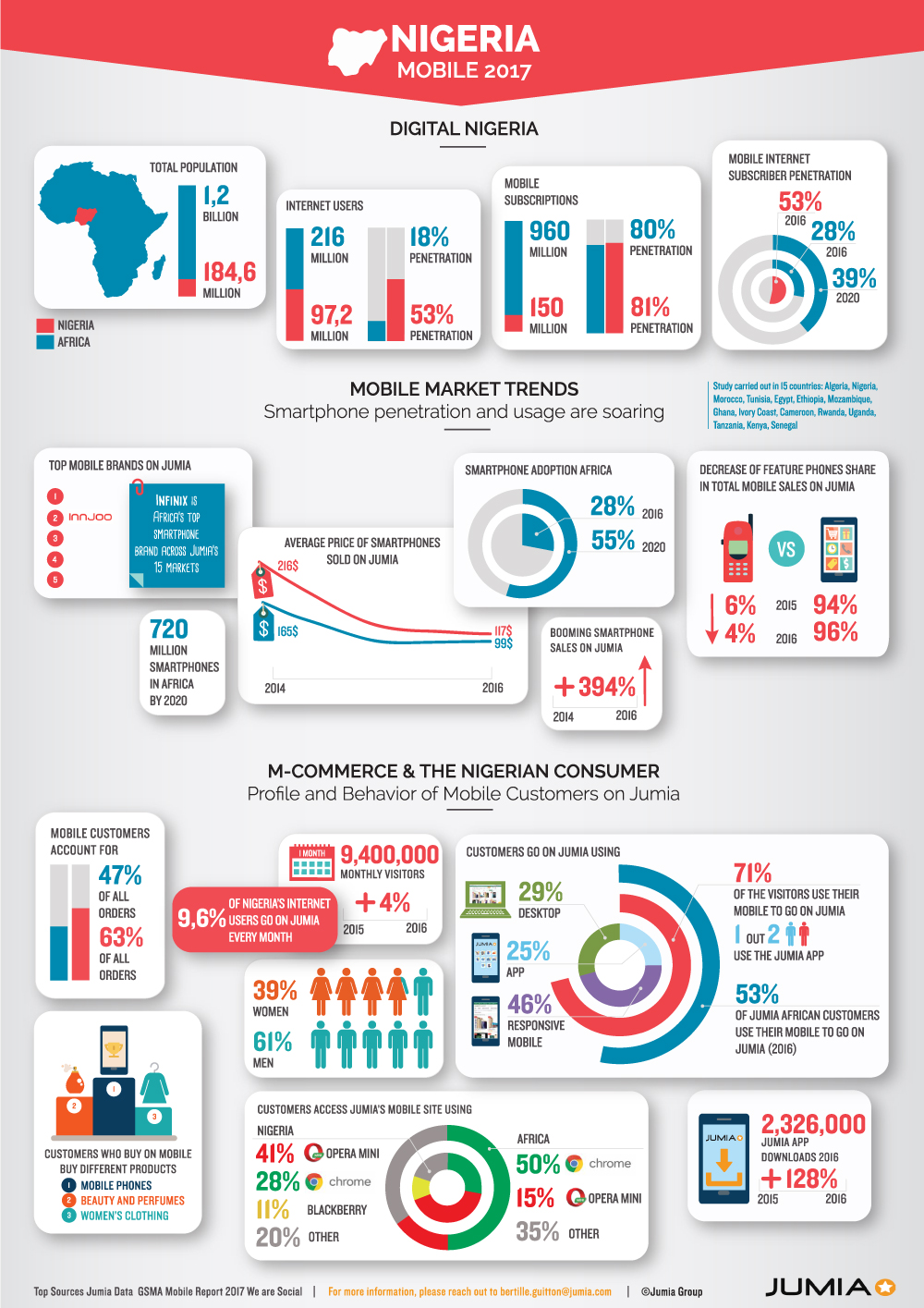
There are 960 million mobile subscriptions across Africa – an 80% penetration rate among the continent’s population. Internet penetration is at 18% with 216 million internet users. While Nigeria’s internet penetration is much higher at 53%, it mobile subscription is similar to Africa’s at 81% penetration (150 million mobile subscriptions). Like last year, it is presumed that the unique subscription rate is lower as each subscriber owns an average of 2 sim cards.

Nigeria: A Mobile First Nation

As predicted in 2016, Nigeria continues its trajectory down the increasingly widening highway that is the mobile internet. With a current internet penetration rate of 53% (97.2 million users) Nigeria has a much higher penetration rate than across Africa (18%).

About 71% of website visitors on Jumia use their mobile phones. This is in comparison to 53% of Jumia African customers. One of the main vehicles of this mobile trajectory is the increasing adoption of the smartphone device by consumers. As predicted in our 2016 report, smartphone adoption continues to rise in Nigeria. The mobile phone category continues to be the most popular among Nigerian shoppers on Jumia, both in terms of the number of items sold, and in terms of revenue generated. The sales of smartphones jumped up by 394% between 2014 and 2016, mostly driven by an increasing range of smartphones price points.

E commerce and the Diversification of Smartphones

The average price for a smartphone on Jumia is $117, down from $216 in 2014. Correlating with this is a drop in the share of sales of basic feature phones from 6% in 2015 to 4% in 2016, even as the share of smartphones on the website increased.

In 2016 Chinese mobile brands held dominance and played a major role in introducing smartphones with lower price points. Infinix, Innjoo, Tecno, Samsung and Yezz are the top 5 smartphone brands in terms of sales on Jumia. Infinix continues to be Africa’s top smartphone brand across Jumia’s 15 markets. One of their entry level smartphones, the Infinix Hot4Lite was one of the best-selling phones across several African markets including Nigeria.

Browsing in Nigeria: adapting to high data costs and lower performance smartphones

The increased access and affordability of low specification smartphones has also revealed a need for the mobile ecosystem to respond with data-efficient browsers and mobile apps that are optimized for performance and an easy user experience.

Looking at the mobile internet browsers customers use to access Jumia, 50% of customers in Africa come onto Jumia’s mobile site with Google Chrome. In Nigeria that number is just 28%. Instead, the Opera mini browser is much more popular, with 41% of the mobile traffic to Jumia Nigeria coming from Opera mini.

One reason for this could be that countries with higher levels of income have been found to have more users accessing the internet with heavier browsers like chrome – which typically have higher system requirements. Opera mini is a lighter browser in terms of data usage and is popular among new mobile internet users who have lower incomes and can’t afford costly internet data packs. A recent report from Opera determined the savings on mobile data costs for Opera mini users in Nigeria has amounted to about $198 million (N39.5 billion) over a 10-month period, due to its data compression technology. This is a clear example of the ripple effect that customer enjoy when a slight change is introduced by one of the digital ecosystem players.

On our end, an immediate key priority is to deliver a Jumia progressive web app that bridges the gap between conventional web pages and native mobile applications. Such web apps are accessed from within the mobile phone’s browser (e.g Chrome), but they are enhanced for a faster web experience and include functionalities like push notifications and the ability to browse while offline.

MCommerce – Beyond browsing on mobile

The trend since 2013 was for people to use their mobile phones to browse and look up products and then purchase them on their desktop. Now customers are checking out and paying for orders from the mobile app or the mobile friendly version of the website. This is a trend we foresee growing in the future based on the current figures.

Mobile customers (both those who use the Jumia app and those who browse from mobile browsers) account for 63% of all orders on Jumia Nigeria. Across the 15 markets where the study was carried out, that figure is at 47%.  With a whopping 2,236,000 Jumia app downloads from 2015 to 2016 (a 128% increase), Jumia app users form a significant portion of the mobile traffic on Jumia Nigeria. Currently, 1 out of 2 mobile visitors in Nigeria are coming from the Jumia mobile app.

The highest conversion rate recorded in the last year has been on the app. That is the number of completed orders in relation to the number of visitors is higher on the mobile app than on the mobile or desktop versions of the website. This could be driven by the fact that the app is exclusively designed for mobile and therefore has a faster and better shopping experience for users.

Hence, the priority for mcommerce for the next few years is to continually democratize the usage of the app and incentivize an increase in usage by maintaining a better browsing experience and lower data consumption.

Strategic collaborations with phone operators and data providers are also a key factor for enhancing customer experience. For example, the 0 data usage (free browsing) offered to MTN sim card owners when they browse on both the Jumia mobile site and the app will remain a key feature and value-added service for Jumia customers.

Nigeria’s mobile trends for 2017 are positive with a steady growth of smartphones adoption and diversity. These increased offerings deliver more value for customers and cheaper access to internet connectivity. As smartphone brands and mobile operators continue to invest in research and development and innovative data packages, and ecommerce providers invest in customer service, logistics and marketing over the next few years, our outlook is for an even more synergized digital ecosystem over the next few years.

Mobile penetration in Africa reaches 80%

There are 960 million mobile subscriptions across Africa – an 80% penetration rate among the continent’s population. Internet penetration is at 18% with 216 million internet users, according to the latest Jumia mobile trend report for Africa.
The 2017 edition of the African Mobile Trends Paper is the third white paper presentation from Jumia delving into mobile trends across Africa and specifically Nigeria. The study takes a look at the how the market has democratised mobile internet use, the consumer behaviours driving increased smartphone adoption and the role of mobile brands, mobile operators and m-commerce in creating a synergy of an enhanced customer experience.

This year’s Mobile Africa Study was carried out in 15 African countries which generate more than 80% of Africa’s GDP: Algeria, Nigeria, Morocco, Tunisia, Egypt, Mozambique, Ghana, Ivory Coast, Cameroon, Rwanda, Uganda, Tanzania, Kenya and Senegal.

Africa mobile, internet penetration

There are 960 million mobile subscriptions across Africa – an 80% penetration rate among the continent’s population. Internet penetration is at 18% with 216 million internet users. While Nigeria’s internet penetration is much higher at 53%, its mobile subscription is similar to Africa’s at 81% penetration (150 million mobile subscriptions).

Like last year, it is presumed that the unique subscription rate is lower as each subscriber owns an average of two sim cards.

Nigeria: a mobile first nation

As predicted in 2016, Nigeria continues its trajectory down the increasingly widening highway that is the mobile internet. With a current internet penetration rate of 53% (97.2 million users) Nigeria has a much higher penetration rate than across Africa (18%).

About 71% of website visitors on Jumia use their mobile phones. This is in comparison to 53% of Jumia African customers. One of the main vehicles of this mobile trajectory is the increasing adoption of the smartphone device by consumers.

As predicted in the Jumia 2016 report, smartphone adoption continues to rise in Nigeria. The mobile phone category continues to be the most popular among Nigerian shoppers on Jumia, both in terms of the number of items sold, and in terms of revenue generated. The sales of smartphones jumped up by 394% between 2014 and 2016, mostly driven by an increasing range of smartphones price points.

eCommerce and the diversification of smartphones

The average price for a smartphone on Jumia is $117, down from $216 in 2014. Correlating with this is a drop in the share of sales of basic feature phones from 6% in 2015 to 4% in 2016, even as the share of smartphones on the website increased.

In 2016 Chinese mobile brands held dominance and played a major role in introducing smartphones with lower price points. Infinix, Innjoo, Tecno, Samsung and Yezz are the top five smartphone brands in terms of sales on Jumia.

Infinix continues to be Africa’s top smartphone brand across Jumia’s 15 markets. One of their entry level smartphones, the Infinix Hot4Lite was one of the best-selling phones across several African markets including Nigeria.

High data costs and lower performance smartphones

Currently, one out of two mobile visitors in Nigeria are coming from the Jumia mobile app

The increased access and affordability of low specification smartphones has also revealed a need for the mobile ecosystem to respond with data-efficient browsers and mobile apps that are optimised for performance and an easy user experience.

Looking at the mobile internet browsers that customers use to access Jumia, 50% of customers in Africa come onto Jumia’s mobile site with Google Chrome. In Nigeria that number is just 28%. Instead, the Opera mini browser is much more popular, with 41% of the mobile traffic to Jumia Nigeria coming from Opera mini.

One reason for this could be that countries with higher levels of income have been found to have more users accessing the internet with heavier browsers like chrome – which typically have higher system requirements.

In 2016 Chinese mobile brands held dominance and played a major role in introducing smartphones with lower price points.

Opera mini is a lighter browser in terms of data usage and is popular among new mobile internet users who have lower incomes and can’t afford costly internet data packs. A recent report from Opera determined the savings on mobile data costs for Opera mini users in Nigeria has amounted to about $198 million (N39.5 billion) over a 10-month period, due to its data compression technology. This is a clear example of the ripple effect that customer enjoy when a slight change is introduced by one of the digital ecosystem players.

For Jumia, an immediate key priority is to enhance the desktop user experience (which accounts for almost 30% of Jumia’s traffic and almost 40% of orders placed), by delivering a progressive web application that bridges the gap between conventional web pages and native mobile applications. This is to give customers a faster web and desktop experience that includes functionalities like push notifications and the ability to browse while offline.

mCommerce – beyond browsing on mobile

The trend since 2013 was for people to use their mobile phones to browse and look up products and then purchase them on their desktop. Now customers are checking out and paying for orders from the mobile app or the mobile friendly version of the website. This is a trend we foresee growing in the future based on the current figures.

Mobile customers (both those who use the Jumia app and those who browse from mobile browsers) account for 63% of all orders on Jumia Nigeria. Across the 15 markets where the study was carried out, that figure is at 47%.

With a whopping 2,236,000 Jumia app downloads from 2015 to 2016 (a 128% increase), Jumia app users form a significant portion of the mobile traffic on Jumia Nigeria. Currently, one out of two mobile visitors in Nigeria are coming from the Jumia mobile app.

The highest conversion rate recorded in the last year has been on the app. That is the number of completed orders in relation to the number of visitors is higher on the mobile app than on the mobile or desktop versions of the website. This could be driven by the fact that the app is exclusively designed for mobile and therefore has a faster and better shopping experience for users.

Hence, the priority for mcommerce for the next few years is to continually democratise the usage of the app and incentivise an increase in usage by maintaining a better browsing experience and lower data consumption.

Strategic collaborations

Strategic collaborations with phone operators and data providers are also a key factor for enhancing customer experience. For example, the zero data usage (free browsing) offered to MTN sim card owners when they browse on both the Jumia mobile site and the app will remain a key feature and value-added service for Jumia customers.

Nigeria’s mobile trends for 2017 are positive with a steady growth of smartphones adoption and diversity. These increased offerings deliver more value for customers and cheaper access to internet connectivity.
As smartphone brands and mobile operators continue to invest in research and development and innovative data packages, and ecommerce providers invest in customer service, logistics and marketing over the next few years, Jumia’s outlook is for an even more synergised digital ecosystem over the next few years.

(Bizcommunity)