




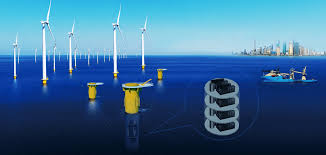
China has officially activated the world’s first underwater data centre powered primarily by offshore wind energy, marking a significant milestone in the global race to develop more sustainable digital infrastructure for the growing demands of artificial intelligence and cloud computing.
The facility, located off the coast of Shanghai, became operational in late May 2026 following the completion of its first development phase. The project combines underwater computing technology with renewable energy generation, creating a model designed to reduce power consumption, minimise land requirements and lower dependence on freshwater resources.
The development comes as governments and technology companies worldwide seek new ways to address the soaring energy demands of data centres, which are becoming increasingly critical to digital economies and AI-driven services.
According to Brandspur Brand News, the underwater facility is supported largely by nearby offshore wind farms, which are expected to provide the overwhelming majority of its electricity needs while significantly reducing pressure on conventional power infrastructure.
Unlike traditional data centres that often rely on extensive cooling systems and freshwater resources, the new underwater facility uses surrounding seawater as a natural cooling medium. Engineers have deployed a specialised heat-exchange system that transfers heat away from computing equipment more efficiently than many conventional land-based alternatives.
Project developers estimate that the innovative cooling design substantially reduces electricity consumption associated with temperature management, one of the largest operational costs for data centres globally. The reduction in cooling requirements could help improve overall energy efficiency and lower long-term operating expenses.
The centre currently operates at a capacity of 2.3 megawatts but has been designed for future expansion to 24 megawatts, providing significant room for growth as demand for computing power continues to rise. At full capacity, the facility would generate enough power to support energy consumption levels comparable to thousands of households.
The project also delivers environmental advantages beyond energy efficiency. By locating computing infrastructure underwater, developers have significantly reduced the amount of land required for construction compared with conventional data centres. The design further eliminates the need for large volumes of freshwater often associated with cooling systems at inland facilities.
Industry experts view the initiative as an important experiment in next-generation infrastructure development. As demand for cloud services, artificial intelligence applications and high-performance computing continues to accelerate, operators are increasingly exploring unconventional solutions to improve sustainability and operational efficiency.
However, questions remain regarding the long-term environmental impact of underwater data centres, particularly concerning the effects of continuous heat transfer into surrounding marine ecosystems. Researchers and environmental specialists are expected to closely monitor the project as operations continue.
The Shanghai facility is among the first large-scale attempts to combine renewable energy generation, underwater engineering and advanced computing infrastructure within a single integrated system. Its performance could influence future investment decisions and technological strategies across the global data centre industry.
As nations compete to build more efficient digital infrastructure capable of supporting the next wave of technological innovation, China’s latest achievement positions the country at the forefront of emerging data centre technologies and sustainable computing solutions in 2026.
