




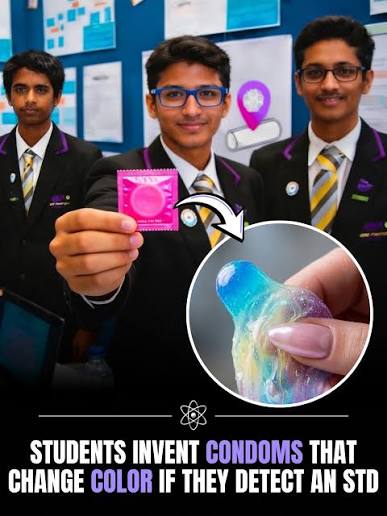
A group of British teenagers once proposed a condom designed to do more than prevent pregnancy and reduce the risk of sexually transmitted infections, it could potentially alert users to the presence of certain infections by changing colour.
The concept, known as S.T.EYE, was developed by Daanyaal Ali, Muaz Nawaz and Chirag Shah, students at Isaac Newton Academy in London. The teenagers, who were aged between 13 and 14 at the time, created the idea as part of the TeenTech Awards, where it won the Future of Health category in 2015.
The proposed device would use specially designed molecules incorporated into the condom to react with markers associated with particular infections. Different colour changes were proposed for different infections, including chlamydia, herpes, human papillomavirus and syphilis.
Brandspur Brand News reports that the idea was aimed at making STI detection less intimidating and allowing people to become aware of a possible infection without immediately relying on conventional testing procedures. However, the S.T.EYE was a student concept and was not an established commercial product. ScienceAlert later clarified that the proposed technology had not actually been produced and questioned whether the concept was scientifically feasible in the form originally described.
The idea nevertheless highlighted an important challenge in sexual health: many infections can exist without obvious symptoms, making testing and prevention important even when a person feels healthy.
Other researchers have explored related approaches to STI detecting condoms. A separate US patent describes a condom incorporating testing components capable of producing a visible colour change when specific sexually transmitted disease markers are detected.
Such technologies could, if successfully developed and clinically validated, add another layer of information to sexual health protection. But a colour-changing condom should not be treated as a replacement for established STI testing, particularly because different infections require different diagnostic methods.
For now, the teenage invention remains notable less as a product on the market and more as an example of how young innovators have attempted to rethink sexual health technology.
