ARIYA REPETE: FIRST SET OF ARTISTES FOR QUARTERFINALS EMERGE IN AKURE AND IBADAN

A total of nine contestants, four from Akure and five from Ibadan, have made it to the quarter final stage of the ongoing Ariya Repete, a talent hunt competition for Fuji and Juju music in the South-West. The auditions that produced the winners held in Akure and Ibadan on April 19 and 21, 2017, respectively.

After a breathtaking audition that judged the appearance, composure, creativity, vocalization and stage craft of each contestant, seven Fuji and three Juju artistes were chosen from each city to compete at the selection party, where two winners emerged from each category in Akure, while three from Fuji and two from Juju emerged in Ibadan.

The Fuji artistes that were selected in Ibadan are Aliu Inaolaji, Taiye Akanji and Ashafa Olusola, while the Juju artistes are Oshinbanjo Gabriel and Wale Daniel. In Akure Oladele Damilola and Afolabi Ibrahim emerged from Fuji category, while Osadare Abayomi and Ojo Abiodun emerged from Juju category.

The artistes will compete at the quarter finals slated for June 30th in Akure with winners from other auditions in Ilorin, Ijebu Ode, Oshogbo, Abeokuta, Ado Ekiti and Ile Ife.

The semi-finals will take place on July 7th in Abeokuta with the grand finale scheduled for July 14th in Ibadan, Oyo State.

In the quarter finals, 32 artistes selected from the different locations would be reduced to 10 and this would be further pruned to five for the grand finale.

At the grand finale, a winner, each for Fuji and Juju will emerge with each clinching a grand prize of One million Naira (N1, 000,000) and a recording deal.

Ariya Repete, an initiative of Goldberg, from the stables of Nigerian Breweries Plc is an expanded music talent hunt platform that seeks to promote and develop indigenous Yoruba music that includes Fuji and Juju music genres.

According to Emmanuel Agu, Portfolio Manager, Mainstream Lager and Stout brands, “the brand is using the new platform to extend its drive to discover new talents in the two indigenous Yoruba music genres and the move is in line with its commitment to promote the culture and tradition of the people of South West Nigeria.

CEO, i-naira.com Receives Technology Innovator of 2016 in the ICT sector

0

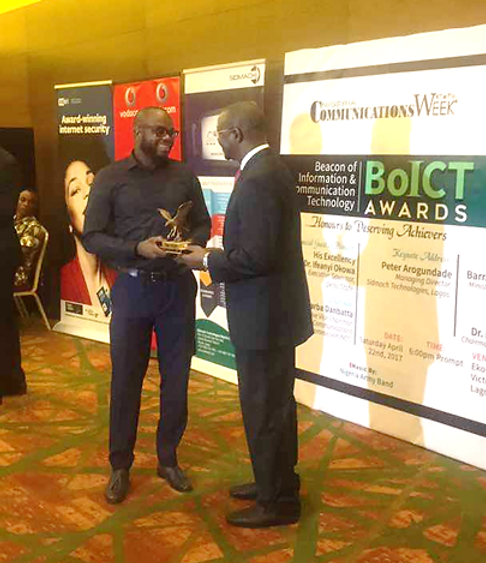
The CEO at i-naira.com; Hillary Nwaukor was recognized and awarded the  “Technology Innovator of 2016 in the ICT sector”.  He received the award  during the just concluded “Beacon of  Information & Communication Technology (BoICT) Awards; 9th edition organised by Nigeria Communication Week – which held on Saturday the 22nd of April 2017, at Eko Hotel & Suites, Victoria Island, Lagos.

While receiving the award, he thanked the teeming customers of i-naira.com for all their support and patronage. He equally extended his appreciation to the Lagos state Government for putting a law in place (Lagos Auction Law) which has set the stage for the professionalization of auction practice in Lagos state.

 The Beacon of ICT Distinguished lecture/awards, is designed to put Nigeria on the global information and communication technology map while recognizing impactful individuals and companies that are using technology to make life better for consumers in the Nigerian market space.

Nigeria’s First House Price Index Unveiled (Download the full Report)

The country ’ s pioneer house price index has been unveiled by the Roland Igbinoba Real Foundation for Housing and Urban Development , Nigerian Mortgage Refinance Company , Lekki Gardens and BusinessDAY Media Limited. The Roland Igbinoba House Price Index is expected to be a tool that measures changes in single family home prices across designated markets in the country , as well as reflect areas where some values
are increasing or decreasing.

It is also expected to provide necessary information for individuals to make decisions of when to purchase a house , where and even what type of house to buy. The Founder, Roland Igbinoba Real Foundation for Housing and Urban Development , Mr. Roland
Igbinoba , said the house price index was a variant of the weighted average or median method . Igbinoba said , “ The approach adopted in calculating the RI Index is that of the Laspeyres Index . A Laspeyres house price index calculates the weighted average change in prices over a period for fixed types of houses drawn from some base period.

“ It compares the total cost of purchasing a specific type of house in the base period with the total cost of purchasing the same type in other periods. An index of these costs is then constructed , taking the quantity of each house listed for sale in the base period as weight .”

According to him , the index will help to reflect both the relative costs of production and the relative utilities to purchasers as it measures changes in single-family home prices across Lagos and Abuja for a start .

He added that the index reflected areas where home values were increasing or decreasing and could provide necessary information to make decision of when to purchase a house, where and even what type of house to buy as well as help developers to know and gauge market affordability in different locations across the cities where the index currently covered . Igbinoba said , “ For the RI Index , we adopted a stratification approach to deal with the issue of changes in the composition of houses sold every quarter. Houses are stratified into three , four and five bedrooms ; other types of house with more than five bedrooms or less than three bedrooms are not considered in this report .

“ Due to lack of data sources in the country, the prices of houses listed for sale every month are collected from different sources . The median price of house in each stratum every month is obtained. The average of the three median prices per quarter is also obtained . This average of median price is then used as the average price of houses in each stratum .”

Click here to download the full report…

About Roland Igbinoba House Price Index (RI Index)

The Roland Igbinoba House Price Index (RI Index) is a variant of the Simple Mean/Median method. The approach adopted in calculating the RI index in this report is that of the Laspeyres index. A Laspeyres house price index calculates the weighted average change in prices over a period for a fixed type of houses drawn from some base period. It compares the total cost of purchasing a specific type of house in the base period with the total cost of purchasing the same type in other periods. An index of these costs is then constructed, taking the quantity of each house listed for sale in the base period as weight. In a market system, the price of housing should reflect both its relative costs of production and relative utilities to purchasers, whether the latter intend to use them for residential or commercial purposes. A House Price Index (HPI) is a tool that measures changes in single-family home prices across a designated market. It reflects areas where home values are increasing or decreasing. Hence, In association with for individuals, HPI can provide necessary information to make decision of when to purchase a house, where and even what type of house to buy. Economists and Financial Analysts also use House Price Indices to monitor long-term trends in house prices. 


(PunchNg, Reic-ng)

Updated: List of approved Micro-finance Banks in Nigeria

A Micro-finance bank is a type of bank that offers small loans, or microloans, to individuals, entrepreneurs and small businesses. These banks typically function to provide opportunities to low-income regions where small amounts of money can go a long way. Simply put Micro-finance banks ultimately provide credit to those who are unable to access the type of capital needed to develop businesses or kick-start their entrepreneurial dreams.


According to the Apex Bank, Central Bank of Nigeria (CBN), there are 1023 Micro-finance banks in Nigeria and 5 are foreign owned.

Top 5 states are: Lagos, Anambra, Abuja, Ogun and Oyo while the bottom 5 are: Sokoto, Taraba, Bayelsa, Imo and Yobe.

Click here to download the complete list with their names, addresses, phone numbers, email address etc…

See below breakdown by states:

States No. of MFBs
Lagos 195
Anambra 81
Abuja 70
Ogun 60
Oyo 60
Delta 40
Kaduna 40
Kano 40
Niger 40
Osun 30
Kwara 27
Enugu 24
Kogi 24
EDO 22
ABI 20
Ondo 19
Rivers 19
Bauchi 17
Plateau 17
Ekiti 14
Akwa Ibom 13
Cross River 13
Jigawa 12
Adamawa 11
Benin 11
Kebbi 10
Nasarawa 10
Enbonyi 9
Katsina 7
Zamfara 5
Borno 4
Gombe 4
Sokoto 4
Taraba 4
Bayelsa 3
Imo 3
Yobe 1
Total  1023

CAP PLC unveils Nigeria’s first automated paint factory in Lagos

0

There has been consistent growth in the Nigerian property and real estates development market; both private and corporate clients in recent years, and the dynamic trend in the paint market has motivated Chemical and Allied Products (CAP) Plc, the manufacturers of Dulux premium brand of paints to execute a multi-million dollar strategic investment to build state-of-the-art automated paint in-plant facility to meet the constantly changing customers’ taste and to maintain the brand’s reputation positioning as an innovative market leader in Nigeria.

This unprecedented project was unveiled at the commissioning event recently held at the company’s factory in Lagos, where the Managing Director, CAP Plc, Mrs. Omolara Elemide confirmed that the acquisition of In-Plant Tinting technology was well-thought-out in order to place the company in alignment with the market dictates and trends as well as to meet the increasing demand from the customer for paint colours in small volumes.

However, in what is considered to be a bold-strategic-smart investment in the paint industry in Nigeria ever, Elemide revealed that the company invested in the new automated In-Plant Tinting Technology plant, which is the first of its kind in Nigeria to continue to push the limit of excellence in the paint industry and reaffirm its leadership positioning.

She explained that the automated In-Plant Tinting Technology will make it possible for the company to profitably manufacture premium quality paints in large and small batches within the shortest possible time while also completely eliminating the issue of colour variation from batch to batch.

“Over the years, there has been an increase in demand for colours in small volumes from the factory. This has resulted in production lead-time challenges, as the plant was not configured to produce colours in small volumes. As a customer-focused company, we took up the challenge to meet this emerging need of our customers by acquiring the in-plant tinting technology,” she said.

Also speaking at the event, the Group Managing Director, cPlc, and Chairman, CAP Plc., Mr.Larry Ettah, who was represented by Mr. Abdul Bello, described the actualization of CAP Plc’s automated In-Plant Tinting factory as a testament of what could be achieved when innovation and advancement are encouraged in any organization.

According to Etta’s comment the investment confirms sensitivity of the brand’s consumers’ insights and agility of the brand to seize inherent opportunity to adapt to dynamic nature of the market. He declared that the new state-of-the-art factory is CAP’s response to meet the current needs of customers.

“Today marks the beginning of another revolution in the Nigerian paint market. Customers should be ready for pleasant and thrilling experience as we commission the first fully automated paint factory in Nigeria. The benefits of the new factory to customers are enormous. These include prompt product delivery, more colour offering and colour consistency. With this accomplishment, CAP Plc. has undoubtedly reinforced its leadership position in the Nigerian Paint Industry” he said.

The Chairman of the company further stressed that all the stakeholders will benefit from this rewarding experience as the modernized paint factory will increase the market share of the company, optimize cost and increase profitability. All these benefits will ultimately yield higher returns to our shareholders and enhance customer experience.

CAP Plc, a subsidiary of UAC of Nigeria Plc. (UACN), manufacturers of Dulux premium brand of paints and the technological licensee of AkzoNobel, world’s largest paints and coatings company.


(PageoneNg)

Four challenges AfriOne Mobile must consider to be successful in Nigeria

Last week, AfriOne launched its mobile phone manufacturing facility in Lagos, Nigeria’s commercial capital. The arrival of a mobile manufacturer is a cheering news for Africa’s largest mobile market without an original equipment manufacturer (OEM).

The company is called AfriOne Limited and backed by venture funding from India’s Contec Global, a security technology company providing automated systems for the authentication of people, objects and documents.

Contec Global was reported to have invested about USD10 million in the manufacturing facility that is more or less Nigeria’s first smartphone manufacturing plant.

However, there are challenges ahead of this promising venture that must be looked into. These four concerns must be critically considered:

  • Substandard imports: There is no gainsaying that Nigeria’s mobile market has exploded, perhaps for good. The market is now active with many smartphone brands giving customers expansive choices. However, there are downsides to this positive development. Nigeria is fast becoming a dumping ground for all kinds of devices. Many of them are behind standards across Europe and China, their common country of origin. The spate of these substandard smartphones must be checked by the Standard Organisation of Nigeria (SON). As a local manufacturer, AfriOne will have to work with standards agencies to ensure it does not become a victim of these cheap imports.
  • Government regulations: Nigeria is known for policy flip-flop or a total lack of many needed policies for local manufacturers and entrepreneurs. In this matter, there are concerns about how AfriOne and other willing investors in the smartphone business will benefit from government policies. Various manufacturers were taken to the cleaners after past governments unilaterally introduce or scrap policies without deep consideration for local ventures affected by these policies.
  • Essential infrastructure: It is no longer a surprise that manufacturers such as AfriOne will be providing its own power and other infrastructure needed in its value chain. As soon as more competitors come into the scene or economic cycle swing against its fortune, AfriOne might start whining and looking for another market out of Nigeria. Before it degenerates to this level, AfriOne will benefit more should Nigeria’s government carve out a serious strategy to fix critical infrastructure for these kinds of businesses.
  • Manpower: Many Nigerians would have been more knowledgeable about mobile technology should more manufacturers coming into the scene. In the absence of mobile plants, the knowledge bank has been focused on retail, marketing and sketchy knowledge on repairs and after sales services. AfriOne will need to scale its training and capacity development in order to grow beyond the norm.


(PageOneNg)

Osa7 Transforming Lagos With Street Graffiti

Osa Okunkpolor, popularly known as Osa Seven (Osa7) is a Nigerian Graffiti artist, brand developer and GFX designer. His work ranges from portraits of iconic characters to scenic images, brand designs, abstract art, and tribal art designs.

Osa is a visual communications graduate from the University of Lagos. He has worked with different street art media, and major brands including, Globacom, MTV Base, Diageo, Chicken Republic, Live Mechanic, and Empire Mates Entertainment. Some of his popular work includes a Live Graffiti Art Performance on the MTV Base Guinness #MADEOFBLACK Campaign, and the award winning SUPSERSTAR Album Art for Wizkid.

Image result for osa7

Last year, 28th and 29th of May, 2016 he hosted the 7th Element with A2Creative, an Art exhibition featuring some of his works like: portraits of Bob Marley, Nelson Mandela, Kanye West, The map of Africa created with Guinness cans, The Lekki Link Bridge, a painted KIA Vehicle, etc

Early this year he announced that he would be working on something huge with the Lagos state government. The project is no more a secret as evidence of his work can be seen in public. The project titled the ‘The Eko Tag’, from all indications and from his location in a recent photo, it seems Osa7 is about to tag the long stretch of wall along Ozumba Mbadiwe, right opposite the Civic Center.

He wrote about his project with the Lagos state government:

“There’s so much I can say about this photo, but I’ll keep it simple and say, I’m honored to be working with Lagos State Government on this monumental project. This piece is going down in History as an official commissioned monument, and Im humbled to be making it. To all the artists who are focused on making a positive impact through their art, this one is for you! Over the next few weeks, i’ll be working on site – will let everyone know when ill be working, and your support would be greatly appreciated! #GraceUnlimited #OsaSeven”.

#TheEkoTag project is ongoing and motorists that ply the Lekki-Ajah road would have seen him working on beautifying the walls along Ozumba Mbadiwe road. This is a very big project which will take weeks or months to complete because that road is very long. Once he is done that road is going to standout with beautiful and artistic graffiti designs.

Celebrities like Ice-Prince, DJ Lambo, Praiz, DJ Spinall, DJ Obi, Banky W and a host of others have visited him on site to motivate and appreciate his effort towards beautifying Lagos state.


Vibe.ng

Cover Image: GuardianNg

Daily Energy Generation Attained a Peak of 5,846 MW in Q1 2017 – NBS

0

The power generation statistics for Q1 2017 reflected that a total average of 3,687 MW of energy was generated by power stations as Afam VI Power Plant contributed about 12.64% share of the average energy generated which represents the highest generation among the twenty-three (23) power plants within the period under review.

Daily energy generation attained a peak of 5,846 MW on the 24th January, 2017 and daily energy sent out on same date was 5,747 MW. Similarly, the highest daily energy generated per hour attained a peak of 140,316 MWh on the 24th January, 2017 and daily energy sent out per hour on same date was 137,920 MWh. This represents the highest level of energy generated and sent out in the month of January 2017 and in Q1 2017.

However, the lowest daily energy generation, 1,660 MW, in the month of January 2017 and in Q1 2017 was attained on 18th January, 2017 and daily energy sent out on that date was 1,618 MW. The lowest daily energy generation per hour was also attained on same date. 39,837 MWh was generated and 38,831 MWh was sent out.

In February 2017, daily energy generation attained a peak of 4,279 MW on 21st February, 2017 and daily energy sent out on same date was 4,217 MW. Similarly, the highest daily energy generated per hour in the month under review attained a peak of 102,705 MWh and daily energy sent out per hour on same date was 101,208 MWh. Nevertheless, daily energy generation attained its lowest of 2,915 MW in the month of February on 1st February, 2017 and daily energy sent out on same date was 2,869 MW.

Similarly, the lowest daily energy generation per hour was also attained on same date. 69,962 MWh was generated and 68,847 MWh was sent out. Daily energy generation in March 2017 attained a peak of 4,156.03MW on 9th March, 2017 and daily energy sent out on same date was 4,096 MW. Similarly, the highest daily energy generated per hour attained a peak of 99,732 MWh on 9th March, 2017 and daily energy sent out per hour on same date was 98,300 MWh.

The lowest daily energy generation attained in March 2017 was 3,496 MW and the lowest daily energy sent out of 3,441 MW was attained on 16th March, 2017. Likewise, the lowest daily energy generation per hour was also attained on same date. 83,790 MWh was generated and 82,580 MWh was sent out.

Click here to download full report (PDF)

Ekiti State Empowers 1,000 Youths In Digital Marketing

0

Thousands of Ekiti youths from the 177 wards of the 16 Local Governments were sponsored and mobilized by the State government to benefit from a one day digital training programme .

The programme  which was a partnership arrangement between the State Government, the Office of the Senior Special Assistant to the President (OSSAP) on Sustainable Development Goals (SDGs) and Google Nigeria through its affiliate, Mind the Gap was tagged DIVERSIFYING THE NIGERIA ECONOMY: Enabling Youths through Digital Skills Training.

The youth from all the sixteen local government areas  of the state  who were eager to acquire more knowledge to be abreast of contemporary and modern digital techniques flooded the  Emmanuel Event Centre , Ikere Ekiti venue of the flag-off ceremony of the programme as  as early as 8am on Friday to participate in the training programme .

Bar. Dipo Anisulowo, the Chairman (State Implementation Comittee on SDGs) who doubles as the Chief of Staff to Governor Peter Ayodele Fayose in his opening address at the flag-off ceremony advised the participants to make use of the programme to put an end to unemployment.

He said the programme  is an opportunity and a rare one of its kind to empower unemployed youths in the state in the art of digital marketing skills in this digital industrial age” and he advised  participants to make use of the opportunity for self development and empowerment.

He appreciated the state goverment under the leadership of Governor Ayodele Fayose (OSOKOMOLE) for his gigantic roles and initiatives in empowering  women, traders, artisans and workers in the public service which coincidentally is in tandem with goal number  One of the SDGS which is to end poverty in all forms everywhere.

Mr Adunmo, the Executive Secretary of SDGs in Ekiti state implored  the participants to be attentive and make use of the knowledge acquired to benefit themselves and the Nation as a whole. He appreciated the Governor of Ekiti state for creating an enabling environment and giving his full support for the hosting of this programme  in the state.

Some of the participants thanked  the state government and the organisers for this laudable programme and promised to build on the knowledge acquired through the training to make the State greater.

Guests  at the occasion were  Barrister  Ola Alonge, the  Chairman of Ikere Local Government and  Mr Olufemi Iroko from Google Nigeria as resource persons. Others include Mr Etu Suraju, Mrs Lasore Grace and Mr Oyebade, all from OSSAP on SDGs in Abuja.

(Brandcampaign)

World Malaria Day: Mosquito nets as most effective way to prevent Malaria

0

Ahead of World Malaria Day coming up on Tuesday, April 25 2017, the long lasting insecticide treated mosquito net has been described as an effective way of preventing malaria cases. But interestingly, only one in four children in Nigeria sleeps under the mosquito net.

One of the major challenges confronting international malaria prevention agencies is the cultural resistance to using bed nets in communities, where people view nets as intrusive. There is also evidence that in some countries, more bed nets go to the rich than the poor. Health groups are devising strategies to encourage use of bed nets and ensuring they are distributed more equitably.

Treated mosquito net forms a protective barrier around people sleeping under it. The insecticide in it not only kills mosquitoes, which carry the malaria parasites and other insects, but also repels mosquitoes. With treated mosquito nets, the number of mosquitoes, as well as their life span, is reduced.

Malaria, the leading cause of death among children in Africa, could be eliminated, if the population used insecticide treated bed nets. According to experts, if 75 percent of the population in Nigeria were to use treated mosquito nets, malaria could be eliminated. Therefore, it is clear that educational campaigns around the use of bed nets must continue.

Dr. Sam Awolola, Head, Malaria Research Programme Nigeria Institute of Medical Research (NIMR), Yaba, Lagos, said fight against malaria has been in existence over the years until year 2000, when Abuja declaration came in and malaria has been viewed from the economic angle, which has helped in reducing malaria infections in the country.

Awolola stated that children under five years and pregnant women are vulnerable to malaria infections; so, they should sleep under long-lasting treated mosquito nets and always try to buy nets at primary healthcare and pharmacy to avoid adulterated ones.

He said malaria has been over diagnosed over the years because every case of fever was taken as malaria, but malaria researchers now know better that not all cases of fever are malaria.

He said: “We have scaled up our interventions, which include distributing treated mosquito nets, which has been very wonderful. Over 70 million treated mosquito nets have distributed to Nigerians, but have they been used? And have they reduced the number of malaria cases in Nigeria? The answer is no, because people do not use the nets. We have distributed many rapid diagnoses test kits for malaria to enable us respond to treatment quickly. But will that alone lead us to reduction in malaria? The answer is no, because there are critical areas that need to be looked at holistically. So, government needs to encourage malaria researchers in term, of funding.

“Many people think eliminating mosquitoes would lead to reduction of malaria cases, but that is a wrong approach, as we do not need to eliminate all mosquitoes in the country. In most countries, where malaria has been eradicated as public health disease, mosquitoes are not eliminated totally. They only reduce the number of mosquitoes. These countries include Brazil, Europe, Italy and America, among others.

“Mosquitoes are very difficult to eliminate, because they have been in existence before human beings. So, it is not possible to eliminate mosquito totally, but we can only reduce them to the barest minimum.

“Government must encourage strategy together with milestone to measure success in the fight against malaria. For us to achieve success in fight against malaria there must be a robust plan and execution of the plan is also very important. When you have a plan, you have a team that is determined to support the plan; there must be financial support, including measures to determine if you have achieved the plan.

“Indoor insecticide spread is a key prevention method to countries that have eradicated malaria. Why is our government not investing in indoor insecticide spread? Today, we have a lot of unemployed youths. Government needs to invest in the youths for them to take the indoor spread exercise to the communities in the country on regular basis, maybe at every six month interval, as it would go a long way in reducing malaria.”

Awolola explained that NIMR is the only malaria research institute in Nigeria, adding that their finds show that if government wants to eradicate malaria, there must be serious investment in infrastructure and the people who will execute project trainings, capacity buildings and provision of medical facilities.

“There are local basic things needed to be done, apart from other preventive methods,” he explained. “Environmental sanitation is very important, because mosquitoes breed well in the environment, especially when the environment is dirty. Mosquito does not transmit only malaria infection, but there are other such infections as Zika virus, chikungunya virus, yellow fever and dengue fever, among others. All these are mosquito-transmitted diseases and we can avoid them, if our environment is clean.

“There is no country that could survive malaria without research to compare with other countries in Africa that put in more money into research, such as South Africa, Gambia, Kenya, Uganda and Malawi, among others. So, if there were a political will in Nigeria to fight malaria by year 2020, the country would be where it ought to be in terms of malaria elimination.

“People complain of hot weather because there is no electricity, which is the reason they do not use bed nets. So, government should encourage people by providing electricity. Again, some people believe that mosquito net does not conform to their tradition. For instance, some feel that after building a beautiful house, there is no need to put net on it.

“Again, there are lots of misconceptions and myths in the use of misquote nets. Some people believe the chemical on the net would affect their health. But I believe with more education, people may change, but electricity problem has not been solved, which is a major challenge.

“Most treated mosquito nets do not just go into the market; they must have been tested by World Health Organisation (WHO), before sending them into the market. So, the chemical has been tested for human use and it is very safe. This is not a guarantee that there would be no fake mosquito nets in the market because you see people selling nets on the street, which source we don’t know.

“This is a major challenge for most of us who are researchers in malaria treatment. Most of the fake mosquito nets do not have labels to show the company that manufactured them. So, people should go to primary healthcare and pharmacy close to them, whenever they want to buy genuine mosquitoes nets. But if you buy your mosquito net on the street, there is no doubt that it is fake one. I can assure you that genuine treated mosquito net can kill mosquitoes, cockroaches, scorpions, spiders and snakes, among others.”

Prof. Wellington Oyibo, Consultant Medical Parasitologist, and Director Research and Innovation Office, University of Lagos (UNILAG), Akoka, Lagos, noted that pregnant women should sleep under treated mosquito nets to avoid malaria infections, as well as go for antenatal care during pregnancy.

Oyibo said children can have pneumonia and other life-threatening diseases, that have the same symptoms with malaria, which is why people must conduct medical test before treatment of malaria, with micro scoping or rapid diagnosis test.

He said: “There is need for enlightenments because other things can cause fevers. If we continue to assume all fevers are malaria, it would cause a lot of harm. The same thing applies to heath workers, who treat and manage people with malaria down to all levels of health care. The same thing applies to the people on the street.

“Why do people assume all fever symptoms must be malaria? Now, things are beginning to change. Several years ago, when malaria was endemic, Nigeria was first among other endemic countries, which means 75 percent of children aged under five would have malaria. It was over 20 years ago, when we did not need laboratory tests, and one must be sure of every fever symptoms caused by malaria.

“During that period, Chloroquine was still efficacious, as one of the most affordable medicine ever seen in management of malaria. So, at that time, there was no need for laboratory tests because we were on the street. We had presumable treatments based on clinical symptoms of malaria, which was the norm, and it was simple to say all fevers were malaria.


(GuardianNg)