Dangote Salt, NAFDAC collaborate to sanitize food market

The management of Dangote Salt and the National Agency for Food and Drugs Administration and Control (NAFDAC) have expressed their readiness to collaborate and corroborate efforts to rid the food market of unwholesome practices by unscrupulous traders.

The two managements resolved to work together closely to monitor the quality of products that are delivered to the market after ascertaining that the right quality of products are taken out of the factory.

The management of NASCON Allied Industries Plc led by the Managing Director, Mr. Paul Ferrer and the Dangote Group’s Chief Corporate Communication Officer, Mr. Anthony Chiejina had paid the Agency Director-General, Mrs Yetunde Oni a courtesy visit in her office in Lagos.

Mr. Ferrer had expressed satisfaction at the efforts of the Agency leadership to sanitise the food market by getting rid of fake and substandard products and turning the heat on the perpetrators, adding that the efforts had paid off.

He however explained that he observed an infringement on the directives of the Agency on the packaging of industrial salts by some undesired elements.

According to him, contrary to the directives of the NAFDAC that industrial salt should only be packaged in 50kg, his organization observed the existence of the industrial salt in small sizes as 5kg, 10kg, 15kg, and 20kg.

He reasoned that someone somewhere has been has been repackaging the 50kg size to smaller sizes and supplying to the markets, a development he said is dangerous as people may be misled to be buying the industrial salt in place of the table salt which comes in the smaller sizes.

The Dangote Salt boss therefore enjoined NAFDAC to help see to the development as the unsuspecting consumers might not know the difference between the iodised table salt and the industrial salt.

In her response, Mrs. Oni thanked the NASCON management for the confidence reposed in her Agency. She said the observation was one of the many infringements the her agency has been battling tooth and nail and that the NAFDAC management would not relent in the fight against every infringement to see that the people have access to right quality products always.

(Newtelegraphonline)

Nigeria to crack down on frozen food importers

0

The Federal Government says it will henceforth arrest, prosecute and fine illegal importers of frozen foods into the country through the land borders and seal cold rooms where it is sold.

Sen. Heineken Lokpobiri, the Minister of state for Agriculture and Rural Development, announced this while speaking with newsmen in Abuja on Thursday.

Image result for frozen fish nigeria customs

Lokpobiri said the government would also set up a taskforce to seal and prosecute operators of cold room, who deal on those illegally imported produce.

The minister said the ministry was working in collaboration with the Nigeria Customs Service, Nigerian Navy and the Nigerian Marine Police to actualise the plan.

He said the offenders would pay a fine of $250,000 or attract five years imprisonment or both in addition to the forfeiture and destruction of the produce as stipulated by the law.

He listed some of the fishes usually being imported to include tilapia, red pacus, river bream, pangassius, horse mackerel, sardine and croaker, among others.

Lokpobiri said the illegal venture had resulted to huge loss of revenue, decrease in local production and loss of jobs, as well as discouragement by farmers.

The minister, who said that the move was to encourage local production and exports, disclosed that the country’s annual demand on fish was currently at 3.2 million tonnes and deficit at 1.9 million tonnes.

According to him, the Department of Fisheries and Aquaculture in the ministry is the only competent authority empowered by the Nigeria Sea Fisheries Act to issue distant water fishing licence for the importation of frozen fish into Nigeria.

“The department does not issue licence for the importation of frozen farmed fish into Nigeria through the land borders.

“The smuggling of unhealthy frozen fish into the country is detrimental to the progress being made toward guaranteeing the good health and nutrition of Nigerians.

“We will continue to partner with the Nigeria Customs Service, the Navy, marine policy to see how we can clamp down on the offenders.

“Even those that have brought the produce into the country, we are setting up a taskforce that will go round different cold rooms, like what Customs is doing to rice.

“Any cold room that we find these fishes, we will seal them up, ensure you pay the $250,000 fine because laws are meant to be obeyed,’’ he said.

The minister said that consumption of those imported frozen foods were major cause of some health challenges being experienced in the country.

Lokpobiri, who frowned at the rising cases of kidney disease among children between the ages of five and seven, assured that the government would fight the menace to a halt.

In an interview, Mr. Lamina Rasheed, the National Chairman, Association of Indigenous Seafood Stakeholders, appealed to the Federal Government to release foreign exchange (FOREX) for the importation of fish.

He said that getting FOREX at a cheaper rate would ensure reduction in the price of the produce and make it affordable.

The chairman said the illegal importation of fishes was detrimental to their business.

Rasheed said that members of the association paid import duty of 14 per cent, which amounted to millions of naira to the Federal Government while the illegal importers pay next to nothing through the land borders.

According to him, it is difficult to compete with them in the market because they slash their prices.

He attributed the high cost of fish to the current exchange rate, adding that the frozen fish did not enjoy FOREX from the Central Bank of Nigeria (CBN).

“Before, we were getting FOREX from the government but now, we are buying from the open market.

“When you pay 14 per cent and somebody is paying zero per cent, how do you sell your commodity?

“Therefore, all the fishes we brought legally into the country are currently stocked in the cold room because we cannot afford to lose our money or bank’s money.

“We have a lot of stocks in the cold room, which are unsold,’’ Rasheed said.

(thenationonlineng)

British American Tobacco Releases 2016 Annual Report

0

British American Tobacco’s annual report for the year 2016 highlights significant progress Next Generation Products, a category called by the company “outstanding next generation tobacco and nicotine products” which includes the Cigalike Vype, the starter kit Vype Pebble and the HNB cigarette Glo.

The Group confirms its strategy to expand their activities in the category of Next Generation Tobacco and Nicotine Products as combustible tobacco sales decreased but less than for the rest of the industry.

Follow the link (www.bat.com/annualreport) to the interactive report and PDF file.


Hotel fitness centres, a new gold in the hospitality industry

Fitness centres have become the new ‘gold’ in the hospitality industry, with a recently published Hospitality Report Nigeria by Jumia Travel showing the gym as one of the most sought after amenities by customers booking a hotel stay.
Image result for NIGERIA GYM
The growing trend from home based fitness programmes to local fitness memberships now includes the need for travellers to keep fit even when on their trips, be it leisure or business. In this regard, most hotels have adopted to the trend and incorporated gym/fitness facilities in their properties, while those with existing ones have gone a notch higher to renovate in a bid to create a better impression.
Image result for GYM fitness NIGERIA
As the head of customer service for Jumia Travel Nigeria, Omolara Adagunodo ascertains: “The percentage of our customers often inquire the inclusion of a gym or fitness facility is overwhelmingly high. Some are concerned about keeping up with their workout routine while on the road, while others are purely on a wellness trip and, therefore, have a fitness facility as a priority. We have but to refer and recommend only hotels that have the capacity to meet their needs.”

An untapped revenue stream

Whether running a luxury hotel or a budget lodge, it is no doubt a fact that not having an onsite fitness facility is a big time untapped revenue stream. In a 2016 survey conducted by MMGY Global, a travel and hospitality firm, a premium fitness center with options for on- or off-site exercise classes was a major influence for almost 50% of millennials when choosing a hotel.
Image result for NIGERIA GYM
A group of travellers aggressively disrupting the hospitality sector, the millennial, unlike their Generation X counterparts, are often keeping hotel owners on their toes, requiring them to flexibly meet them at their point of need. The good news is, they are willing to part with the extra dollar, for the extra attention and satisfaction.

However, it is important to also note that a high number of guests are yet to integrate wellness into their travel plans, and may require a little push to get them to workout. Going a step further to include fitness zones in the hotel rooms, and simple workout gears may just compel them to get on the mats, which is a win-win solution for both the hotel and the guests.

(Bizcommunity.)

Ringier, Silvertree end JV; Silvertree gets DealDey

Switzerland’s Ringier Africa has exited its recently formed joint venture with South Africa’s Silvertree Internet Holdings, with Silvertree taking full ownership of Nigerian discount online shopping platform DealDey.
Ringier, Silvertree end JV; Silvertree gets DealDey
Disrupt Africa reported in March last year DealDey was acquired by the Ringier Africa Deals Group, a newly formed joint venture between Ringier Africa and Silvertree Internet Holdings.

The joint venture was created by a carve out of the leading Kenyan online deals business Rupu out of Ringier Kenya, and of the leading Ghanaian online deals platform Tisu out of Ringer Ghana; with the aim of leading the group of online deals businesses to continued success based on a long-term, joint plan.

A year later, Ringier has exited the Ringier Africa Deals Group, in order to focus on the company’s classifieds, content and marketing plays.

As of last week, DealDey is now fully owned by Silvertree, continuing with its deal-based e-commerce model.

Rupu and Tisu became part of PPromos earlier this year, which is part of Ringier Digital Publishing; with these companies focusing on content-driven deals.

“We’re super excited to have 100 per cent of such an icon of the African online space, and have lots of exciting projects underway, plus good synergies realised and coming with the rest of the Silvertree portfolio,” said Paul Cook, founder and managing director of Silvertree Capital.

(Bizcommunity)

GFK NAMES PETER FELD AS CEO

0
Peter Feld has been named as GfK’s new chief executive officer, following the sudden departure of Matthias Hartmann last year. 

Feld (pictured) most recently served as CEO of cookware company WMF. Prior to that he was a member of the executive board at Beiersdorf AG.

“With the appointment of Peter Feld as CEO we have not only found an excellent and highly experienced manager, but also someone who knows how to deal with the challenges our company is faced with,” said Ralf Klein-Bölting, chairman of the supervisory board of GfK.

“Mr. Feld has great expertise in the strategic development of global companies. He is a proven expert in understanding customer needs, as well as in helping companies to expand internationally, and strategically drive digitalisation across the business. The supervisory board is convinced that he is the ideal person to lead GfK SE into a successful future.”

Matthias Hartmann had been CEO since 2011, before agreeing with the supervisory board to leave the company. Gerhard Hausruckinger had assumed the role of speaker of the management board in addition to his role as management board member responsible for the consumer choices sector.

(research-live)

WHATSAPP ‘TESTING BUSINESS MESSAGING TOOL’

Facebook-owned messaging service WhatsApp is reportedly testing a system that would let businesses talk directly to its users for the first time. 

According to communications seen by Reuters, the tests are being carried out with a selection of companies that form part of the Y Combinator startup incubator.

President of Y Combinator, Sam Altman, has reportedly said that he is not aware of such tests.

But according to Reuters, the co-founder of one of the startups involved, Umer Ilyas of Cowlar Inc, has said that the trial is in its early stages. Ilyas, whose company makes collars for dairy cows that collect data on their activity and recommend changes to improve milk yield, wants to use the app to send automatic alerts from the collars directly to farmers.

(research-live)

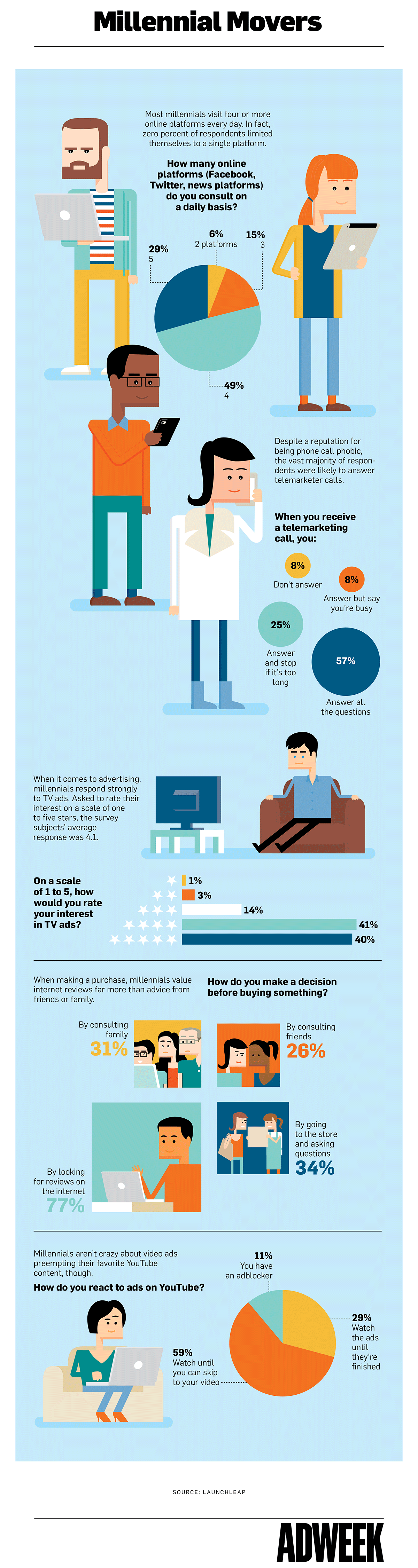
Infographic: What Millennials Want Online and Off

Turns out Gen Y doesn’t mind an old-fashioned phone call

Millennials are open to connecting with brands and prefer bite-size content.

In recent years, marketers around the globe have dedicated a seemingly endless stream of resources toward targeting the ever-elusive millennial consumer. But are those valuable 20- and 30-somethings really all that unpredictable? Not according to Thomas Sychterz, CEO of LaunchLeap, a Montreal-based consumer research startup that recently surveyed a panel of 18- to 35-year-olds about their internet and advertising consumption preferences. “[Millennials] get treated like some sort of hyperactive group of wild gorillas: powerful, unpredictable and difficult to pin down. The reality is quite different and simple,” he said. “Millennials are open to connecting with brands, drawn to bite-size content (paid or not) and intrigued by new information, product-wise. However, the main caveat is that it all needs to get done in an ergonomic, digestible and fluid manner.”

10 ways to get a brand on the online shopping list

In a relatively flat market, e-commerce is the one part of grocery shopping that is growing. Last year this growth was
15% to a value of $48bn, and it’s forecast to rise to $150bn globally by 2025.

To succeed online brands need to get onto the shopping list as a start — 55% of online shoppers use the same list from one purchase to the next, according to a recent global study from Kantar Worldpanel.

The repeat purchase rate in France, for example, grew from 25% for an average hypermarket to more than 40% online in
many grocery categories.

Here are 10 things to do to ensure winning shoppers’ clicks.

1. Win the battle before the click

Getting on the shopping list doesn’t just happen online. The more predisposed people are to choose your brand the more
likely it will be to make the list and the less likely the consumer will be to consider other brands. Your brand needs to
come to mind the moment someone thinks about buying the category. Investing in media, social and PR will build your
brand in peoples’ minds before they start shopping.

2. Differentiate to justify your price point

Adding brands to a shopping list is a more deliberative process than shopping in-store where package design and placement help trigger habitual purchasing behaviour. Premium brands need to think about what qualities best differentiate them, justify the price point and be sure these qualities are apparent online. Let your package do the talking by featuring it in all communications – online and off – and readily associated with meaningful ideas that differentiate it from the competition.

3. Promote to attract

Promotions are more important online than in-store. Globally 40% is purchased under a promotion online compared to 20% normally. Whilst long-term price promotions can be challenging, it’s a good way to attract shoppers in the short term, and to get on to the list. Once the brand is on the list, you should achieve payback over time from the share gained.

4. Offer the right volume

Online is generally used to replenish and stock up. Spend and volume tend to be on average three times higher online. A sensible solution is to adapt the offering online to offer bigger pack sizes. Creating something different should also help to overcome potential cannibalisation of the instore offer.

5. Make purchase easy

Integrate brand communications into other online activity to make online a more natural way to shop. Maybelline in China recently staged a live make-up demonstration, integrating a buy button into the video so that viewers could buy the brand while they watched. This technique was also used by Bird’s Eye in the UK, deliver products directly from a Facebook ad into the basket of whichever retailer was chosen. Integrating the purchase into another activity makes adding the product into a shopping list almost automatic.

6. Deliver a solution

One of the benefits of online is that multiple items can be placed in the basket at once, rather than moving from section to section within a store. Brands that understand this can work across categories to deliver a meal or occasion solution rather than just a single product which will make life easier for the customer.

7. Cater to different needs

Creating special ranges or other points of difference can be a way to leverage online opportunities. Online shelf space is virtually limitless, so create special flavours or formulas that might not be attractive to a mass audience. Offering a greater choice will drive loyalty and increase sales.

8. Connect the dots

Make your brand’s website a place to facilitate online shopping in addition to preparing shoppers for an offline shopping trip. Brands need to focus on key touchpoints like the web site and social media to reduce the friction of shopping online.

9. Take your brand offline to win trial

Good, old-fashioned sampling can have a huge influence on trial. For instance, P&G aims to double down on its investment in sampling for detergent, increasing reach from 17 million households to 30 million in fiscal 2017. Whether the brand is delivered to people’s homes, sampled in-store or at events, there is no substitute for personal experience.

10. Mine the data

Smart marketers will use e-commerce and other data to understand the path to online purchase and maximize sales. Which buyers are most predisposed to choose your brand? How can you reach them before they start shopping? What will best motivate them to put your brand on their list? Data sources that combine both behavioural and attitudinal data will help answer such questions and allow the brand to achieve its full e-commerce potential.

As technology advances different approaches to shopping will become more widespread. E-commerce is growing and marketers must prepare their brands to compete online and off. The best marketers will build a strong brand that people will add to their list instinctively and make it the easiest to choose.

(kantarworldpanel)

What’s next for the smartphone industry

It was an incredible decade for smartphones, but 2016 will be recorded in history as the year when the smartphone market stopped growing. Sales dropped 2% across the markets tracked by Kantar Worldpanel ComTech – including the US, Great Britain, Germany, France, Italy, Spain, China, Australia, and Japan. As the industry matures, fewer consumers are moving between brands and ecosystems, and vendors are turning to selling more frequent upgrades and replacing existing devices, rather than connecting with large numbers of new buyers.

Image result for smartphone nigeria

In a new report available from Kantar Worldpanel ComTech, Global Consumer Insight Director Lauren Guenveur describes a fundamental shift in how carriers and manufacturers are now marketing devices and services to potential customers. Some of their new tactics include:

  • Recognizing and responding to changing buying behavior and enticing consumers to purchase device upgrades more frequently
  • Drawing buyers to new technologies that enhance the smartphone experience
  • Offering consumers a more complete user experience, which includes the combining of compelling services and content with smartphones

Wearables were expected to be the next big mobile technology, promising to expand the smartphone ecosystem to the wrist. However, judging from disappointing sales results, vendors were more excited by the potential than consumers.

Virtual reality (VR), augmented reality (AR), a growing importance of artificial intelligence (AI), and virtual assistants may help stimulate market growth. But without more compelling applications for these technologies, they may end up being more hype than substance.

This report also offers guidance on how the industry can address flattening margins, consumer perceptions about widespread uniformity of competitive product offerings, and a need to introduce higher-spec products at mid-tier price points.

If mobile ecosystem manufacturers want to preserve the global brands they have worked so hard to build, they must trail blaze new, innovative offerings, and nurture fertile, new partnerships.

Full report available through the link: Download the full paper here

(kantarworldpanel)