Global stocks rebound on hope of COVID-19 vaccines and increased business activities

Investors wealth across major global equities market this week increased markedly, as the hope of developing viable COVID-19 vaccines got boosted by new discoveries from the U.S., Europe, and South Africa.

Besides, the hope of improved business activities also played a major role in investors overall sentiment this week, culminating to week-on-week gains in ten of the thirteen equities market indices under our coverage.

In the U.S., the three broadest indices, the NYSE Composite, the S&P 500, and the DJIA all gained 2.53%, 2.84%, and 2.43% w/w, while in other Advanced markets, the German DAX and the France CAC 40 gained 2.10% and 2.18% w/w respectively.

Global stocks rebound on hope of COVID-19 vaccines and increased business activities

In emerging markets, China’s Shanghai Composite Index, India’s S&P BSE, and South Africa’s JSE all gained 0.68%, 2.69%, and 0.19% w/w respectively, save for Argentina marvel which lost 4.33% w/w.

We expect the global stock market to sustain the current trend in the coming week, as more economic activities pick up across the globe.

High Unemployment and Inflation rates: Nigeria setting a new milestone of Misery Index?

In the just concluded week, the Nigerian National Bureau of Statistics (NBS) published two important national data – the July 2020 Consumer Price Index (CPI) report and the Q2’2020 Labour Force Survey report both of which caught our interest for analysis. This became pertinent in other to establish and compare Nigeria’s Misery Index (a snapshot measure of an economy’s health based on the sum-up value of its Inflation and Unemployment rates at a point in time) with other African peers, and to weigh the negative impact of the COVID-19 pandemic on the health of the Nigeria economy in terms of the standard of living of an average citizen.

Inference from the July CPI report

In line with our projection as contained in our weekly note of last week, Nigeria’s Headline Inflation rate printed at 12.82%y/y and 1.25%m/m in the month of July 2020. This represents the eleventh year-on-year and tenth month-on-month consecutive increases in the Headline Inflation rate and was mostly driven by the spike in the Food Inflation sub-component of the Headline Inflation index (due to increases in the prices of major food items), while the Core Inflation sub-component moderated mildly. The spike in the Food Inflation sub-component (we believe) jointly resulted from the disruption of plating activities during the peak of the COVID-19 pandemic induced lockdown between March and May 2020, and the increase in road transport fare in July 2020 owing jointly to the upward review of petrol price to₦145 per litre (from ₦138), the partial closure of the third mainland bridge for repair works, and the characteristic high demand for food product during Salah festivity.

READ ALSO: IITA invests in development and implementation of seed yam certification system in Nigeria


Inference from the Q2’2020 Labour Force Survey report

As anticipated by market analysts (based on the projected negative impact of the COVID-19 pandemic), Nigeria’s unemployment rate rose to an unprecedented 27.1% as at the end of Q2’2020 from 23.1% previously reported in Q3’2019. Aside from the reported 400bps (or 4%) increase in the Unemployment rate between Q3’2019 and Q2’2020, there are also several dynamics in the newly released data that cause for concern.

First, although the number persons in the Economically Active Population age bracket (15-64 years) increased by 1.2% from 115.49 million in Q3’2019 to 116.87 million in Q2’2020, the Labour Force population (defined as the total number of Economically Active Population persons, able and willing to work) fell by 11.3% (or 10.17mn) to 80.29 million compared to 90.47mn in Q3’2020.

The surprise reduction in actual Labour Force Population (which ought to have increased, other things being equal) was mainly attributed (by the NBS) to the culture of “Full housewives” in some states and negative attitude towards work by some in this segment of the population.

However, we are of the opinion that 10.17 million persons of active working age (assuming all are women) cannot have been absorbed into marriages in those ethnic groups that promote the culture of Full housewives within the space of three quarters (or 9months), neither can they all have a negative attitude towards work. Hence, we assume the NBS may have adopted a tacit assumption to arrive at this figure.

Secondly, we noticed a divergent movement in Full employment and Underemployment rates between Q3’2019 and Q2’2020. According to the NBS, Full employment defines a situation in which a person works on a sustainable basis for a minimum of 40 hours a week, while Underemployment defines a weekly working duration of between 20 and 39 hours on a sustainable basis. Given the data release, the number of persons in Full employment declined by 30.7% (or 15.72mn) between Q3’2019 and Q2’2020 to 35.58 million, while the number of Underemployed persons rose by 25.9% (4.72mn) to 22.94 million over the same period.

From one perspective, we suspect that the divergent trend (the marked decline in Full employment and the surge in Underemployment size) could be due to the downsizing of employees (most of whom could be full-time staff) by some businesses/companies badly affected by the pandemic as a result of which most of the affected persons settled for Underemployed jobs to keep their body, soul, and spirit intact.

From another perspective, the divergent trend could be partly attributed to the sudden shift of most business and learning activities to online medium (in other to comply with social distance directive), hence, making some jobs that previously required 40 hours or more (per week) to be completed to now require less.

Thirdly, the total number of Unemployed persons (defined as working between 0 and 19 hours weekly) rose by 4% to 21.76 million from 20.92 million in Q3’2019. When disaggregated based on educational qualifications, holders of First degree/HND accounted for the largest portion – 14%, while the lowest portion – 5.9% are those in Vocational/Commercial education. This further highlights the need for the government to implement policies that will support SMEs, as the sector has strong potential to absorb the large unemployed population.

Lastly, in terms of Age-group, the age range of 15-24 years accounted for the highest proportion of Unemployment rate – 40.81%, while the age range of 45-54 years accounted for the least – 17.14%. This underscores the high rate of youth unemployment in the country; the bane for the rise in social vices.

Peer review of Misery Index.

Drawing from the most recent statistics from Nigeria and five other top economies in Africa –South Africa, Ghana, Algeria, Egypt, and Kenya, Nigeria’s Misery Index stood at 39.92% (based on the orthodox Author Okun’s Misery Index composition – Inflation plus Unemployment rate), high above the five other African peers. This implies that the Nigeran economy is less healthy compared to selected African peers, and an average Nigerian citizen has a relatively low living standard.

Using the John Hopkins modified Misery Index model which is obtained from the difference between the sum of unemployment, inflation, and lending rate and the real GDP growth rate (i.e. Un+In+Lr-GDP), Nigeria’s Misery Index still settled high above other peers, printing at 66.88% compared to the closest peer, Ghana with 47.80%.


IITA invests in development and implementation of seed yam certification system in Nigeria

0

IITA renovated and equipped the diagnostic laboratory of the National Agricultural Seed Council (NASC) at their headquarter in Sheda, Abuja, with equipment worth $100,000 for seed quality control and Seed Tracker e-certification system. A PCR for DNA amplification and other laboratory equipment will allow technicians of the seed regulatory agency to conduct diagnostics and seed quality testing in line with the amended existing standards for seed yam.

PCR AND LAMP FACILITIES ESTABLISHED FOR YAM VIRUS DIAGNOSTIC AT NASC HEADQUARTERS

Strengthening and equipping the diagnostic laboratory of NASC in Nigeria and the Plant Protection and Regulatory Services Directorate (PPRSD) in Ghana with new tools for seed yam quality inspection is one of the outputs of the establishing a fit-for-purpose quality assurance system for seed yam quality component of the YIIFSWA-II project.

MR GOOD CHECKING THE RT-LAMP RESULTS OF YAM MOSAIC VIRUS

“The renovation of the laboratory and the installation of new equipment is one of the most important components for building a sustainable and viable formal seed yam system in Nigeria. This is one of our primary strategies for ensuring the availability and use of quality seed yam and planting materials in West Africa,” said Dr. Lava Kumar, Head Germplasm Unit, and Virology and Molecular Diagnostics Unit at IITA, who leads the YIIFSWA-II “Seed Quality” component.

“Through projects like YIIFSWA-II, IITA has initiated several activities to support the establishment of a quality assurance and seed certification system.“ said Dr Philips Ojo, Director-General of NASC. One of these activities involved revising and amending the seed yam certification standards for the quality control of seed yam production. In October 2018, IITA hosted and facilitated a workshop on Quality Management Protocol (QMP). The meeting produced standards for quality control and parameters for inspection and certification. In August 2019, NASC hosted national stakeholder consultations to raise awareness on the new standards.

IITA also trained the technical staff of the regulatory agencies in yam diagnostics, seed testing standards, and field inspection methods for seed yam certification. Along with training, the regulatory agencies were also given the robust diagnostic tools developed in YIIFSWA for seed yam certification.

In February 2020, IITA, in conjunction with NASC, launched the Google.Org award-wining Seed Tracker e-certification control room institutionalizing the digital system to facilitate real-time e-certification for yam.

THE YIIFSWA-II TEAM AT THE NASC CENTRAL DIAGNOSTIC FACILITY

”The main objective of Seed TrackerTM is to support the regularization of the seed sector in Ghana and Nigeria, thus ensuring a sustainable linkage between the value chain actors of the yam production system. This will consequentially result in increased production that will not only contribute to the improvement of farmers’ livelihoods but also promote the market potential of yam in the two countries.” Dr Kumar said.

HEADLINES YOU MIGHT HAVE MISSED FROM BRAND SPUR

Efe Omoregbe, Bada Akintunde-Johnson, Ayeni Adekunle, others confirmed to speak at MTN’s business of the art series

In line with its continuous commitment to youth development in Nigeria, MTN Foundation, the CSR arm of Nigeria’s leading ICT company, MTN Nigeria, has engaged leading minds in the Nigerian entertainment and media industry for this year’s edition of MTN’s Business of the Art Series.

LASCODA trains youths on commercial coconut oil processing

The Lagos State Government has embarked on the training of youths and women on commercial Coconut Oil processing at the Farm Service Centre, Oko-Oba, Agege as part of efforts towards Making Lagos State a 21st Century Economy.

Lessons we need to learn about record labels moving into African music

If we are not careful, we are in the beginning of the creativity of African music and artistry being captured and abused by the American corporate system?


Why not yam? A case for investment in yam research and development in Africa

0

Yam feeds, nourishes, and provides a living for millions of people in sub-Saharan Africa and beyond. In the largest am-producing country in the world, Nigeria, yam is more than just a crop. It is the king of crops, and the production value is higher than the value of cassava and popular cereal crops (maize and rice) combined. Moreover, for exporting countries like Ghana, it commands a premium price in regional and international markets. So why isn’t Africa interested in the development of its most valuable indigenous crop?

Africa,  research and development, yam

According to Dr Djana Mignouna, who recently published a paper titled Potential returns to yam research investment in sub-Saharan Africa and beyond., “Yam is often referred to as an orphan crop. It is seen as a minor crop relative to global crops like wheat, rice, and maize, even though it is an important economic and food security crop in sub-Saharan Africa and the diaspora. Therefore, it receives limited attention from African governments and regional development agencies. And due to such neglect, it is underfunded and under researched and, often not included in agricultural policies and intervention programs.”

To further illustrate the neglect of the root and tuber crop, he said, “When we look at Africa’s contribution to global food production, the continent contributes about 5% and 50 % of cereal crops and cassava to the global barn, respectively, yet African governments amply provide funds for research and support development programs. But that is not the case for Yam even though West Africa accounts for 97% of the total world production, and more than five million people in the Yam growing countries directly depend on the value chain for their food security and livelihoods.”

Although Yam has long been ignored, research projects like the Yam Improvement for Income and Food Security in West Africa (YIIFSWA) demonstrate that with funding technological developments present an opportunity to make a big difference in improving the productivity of Yam.

The flagship project executed by the International Institute of Tropical Agriculture (IITA) and partners explored major production constraints and developed technologies that could double yam yields and contribute to food security in Nigeria and Ghana. Currently, it is scaling out some of these technologies to address the constraints of lack of sufficient quantities and the absence of quality seed yams.

YOUTHS LEARNING HOW TO PLANT AYMT IN ISEYIN, OYO STATE

In the article, Dr Mignouna showcases how yam research and development programs like the YIIFSWA project can provide high rates of return on investments over 10 to 15 years. He said that based on YIIFSWA’s experience, the adoption of key technologies such as the adaptive yam minisett technique (AYMT), varieties adapted to low soil fertility and drought (VALSFD), nematode-resistant cultivars (NRC), and crop management and postharvest practices (CMPP) could lead to the following results:

  • Under the baseline adoption scenario, the land area coverable by various technologies ranges between 770,000 ha and 1 million ha in the eight countries of SSA and beyond: Nigeria, Ghana, Benin, Togo, Cote d’Ivoire, Papua New Guinea, Jamaica, and Columbia.
  • Currently the value of the various technologies’ ranges from $584 million and $1.392 billion with the highest for NRC.
  • Moreover, if adopted, the technologies will lift 1.05 million people out of poverty, and more than 96 million people would be expected to benefit from the technologies in all the yam-producing countries by the year 2037.

In conclusion, Dr Mignouna stated that “the realization of the potential economic gains depends on the rate and extent of adoption of these technologies. And due to the knowledge-intensive nature of some of these interventions, capacity building of potential adopters will be critical to increasing the sustainability of the yam sector, thereby enhancing food security and reducing poverty.”

The 2020 gold rush and Africa

0

In times of crises, investors take the advice of an Indonesian economist, Toba Beta, that says “Never trust money more than Gold.” The current COVID-19 induced economic crisis is one of such moments as investors rushed for Gold amid uncertainty and fear of post-COVID inflation.

The 2020 gold rush and Africa

Notably, Gold price reached an all-time high of $2063.5/oz in August
2020, currently up 26.6% YTD.

During this same crisis, African economies have been negatively impacted by lower commodity prices like crude oil, iron ore, cocoa, among others. However, we ask, does the increase in Gold price offer any comfort for the Gold-rich African countries? As much as the COVID19 pandemic has caused a surge in Gold price, the associated lockdown measures also caused a disruption in mining activities across the continent.

Notably, South Africa and Ghana, African’s leading Gold producers are top of mind within the continent. According to the World Gold Council, South Africa and Ghana rank amongst the top ten producers of the precious metal globally. Despite being naturally blessed with the resources, unfair mining deals, characterized by highly generous concessions to attract investments, poor negotiation terms with mining companies, little or no economic linkage with the rest of the economy, illicit gold trade and smuggling means that African countries might not benefit much from the current Goldrush. In 2019, Reuters estimated that
billions of dollars’ worth of gold is smuggled out of Africa every year.

In Nigeria, there are report linking the recent banditry in the northern region to illegal gold mining. Other challenges include outdated mining technics and the lack of value-added capabilities to the mined Gold on the continent.

HEADLINES YOU MIGHT HAVE MISSED FROM BRAND SPUR

Efe Omoregbe, Bada Akintunde-Johnson, Ayeni Adekunle, others confirmed to speak at MTN’s business of the art series

In line with its continuous commitment to youth development in Nigeria, MTN Foundation, the CSR arm of Nigeria’s leading ICT company, MTN Nigeria, has engaged leading minds in the Nigerian entertainment and media industry for this year’s edition of MTN’s Business of the Art Series.

LASCODA trains youths on commercial coconut oil processing

The Lagos State Government has embarked on the training of youths and women on commercial Coconut Oil processing at the Farm Service Centre, Oko-Oba, Agege as part of efforts towards Making Lagos State a 21st Century Economy.

Lessons we need to learn about record labels moving into African music

If we are not careful, we are in the beginning of the creativity of African music and artistry being captured and abused by the American corporate system?

NNPC generates $4.60bn revenue from 19.104bn litres of crude oil, gas export in one year

The Nigerian National Oil Organization (NNPC), on Sunday, said it made a sum of $4.60billion from raw petroleum and gas sent out between June 2019 and 2020.

The shape of disruption in the retail space: how it works, how to respond to it, and why it matters

You won’t find too many jokes about ‘digital transformation’. It’s a serious business. And if you ask who is doing it, every corporate will raise their hands – but there’s little agreement around exactly what it is, the implications for the organisation, how to go about it. RMB’s recent retail client webinar, featuring Wits’ Prof Brian Armstrong, provided strong direction.

Nigeria’s GDP Shrinks by 6.10% in Q2 2020 – NBS

Nigeria’s Gross Domestic Product (GDP) decreased by -6.10% year-on-year) in real terms in the second quarter of 2020, ending the 3-year trend of low but positive real growth rates recorded since the 2016/17 recession.

Market Cap of the World`s Five Largest Automobile Manufacturers Plunged by $63bn in 2020

The COVID-19 pandemic has had a severe impact on the global automotive industry, causing supply chain disruptions and factory closures. All of this placed intense pressure on the market already coping with a downshift in global demand.

Digital Ticketing Sales to Grow 150% by 2022, as Passengers Return to Travel

Hampshire, UK – 24th August 2020: A new study from Juniper Research has found that digital ticketing transaction volumes will exceed pre-COVID levels by 2022; rising from 12.7 billion in 2020 to 32 billion in 2022. It anticipates that continued easing of global travel restrictions will drive increased demand for mobile ticketing in the rail, metro and bus sectors, as commuters return to work.

IITA empowers Ogoni youth on agribusiness for sustainable livelihoods

The Federal Government of Nigeria, through the Ministry of Environment in partnership with IITA, under the Hydrocarbon Pollution Remediation Project (HYPREP), commissioned a cassava processing factory in Korokoro Community, Tai Local Government Area of Rivers State.

Aruba Research: Network as A Service Adoption to Accelerate by 38% Within the Next Two Years as Businesses Adapt to COVID-19

74% of organizations reported moderate to significant impact to their employees due to the pandemic


Capital inflow in Nigeria declines by 78.6% as importation stood at $1,294.94m in Q2

The National Bureau of Statistics (NBS) has said that the total value of capital importation into Nigeria stood at $1,294.94 million in the second quarter of 2020 as capital inflow declined by 78.6%.

Capital inflow, importation, Nigeria’s GDP, GDP in Q2-2020

The National Bureau of Statistics (NBS) has said that the total value of capital importation into Nigeria stood at $1,294.94 million in the second quarter of 2020.

This is according to its Nigerian Capital Importation (Q2 2020) report published on its website on Friday.

The total value represents a decrease of -77.88 per cent compared to the first quarter of 2020 and -78.60 per cent in the second quarter of 2019.

The largest amount of capital importation by type was received through Other Investment, which accounted for 58.77 per cent ($761.03 million) of total capital imported.

This was followed by Portfolio Investment, which accounted for 29.76 per cent ($385.32 million).

Also, Foreign Direct Investment (FDI) accounted for 11.47 per cent ($148.59 million) of total capital imported in the second quarter of 2020.

By sector, capital importation by shares dominated in the second quarter of 2020 reaching $464.57 million of the total capital importation.

The United Kingdom emerged as the top source of capital investment to Nigeria with $428.83 million.

The investment accounted for 33.12 per cent of the total capital inflow in the second quarter of 2020.

By Destination of Investment, Lagos state emerged as the top destination of capital investment in Nigeria with $1,130.49 million.

This accounted for 87.30 per cent of the total capital inflow in the second quarter of 2020.

By bank, Standard Chartered Bank Nigeria Limited emerged at the top of capital investment in Nigeria with $425.21 million.

This also accounted for 32.84 per cent of the total capital inflow in the second quarter of 2020.

HEADLINES YOU MIGHT HAVE MISSED FROM BRAND SPUR

Efe Omoregbe, Bada Akintunde-Johnson, Ayeni Adekunle, others confirmed to speak at MTN’s business of the art series

In line with its continuous commitment to youth development in Nigeria, MTN Foundation, the CSR arm of Nigeria’s leading ICT company, MTN Nigeria, has engaged leading minds in the Nigerian entertainment and media industry for this year’s edition of MTN’s Business of the Art Series.

LASCODA trains youths on commercial coconut oil processing

The Lagos State Government has embarked on the training of youths and women on commercial Coconut Oil processing at the Farm Service Centre, Oko-Oba, Agege as part of efforts towards Making Lagos State a 21st Century Economy.

Lessons we need to learn about record labels moving into African music

If we are not careful, we are in the beginning of the creativity of African music and artistry being captured and abused by the American corporate system?

NNPC generates $4.60bn revenue from 19.104bn litres of crude oil, gas export in one year

The Nigerian National Oil Organization (NNPC), on Sunday, said it made a sum of $4.60billion from raw petroleum and gas sent out between June 2019 and 2020.

The shape of disruption in the retail space: how it works, how to respond to it, and why it matters

You won’t find too many jokes about ‘digital transformation’. It’s a serious business. And if you ask who is doing it, every corporate will raise their hands – but there’s little agreement around exactly what it is, the implications for the organisation, how to go about it. RMB’s recent retail client webinar, featuring Wits’ Prof Brian Armstrong, provided strong direction.

Nigeria’s GDP Shrinks by 6.10% in Q2 2020 – NBS

Nigeria’s Gross Domestic Product (GDP) decreased by -6.10% year-on-year) in real terms in the second quarter of 2020, ending the 3-year trend of low but positive real growth rates recorded since the 2016/17 recession.

Market Cap of the World`s Five Largest Automobile Manufacturers Plunged by $63bn in 2020

The COVID-19 pandemic has had a severe impact on the global automotive industry, causing supply chain disruptions and factory closures. All of this placed intense pressure on the market already coping with a downshift in global demand.

Digital Ticketing Sales to Grow 150% by 2022, as Passengers Return to Travel

Hampshire, UK – 24th August 2020: A new study from Juniper Research has found that digital ticketing transaction volumes will exceed pre-COVID levels by 2022; rising from 12.7 billion in 2020 to 32 billion in 2022. It anticipates that continued easing of global travel restrictions will drive increased demand for mobile ticketing in the rail, metro and bus sectors, as commuters return to work.

IITA empowers Ogoni youth on agribusiness for sustainable livelihoods

The Federal Government of Nigeria, through the Ministry of Environment in partnership with IITA, under the Hydrocarbon Pollution Remediation Project (HYPREP), commissioned a cassava processing factory in Korokoro Community, Tai Local Government Area of Rivers State.

Aruba Research: Network as A Service Adoption to Accelerate by 38% Within the Next Two Years as Businesses Adapt to COVID-19

74% of organizations reported moderate to significant impact to their employees due to the pandemic


Diageo unveils 2020 special releases whisky collection

This year’s Special Releases Single Malt Scotch Whisky Collection features eight vibrant expressions, each selected to bring a taste of Scotland to every enthusiast’s home.

The 2020 collection, curated by Master Blender Dr Craig Wilson, includes eight cask strength single malt Scotch whiskies drawn from some of Scotland’s most interesting distilleries.

whisky collection, Diageo

The annual collection explores unusual age points, experimental maturation techniques and this year, welcomes our first-ever release finished in pot-still Caribbean rum casks. The “Rare by Nature” theme highlights the extraordinary nature that surrounds each distillery, with each whisky visually brought to life through intricate illustrations that decorate the bottles.

Where do the most romantic Nigerians live?

In search of romantic

Our queries list consisted of terms like “Valentine’s Day”, “love confession”, “flowers”, “love”, and others which would associate with Valentine’s Day. During the period before Valentine’s Day, the frequency of searching these queries increases in whole Nigeria.

However, in some places, the interest in making a pleasant surprise to the significant other increases more, and in some – notably less.

Where do the most romantic Nigerians live?

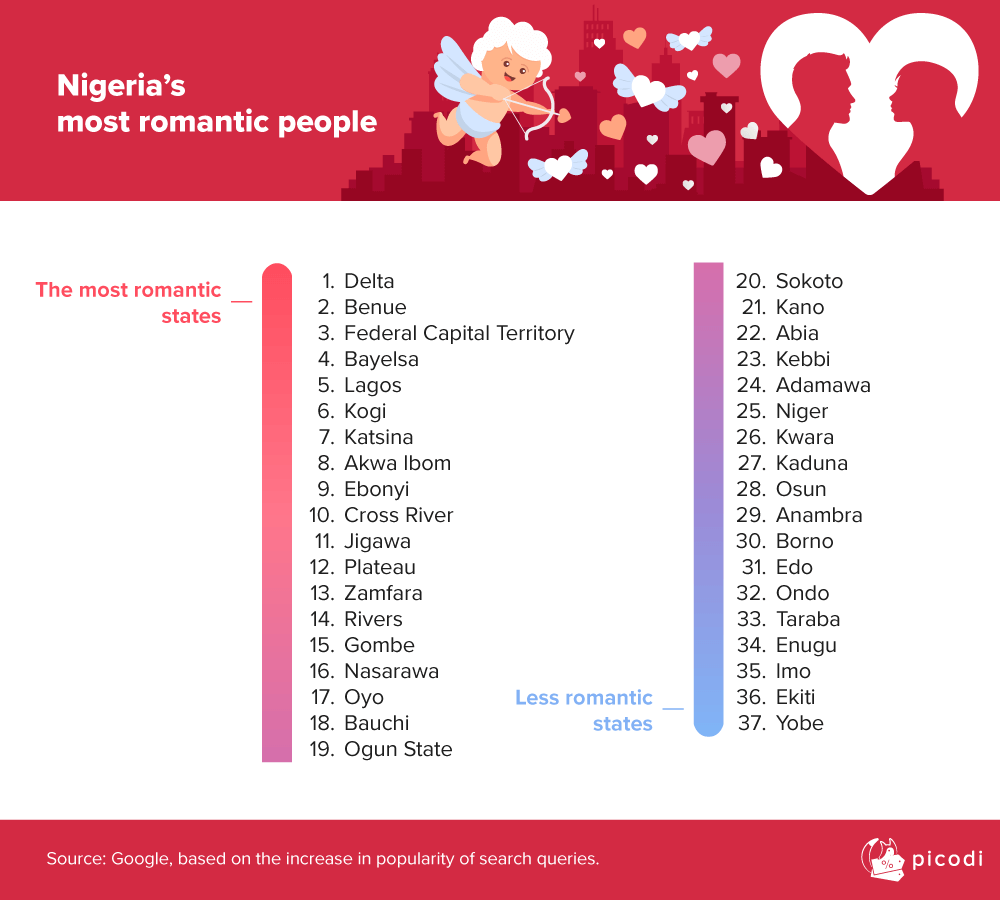
After looking closely at Google’s figures, it turns out that the most romantic Nigerians live in Delta, Benue, and Federal Capital Territory. In these states, the increase in popularity of queries connected to Valentine’s Day was the highest. Although Delta is most known for its oil reserves, it turns out that the state has also a more romantic side of it.

Among all states, the lowest interest in Valentine’s Day and all connected to it was noted among residents of Yobe (37th place). Ekiti and Imo turned out to be quite unromantic as well (36th and 35th place respectively).

Here’s the full ranking of states:

The most romantic states in Nigeria
Most romantic Nigerians

The research was based on a comparison of the increase in popularity of various keywords during the period of January-February 2019 according to Google archived data (through Keyword Planner tool).

Oil Prices Fall As Hurricane Fears Subside

Friday, August 28th, 2020 – Oil prices retreated in the wake of Hurricane Laura, which led to much less destruction than the market had anticipated. That leaves the oil price dynamic little changed from the past two months – WTI and Brent are stuck in the familiar territory between $42 and $45.

Gulf of Mexico energy industry largely dodges Hurricane Laura. The concentration of energy assets along the Texas and Louisiana coast more or less avoided the worst-case scenario from Hurricane Laura. “The damage is not as bad as anticipated, which is creating more sell pressure along with the energy complex,” said Phil Flynn, senior market analyst at Price Futures Group.

More than 80 per cent of oil output in the Gulf of Mexico and almost 3 million barrels a day of refining capacity had been shut ahead of the storm, most of which should come back online fairly quickly.

Oil and gas exports impacted. Laura shut-in some LNG operations, and gas exports are set to fall to about 2.1 bcf on Thursday, the lowest level since February 2019. Oil exports are expected to drop by nearly 1 mb/d this week.

New Mexico oil auction is a dud. The Bureau of Land Management sold 93 land parcels covering more than 45,000 acres in New Mexico on Thursday, and the two-day auction posted an average bid per acre of $169, down from $1,386 per acre in February. The average during the Trump era in New Mexico has been $5,500 per acre.

Kinder Morgan brings Elba LNG unit online. Kinder Morgan (NYSE: KMI) brought the last of its 10 LNG units into service on Thursday, bringing capacity up to 2.5 mtpa.

Equinor drops South Africa exploration. Equinor (NYSE: EQNR) decided to give up its leases in offshore South Africa after a disappointing seismic campaign, according to S&P Global Platts. ExxonMobil (NYSE: XOM), which Equinor partnered with, may also abandon the effort, according to Platts, although the company has not commented. Meanwhile, Equinor also said it would suspend drilling in U.S. shale for the rest of the year.

Report: Oil majors can’t afford dividends. The five supermajors – ExxonMobil (NYSE: XOM)Royal Dutch Shell (NYSE: RDS.A)BP (NYSE: BP), Chevron (NYSE: CVX), and Total (NYSE: TOT) – collectively paid $16.9 billion more to shareholders than they generated from their core business operations, according to an IEEFA report. They plugged the gap through asset sales and debt. ExxonMobil, which is being removed from the Dow Jones Industrial Average, posted negative free cash flow of $4.4 billion and paid out $8.1 billion to shareholders. Collectively, the majors added $50 billion in debt in the second quarter.

Barclays downgrades Shell. Barclays cut Royal Dutch Shell (NYSE: RDS.A) to Underweight from Equal, citing expensive shares.

Mountain Valley Pipeline asks FERC for an extension. Developers for the Mountain Valley Pipeline asked FERC for an additional two years to complete construction, citing litigation and permitting risks.

ConEd: No more gas pipelines. Consolidated Edison (NYSE: ED) said it would no longer invest in long-distance gas pipelines. The comments came in the context of the company’s investment in the Mountain Valley Pipeline. “We made those investments five to seven years ago, and at that time we — and frankly many others — viewed natural gas as having a fairly large role in the transition to the clean energy economy,” CEO John McAvoy said during an Aug. 26 investor presentation. “That view has largely changed, and natural gas, while it can provide emissions reductions, is no longer … part of the longer-term view.”

Vaca Muerta sees slow recovery. Argentina’s Vaca Muerta shale patch will take 12-18 months to resume pre-COVID-19 activity because of lagging demand, according to Argus.

Elon Musk has a nickel problem. Large spills of toxic waste from nickel projects demonstrate the challenge that Tesla (NASDAQ: TSLA) will have in sourcing clean nickel supplies, Bloomberg Green reports. Nickel projects planned for Indonesia will dispose of toxic tailings at sea.

Shale should get on board with ESG. Investors are increasingly favouring environmental, social, and governance issues, and poor financial performances and bad environmental externalities from shale drillers stand out as a major liability.

California approves energy storage system. In an effort to bolster electric grid capacity, California approved on the largest energy storage systems in the country, approving contracts on 1.2 GW of storage, expected to come online in August 2021.

PetroChina reports $4.4 billion loss and pledges near-zero-emissions. PetroChina reported a $4.4 billion loss for the first half of the year. The company announced that it would move towards near-zero emissions by 2050, including ramping up clean energy investments over the next five years.

Exxon presses Guyana for approval. ExxonMobil (NYSE: XOM) is pressing the Guyanese government for approval of its third offshore oil project in the country. The project came under scrutiny during the presidential election and political turmoil, and the new government has advocated for more favourable terms.

Morgan Stanley: Climate a key topic for oil executives. “Despite a historically weak quarter, climate change and oil companies’ energy transition strategies remained a key topic in the 2Q20 conference calls,” Morgan Stanley wrote in a report.

Dakota Access’ fate is up to the election. The U.S. Army Corps of Engineers has asked an appeals court to reverse a lower court’s ruling vacating the permit of the Dakota Access oil pipeline to operate, arguing that such ruling creates “impossible” standards that could scupper future major infrastructure projects. The pipeline’s fate largely depends on the outcome of the presidential election.

OILPRICE.COM